Showing posts with label techno thrillers. Show all posts

Monday, August 10, 2026

Review: w0rldtr33, collected volume 1 by Fernando Blanco and James Tynion IV

This is not your internet

I picked up w0rldtr33 because of the cover, the creators behind it (Tynion is always a draw for me) and because I was in the mood for something contemporary with tech and guns and people with phones.

The story can best be introduced along the following lines: Gabriel and his friends were teenage tech geeks in the early days of the internet. As they built their own networks, hacked newly emerging systems and generally fucked around, they discovered the Undernet, a hidden architecture to the internet and possibly something more, something deeper. They charted their explorations on a message board called W0RLDTR33. Then it all went wrong. 20 years ago, Gabriel and the others sealed the Undernet away for good. Or so they thought. They were wrong.

Told both in the past and now, this is full-blown horror. This first collected volume hints at some deeply “other” stuff. This isn’t the internet of conspiracies or monsters from myth; this is something different. Tynion and Blanco are in full horror territory here and it’s of the cosmic variety. Honestly I wasn’t quite ready—the opening pages are in technothriller territory with a sense that the secret architecture could be a government agency/conspiracy theory landscape, but, a little like it does for the characters, then it all goes wrong.

I mean that in a good way and there’ll be no more about the actual story here except to say it sits comfortably in the Event Horizon/Hellblazer space (at least in vibes), is gruesome, nasty and very, very bloody.

The story is well executed, and wrong-footed me on a couple of crucial occasions in a good way. w0rldtr33 is clearly looking to do something different with its tropes and its themes, and I welcome that commitment to telling the story slightly differently.

For me horror thrives when, like any genre, it’s in conversation with themes and topics that can be hard to discuss without metaphor. w0rldtr33 is absolutely talking about the deleterious impact of algorithms on human culture and individual cognition, but if that sounds a little tiresome, I think this is a good example executed well and using the setting to great effect.

Visually this feels akin to recent horror It Follows (2014) and Dark City (1998) or Talk to Me (2022), perhaps even Unfriended (2014), although this is superior to those. This combination of visuals together with the techno-cosmic-horror theme works really well, even in this first volume where there’s only really enough space to establish the stakes and give hints at where this is going.

The sense that the internet is a bad place is nuanced here—the internet itself, especially given the initial timeframe, is seen as a place of huge potential for good, for communication and community. It’s the Undernet that is the bad place, although what it is and why it’s bad are unclear so far. It’s enough that this is a story in which communication has two sides to it, one which does untold good and one which can do untold evil.

As with any great horror like this, the evil at work is not simply immoral; it is deeply amoral in the sense that it has no morality we can recognise except that its wants and needs are cruel and destructive in execution. Why? Yet to be revealed, and given how adjacent it is to cosmic horror in this tone, it might be simply that whatever lurks in the Undernet is what it is. We’re not going to get a tragic backstory to the supernatural monster(s) waiting for the world here.

The main characters around Gabriel are strongly drawn so far, and I’m looking forward to seeing where they go—they are scarred by their history, the world has changed since they initially locked away the Undernet, and they aren’t ready for what’s unfolding around them. Like Stephen King’s IT, this group of young friends have gone their separate ways since the original events, and that’s largely because of the trauma of what happened. As they come back together now, it is with trepidation, rancour and suspicion—these do not make for good outcomes when faced with a threat no single person can handle alone.

w0rldtr33 is great horror, and highly recommended for anyone who likes the thriller/cosmic horror genre with lashings of gore and people who aren’t ready for what they’re facing.

I do have one criticism, and it’s potentially transient. There is one character who spends all her time nude, and is drawn in a way that you’d not be surprised to see as the ideal feminine form for a particular type of cis het male. I cannot see why, at this stage in the story, she’s appearing like this, and it is uncomfortable for reasons that have nothing to do with horror. However, volume 1 is just that, the first 5 issues of the monthly comic, so it’s possible this will have a narrative reason, so I raise it, but caveat that concern with an admission that I don’t know where the story is going. Given that this is about the horror of the internet, a naked woman appearing for the sake of it isn’t really out of place. Yet.

Highlights:

  • Great art and colouring
  • Cosmic horror!
  • Lots of blood and gore

Nerd coefficient: 6/10, a great story so far, lots of unexpected horror and plot, good characters and compelling visuals.

Reference: Tynion, James (writer) and Blanco, Fernando (artist). w0rldtr33 [Image Comics, 2024 - current].

STEWART HOTSTON is an author of all kinds of science fiction and fantasy. He's also a keen Larper (he owns the UK Fest system, Curious Pastimes). He's a sometime physicist and currently a banker in the City of London. A Subjective Chaos, BSFA and BFA finalist he's also Chair of the British Science Fiction Association and Treasurer for the British Fantasy Society. He is on bluesky at@stewarthotston.com.

Tuesday, November 28, 2023

Double feature: Don't believe everything you see

Cinema is the art of illusion, so what new thing can films say in the age of the deepfake?

A shady government agency has been researching the use of paranormal powers, more specifically projected illusions, implanted memories and mind control, as a mechanism to secretly influence global politics. Their experiments culminated in the improbable birth of the child of two psychics, a prodigy who upon reaching adulthood might manifest formidable talents. However, ethical scruples move an employee of the agency to take the baby away from what would surely have been a lifetime of servitude and medical torture. Years later, the agency's deadliest psychic is still hunting down that child, eager to twist the world's most powerful mind into an unstoppable weapon. Successive layers of illusion are deployed until the movie pulls out of its hat the big reveal that not only the protagonist has been deceived from the start, but also the viewer, who must now reevaluate all the events that have supposedly happened so far.

Probably nothing in this description strikes you as particularly original or groundbreaking. What I do find at least noteworthy is that in 2023, not one but two movies used this exact plot: Hypnotic, co-written and directed by a shockingly out-of-form Robert Rodriguez, and starring a very tired Ben Affleck in exactly the type of depressed-divorced-detective role you accept when you no longer have a superhero salary; and Awareness, co-written and directed by Daniel Benmayor and starring Carlos Scholz as a rogue mentalist whose most daring trick is the illusion that he can still play a teenager.

It's understandable that the idea of lies-based espionage is becoming popular. Our historic moment is ripe for science-fictional allegories of disinformation for political gain. You've heard of fake news, alternative facts, CGI impersonation, distorted curricula, journalistic and scientific malpractice via LLMs, and the most absurd conspiracy theories asserted with a straight face. Real life has become a bad magical tournament/urban fantasy: whoever can cast the most convincing illusion spell will control the world.

Unfortunately, when it comes to representing those anxieties on the screen, neither Hypnotic nor Awareness does a very convincing job. In both movies, the momentum gained by what is admittedly a strong start gradually loses its punch as the plot keeps adding more and more outlandish complications until the ending arrives forcefully, not because the story has been resolved, but because it ran out of the sense it could pretend to make.

A few good things can be said of Hypnotic. It boasts careful coordination of the choreography between the initial scenes and later ones that reenact the same events without the filter of mental trickery. Borrowing perhaps too many pages from The Prestige and Inception, most noticeably in its visual effects, it makes an interesting argument about the dangerous uses of dramatization as a method of control. However, in hindsight, the reveal that most of the plot has been a fiction-within-a-fiction fails the moment you pause to examine the incompatibility between the villains' actual goal and the feigned actions they scripted for the protagonist to witness. Even worse, the cinematic language successfully established all through the movie, which communicates to the viewer the simultaneous unfolding of an illusory action and its real counterpart, breaks apart in the ending, where the same editing technique is used to introduce shots that may not be immediately recognized as the flashback they actually are. The last thing you need during a crucial scene where instead of dramatizing your climactic resolution you make a main character quickly vomit a mountain of exposition is to confuse the viewer as to which events are in the past and which in the present.

As for Awareness, its merit is to be found in the deliberate use of the camera during fight scenes. By affixing a camera to the end of a character's gun, an otherwise ordinary arm motion forces the viewer to reverse the focus of their gaze: instead of a stationary body with a moving limb, here the limb appears stationary while the rest of the body rotates across the frame. This technique is used in scenes where psychics use mind control to force other characters to shoot at each other; the possessed hand becomes the center of the action as the victim helplessly watches in the periphery. A variation of this type of shot (pun only half intended) occurs when the psychic twitches his head to give a mental command: the camera rolls in sync with the head, effectively keeping it static in the frame, signifying its control over the action, while the world around it looks momentarily kicked out of balance by the character's thoughts. Many such camera tricks inundate the fight scenes to express distortions of reality, although there are times they become excessive, almost hostile to the eyes, especially in the flashbacks that reveal one character to be a mental fabrication. Little else is worthy of praise in this movie. The tone is a mishmash of the best bits of Push with the saddest bits of Stranger Things, and the dialogues are so painfully hackneyed that the viewer may start suspecting that the plot has more than one purely imagined character.

The theme of deception as an instrument of war is enormously relevant today, but these two films waste their opportunity to say something meaningful about it. They're serviceable action thrillers, as long as you don't poke too hard at the plot's logic, and the implied subtext about children being the biggest potential victims (and unwitting tools) of organized disinformation is one worth taking to heart. As Orwell warned, a war over the telling of our past is really a war over our future.


Nerd Coefficient

Hypnotic: 4/10.

Awareness: 5/10.


POSTED BY: Arturo Serrano, multiclass Trekkie/Whovian/Moonie/Miraculer, accumulating experience points for still more obsessions.

Thursday, December 15, 2022

Maybe there's a parallel timeline where 'The Peripheral' hit the mark

It's a shame that a series with so many interesting ideas didn't try to go farther with them

Amazon Studios TV series The Peripheral, an adaptation of William Gibson's 2014 novel, has come up with an original angle on the overstretched "metaphor for class inequality" trope. In this story, scientists from the late 22nd century create alternate possible pasts where they can run unsanctioned experiments on live humans with cosmic impunity. Those other timelines are not seen as having real moral value, but in one of them lives our protagonist, Flynne, an experienced gamer who stumbles upon these secrets after beta-testing a new VR headset, and who is determined to defend her and her world's inherent right to exist.

This is an amplified echo of the cry of protest you can hear from exoticized peoples: Your Vacation Is My Home. Or, in The Peripheral, something more like Your Disposable Petri Dish Is My Spacetime Continuum. Such a concept sounds like it could spark lengthy discussions about the colonial practices still embedded in scientific research, the ethical loopholes of the gig economy, the rights of counterfactual agents, the mutual responsibilities between generations, and the still unsolved safety issues with brain-computer interfaces.

Unfortunately, the show doesn't meet the high expectations set by its premise. A research institute officially known as The Research Institute and a cleptocracy of mafia bosses collectively known as the Klept are the first signs that The Peripheral devoted only the barest of efforts to worldbuilding. Our near future, as shown in a small town in the southern US, looks almost like the present, with the changes established mostly in dialogue: stratospheric medicine prices, a vaguely mentioned Texan war, ubiquitous 3D printing, far superior video game graphics. With the supporting characters, the show follows the opposite approach: they are established implicitly, with minimal exposition, and the viewer doesn't connect who works for whom and who is whose childhood friend until well into the season. The mental bandwidth expended in keeping track of the scant clues about these characters detracts from the viewer's ability to follow the plot.

In the scenes set in the 22nd century, these deficiencies are multiplied: three separate factions are described but not properly introduced until the halfway point, and Flynne, who should serve as our eyes into that society, is persistently kept in the dark about how it works.

Worse problems afflict the visual style of the 22nd century. We only get to see future London as a vague skyline that blends impossibly cyclopean statues with incompletely rendered ruins, or as deliberately secluded side streets that look like the production team only had access to a small number of set designs. It's true that this society is recovering from multiple catastrophes that killed a huge portion of the world's population, but it's inevitable to get a sense of artifice from the continued recourse to the same few sets and the same few immensely powerful characters without ever learning how ordinary life proceeds for the average human.

The conflict between the near future and the not so near future is hindered by unnecessary mystery. Flynne only discovers what the villain wants from her in the last episode, and then almost by chance. Until then it's hard to get invested in the stakes of her fight, because the show insists on delaying as much as possible the moment of letting the viewer know what every faction wants. The lead characters of this future act as if they were facing an imminent crisis of utmost urgency, but then they spend interminable scenes sitting for tea to exchange barbs about their respective leverage and strategic weak points, and it's no longer believable that there's anything actually being fought over.

The Peripheral suffers gravely from this intentional slowness. Each episode spends too much time in revealing too little at a time, and the way the final two episodes resolve all the plotlines may as well have occurred just after the pilot, if only these characters stopped walking around, looking menacing and launching indirect taunts. This ungenerous pacing, combined with the barely-there London of the future, deals a near-fatal blow to the viewer's suspension of disbelief. It's no wonder that the villains managed to convince Flynne that she was playing a video game instead of visiting a physical place, because this supposedly broken and polluted London looks too small and too fake to take seriously.

There's no word yet on whether Amazon will produce a second season of The Peripheral, but if it comes to pass, the producers should ask for a higher VFX budget or larger outdoor sets, and stop being smugly mysterious just for the sake of being smugly mysterious. The viewer is supposed to be given a reason to care, and this first season relied too much on hidden agendas kept hidden too long for the resolution to have the impact it should.


The Math

Baseline Assessment: 6/10.

Bonuses: +1 for showing a realistic brother/sister relationship rich in complexity and disparate perspectives, +3 for T'Nia Miller's wonderful acting.

Penalties: −1 for the criminal underutilization of Alexandra Billings, −1 for having a tad too many extraneous subplots, −3 for the whiplash of following too slow a beginning and middle with too rushed an ending.

Nerd Coefficient: 5/10.

POSTED BY: Arturo Serrano, multiclass Trekkie/Whovian/Moonie/Miraculer, accumulating experience points for still more obsessions.

Thursday, April 16, 2020

Microreview [book]: Dark Matter by Blake Crouch

Something to pass the time at home


Blake Crouch is best known for his Wayward Pines trilogy, a heavily Twin Peaks-influenced entry into the "what is even real anymore" style of imaginative fiction. Dark Matter more or less follows suit, though in this case the conceit is science fictional. I won't tell you what the conceit is, as a great part of the enjoyment is finding out on your own. And honestly there isn't all that much more to recommend outside the page turner shtick, which admittedly is quite fun.

Dark Matter centers on Jason Desson, a once promising academic who has settled into a comfortable rut as small college lecturer, husband and father to one. One night he goes out to celebrate the accomplishments of a much-more-successful colleague, who was once a romantic rival for Desson's wife. Both, it seems, envy the other for what they were not able to have.

On the way home, Desson is kidnapped by a masked assailant with a gun. After a harrowing ordeal, Desson finds himself in an underground laboratory, strapped to a gurney and facing a mysterious scientist who welcomes him "back." But as he soon finds out, the life he led is gone.

Dark Matter is, in essence, a mystery box with shock twist. The race to that twist is fast paced and suitably exciting. And when it does come, it shines a new light on all the events up to that point. I guessed what it was, but that did not take away from my enjoyment of the book.

Unfortunately, the post-reveal half of the novel isn't as fun. It's fine, just not better than fine. As with most mystery boxes, you lose a good chunk of the fun once you know what's inside.

In terms of craft, I found Dark Matter to be a solid thriller with prose that won't win any awards but also doesn't get in the way. It's perfectly suited to a long plane ride or, perhaps, a few days out of an extended lockdown.


The Math

Baseline Assessment: 6/10

Bonuses: +1 for a mystery box where the contents of the box are not a complete disappointment; +1 for this is a thoughtful and brainy airport page-turner

Penalties: -1 for it's just not as interesting after the box is opened; -1 for I'm not really an airport page-turner guy.

Nerd Coefficient: 6/10. "Still enjoyable, but the flaws are hard to ignore"


***

POSTED BY: The G--purveyor of nerdliness, genre fanatic and Nerds of a
Feather founder/administrator, since 2012. 

Tuesday, September 19, 2017

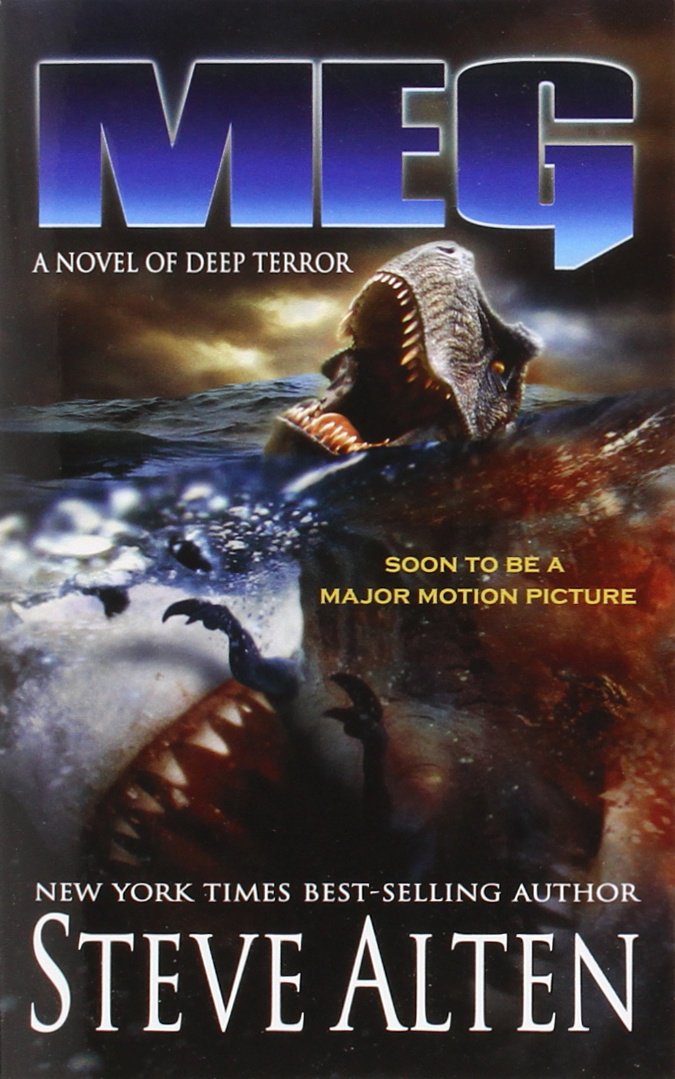
Microreview [book]: Meg: A Novel of Deep Terror by Steve Alten

Chomp chomp


My daughter is really into dinosaurs. Like, really, really into them. So naturally I wanted to read a book about dinosaurs. Only, I've already done the Jurassic Park novels and Red Raptor isn't available for Kindle (or at local bookshops). So I went for the next best thing: a novel about prehistoric sharks.

Meg is the story of Naval diver Jonas Taylor, who thinks he saw a Megalodon on a disastrous dive down the Mariana Trench. He then gets a PhD, and flogs this kooky idea wherever possible: that vents at the bottom of the Trench make it possible for life once thought extinct to survive. Actually there's some merit to this view: not only does the Mariana Trench have a much biodiversity than once assumed, scientists have also discovered that species once thought extinct are still around, like the Coelacanth. (Though that's a 60kg fish, not one that's as long as two school buses.)

Plausibility aside, some people do believe in Taylor, including oceanography patron Masao Tanaka, who wants to build a refuge lagoon for whales near Monterrey, CA. He also wants Taylor to assist his son on another dive down the Trench, this time to recover an earthquake-monitoring device. Why? I can't remember, and frankly, it doesn't really matter. Taylor agrees, Tanaka's son gets chomped and a female Meg ascends through the middle portion of the ocean to the warmer water above.

What ensues will be familiar to aficionados of the "monster eats people" genre: the giant shark proceeds to eat a lot of people. This is, of course, completely absurd. Great white sharks, which are much smaller than a megalodon, don't even bother eating people, because our fat content is too low for the energy it takes to consume us. When they bite humans, it's usually because they mistook us for seals (which do have enough fat), or because they're just trying to see what we are, and they do that by biting. Yet this 25 meter shark, which presumably requires a shit ton more fat than a great white to keep the motor running, inexplicably acquires a taste for human flesh.  

This is only the tip of the spray-cheese iceberg. There's a "historical" scene where a megalodon eats a tyrannosaurus rex, even though the two species didn't exist at the same time.* There are characters introduced for the sole purpose of being eaten, my favorite being the naval officer "just one job aware from retirement." There are multiple over-the-top chomp scenes, each more gruesome and outlandish than the last, and an extended scene from inside the meg's belly. All amazing, and patently absurd.

Most characters, furthermore, are straight-up cardboard, like the ass-covering captain who covers up the first meg discover and will endanger everyone to save his own career--even coming out of retirement to deep-six whatever Taylor has planned. Or Terry Tanaka, the headstrong and free-spirited daughter of patron Masao Tanaka, who hates Taylor until she loves him. But the "best" of all has to be Masao Tanaka, who speaks English with the diction of proverbs, bows frequently, has stereotypically "old world"** views on gender, refers to Taylor as "Taylor-san" and peppers his speech with hai. Only problem is, we're told Tanaka grew up in Seattle, the adopted son of an American couple. Now, I don't know about you, but most people I've met who immigrated to the US as children speak English fluently; and, though possessing two cultural backgrounds, are just as American as anyone else. Yet Tanaka, somehow, embodies every every stereotype of Japanese-ness as portrayed on American television programs prior to 1990. I mean, come on--only weeaboos do that.

All that said, there's something likable about Meg. Sure it's a trashy dumpster fire of bad writing, but the ridiculousness factor is so absurdly high, you kinda sorta can't help enjoying the experience of reading it. As Chloe said on twitter, it's a great bad novel. Chomp chomp.

*This is explained as "hypothetical," though it's still ridiculous.

**Framed as "old world" in the novel.


The Math

Baseline Assessment: x/10.

Bonuses: + (n-2)/y for all the chomping.

Penalties: - (d/dx)(c) = q for all the terribleness.

Baseline Assessment: SYNTAX ERROR.


***

Reference: Alten, Steve. Meg: A Novel of Deep Terror [Bantam, 1997]

POSTED BY: The G--purveyor of nerdliness, genre fanatic and Nerds of a
Feather founder/administrator, since 2012. 


Tuesday, July 4, 2017

Summer Reading List 2017: The G

It's summer again, and that means its time for beaches, barbecue and books, books, books! Well, it does for me at least. Always has, always will.

Since summer is my favorite season, it stands to reason that posting a summer reading list would become my favorite annual nerds of a feather tradition. Unfortunately, I haven't been terribly good at sticking to them. I only managed 3 of last year's list, the remainder falling prey to fickle tastes and me moving across the Pacific. This year I'm going to try to do all of them, perhaps even in the order I've listed them below. Somehow I doubt it will work out that way, but you never know...

The G's Summer Reading for 2017

1. Meg: A Novel of Deep Terror by Steve Alten [Bantam, 1997]

My daughter is obsessed with dinosaurs and everything prehistoric at present, so I decided it might be fun to read another book about prehistoric creatures eating people. Since I'd already done the two Jurassic Park novels, this one--about monster sharks in the Mariana Trench who develop a taste for human blood--seemed like it would scratch that itch. It's as trashy and ridiculous as you'd expect from that description. But it's pretty fun too. Chomp chomp.


2. Gardens of the Moon by Steven Erikson [Tor, 1999]

This is a re-read for me. A few years ago I dipped my feet into Malazan, making it 3 books in. I really enjoyed it, and have meant to revisit the series. Playing Obsidian's excellent CRPG Tyranny, which is noticeably influenced by Erikson's books, gave me the urge to do just that. At the same time, I feel like I've forgotten a lot of important stuff, so the plan is to restart the whole series. Very much looking forward to this.


3. Six Wakes by Mur Lafferty [Orbit, 2017]

Crime is my other genre of choice and this is a crime novel set on a spaceship. Where clones solve the mystery of their own murder. What's not to like about that?


4. Six Four by Hideo Yokohama [Farrar, Straus & Giroux, 2017]

Speaking of crime, and books with the number six in the title, I recently picked this one up at the bookshop. In Japan, it's become one of those "sensation" novels, like The Girl with the Dragon Tattoo or Gone Girl. It's meant to be quite good, if not exactly breaking with the style's conventions.


5. After Dark by Haruki Murakami [Knopf, 2007]

...and speaking of novels translated from Japanese, I've also decided to give Murakami another try--something I haven't dared attempt since enduring 1Q84. My opinions to date have been decidedly mixed. I love his prose, the way he explores pop culture and the general weirdness of his books; at the same time, it never really feels like he knows where he's going, which means the novels tend to fall apart to varying degrees. This one is short, so here's hoping that also means "well-edited."


6. The Trench by Steve Alten [Kensington, 1999]

Oh god, I'm going to read this one too, aren't I?

Monday, July 11, 2016

Microreview [book]: Jurassic Park by Michael Crichton

Never put Newman in charge of your computer systems.


I spent last summer with my nephews, one of whom is hardcore into dinosaurs, kaiju--all that good stuff. Our daily "who would win in a fight" conversations convinced me to re-explore that territory as an adult. So I decided to finally sit down and read Jurassic Park by Michael Crichton.

On the surface, Jurassic Park is about dinosaurs and cloning. Billionaire John Hammond has created an island theme park off Costa Rica that features living, breathing dinosaurs. But with reports of strange lizards attacking children on the mainland, and the park behind schedule, Hammond decides he needs to demonstrate that his venture is both safe and ready to open. So he invites a group of observers to the island: paleontologists, Alan Grant and Ellie Satler, chaos mathematician Ian Malcolm, lawyer Donald Gennaro (who represents the islands chief investors) and his niece and nephew, Tim and Lex Murphy. Only there's a problem with the computer systems, and the guy he's hired to fix things--Newman from Seinfeld--has his own agenda. What could possibly go wrong?

In short, just about everything. And it all starts with Newman and his nefarious scheming, which causes a power outage that, in turn, lowers the electrical barriers between the island's different dinosaur pens.

Newman! 
Consequently, much of the rest of the novel is basically made up of people running from and/or getting predated by the island's two giant Tyrannosaurs and pack of mid-sized Velociraptors. And as a horror/technothriller mashup, Jurassic Park works brilliantly. Crichton is not an artful writer, but he is a master at building tension. The prose is lean, the dialogue snappy and the book manages to be quite scary at times. I could not put it down, and felt thoroughly enmeshed in the world of the dinosaur park.

Unfortunately, as science fiction, Jurassic Park works rather less well. Very little of the dinosaur science is actually correct--even by the standards of 1990, when the book was written. For example, Velociraptors in the book are (1) reptilian; (2) human sized; (3) super fast; and (4) highly intelligent pack hunters. While fast, real Velociraptors were also feathered and about the size of a small turkey. And there is no evidence of either intelligence or pack hunting behavior. Of course, some have argued that Crichton merely used the name Velociraptor to describe Deinonychus--a larger cousin. But that only solves the size issue. And paleontologists do not believe that Deinonychus shared Velociraptor's speed. So yeah...the science? Still not so good.

Then there's the T-Rex, who ignores the island's many herbivores in order to chase three humans around the park. Given the dietary requirements of a large body, and the lack of protein and fat on a human body, this makes zero sense.

Thankfully, Jurassic Park does a better job with chaos theory than with dinosaur paleobiology. You may recall that chaos theory had achieved a certain cultural cachet in the late 80s/early 90s, commonly shorthanded through the metaphor of the butterfly effect (which holds that a butterfly flapping its wings can affect global weather patterns at the aggregate). While not literally so, researchers across the physical and social sciences have demonstrated the broader truth of the butterfly effect--namely, that small changes to a nonlinear system can have deep, abiding and unpredictable effects.

In Jurassic Park, chaos theory serves as the explanans for why everything goes wrong with the park. Malcolm, the chaos mathematician, serves as the book's Cassandra. He doesn't know what, exactly, will fail; he just knows that you can't clone dinosaurs with added frog DNA and hope to keep them safely in a theme park. Of course, you don't really need chaos theory to figure that out. And the fact that Malcolm's argument against the park basically boils down to "this park is going to fail because...chaos" make the scenes he shares with Hammond increasingly tedious as the book goes on.

In the end, though, you aren't here for mathematical theories or dinosaur science. You're here for bone-crunching thrills, and in that respect, Jurassic Park does not disappoint. Issues aside, it's a hell of an airport novel.

Chomp chomp.    


The Math

Baseline Assessment: 8/10

Bonuses: +1 for chomp chomp; +1 crunch crunch.

Penalties: -1 for all the dinosaur science being wrong; -1 for one too many "...because chaos" soliloquies from Malcolm.

Nerd Coefficient: 8/10. "Well worth your time and attention."

REFERENCE: Crichton, Michael. Jurassic Park [Knopf, 1990].

Our scoring system demystified.

***

POSTED BY: The G--purveyor of nerdliness, genre fanatic and Nerds of a Feather founder/administrator, since 2012.