Showing posts with label eco-horror. Show all posts

Thursday, August 13, 2026

Film Microreview: The Last House

Coronavirus allegories are needed in film, but this is the wrong allegory

At the start of this decade, when mass quarantine briefly reduced the footprint of human activity on the world, the meme “Nature is healing” achieved viral popularity. In the new Netflix movie The Last House, the premise seems to be: “Nature is healing… BUT AT WHAT COST?”

It all starts when the creatures of the sea revolt against humanity’s predation (there are a lot of references to dead fish in this movie) and weaponize the water cycle to produce a special type of water that seals houses hermetically. Their revenge comes in the form of a continuous rain that coats houses in a self-reparing layer, keeping people locked inside. The plot of the movie follows a suburban family (whose hobbies and interests are a bit too obviously gender-coded) as they find themselves forced to work together, contributing their respective talents, so they can survive with the food they have until they figure out how to force their front door open.

The movie is sharply divided in two parts: at the beginning, this family deals with their situation with a light-hearted attitude—at times too light-hearted, as if it wanted to be a comedy. The second part abruptly becomes survival horror when the neighbors start dying of starvation and it’s revealed that there are big, scary creatures lurking in the rain, and they can unlock the doors whenever they want.

Movies about the collective trauma of the coronavirus pandemic were to be expected, but it’s strange that they have been so few. In The Last House, an even bigger strangeness is that, while it’s unafraid to explore directly the psychological toil of a worldwide crisis that forced us to stay apart from each other, the movie’s attention is aimed at the isolation, not at the underlying crisis. Translating the allegory back into real life, it seems to be saying that the real disaster wasn’t so much the widespread infection as the quarantine, that the generation-defining scar we’ll carry forever isn’t the count of possibly tens of millions of deaths, but rather, having had to stay indoors for some months. This is a movie that wants to say something about a tragedy but prefers to focus on a related inconvenience.

This attitude is noticeable in the way the parents try to keep the kids occupied during the first weeks of isolation. Helpfully for the scope of the plot, phone and internet service is lost immediately, but somehow electricity, water and gas keep functioning for far longer. This family happens to own just two DVDs that they rewatch a sickening number of times: Annie and Air Force One, a melodrama about finding a home for a child and a hyper-patriotic thriller structured like a home invasion movie. Such choice of allusions reveals The Last House’s conservative stance: the priority is to safeguard a home for the kids, and prolonged separation denies them a proper childhood. This echoes the real-life argument that mandatory quarantine was an invasion of personal freedom. Nevermind that, in the world of The Last House, the weird rain has also conjured tentacled horrors that kill anyone who makes it outside. The movie heavily implies that Homo sapiens is to blame for the suffering of sea creatures, but our heroes’ response in the end is to wield those big brains and opposable thumbs to hunt and kill sea creatures.

So the elements for a story that comments on the early 2020s are there: people can’t leave their houses, the outside world has a mysterious deadly enemy, and the feeling of powerlessness is stressful for everyone. But it has its commentary backwards: in real life, being confined indoors was a solution, not the problem. The problem was that the virus made physical socialization dangerous, and isolation was what we decided to do to protect each other. In the movie, isolation is treated as the problem, an excessive punishment on humankind imposed by monsters, and protecting each other means finding a way to break the forced isolation.

The Last House works better when it feels small, when it cares about the value of mutual care and the cumulative weight of uncertainty. But it mutates into a power fantasy for doomsday preppers, with confusing editing and quick flashing lights during action scenes that detract from the emotional content. And again, it mistakes the nature of the crisis it’s trying to talk about. This is not the right way to contribute to collective catharsis. This is a reassuring pat on the back for those who whined that quarantine was an unacceptable affront that needed to be opposed with violence.

Nerd Coefficient: 3/10.

POSTED BY: Arturo Serrano, multiclass Trekkie/Whovian/Moonie/Miraculer, accumulating experience points for still more obsessions.

Tuesday, December 31, 2024

Nanoreviews: Private Rites, Orbital, Three Eight One

A roundup of three British novels that play with genre and form to create something a little bit special

Private Rites by Julia Armfield

Julie Armfield is a pioneer in the microgenre of "melancholy lesbians," and has followed up her last sad banger Our Wives Under the Sea with another tragic hit, this time a climate-fiction/horror-adjacent reimagining of King Lear, in which three queer sisters navigate their lives and relationships, especially with one another, in the aftermath of the death of their famous architect father, all against the backdrop of a world being steadily drowned by unending rain.

The main focus of the text throughout remains on the three sisters, using each of them as viewpoint characters, interspersed with some others, including the city itself (predominantly washes of beautiful descriptions of place and vignettes of the various inhabitants trying to live their lives in this damp, changing, drowning world). But the rain is constant—its fact and effects a touchstone throughout the story, never the focus but constantly noticeable just out of the corner of your eye. And so, by the time we reach the end, it is a looming horror that overwhelms the true plot of the story, the disintegrating psychodrama of betrayal and inheritance.

What I found most interesting, and something I think Armfield manages very well, is how the climate-fictional aspects of the story do not read as SFnal in tone, sharing more with litfic and horror respectively in how they are presented—this is a story that rejects explanations, whose climate change takes on a hint of the arcane before the end—and uses it instead as a setting, a psychological spectre and an act of god, not something to be reckoned with or solved, or even survived, but merely endured. Or perhaps weathered (ha). It loses no power from being treated this way, and perhaps even gains some—there is a weight to treating the climate disaster aspect as something unstoppable, unsolvable, that lingers long after the book is done, and felt more impactful on me at least than any number of stories that tackle the issue more head on.

Like all of Armfield's books, Private Rites is chock full of beautiful prose work, lush descriptions of place that unite the profound and the mundane, and sad, queer women in whose interiority we are allowed to revel, finding almost uncomfortable levels of sympathy with their most personal thoughts. It is gripping in all its aspects, and in my opinion may be her best work yet.

Nerd Coefficient: 10/10.

Reference: Armfield, Julia. Private Rites [HarperCollins, 2024].


Orbital by Samantha Harvey

If we count Orbital as genre, the Booker has been on a three winner SFF streak, with 2022's The Seven Moons of Maali Almeida, 2023's Prophet Song and now Orbital. But that's a big if. The events of the story—such as there even are events—may not have strictly happened as yet, but they fall so closely into the realm of the possible that it feels an enormous stretch to call this speculative work, unless you consider all fiction that contains space travel to be that by default. In any case, whether or not it comes in under a technicality, its mode is far from the usual for genre fiction, and therein lie both its strength and its weakness. We follow six astro/cosmonauts on the ISS through one day—sixteen passes over the surface of the Earth—as they muse on their place in the universe, their relationship with Earth, each other and their loved ones, and the new manned mission to the moon they witness launching. They don't do much, and what they do isn't the focus anyway—instead it's a book of pondering, a rolling set of banger one-liners and intensely evocative descriptive passages, lush and wallowing in its use of language. All of which it does stunningly.

The problem comes with the unrelenting sameness of that—Harvey does a great job of evoking wonder at the view from the window of a tin can in space, and at the marvel of space travel at all, genuinely working to craft that emotional response where other books might rest on the assumption that the feeling comes pre-packaged in the reader (which it does not in me). But that feeling—that awe at everything—persists regardless of the variation in content, even when dealing with the cramped mundanities of astronaut life, and the lack of tonal variation rather wears the wonder thin by the end of its (quite short) duration.

However, what it does it does do remarkably well, and only begins to overstay its welcome towards the end. If, unlike me, you are truly dazzled simply by the reality of space travel, it may well continue to land all the way through.

Nerd Coefficient: 7/10.

Reference: Harvey, Samantha. Orbital [Vintage Publishing, 2023].


Three Eight One by Aliya Whiteley

A story of two texts. The first, a fantastical, quest-like, quasi-mythological narrative of a girl who must leave her home village to go on a ritualised journey. The second, in the margins of this, the footnotes of a far-future archivist, reckoning with her life via her connection to this text from a time far outside her ability to fully contextualise.

Three Eight One uses the interrelation of these two stories, their contrast in tone, in voice and in formatting on the page, to examine our relationship with the past and the present, with the nature of humanity and what might be lost to make a utopia, with the things that remain constant no matter how much humanity changes, and with the power of stories.

In the quest narrative, Fairly has to leave her village to follow the Horned Road, as is traditional for young people. This begins by pressing a button on a chain device, switching the narrative from third into first person, and far from the last time format will be played with in such a manner. Her progression through the quest—neatly parcelled out into sections, each of precisely 381 words—becomes increasingly stranger, leading us through a world that feels both modern and alien, both using and defying the tropes of fantasy as we know it. Even alone, Fairly's story, with its interrogation of the motivations of quests, of power structures and community, with its ambiguous and thought-provoking ending, would be worthwhile.

But it is not alone, and it is the annotation from the future author which, for me, really makes this book. We slowly learn through the story that she writes from a time so far ahead of ours as to render some of the context of the story beyond her grasp—the way that she talks about details of narrative and place make it clear through subtle repetitions the extent of her ignorance, despite her profession that she lives in an age of knowledge. We see glimpses into her world, a utopia she considers hard-earned but worthwhile, a world without conflict but where much has been lost to secure that safety. But we also see simple glimpses into her life, into her emotional relationship with a text from a long-dead civilisation. The connection that she herself can barely explain to a text she doesn't fully understand is one of the most compelling things in the story, and watching it develop over the pages, intertwining with that story itself, is incredibly rewarding.

Add to that her development in the later half of the book, where we meet her older, wiser self, and learn how her life has been shaped beyond the boundaries of the text she's annotating, and it becomes even more special.

Above all, it's a book of subtlety, refusing to spell things out for the reader but instead trusting them to make their own connections, while making sure all the tools are available to do so if they're willing. It's a book full of thoughtfulness, and one to sit with, digest and discuss, and one of the most fascinating things I've read this year.

Nerd Coefficient: 9/10.

Reference: Whiteley, Aliya. Three Eight One [Rebellion Publishing, 2024].


POSTED BY: Roseanna Pendlebury, the humble servant of a very loud cat. @chloroformtea.bsky.social

Thursday, January 25, 2024

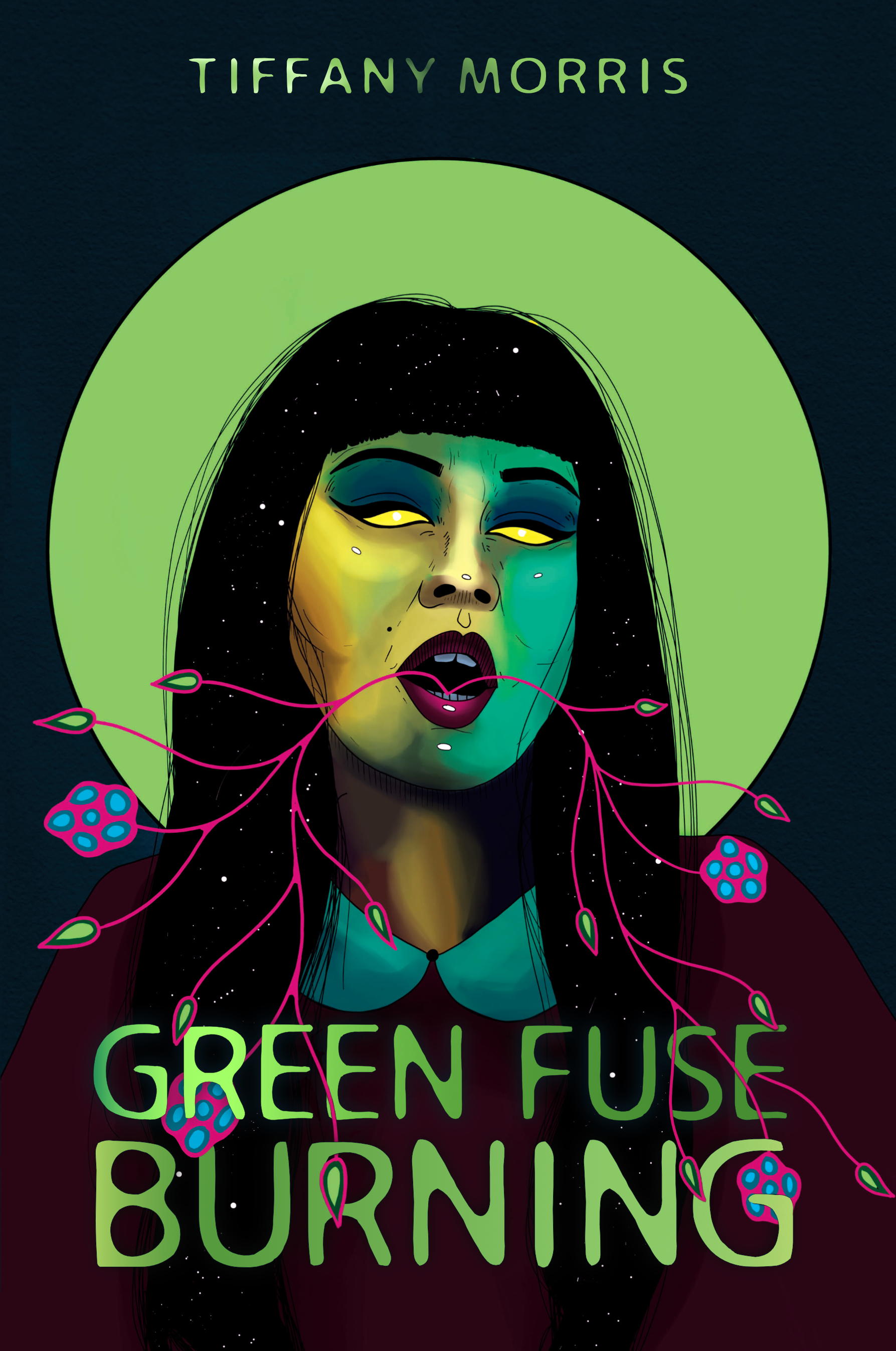
Novella Project: Green Fuse Burning by Tiffany Morris

Get lost in the swampland in this short novella exploring grief, climate change anxiety, colonization, and mental health.

an Indigenous woman's face is lit in shades of swampy green with some sort of plant growing from her mouth.

Note: Tiffany Morris includes the following content warnings at the beginning of the novella: parental death, suicidal ideation, animal death/gore, explicit sex.

Tiffany Morris’s eco-horror novella Green Fuse Burning keeps a tight focus on place, a large pond, while exploring major issues from grief, PTSD, climate change, colonization, and more. Rita Francis is a Mi’kmaw artist working in landscaping paintings. She goes on a week-long residency paid for by a grant that her white girlfriend, Molly, applied for in her name in hopes of igniting Rita’s artistic spark again. The cabin is on the shore of an isolated pond, and Rita goes early in the season since the warming climate has made the summers too hot and the winters shorter. 

The novella opens with Rita’s first night at the cabin when she’s woken up by what sounds like people dragging a body to the pond. She tries to watch through the window but decides not to go outside. Since she hardly has any cellphone signal at the isolated cabin, she resigns herself that there’s nothing she can do, and she’s not entirely sure what she might have seen was real. She reassures herself: “She’d sleepwalked as a kid, hallucinated all manner of things, found herself waking up on the porch some mornings with muddy feet and the imprint of grass on her arms, impressions of an unknown hour” (13). When she goes into town the next day to ask around, she’s met with the typical rude locals suspect of anyone new, particularly an Indigenous woman.

Rita only has a week at the pond to work on her paintings. Even if the pond seems to have some odd flora and fauna—including some loud and bloody crows—that’s no reason to run away and possibly strain her relationship with her girlfriend even further. But the longer she stays at the pond, the more things unravel. Her girlfriend leaves her a cryptic voicemail, her paintings are oozing, her will to live is fading, and there may or may not be something coming for her from the swamp.

This novella tackles a lot of themes in a tightly plotted story. One of my favorite parts was the meditation on what it means to be an artist. Rita’s livelihood influences her reaction to the weirdness of the pond as she processes it through her paintings. Beyond that, art influences this book, from the great cover, to the inside illustrations. Importantly, the story is structured as if the reader is walking through a gallery of Rita’s work, reading the descriptions of each painting. The following section of the story features some of the inspiration from that painting, and they grow weirder as Rita spirals into the swamp. I loved how the voice of the gallery descriptions differed from the voice of Rita and gave the reader such lines as: “In these paintings we see the murky, urgent depths of a woman’s spiritual journey into the swamplands of uncertainty” (7). Through these paintings and descriptions of Rita’s artistic process, Morris captures one branch of eco-anxiety not depicted as often as a general fear of the changing climate. For artists who work intimately with the land, that change is explored through art, which means a much more intense focus. It’s impossible for the artist to look away from the climate crisis if their chosen focus is landscape, such as Rita. 

While this novella is a fecund meditation on grief and its branching impacts, one of my favorite aspects was the descriptions throughout. Morris’s title comes from the Dylan Thomas poem “The force that through the green fuse drives the flower.” Thomas’s body of work is full of lush, wordy poems, so for Morris’s to draw inspiration from his work—and to quote from the titular poem as an epigraph to the novella—promises the reader an equally lush reading experience. She absolutely delivers, and I enjoyed the natural descriptions throughout, especially as they become weirder and more horrific. One of my favorites opens the second chapter: “As Rita made her way through the fog-wreathed world of the pond loop, she admired the vibrant greens around her with a morbid thrill. […] It invaded, pillaged, choked out everything else that breathed, leaving only a teeming verdant landscape in its wake” (31). Morris’s poetic power of description adds depth to the relatively simple—but effective—plot and makes for a rich reading experience. 

Without dipping into spoilers, the swampy weirdness comes fast and quick. While a more common critique of books is that the middle lagged, in this novella, I wish we had lingered in the middle and let the weirdness build a little more slowly. Morris tackles so many themes—which connect back to the central grief of the death of Rita’s father—but I wish more of these paths could have been explored more fully with a slightly longer novella. Then again, that’s the struggle with the novella form—it’s a snapshot in many ways. Much as Rita’s paintings cannot capture everything about the pond, I found myself wanting to spend a bit more time there in the middle of this novella. 

In her debut novella, Tiffany Morris comes out swinging. This short, tightly plotted novella lives up to the linguistic delight of Dylan Thomas’s work, which is referenced in the title Green Fuse Burning. It also brought to mind Annie Dillard’s foundational work Pilgrim at Tinker Creek (1974) with the connections to animals that don’t quite behave as we would expect. Morris’s meditation on grief, climate change, colonization, art, family, and more reminds the reader of the interconnectedness of life—even after death. In that realization is where I find the power and importance of eco-horror. This subgenre, much like horror in general, offers a way to overcome the fear of climate change and move toward an acceptance of this grotesquely changing world. With this acceptance opens up the possibility to live a fuller life, to keep living, even in the face of terrible loss.

--

Reference: Morris, Tiffany. Green Fuse Burning [Stelliform Press, 2023]

POSTED BY: Phoebe Wagner is an author, editor, and academic writing and living at the intersection of speculative fiction and climate change.