Showing posts with label art. Show all posts

19 January 2010

ART: Pillowig (Joo Youn Paek)


“Pillowig” is hand made wearable pillow comforting tireness of people in daily lives, enabling users to sleep comfortably whenever and whenever they’d like. When user test is done in public spaces - subway, airplane, library, class room and laundromat, viewers commented: “I would like to have it for my trip.”, “Very funny.” “This is practical, but a laugh, too.” I made 50 limited editions and sold 47 pieces at the exhibition of the work and gained “Pillowig” fans. Two months later fans did a group performance piece at the Old Palace, Seoul. -- Joo Youn Paek

18 January 2010

ART: "Personnes"


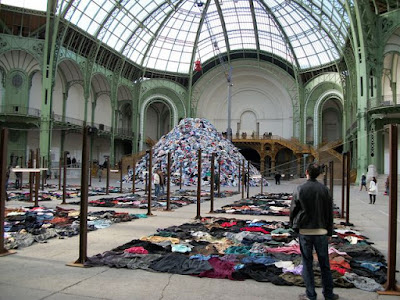
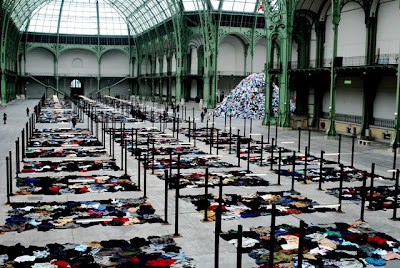
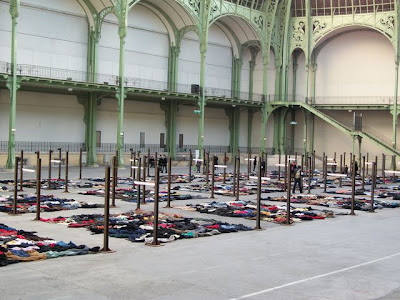
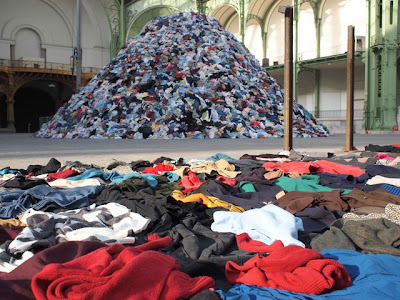
I am stunned (as was Susie Bubble, from whom I snatched these) by these photographs' intimation of the tremendous physical scope of French artist Christian Boltanski's "Personnes," an Monumenta installation in the Grand Palais in Paris. (Monumenta is an annual installation series in which a leading international contemporary artist is invited by the French Ministry of Culture and Communication to create a new work for the Nave of the Grand Palais).

Susie confesses to feeling teary, and it's easy to see why. These clothes conjure the specters of the persons who wore them in some unspecified "before" --perhaps before growth, before divorce, before illness, before death-- which the project's description would appear to confirm: "Conceived as a work in sound and vision, Personnes takes up a new theme in Boltanski's work, building on his earlier explorations of the limits of human existence and the vital dimension of memory : the question of fate, and the ineluctability of death."

The two parts of the installation that I can see from these photographs suggest both memorials in the carefully measured, uniformly spaced rectangles laid with a single layer of clothes --calling to my mind the sheer physical expanse of the iconic AIDS Memorial Quilt-- and a garbage dump in the giant heaping pile of assorted garments at the other end of the Nave. The installation thus suggests something about the seemingly arbitrary nature of human classification between those we treasure and those we discard. (The same classification that the AIDS Memorial Quilt once challenged, but arguably now reinforces.) Or, as Judith Butler writes, "Certain lives are grievable, and others not, and this works to sanctify the violence we inflict, and to disavow any conception of our own precarity."


(Images borrowed from Style Bubble, who borrowed from a Flickr selection)

07 October 2009

ART: Sonic Fabric Ties


Fashion and music share a long and complex history. The conceptual artist Alyce Santoro is intertwining these histories in intriguingly material ways by repurposing audiocassette tapes into mixed media eco-fashionable ties (from $90 - $140). Most fabulous is the synaesthetic component of the sonic fabric. From a description on Ecouterre's website: the ties are "'playable' when you run a tape head across the surface." Fashion you can both see and hear!

01 October 2009

ART: Highway to Heel

Earlier this year, the Van Every/Smith Galleries at Davidson College presented the first exhibition to address the intersection between disability identity and female identity in RE/FORMATIONS: Disability, Women, and Sculpture. The following is an excerpt from the exhibition essay, "Leaving Venus Behind," by Davidson College English professor and co-curator Ann M. Fox.

One corner of [Harriet Sanderson's] Molt, with Scurs is made up of multiple pairs of high-heeled shoes, lined up against a wall, their heels fashioned from the tips of canes. There’s both kinship and whimsy in this installation. Sanderson’s use of a curved cane tip for the heel of a woman’s dress shoe makes the point that such dress footwear can limit the mobility of even the most ambulatory user in the name of beauty, rendering them fully stopped, as if against a wall. And the high-heeled shoe is, of course, unstable and impractical for the body with limited mobility. But the installation also creates the hybridized cane/shoe as an object of whimsy and playfulness, reminding us that canes and shoes are, after all, paired to create mobility in their actual lives as objects. The normal heels of the shoes have been amputated from the bodies of the footwear and lay scattered about the gallery with other cane tips that seem to have exploded free from the “cane chair.” As the viewer looks at the new shoe/cane creations, there’s something sexy and dangerous about the sinuous hooks of the highest heels, a rendering of disability as vehicle for haute couture. Ultimately, these shoes are not a simplistic reinforcement of ableist metaphors to critique beauty norms; they become a kind of expression of alternate movement and “disability cool.”

24 September 2009

ART: Sneakers and Borders

After several years of design research, in 2005 New York-based Argentinian artist Judi Werthein designed a high-top sneaker for both the sneaker freak collecting limited editions, to whom the sneaker is available for $215 a pair at a San Diego boutique, and for the Mexican migrant preparing to cross the U.S.-Mexico border, to whom Werthein and her partners gives the sneaker for free. (Thank god Kathleen Hanna is blogging, or I wouldn't have heard about Werthein.) From Delete the Border:

A compass and flashlight dangle from one shoelace. The pocket in the tongue is for money or pain relievers. A rough map of the border region is printed on a removable insole....

The [Brinco] shoes were introduced in August at inSite, an art exhibition in San Diego and Tijuana whose sponsors include nonprofit foundations and private collectors. [From the BBC: "The artist was commissioned...to develop a project that "intervened" in some aspect of border life."]

Benefactors put up $40,000 for the project; Werthein gets a $5,000 stipend, plus expenses....

Across the border, several curious migrants waiting for sunset along a cement river basin approached Werthein as she took white shoe boxes out of a sport utility vehicle. One man already wore a dirty pair of Brincos. Another, Felipe de Jesus Olivar Canto, slipped into a size 11 and said he would use them instead of his black leather shoes.

"These are much more comfortable for hiking," said Olivar Canto. He said he was heading for $6.75-an-hour work installing doors and windows in Santa Ana, about 90 miles north of border.

From there, Werthein went to Casa del Migrante, a Tijuana shelter that will receive a share of the proceeds from Brincos sold in the United States.

"Does it have a sensor to alert us to the Border Patrol?" joked Javier Lopez, 33, who said he had a $10-an-hour job hanging drywall waiting for him in Denver.
