Showing posts with label subtext. Show all posts

Wednesday, April 29, 2015

Mailbag: Getting repped off contest wins and "They don't get my symbolism!"

So I was going through the old inbox and found a bunch of questions I had by-passed, in some cases for nearly a year. Some of this is because I've not been doing many mailbag posts, some of this is because I wasn't sure if these questions really were relevant enough to answer and in some cases... well, the questions were just too long and involved.

Being succinct is your friend.

First up is Brian,

I'm a longtime reader of your blog and first off just want to say thanks for doing it. I had a practical sort of question (or at least I hope is practical): my screenwriting partner and myself have just won first place in a screenplay competition at a film festival in NYC, Visionfest 14. We placed as finalists a few weeks back and figured we'd take last place, but instead we won the whole damn thing. 

Now, we have worked (slightly peripherally) in Hollywood for several years and have been through some ups and downs as hopeful filmmakers, including making our own micro-budget feature film and racking up the festival rejections (still waiting on a couple dozen at the moment), as well as landing an established agent some years ago when we were not at all ready for an agent, thus resulting in a relationship that went nowhere. Long story short, our parents and friends are really excited but we have learned the value of low expectations.

That said, I'm wondering if you think there is any value to trying to get representation based off this win, since 1st Place does sound pretty good. Then again it's not the biggest competition and I'm sure most people never heard of it even in the industry, so I can't exactly go around like I won an Oscar...

Besides our film, this script is our main trump card. It's got three 8 scores and a couple 7s on the Black List site. Now we have this 1st place win, in one of the first competitions we entered. If you were us, just starting off, what practical next steps might you take to capitalize on these developments (if any)?Any words of wisdom you can provide, it's greatly appreciated!

First up, congrats on your win. Let's get right to the meat of it: "Can you capitalize on this win to get an agent?" My hunch is "No." I've never heard of Visionfest and I suspect that an accolade from the festival doesn't really make much impact for any potential reps.

However, I - and just about everyone in the business - HAS heard of the Black List site. If you really have three 8 scores, you should be able to leverage that into getting a few reads. Since you didn't ask about how to contact these agents and managers, I assume you've done your homework and have that ready to go. I'd send out a brief email that quickly introduces yourself. Give a one or two-line pitch of the script, mention the Black List scores and if there's some really relevant reason why you chose to reach out to that rep, maybe add that too.

But keep it short. See the length of your email to me? Try for half that length.

Next up is Lee:

I'm a lapsed writer, who after many years of working in an unrelated field, finally decided to sit down and write my screenplay. I've received a good mix of reviews and notes (positive & negative), and the feedback has been mostly helpful. However, I'm troubled by the fact that some of the "Symbolism" / "Subtext" I've injected into the story seems to be missed by all 5 of the reads I've received (3Pro's, 2 Friends).

I don't know if this is a case of "speed reading" or "skimming" on the part of the people doing the coverage, but they all seem to be missing the subtext that explains away many of the criticisms of the story (Example: Story is filled with bad people. Well, they are in a "Bad" place, aren't they? Say, is anyone else really HOT? Let's ask the guy over there in the Red Pajamas).

Is this a symptom of Script Readers skimming the script and therefore missing the added layer of "meaning" in the story? Or do I need to be more explicit and "Talk Down" to my audience who may not be paying close attention?

Ah, the "they're not getting my subtext" question. This is hard to answer because I haven't read the script, but if you've got five people who you really trust - three of whom are writers themselves - and none of them even got a hint of the symbolism, the odds are the problem is more with the script than the reader.

That's not to say that readers can't miss that stuff. I think in a read, people are more inclined to take everything at surface value unless there are some key dog whistles in there. I think part of the issue might be that you're expecting the symbolism to explain away what are being called out as mistakes or plot holes. I can definitely understand using inconsistencies to force an audience to think more about "Wait a minute, why the hell would they do that?"

But if the symbolism is done in service of leading an audience to a revelation, the problem might be that such revelation isn't present in the script. To launch off of your "hell" metaphor, in The Devil's Advocate, attorney John Milton (Al Pacino) is revealed to be the Devil. Before that big reveal comes, we get a few clues and winks that allude to this truth, but by the end of the film, it's spelled out for us - he IS Lucifer. In the case of this script, that reveal leads to the climax of Keanu Reaves's character's arc.

In your script, it sounds like there might be some symbolism without any payoff. Maybe it's reading to them the way that Pretty Woman plays off of the Cinderella metaphor lightly without adhering to it strictly (We get a "makeover" scene with her "Fairy Godmother/Hotel Concierge" but the script doesn't go so far to have Vivian pass herself off as someone else, leave behind a slipper and have to be identified by her lost clothing.) Maybe your readers ARE noticing some of these things you've thrown in, but don't realize you intend them as more than mere asides. So I guess in that case, the answer might be to use the symbolism differently.

This is always a tricky question to answer because I can't say definitively if the problem is the writer or the reader unless I read the material myself. If many people are missing it and perceiving this as a plot hole, clearly you have to make some changes, though.

Friday, September 30, 2011

Subtext in "Revenge" with Emily VanCamp and Madeline Stowe

If you follow me on Twitter, you probably saw that Wednesday night I mentioned this scene from ABC's new series Revenge.  This is a perfect example of subtext in dialogue.  Every writer should strive to have subtext, which is the undertone and meaning beneath the dialogue.  It's what the characters aren't saying - but what they mean.  Often a scene with subtext will seem to be about one subject on the surface, but really be conveying a completely different idea or emotion.

Watch the scene and then read below for my explanation of what's going on here.


Okay, the premise of the series is that Emily - played by Emily VanCamp - has returned to the Hamptons fifteen years after her father was betrayed by some of the most powerful people there.  Her father was framed for essentially funding a terrorist act, and everyone who worked at his company testified against him.  Why did they do that you ask?  Because Victoria - played by Madeline Stowe - supposedly masterminded it.

Victoria's the target of Emily's revenge scheme - but before Emily attacks her directly, she aims to destroy everyone around her who was a part of the scheme.  Since "Emily" is actually an identity that Amanda Clarke assumed, Victoria doesn't realize she's having tea with the daughter of the man she destroyed.  However, since "Emily" has taken an interest in her son, she's determined to find out her secrets.

Prior to this scene, Emily had been renting her former childhood home.  In the intervening years, it had passed into the ownership of one of Victoria's close friends.  That woman was Emily's first takedown the week before, which resulted in the house being put on the market.  Emily mentioned to Victoria earlier that she put in an offer - and then later got a call that she was outbid by the tech billionaire/associate who's the only other person who knows who Emily really is.  When Emily confronted him, he revealed that Victoria swooped in and outbid Emily with a cash offer.  Thus, he outbid Victoria with his own offer and then put it in Emily's name.

Victoria doesn't know this at the start of the scene.  She's secure in the belief that she won.  Furthermore, prior to this scene, we saw Emily find out she had the house.  So when she "checks her email" and is excitedly announces her win it's all for Victoria's benefit.  Hence the line, "Thank you so much for tea, Mrs. Grayson.  I can't tell you how much I've enjoyed this."

Yeah, I bet you have.  Now with that Cliff Notes set-up of context, do you see the double meaning in many other lines in this scene?

Victoria's subtext is essentially, "You're on my turf, little girl.  Don't think I'm not aware you're hiding something."  Emily's on the other hand is, "Better luck next time, bitch!  I'm gonna enjoy taking you down before you've even realized what's happening."

I should point out that as strong as the writing is, subtext really needs to be in the hands of capable performers who can really sell it.  Here, VanCamp and Stowe play the scene to perfection.  There's just enough awareness of the subtext in their performances without either of them crossing the line and overplaying it.  That's a tricky tightrope to walk.  Lesser actors might have gone slightly broader just to make sure the audience "gets it."  In doing so, it would have compromised the reality that Victoria doesn't realize exactly what Emily's pulling here. 

VanCamp has to sell that she's tossing darts at Victoria without making the attack obvious, and Stowe has to sell that she thinks she's being subtle and that she doesn't notice the additional layer behind Emily's words.  The result is probably my favorite scene of the week, and watching these two actresses spar is like watching two tennis pros in their prime.  If Revenge keeps serving up scenes like this, consider me hooked.

So far Revenge is one of the best new shows this season.  Check it out if you haven't already.

Thursday, August 13, 2009

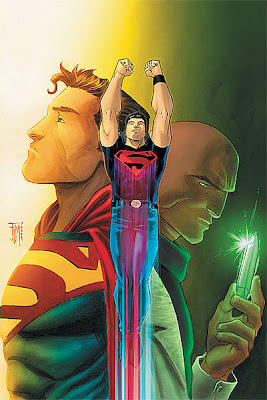
Subtext in Adventure Comics starring Superboy

For obvious reasons I usually limit my writing tips to screenplays and TV scripts, but today I want to take a short break from that and use a recent comic book to illustrate a point. I've been a comic collector for 20 years and I can say that one of the best superhero writers, past and present is a man named Geoff Johns, currently responsible for Green Lantern, Blackest Night, Superman: Secret Origin, Flash and Adventure Comics. One of these days I'll have to get around to explaining how Geoff's Green Lantern: Rebirth helped me structure a fantasy script I recently wrote, but now I'm going to talk a little about Adventure Comics #1, out this week, and how it illustrates both "showing, not telling" and effective communication of subtext.


Superboy is the lead feature in the title, though he's not a young Clark Kent, but rather a teenager named Conner Kent who was cloned from a mix of Superman and Lex Luthor's DNA. He had been killed back in 2006's Infinite Crisis but was recently resurrected in 2009's Legion of Three Worlds. This issue picks up his story from there, as he moves in with Clark Kent's mother in Smallville.

If you're so inclined, please follow this link to preview pages from the story, featuring the wonderful Norman Rockwellian art of Francis Manapul.

Early in the story we see text that appears to be writing from Conner's diary, opening with the question "What did Superman do?" Item 1 on that list: "Lived with the Kents." We're shown a panel of young Clark with his parents, and then the next panels show Conner moving in with Ma Kent, as another text box shows Conner checking off "1) Lived with the Kents."

Throughout the issue, several other examples follow this pattern, such as "Went to Smallville High," "Joined a team of superheroes," and "Helped anyone who needed it." So I ask you, dear reader, what do you think all of this means? Why is Conner writing this? I'm guessing most of you surmise that Conner is trying to figure out how to follow in Superman's footsteps, to live up to his legacy.

About midway through the story, Conner goes to the dilapidated house where Lex Luthor lived when he was in Smallville. Superman finds him there and wonders why Conner would come here. Superboy asks, "Do you think it would've been different if Lex had grown up with your parents?" Superman says "no," elaborating that he thinks Lex is completely delusional. Conner probes further, "So was he born bad?" Eventually, he admits he just wants to understand him. Superman assures the boy, "You're not him. And you're not me. You're your own person." He asks Conner to steer clear of Luthor, saying he's Superman's problem. Conner promises, "If I EVER see Lex Luthor again, it'll be too soon."

The final page of the issue shows Conner looking at his checklist. Then there's a one panel flashback to that last line of dialgoue. Then we see the second page Conner has written:

"What does Lex Luthor Do?
"1) Lies to Superman"

Final panel - Conner checks that off of his list.

It's a nice bit of showing rather than telling. Conner essentially is trying to figure out how much of each "father" is in him. His checklist isn't just about him trying to be Superman - it's about him figuring out if he already is on the path to being Luthor. That's not only clever writing, but it's handled in a sublte way. Despite the subtext of the scene in Luthor's house being pretty clear in showing Conner wondering if he was born bad, this final scene still was a surprise.

At no point in the story does Conner say, "I am worried I might turn out like Luthor." He talks around the subject, and his actions hint at these motivations, but Johns never stops and puts those words into his mouth. It's also equally clear that Superman senses Conner might be worried about this, and his reassurance to the boy also comes without him being on-the-nose in revealing Conner's feelings. Take note of this - people rarely say exactly what they feel. If your characters do this often, it usually makes their dialogue sound on the nose and false.

The subtext of this whole issue is Conner's identity crisis. His concerns don't even become all that evident until more than halfway through the story and then the ending forces the audience to reevaluate the whole issue in a new context. Conner didn't just happen upon Lex's old house and then that led him to wonder about "nature or nurture?" It's been on his mind the whole time - and hiding from the audience in plain sight.

So check out Adventure Comics if you get a chance. It's a nice single-issue story that doesn't require you to buy 15 different crossovers to get the whole story.