Showing posts with label Common Redpoll. Show all posts

Sunday, April 21, 2013

Ah Spring!

Snow still lingers behind the barn and redpolls have made the occasional visit to the feeders in the last few days ...


Common Redpoll

... but otherwise, all signs point to the arrival of Spring. The Chipping Sparrows are doing vocal battle in the morning, and the "peter, peter, peter" of the Tufted Titmouse proclaims his jealous watch over his territory ...

Tufted Titmouse: "What are you doing of my property?"

In the garden, crocus draw in the honey bees ...


No one needed to "plan" a birders' walk at Herrick's Cove this morning; it just happened as we  welcome the vanguard of the season's migrants and anxiously await the next wave. Among those recent arrivals today were the Yellow-rumped Warblers in splendid breeding attire and Ruby-crowned Kinglets flashing their crown ...

Yellow-rumped Warbler
Ruby-crowned Kinglet

In many wetlands, the geese are well beyond the courtship stage, as this incubating goose attests, her nest perched atop a beaver lodge in Putney's Wilson Wetlands.

Canada Goose
Good birding!

Thursday, February 28, 2013

Winter Irruptions

Watching birds can do lots of good things for you, including expanding your vocabulary. Or at least, it has expanded my vocabulary. Until I had the time to pay attention to seasonal changes and movements of birds, I did not have the word, “irruption,” in my working vocabulary. I knew “eruption,” which involves something bursting out, like lava from a volcano. Irruption refers to something bursting in, or surging up. It is the word used by ecologists to describe a sudden, rapid, and irregular increase in an animal population. It typically involves some kind of change in the natural ecological checks and balances.

In the bird watching world, irruptions are hoped for events, especially as winter imposes its grip. Winter birding can be rather monotonous - the same old, same old, unless one or more irruptions occur. “Bird Source,” the website of National Audubon and Cornell Lab of Ornithology, puts it this way: “Every winter, bird watchers across North America anxiously await the possible incursion of birds that don't normally winter in their areas. These periodic bird irruptions add a dramatic level of excitement to winter birding.”

Snowy Owl - Brattleboro, Dec, 2011

Last winter (2011-12) was an irruptive year for Snowy Owls. These large arctic predators were reported in record numbers across the northern states, often in places where they have rarely, or never, been reported. Sightings extended deep into the Great Plains and even as far south as Texas. The Snowy Owl irruption was driven by a crash in the lemming population in the Arctic; the lemming is the owls’ principal food source.

When a Snowy Owl was reported in mid-December, 2011, in the corn field behind the marina in Brattleboro, the word spread quickly through the birding community. Within an hour of the first report, a dozen birders were focusing their scopes on the white object among the corn stalks. More observers followed in a steady stream.

Finch species which inhabit the northern forests are the most common irruptive birds, and this winter has been a banner year in our area. During October, large flocks of Pine Siskins (closely related to the American Goldfinch) moved through New England and the mid-Atlantic states. The flocks which visited my bird feeders numbered 200+; they put a serious strain on my bird seed budget.
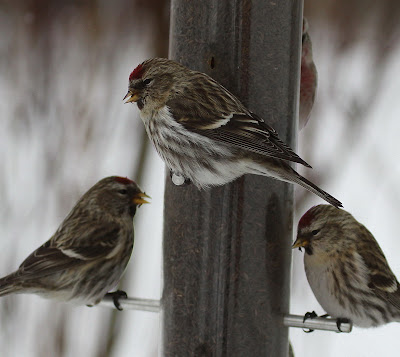
Common Redpoll have irrupted in New England this winter

The siskin flocks moved on, to be followed by the Common Redpolls (also closely related to goldfinches). Throughout December and January, and on into February, there have been breathless reports about the sudden appearance of these small finches.

What makes the winter irruptions both exciting, and frustrating, is their unpredictablility. As the birds irrupt into New England, they do so in flocks - often large and typically very nomadic. So you hear about all of these redpolls being seen, and you are frustrated, because you have not seen a single one. And then you are snowshoeing through an old hill farm, or walking along a frozen lane, or sitting in your kitchen watching your bird feeders, and suddenly you have a surfeit of redpolls, scratching the snow, squabbling over seed, and taking hurried flights into the hedges.

Winter finches are notorious for quickly exhausting a food source and then moving on. The epitome of this practice is the Evening Grosbeak. Long time bird feeders describe the Evening Grosbeaks’s winter presence with ambiguity. They are delighted to have these large, colorful, and handsome finches at their feeders, but they cannot avoid the additional use of adjectives such as voracious and greedy to describe their presence. This winter Evening Grosbeaks seem to have taken their blitzkrieg feeding habits further south; I have seen few winter reports from our area.
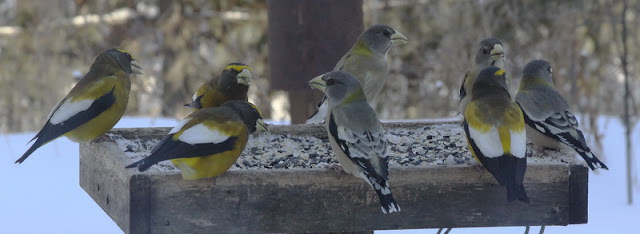
Evening Grosbeak flocks are notorious for emptying bird feeders & moving on during winter.
 The winter finches which are typically more common in our area have been hard to find this year. In addition to the siskins and grosbeaks which have moved on, Purple Finches and goldfinches are scarce.

Pine Grosbeak - Brattleboro, December, 2012

But then there are the frustrating reports of other winter finches - frustrating because you would love to see them, but they do not make it easy. For a couple of weeks in December, a flock of Pine Grosbeaks fed on the yew berries in front of Center Church in Brattleboro. There were females and young males. (The adult males apparently stayed home to defend their territory through the winter). When the berries were exhausted, the flock moved on. If you have not seen the Pine Grosbeaks, you may still have the opportunity. Be alert, because they could be anywhere. On the Christmas Count, we came across several getting grit and salt on a road in Dummerston. If you miss the Pine Grosbeak this winter, I am sorry to tell you that you may not have another opportunity for several years. But, that’s bird watching.

White-winged Crossbill (l) & Red Crossbill (r), December, 2012

On the New England coast, this has been a good winter for Red Crossbills and White-winged Crossbills. I made a trip to Salisbury Beach on the New Hampshire coast and had my best crossbill day ever.

Winter irruptions are driven by conditions in the northern forests. Scientists and naturalists in Ontario and the Maritime Provinces have been studying the preferred food sources of various species for years. Based on their collected data, fairly accurate predictions are possible about which species will irrupt. When they document the shortage of a food that a particular species prefers, they predict an irruption. Winter survival depends upon getting enough food. When local food sources are scarce, the birds go elsewhere.

Red-breasted Nuthatch

Finches are the most common irruptive species during winter, but not the only ones. It is easy for us to miss an irruption of the Red-breasted Nuthatch, since this species also nests in the higher elevations of our area and may be seen year-round. Harder to miss when you come across them are the Bohemian Waxwings. When you find Bohemians among the flock of their cousins, the Cedar Waxwings, then you have counted a coup among bird watchers. And when you meet a waxwing flock dominated by Bohemians, you have certainly encountered evidence of an irruption. And, you will be breathless.


Bohemian Waxwing, Putney, 2011
For any of these winter irruptions, I have two pieces of advice if you are not a hard core birder: First, I am sorry to say, don’t hold your breath. The winter flocks are nomadic and erratic. Hard core birders sometimes spend days trying to chase them down, not always successfully. Second, when you do stumble on one of these flocks, or when one of these flocks stumble on you, don’t forget to breathe!

Good birding!

Saturday, December 22, 2012

CHRISTMAS BIRD COUNT - A SNAPSHOT OF WINTER BIRDS

Eastern Bluebirds favor orchards during winter.
During the winter months, it is not uncommon to hear the question, “Where are all the birds?”

A flip answer would be - “They’ve gone south” - which they have. Most of the birds which fill our landscapes during the summer are tropical birds which return to the tropics in Central and South America during our winter months. Most of the warblers, vireos, thrushes, and flycatchers fall into this category. Many other birds move to the milder climate of the southern states: This includes many species of waterfowl, wading birds, and raptors, plus some of the hardy songbirds.

On the other hand, boreal species from the north also move south, driven by changes in the weather, but also, and probably more importantly, by the availability of food in their northern homes. Food availability means that some winters they more or less stay home, while other winters they irrupt southward. When there is an irruption, we may notice their numbers. When they stay home, we may ask that question about where they are.

Common Redpoll has irrupted into New England this winter.
As we watch our feeders, or wander about on our skis or snow shoes during winter months, it often seems as though we are seeing very few birds compared to what we remember seeing in other years. For example, two years ago during the holidays, my feeders were inundated with northern birds. Flocks of Common Redpolls, and mixed flocks of Evening Grosbeaks and redpolls descended in swarms. I was filling my bulk feeders twice a day. This year as of the time of writing, my feeders have been visited by a small flocks of 15 redpolls, while the grosbeaks have been completely absent.

In October, flocks of 200+ Pine Siskins swarmed about my feeders. During December they have been absent. Where are they? Undoubtedly, they have gone further south, in spite of the dependable food source at my feeders ... because ... birds do not simply rely on bird feeders, but in fact, derive most of their food most of the time from naturally occurring food sources. If those sources do not seem adequate, they move on.

White-breasted Nuthatch is a year-round feeder bird.
There are two citizen science projects which provide a snapshot of where the birds are during the winter. One is the Great Backyard Bird Count. This is primarily a feeder count which is conducted on the President’s Day weekend in February. To learn how you can participate (in the comfort of your home) visit this website: www.birdsource.org/gbbc.

The second citizen science project is the Christmas Bird Count. In its 113th year, the CBC engages over 60,000 people in about 2500 locations.

There are several Christmas Bird Counts done in southeastern Vermont and southwestern New Hampshire. I participate in the Brattleboro Area CBC on the third Saturday in December, so that is the one I can write about.  Here is a snapshot of where the birds are around Brattleboro.

Many participants returned from their day of counting speaking of how hard it was to find birds and how low the numbers were. But when the counts were tallied, the number of birds counted (4100) was slightly above the ten year average (3900).

With open water in the Connecticut and West Rivers, waterfowl were well represented by Canada Goose, Mallard, and American Black Duck. Most significant was the number of Hooded Mergansers. Consistently present on the count, this year the 138 “hoodies” was five times greater than in any previous year.

The winter finches and boreal species showed no consistency as a group. The American Goldfinch was hard to find and the count was the lowest in the last 15 years. Pine Siskin, so abundant in October, was absent. Evening Grosbeak, consistently present the last 11 years was absent. There are usually a few Purple Finches in December; not this year.

Pine Grosbeaks appear in SE Vermont every 5 or 6 years.
On the other hand, Pine Grosbeaks appear every 5 to 6 years. This was their year. Common Redpolls show a consistent pattern of being present every other year. This was the year they were expected, and they did not disappoint; counters tabulated the largest number of redpolls (almost 300) in recent years.

Sparrows were hard to find, but the winter sparrows, American Tree Sparrow and Dark-eyed Junco were within their expected numbers, along with small numbers of Song and White-throated Sparrows.

Red-bellied Woodpecker has continued its expansion in Vermont.
The Red-bellied Woodpecker which first nested in Vermont in Brattleboro in 2001 continued its steady population increase.

Blue Jay and American Crow had their smallest numbers in years. Putney Mountain Hawk Watch counts migrating Blue Jays (when not counting hawks); they counted hundreds of jays. Apparently, the Blue Jays kept on moving because they were difficult to find in the Brattleboro area.

Other common feeders birds were present in average or above average numbers: Black-capped Chickadee (up), White-breasted Nuthatch (up), Downy Woodpecker (down slightly), Tufted Titmouse and Northern Cardinal (steady).

American Robin often winter in Vermont, feeding on fruit.
Some species are seen in flocks, and may be very localized. Horned Larks were in Vernon (180). Eastern Bluebirds were mostly in Dummerston (total 59 verses 10 year average 25). American Robins were scattered, but with a large flock in an old Dummerston orchard (total 244 verses 10 year average 44). Only one small flock of Cedar Waxwings (31) was found around Sunset Lake.

There are always a few birds which should have migrated, but have not. Brattleboro recorded this year a Red-shouldered Hawk and a Common Yellowthroat (a first CBC record for Brattleboro).

If you are a reader who is worried about a lack of birds at the bird feeders, I say, “Don’t be.” The CBC suggests that the birds are still around. Except when humans really screw up the environment, the birds are resilient and adaptable. Their population numbers go through regular and natural fluctuations. Once the counters on a CBC thaw out and examine the count numbers, this is confirmed (for most species) year after year.

Stay warm, and if the birds don’t come to your feeders, go out and look for them. Good birding!!

Friday, December 07, 2012

Crossbills

Yesterday was a crisp, clear, bright day - a marvelous day for birding and wonderful light for photography. I drove to the Massachusetts shore. Crossbills were being reported in the campground at Salisbury Beach.

The cone-laden pine trees hosted flocks of White-winged Crossbills and Red Crossbills, the most concentrated winter irruption of these boreal species that I have seen. Here is an early sampling. I'll post additional photos soon.

White-winged Crossbill (male)

Red Crossbill (female and male)
 Crossbills usually travel in single species flock (Sibley), but there was a mixed flock (or two separate flocks which decided to forage in the same trees), as seen in this photo ...

White-winged Crossbill (l) and Red Crossbill (r)
Red-breasted Nuthatches were clearly another irruptive boreal species, with numbers almost rivaling the crossbills ...

Red-breasted Nuthatch
 As I stood with two other birders was watching the crossbills feeding, my binoculars picked up a Common Redpoll. I casually named the bird. A few moments later, one of the birders said, "Thank you. That's a life bird." It is always gratifying to help others add to their observations.

Common Redpoll
 In the estuary near the campground, Bonaparte's Gull provided an accesible display of their tern-like hovering ...

Bonaparte's Gull
At Plum Island, a scan of the ocean produced a rare Western Grebe, plus Horned Grebe, Common and Red-throated Loon, Razorbills, Surf and Black Scoters, Common Eider, and Red-breasted Merganser, all fairly close to shore but too distant for photography. At the waters edge was a flock of Sanderling and Dunlin ...

Sandering (l) and Dunlin (r)
A day of Good Birding!!

Saturday, January 08, 2011

Winter Finches - Common Redpoll


“What a rich contrast! tropical colors, crimson breasts, on cold white snow! Such etherealness, such delicacy in the forms, such ripeness in the colors, in this stern and barren season!”
-- Henry David Thoreau, Concord, Massachusetts, December, 1855


On the morning of the blizzard, I was doing some work in my study while the rest of the family was slowly stirring into activity. My grandson came up the steps and said, “Grandad, you should see all the birds at the bird feeders.”

“Ohhh, you’ve got to show me,” and I followed him down the steps.

In the kitchen, he stepped slowly. “Don’t scare them,” he warned.

The platform feeder was covered with small, brown streaked birds, and my first thought as I looked from mid-kitchen through the window was that the Pine Siskins had returned. As I crept closer to the window with my young guide, the connection between eyes and brain started to wake up. Some of the fifteen small birds crowded on the platform were facing me, and they had reddish wash on the breast, a tiny black chin, and a red crown.

“The redpolls are here!” I announced quietly.


I had been expecting them - or to be a little less arrogant - I was expectantly hopeful that redpolls would visit the feeders this year. I did not see a single redpoll all of last winter, and the last time I had significant numbers was during the winter of 07-08. But this year redpolls had been reported for a couple of weeks, the reports gradually moving from northern Vermont toward southern Vermont. My expectations were high.

The “Winter Finch Forecast” stoked the expectations: “Redpolls should irrupt into southern Canada and the northern United States this winter. The Common Redpoll's breeding range in Ontario is mainly in the Hudson Bay Lowlands from the Manitoba border southeast to southern James Bay. Redpolls in winter are a bird seed specialist and movements are linked in part to the size of the birch crop. The white birch crop is poor across much of northern Canada. Another indicator of an upcoming irruption was a good redpoll breeding season in 2010 with double and possibly triple broods reported in Quebec. Samuel Denault of McGill University has shown that redpoll movements at Tadoussac, Quebec, are more related to reproductive success than to tree seed crops in the boreal forest. Redpolls will be attracted to the good birch seed crops on native white birch and European white birch in southern Ontario and to weedy fields. They should be frequent this winter at feeders offering nyger and black oil sunflower seeds.” (Ron Pittaway)

The Common Redpolls crowded the platform outside the kitchen window. They filled the perches on the sunflower feeder hanging from the eave. They scratched the snow beneath the hanging feeder and around the bulk feeder, and they milled on the porch where I had scattered seed. Counting a restless, ever moving flock is difficult, but over the next couple of hours I became confident that the redpoll flock was a conservative fifty-plus.

The redpolls shared the feeding grounds with Evening Grosbeaks. In the week prior to the blizzard, my physical count of the grosbeaks rose to 64. On the day of the blizzard, the grosbeak flock was significantly larger, conservatively in excess of 100.

Common Redpolls are closely related to siskins and goldfinches Their Genus is “Carduelis,” deriving from the Latin for thistle, a favorite food of these birds. The “poll” of the redpoll comes from Middle English “pol” meaning head, as in taking a poll or “counting heads.” Hence redpoll means “red head.” As you may guess, redpolls are circumpolar and were known by the British long before the British found their way across the pond. John James Audubon called this bird the Mealy Redpoll Linnet, but could discern to difference between it and the Common Redpoll which he met in northern Europe.

Forbush wrote of the redpoll, “This little wanderer drifts into the most northerly of the United States every winter in considerable numbers, but rather irregularly as far south as the latitude of New York City ... They come with the snowflakes out of the dun sky of November and leave as spring approaches. They are such hardy, boreal birds that probably they leave the northern wilderness in great numbers only when driven south by lack of food.”

There was no lack of food in my feeders during the late December blizzard.

As the blizzard swirled snow outside my window, I was warm and cosy on the inside. One of the delights of living in rural Vermont is being able to take winter in stride, accepting it as a normal part of living with changing seasons. Before the storm arrived, many neighbors canceled plans and headed toward the frozen ponds for a last bit of ice skating while the ice was still snow free. And as the storm ebbed, they canceled work; fresh deep powder is a time for snow shoes, cross country skis, sleds and saucers. I feel sorry for the people crowded in the cities who view a winter storm as a massive inconvenience that interferes with their plans. They yell at politicians for not making it go away immediately. Where I live snow is an opportunity, not a problem. I took the opportunity to watch the redpolls that came with the snow.

Arthur Cleveland Bent began his “Life History” of the Common Redpoll with the context in which they are often seen: “When the cold air masses of winter extend their fronts into our northern tier of states, a period of welcome surcease from the storminess of the seasonal transitions descend upon regions within their influence. During this month or more of calm the days scintillate and begin to lengthen, and the dwellers of the northland, human as well as wild, come out of hiding to enjoy the sun and the cold, dry air. These are among the most beautiful days in the northland; the temperature hovers between -10 and -20 F; there is no wind, and a great silence lies upon the winter barrens. From the distant spruces that dot the valley slopes like stubble come ... the occasional rattle of redpolls, sounds so faint that you must hear them repeated to feel sure that the sound is not coming from your own lungs.

“... To those who have not visited the northland, the redpolls remain erratic winter visitors; they rarely go south of the 40th parallel. They are rare in many years, but are sometimes abundant, often occurring then in large flocks, the members of which may be alternately wild and delightfully tame.”

Of all the winter finches, the redpoll is my favorite. Good birding!

Friday, January 07, 2011

Redpoll Invasion

As today's snow storm slowly got underway, the redpolls invaded my yard in numbers that left me breathless. The moments of repose for the birds were few as they fed with a frenzy.


At one point, my spouse offered her estimate: 200-300 redpolls. I did not disagree, but needed some more tangible means for reporting such a number. It came with this following picture. The photo will win no awards, but the physical count yielded 105 birds. This does not include the many birds hidden beneath the edge of the porch and around the edge of the barn. Nor does it include at least as many birds feeding beneath the bulk feeder, nor those picking seeds from beneath the kitchen window, or crowding the perches on the thistle feeders, or perching in the trees, or continuing to fly in. To say 100s of redpolls is not unreasonable, although to keep it conservative I will confine the count to the 200-300 which she proposed.


The birds were continually moving, frequently bursting with so many wings that "roar" is appropriate.


Though there was no shortage of food, they vied for perches and contended with one another.


With each "spook," they just as quickly returned. Even my presence on the back porch did not keep them from returning and feeding at my feet. From time to time there were even moments that I could call "pensive."


With such a rich display, one should be satisfied, and I was - but I was also hopeful that a Hoary Redpoll might be somewhere in the flock. It would be a lifer. But today was not the day. Someday.

Good birding.

Tuesday, December 28, 2010

Portraits during a Blizzard

Individual portraits of a few feeder birds which visited during Monday's blizzard.

Common Redpoll
Evening Grosbeak
Blue Jay
Northern Cardinal
Red-breasted Nuthatch
Good Birding!

Monday, December 27, 2010

With the Blizzard came ...

I was preparing another Little Brown Job exercise this morning, when a grandson came up the stairs to tell me there were lots of birds at the feeders. Indeed there were!!!

Common Redpolls arrived with the blizzard in numbers I have not seen in almost four years. The flock numbers at least 50 birds.

A few days ago I extended the actual count of Evening Grosbeaks to 63. The flock feeding this morning could not be counted, but was 100+.

Early this morning, I swept 12 inches of snow off the platform feeder, shoveled the snow from the back porch and scattered seed there, and filled all the feeders. Soon after, the birds arrived ...

10 Common Redpolls (and one Dark-eyed Junco)

An additional 12 redpolls - still a small part of total flock, & only 1/3 of those feeding on porch

6 Redpolls feeding with 3 Evening Grosbeaks & 1 junco

Redpolls lining up on the bulk feeders

17 Evening Grosbeaks beneath bulk feeder
Red-bellied Woodpecker reluctantly shares feeder with Evening Grosbeak
I wish I could answer the inquiries as to why I have so many Evening Grosbeaks. Probably because I provide plenty of seed all year, and there are nesting pairs which feed their young here. Then add in the grosbeak communication network, and the result seems to be that most of southern Vermont's wintering Evening Grosbeaks are in my yard (judging from the lack of reports from elsewhere).

More blizzard/bird images soon.

LinkWithin

Related Posts with Thumbnails