Showing posts with label current affairs. Show all posts

Wednesday, 10 August 2011

“And that is the nature of the historical moment...": On the London Riots, August 2011


(Click the picture to enlarge)

Saturday 6th August, 2011: family members, community activists and local residents marched from Broadwater Farm to Tottenham Police Station, to protest the police shooting of local man Mark Duggan. Demanding to speak to a senior officer, they were refused dialogue, and stayed outside the station for hours, waiting to be spoken to, waiting to be heard. The arrival of a younger crowd and what seem to have been the usual heavy-handed police tactics (there were rumours that cops had attacked a 16-year old girl) then sparked off what turned into a full-scale riot, a riot which has since spread, in the past few days, to Brixton, Liverpool, Manchester, Nottingham, Birmingham. Prime Minister David Cameron has returned from his holiday and is talking about authorising the use of water cannon and plastic bullets on protestors. Memories of Brixton and St Pauls in the 1980s come flooding back. Of course, seeing all this on the television and thru the prism of the internet is a totally different thing to seeing it on the ground – mis-information, wilful or not, confusion, rumours, outright lies, knee-jerk opinions and reactions abound, and one has to pick one’s way thru the mess. Seeing the disparity between what was being reported on ‘reputable’, ‘balanced’ news outlets, and what was actually happening in-situ, during the November 2010 education protests, is proof of that, if proof were needed. So what to make of it all?

The quotation that I’ve appropriated as a title for this post comes from Darcus Howe, being interviewed by a typically hostile and aggressive BBC journalist who, rather in the style of ‘Hard Talk’ frontman Stephen Sackur, attempts to force him into a ‘gotcha!’ endorsement of the riots. She doesn’t get that (instead, she’s deflected with the rather wonderful “I have never taken part in a single riot. I've been on demonstrations that ended up in a conflict. And have some respect for an old West Indian negro, and stop accusing me of being a rioter. You won't tickle me to get abusive, you just sound idiotic. Have some respect.”), but Howe does say: “I don't call it rioting, I call it an insurrection of the masses of the people. It is happening in Syria, it is happening in Clapham, it's happening in Liverpool, it's happening in Port of Spain, Trinidad, and that is the nature of the historical moment...” Howe is not, as I take it, arguing that the riots are genuine revolutionary action (he make it clear that he has never been a pure rioter, but a politically-motivated protestor), but he is saying that they are more than just mindless thuggery; that the political, economic, social and racial causes behind them deserve closer examination; and that the fact of these riots cannot simply be tut-tutted away by ‘non-violent’ liberals or rabid, racist conservatives.

Of course, the spark for the London riots *was* political – the shooting of Mark Duggan, which is just a single point on the edifice of racial profiling, unexplained deaths, and general brutality for which the police never do, and never are expected to answer (as if, perhaps, ‘it couldn’t happen here’ – yes, America, images of Miles Davis covered in blood outside Birdland, perhaps, or Thelonious Monk gifted years of mental trauma after an unjustified beating, or Oscar Grant, yes, how could we forget him? (ok, we'll grant you Smiley Culture, yeah, he died here, didn't he?)). But, in the transition to a full-blown riot, the original motivation becomes lost in a sea of other, individual and collective motivations – resentment at the poverty in which one finds oneself and the contempt with which one is daily treated; resentment at the lack of horizons, at the insistence that this is how it is and will always be, that *you* are the unavoidable by-product of economic policy and are regrettable but disposable, human cannon fodder/ 'collateral damage' in the worldwide war of free-market economics – anger even more personal than that, at a failed relationship or the way that is entwined with the social – losing one’s job and its personal consequences, failing to get a job, going back to the job centre to be treated with snooty derision, seeing oneself lambasted and parodied or just ignored in the news media, on the shiny televisual box that shapes how everyone thinks – maybe even a desire somehow to ape those action heroes one sees on that same box, to be a warrior, an action man, to engage in physical acts of violence as an assertion that yes, you are making a mark on the world, yes, *you are there.* It’s this super-abundance of motivations, and, at the same time, the negation this produces – the sense that one doesn’t quite know why one is doing this, why one is smashing this particular window or taking this particular object (beyond the fact that one is told all the time by big papa advertisement that it is desirable, you’ve gotta have it (the blackberry, the trainer), even if you can’t, can’t afford it, could never afford it) – that spreads, almost organically, in the riot: no programme, no specific relation between ends and means, no end(s) in sight, just this pure act, this open moment of negative possibility. The only alternative to poverty one is allowed is the spurious notion that one can somehow pull oneself out of poverty, be Alan Sugar’s apprentice, bawl out a tried-and-tested number on The X Factor, be mocked or paraded or degraded in the freak-show spectacle of Big Brother, exist in that other unreal-world of Z-list celebrity, Botox, bling, false smiles and breasts and lives – the only alternative is to be rich, to be born somewhere else, to get lucky; and the only *real* alternative, now, is to riot, to still be in the place and the situation in which one was the day before, but to transform it, yes, negatively, but still to transform it, for a few days at least, before ‘normality’ is restored by the big guns (plastic bullets, anyone?), before police sentences are slapped down (and Mark Duggan’s murderers are never touched, of course, of course), before Liberal/Tory condemnation dies down and we all forget about the temporary inconvenience of the England-Netherlands football match at Wembley being called off, or that we were worried the Olympics might be affected (O God forbid).

Hey, I’m not *celebrating* the riot: let’s face it, most of the internet commentators who seem to some extent to be sympathetic to the rioters, who, at least, don’t call them animals and scum and say ‘bring back thatcher’ and ‘this is like planet of the apes’, would be fucking terrified if it was *their* street that was on fire, *their* corner-shop window being smashed, because they don’t know what it’s like to live without horizons, without a university degree that enables you to talk about Marx and sociology and the real political causes of the violence etc etc, without the privileges they daily enjoy even as they condemn the system that extends them these. I’m not excluding myself, I’m talking about myself, in fact, what courage of convictions I possess I don’t know, it’s easy to type a few hundred words while the news unfolds on screens before you – but, yeah, let me carry on for just a moment. I’m not celebrating the riot, but neither am I going to fall into the other camp, of weak pseudo-pacifist condemnation of what those nasty urban youths are getting up to. As Chris Goode puts it in an invaluable blog-post working thru his own thoughts on the riots, the binary choice we are presented with – that Darcus Howe is presented with by that idiotic BBC journalist (does she call him ‘*Marcus* Howe’ at the beginning of the clip or am I just imagining things?) – between ‘condemning’ and ‘condoning’ what is taking place, absolutely fails to grasp the complexity of the actual situation. If the violence was motivated by an actual political programme, with specific goals in mind, then it would be truly scary for those in power, then it would be, perhaps, true *revolutionary* violence – the fact that it isn’t renders it brief, impotent, disruptive, but it still exists as an objective fact, in some sense mimetic of the latent, implicit, hidden and not-hidden violence that allows capitalism as we know it, as it infiltrates nearly every portion of our daily lives, to exist, to continue, to suppress, to exploit. One could see it, in some sense, as capitalism turned on itself – every day you are tell you can and should and must have the latest gadget or item of clothing, the latest craze invented as a distraction in a self-sustaining, never-ending circle of acquisition and consumerism – and so when you smash a window and you take that pair of trainers for yourself, without paying for it, you are at once negating the system by eliminating that all-important factor of money, and you are embodying its values, those advocated attitudes of dog-eat-dog, take-what-you-can-at-others’-expense; embodying those values and turning them against the system that spawns them. This doesn’t make ‘looting’ a revolutionary activity – not in the semi-motivated, indiscriminate sense of vague boiling rage that would seem (to this outsider) to characterise the riots currently taking place – but it does make it more than simple stupidity, more than the thuggery and hooliganism of the Bullingdon Club (we smash stuff because our privileged position in society allows us to) or the Reading Festival-goers, middle-class kids who go on a rampage at the end of three days of drink and drugs and pop music. In other words, we can *understand* the riots, understand and even be excited by the potential that is there, for genuine revolutionary ‘movement of the people’ (in Fela Kuti’s words), even as its direction into blind shop-window-smashing and building-burning remains un-channelled, its energies un-directed, un-fulfilled.

In ‘V for Vendetta’, Alan Moore’s anonymous anarchist instigator (following Robert Anton Wilson) pontificates on the difference between ‘chaos’ and ‘anarchy’.
Evey: "Is this the land of do-as-you-please?"
V: "No, this is only the land of take-what-you-want. Anarchy means ‘without leaders’, not ‘without order.’ With anarchy comes an age of true ordung, of true order, which is to say, *voluntary* order. This age of ordung will begin when the mad and incoherent cycle of verwirrung has run its course. This is not anarchy, Eve. This is chaos. Involuntary order breeds dissatisfaction, mother of disorder, parent of the guillotine. Authoritarian societies are like formation skating. Intricate, mechanically precise and above all, *precarious.* Beneath civilisation’s fragile crust, cold chaos churns. And there are places where the ice is treacherously thin."
Let’s say now that we’re witnessing chaos. But let’s say too that there is the potential for anarchy – or, if you don’t hold to that political persuasion, for that afore-mentioned revolutionary movement of the people. (The rioters are Black, Jewish, White, Men, Women.) Yes, the crack-down will begin and things will return to the way they were – but not even that, the charred buildings and the smashed windows that will take months to repair will provide a constant physical reminder of what happened – and, more importantly, tremors such as this, added to the more politically coherent protests and marches of November 2010 or March 2011, added to the Arab spring, added to everything, suggest that the earth-quake to come may be more than just a simple riot.

Monday, 13 December 2010

December 9th 2010


I was away for a few days after 'attending' (is that the right word?) last Thursday's protests in London, and thus missed the majority of the news coverage (though I did catch a little snippet on the BBC where Nick Robinson complained about vandalism, the disrespect shown to Mr Churchill's statue (Churchill being, let’s remember, the man who advocated using gas against the Kurds in the 1920s: as he put it, "I am strongly in favour of using poisoned gas against uncivilised tribes"), and the terrifying ordeal suffered by Prince Charles and his wife when their car was attacked by a group of 'yobos'). Now that I'm back, I've been able to check a broader spectrum of reporting and, though I shouldn't be surprised, still can't fucking believe the extent to which the protestors have been demonized and the cops get off virtually scot-free.

There was some speculation among protestors on the day (though not in the media) about what motivates riot police: one cop apparently agreed with those opposing the cuts as he let them out of a kettle (he had three children who would probably now not get to university), but the majority remained stony-faced, advancing behind shields and body-armour or on horses, and brushing aside injured protestors in search of medical treatment (let the fuckers bleed, serve them right, seems to be the reasoning behind this). It comes across as sheer brute force against rational argument, against intelligence, intellect, expression - captured neatly in the photos of cops attacking students who were carrying sandwich boards painted with the titles of books such as Brave New World, Spectres of Marx, The Waste Land, and Society of the Spectacle.


The police, whatever the true motivations of the individuals that make up their ranks, are functioning at the moment as the strong arm of the government – the necessary violent enforcers without which the Con-Dem’s policies could not be sustained. Perhaps some of them fear they’ll lose their jobs if they show too much ‘leniency’ or sympathy towards protestors (which in the current context would probably just mean not charging them and not hitting them over the head), despite the fact that they stand to lose out in the wake of the cuts, just like everyone else. There is also, in all likelihood, a strong thug culture, as there is in the army, that other bastion of legalized criminality – in other words, some policemen get off on clashes with ‘rioters’, with wading in armed and ready to kick the shit out of people.

But speculating about police motives isn’t really that much use to people on the ground, in the midst of the ‘action’ – you don’t care about the internal moral struggle that may be going on behind the riot helmets when you’re in a crowd of people running away from a line of charging horses or anxiously looking around to make sure you’re not being cordoned off into a fresh kettle. It’s as if the entire march has been orchestrated by the cops lining the streets, trying to siphon protestors off down particular routes; and even the spontaneous, guerilla-style breakaways down alternative routes (those breakaways which allow people not to get kettled) are done with an eye over one’s shoulder at all times. On the one hand, this produces an adrenaline buzz, turning the city into a kind of assault course, but on the other, this same adrenaline also leads to the mounting frustration that the cops use as an excuse to wade in. And after the hours of kettling, the shouted slogans and chants and songs gradually start to die down, and a weird kind of hush descends, broken by occasional upsurges of shouting as there’s a fresh cavalry charge or stand-off. When the vote passed, one might have expected a fresh wave of anger, but the crescendo of noise and anger (an energy), seemed to have been reached earlier on, on the way to Parliament Square, before everyone was blocked in. So you head to the pub and then head back and the kettle is still in operation, and ‘sub-kettles’ are opened up as some people break through the first line only for another to form around them; and you think about tactics, how this could become a real live street war, a quasi-military operation (how should we go about organizing and mobilizing against the police when we can’t rely on the media to scare them off?), and you talk about the best way to tip over a car and set it on fire (though you don’t, of course, then go out and actually do it), and talk about the English radical tradition (Abiezer Coppe Ranters Levellers Diggers Luddites) and how it can be resurrected, and talk about Burroughs and Genet, out-of-place perhaps, but still there at the Chicago Democratic Convention riots in 1968.

And so, “back now to our studies,” to that radical re(in)surrection (Raise Race Rays Raze), against the e-rasure of our voices that the government and their flunkies, the Metropolitan police and the Right-leaning media, are trying to effect. Obviously the case of Alfie Meadows and the other protestors who were injured and physically intimidated is not enough to cause a propaganda backlash (which is perhaps no surprise given the craven Tory bias of such hacks as the aforementioned BBC correspondent Nick Robinson); instead, the British public are judged to be so attached to Charles and Camilla...


...that they will willingly countenance a 'stronger police presence' – to do what? Protect the Royals if they happen to choose to come to London again in the middle of a protest? Perhaps some of the proles will attempt to invade Buckingham Palace, or Balmoral, or Windsor. Damn, we can't let the Civil War happen all over again! Even though that incident was a minor one, and the overwhelming media focus on it (the increasingly right-leaning The Guardian made it front page news too) is pretty disgusting, it does capture some truth about what's going on at the moment: an unleashing of forces of desire, of a momentum which I described in relation to the Millbank attack, a momentum which "cannot be made simply to dissipate and disappear, to tail and trail off back down the road into ‘normality’; we – you – want something more and cannot suppress that longing any longer." Sure it’s amusing when Theresa May says the Duchess of Cornwall was “poked with a stick” by a protestor (nudge nudge wink wink), but it also signals something of symbolic value – the desiccation the stiffness the traditionalism of the Royals coming up against the real facts of the real lives of their ‘subjects’, the real facts of discontent and history (history as moving thing rather than static conserve or ‘jam tomorrow’). Dominic Fox has said what I’m trying to say, better: “What I think's uncanny in the above image, and therefore most difficult to "spin" coherently, is that it breaches the boundary between two distinct times: a past that is defunct, over-with, de-libidinalised, and a present that is massively energised and "happening". Look at their faces again: pure car-crash orgasm, like corpses being jolted back to life. No amount of regal "calmness" and "dignity" can erase the memory of that look, its spooked intensity. It's as if they're saying: what the fuck is this? History? Dear God - make it go away!”

But of course while it’s easy to get exhilarated about this – I’d just about given up hope on any widespread anti-Royalist sentiment appearing through the cracks of Will and Kate’s wedding and the dear old Queen soldiering on – it’s important to remember the flip-side, that the Right have seized on this story (or, really, on just that one photo, which to be honest, doesn’t look much different to your common-or-garden paparazzi-shot) and will use it to justify an increase in police presence and in the force that that presence is allowed or encouraged to use. No, charging horses and bone-breaking batons are not enough – we want cannons! But, hey, they’re only water cannons – just like water pistols really, only bigger, fun toys that we can use to teach the young whippersnappers a lesson. Look at that picture of a happy black man getting sprayed with water! He looks hot and it's cooling him down. Protestors actually enjoy having the cannons turned on them, so it's all alright. Of course, what they forgot to mention was this. And, as just another example of how brazen those in power now are: "Sir Paul said one reason water cannon had not been used is that the Met did not own any. It was reported last year that the Met had considered buying six at a cost of £5million." At this time of 'austerity', five million pounds can suddenly materialize to buy weapons to turn on those who protest - some of whom, let's note, feel that their democratic rights have been taken from them, given that Clegg got into power on the back of student support, only to blatantly and quite unapologetically go back on his word. (As Richard Seymour reminds us , “Democracy is not law and order. Democracy is the mob; the mob is democracy. Democracy is supposed to mean popular sovereignty, not the unimpeded rule of a no-mandate government.”) The message: we don't want to hear what the people think or do or say, we want to turn the propaganda machine and the police brutality machine onto them to quell them into submission. Once again, "there is no alternative." And one wonders, how long before we see police holding guns, as in the wake of the 7/7 bombings, and how long before another Blair Peach, another Ian Tomlinson, another Jean Charles de Menezes?

Finally, after all the anger and adrenaline and exhilaration and upset and rage and potential, a reminder of what's at stake, what the government voted in on Thursday:


The vote may have passed, but opposition to the new education measures is not going to go away, and now it’s time to add on top of it a wider campaign against ‘austerity’, against back-slapping for the rich and a boot in the face for everyone else – time to build a bonfire, fight back, raise the dead.

Tuesday, 30 November 2010

Running Scared


Today saw the third wave in as many weeks of student action in protest at the coalition government's education cuts. Once more, universities are going into (or are continuing with) occupations, and marchers have taken to the streets across the country, despite the snow. This has obviously got someone rattled, as the police have been kettling before the fact: i.e. forcibly surrounding and detaining people as a method of intimidation, rather than as a 'defensive' measure to protect property. The tactic is, in effect, a temporary mass arrest, a temporary forced detention as a means of punishment and intimidation for daring to protest. (And if the word 'temporary' suggests a certain softness, bear in mind that being kettled at this time of year means being forced to stand in the middle of the street for as long as six hours, forced to stand in freezing winter weather and to piss on the road because there is nowhere else to go.) Of course, this is no different to what the cops were doing before, but last week in London, the sacrificial police van was strategically placed so as to give an excuse for the kettle: blur the chronology, ensure lots of photos get taken of the poor innocent van, and you've got the licence to scare, bully and physically tangle with schoolkids. This week, though, the cops (or their superiors) don't seem to have been as bothered about how they were perceived: or, perhaps, the protestors out-witted them, denying them the propaganda upper hand by running away when they saw the vast police presence and spreading throughout the city in a kind of psychogeographic protest dérive. After all, it's hard to present people as violent protestors when they're running away from hordes of uniformed policemen in riot gear...

Beyond the specifics of what happened today, what's crucial at this stage is that the momentum is kept up - and so far, there are still thousands of people turning up to vent their frustation and outrage, which the police intimidation and the almost universal equivocation and condemnation of the protests from the mainstream media seems only to have fuelled. A related danger is the hijacking of the movement by bureaucracy and by parties who will negotiate only token compromises, sucking the real life and energy of the movement (i.e. down on the streets with the slogans and placards); because, in fact, seeing so many people who just will not take the shit they are being forced to swallow really has got the government intimidated, caused sweat patches to emerge on 'Dave' Cameron's fashionably tie-less shirt. There's thus no reason that we have to assume they have the 'upper hand'. Finally, some sort of connection with broader concerns about the government's policies must be established - otherwise, it will easy to dismiss the protestors as just a load of selfish/ priviliged/ naive students moaning away, unlike 'real people' who have to hold down jobs and take care of families, etc etc. There's a wave of public outrage just waiting to be tapped into - from those forced onto the dole and made to feel like shit for not beeing able to find a job in a climate which makes that task harder than ever day by day; from those at risk from cuts to public services; from those who don't actually belive in the neo-liberal agenda and still have some sense of social justice. That wave is what the student protest movement can and must recognise, stir up and engage with. After the initial surge of excitement about what happened at Millbank and elsewhere, the next few weeks will be crucial.

Thursday, 25 November 2010

The Idea of an Alternative: Further Student Protests, 24.11.10


Richard Seymour calls it the “biggest student rebellion since ’68,” and, whether or not one thinks of that as an exaggeration, something does seem to be in the air at the moment. Yesterday saw students across the UK stage a wave of occupations, walkouts, and marches in protest at the proposed increased in tuition fees, the scrapping of the EMA (Educational Maintenance Allowance), the marketisation of education, the decimation of Arts and Humanities…

Unlike the recent NUS-organised march, of which the attack on Tory HQ at 30 Millbank was a (large) off-shoot, rather than an intended consequence, this seems to have arisen from a spontaneous, only loosely organised, desire on the part of a crowd of mostly young people – again, many on their first protest, buoyed by the fact that so many of their fellow students had walked out with them from classes, lectures and seminars at 11AM, and further enraged/ encouraged, rather than cowed, by heavy-handed police tactics (charging protestors with horses, establishing a kettle in which thousands of people were trapped for hours on end with little access to water and sanitation, in the freezing cold of the British winter, and, reportedly, physically assaulting teenaged protestors).

Why did the police act as they did? Their actions indicate that they (or their leaders) were severely rattled by what happened at Millbank; after the flak they received for their handling of the G20 protests, they had to appear a little ‘kinder’, perhaps, but they also had some licence to ‘crack down’ given the way the media had painted the Millbank protestors as dangerous anarchist troublemakers. (Intriguing how the word ‘violence’ is so often bandied about in connection to the protests, when the only significant violence against people is perpetrated by armed hooligans (sorry, police) – violence against property is hardly on the same level, and, anyway, might be said to reveal the latent violence hidden behind the smooth glass facades and official spin-talk (lies) of the power structure.) In coverage of both occasions, news coverage has crystallised around violence against, or involving, a specific object : the fire extinguisher thrown from the Millbank roof, and the police van which was abandoned inside the kettle and subsequently trashed. Not sure what to make of this – I don’t think most people are that devoted to vans, that bothered if they get trashed – so why the building up of such spluttering outrage? And why would anyone care? Surely no one really takes seriously the idea that, unless the kettle had been established, there would have been a horde of rampant teenagers running through the centre of London like the zombies in ‘28 Weeks Later’, trashing everything in their wake, a danger to the public and to private property…And surely most people would be more worried about their 15-year old son or daughter being forcibly detained for hours on end by armed and volatile police than by the thought that their offspring might smash a window?

The fact that so many of the protestors were young (mid-teens), does provide an opportunity for those in authority, and their media flunkies, to dismiss the protests as youthful idiocy, the violent action of confused teenagers (who are always angry at mum and dad, even though they know what’s best for them). (The Daily Mail, bizarrely, provides a sexist angle on the whole thing, as does The Telegraph.) But, at the same time, their youth, and the fact they many of them were obviously not experienced leftist organisers, is very exciting – it indicates the potential radicalisation of an entire generation who might otherwise have ignored, or swallowed, the coalition government’s heinous policies.

Finally, to focus solely on the events in London would be to distort the overall picture; whereas the NUS march of November 10th saw students from around the country descend on the capital, yesterday’s walkout, organised mainly by word of mouth and through the new social media (facebook, twitter, etc), saw events happening all over the country – clashes with police in Brighton and Bristol, occupations at many, many universities, peaceful marches elsewhere. Another walkout is planned for next week (November 30th), and hopefully the youthful exuberance and belief of the students can kick some life into the trade unions as well; while these actions may not immediately cause the government to crumble, they will be rattled, and, most importantly, their may be a gradual change in the general mindset, an alternative to the ‘there is no alternative’ fatalism that has been so prevalent recently – or, as Badiou argues in ‘The Communist Hypothesis’ the idea of an alternative.
“As in the 19th century, it is not the victory of the hypothesis which is at stake today, but the conditions of its existence. This is our task, during the reactionary interlude that now prevails: through the combination of thought processes—always global, or universal, in character—and political experience, always local or singular, yet transmissible, to renew the existence of the communist hypothesis, in our consciousness and on the ground.”
And perhaps something more as well...

More details on the protests:
A further post from Richard Seymour
Rolling updates from Libcom
The Guardian's Live Feed
Laurie Penny
Openned H.E. Protests Posting Page

Thursday, 11 November 2010

Spitting Words and Rocks: The London Education Protests, 10.11.10


Oh hello, there was a march through the centre of London yesterday, it went past the House of Parliament and along by the river. It was organised by the NUS and UCU and was protesting education cuts and said things like: “NO to scrapping the EMA / NO to the privatisation of Arts, Humanities and Social Science teaching / NO to cutting ESOL provision / NO to higher fees / NO to fees in FE for ‘adult learning’ / NO to soaring levels of debt / And YES to fairness, equity, and a properly funded state education system.” And this march was supposed to go along its route and then there would be a rally at the end and we would watch some videos and speeches projected on a big screen and then everyone would go home or to the ‘afterparty’ at LSE; and there would be around 15,000 people there, in the middle of the week, in the early afternoon. But then there were 50,000 people from Wales and Scotland and England and some 5,000 of them went to the nearby Millbank Tower and caused damage to private property, which is a mortal sin, and they were not orderly and glass was smashed and there were figures on the roof with an anarchist flag and with fists and they stood out against the blue sky.

So, the media coverage of the demo was predictable, given the way that any of the past few years’ protests and riots in Greece or France have been routinely denounced as dangerous, irresponsible, ‘against common sense’ – the work of thugs, hooligans, ‘yobbos’. In article after article we see the 5,000 protestors who gathered and merged and jostled in the courtyard of 30 Millbank, Conservative Party HQ, similarly denounced as a small ‘extremist’ element (“a minority of idiots” as the NUS president described them). These ‘evil, or at best misguided’ [by whom?!] idiot-thugs (never mind the fact that a number of people there looked delicate and fragile and might be trounced by football hooligans) ‘damage the cause’; these thugs make all reasonable people hate them because they smash a few windows and enter the hallowed sanctum of those who are pushing the low of competition and profit and the law of the market down our throats and telling us to like it and stop choking; because they threw a few eggs and rocks and because there were flares and a small fire was lit with small and delicate wisps of charred paper floating over the crowd and down on them like some sort of confetti; because someone brought out a ghetto-blaster and the crowd started nodding their heads to muffled Drum ‘N Bass and suddenly everything felt like a cross between a rave a riot and a soundtracked piece of film or theatre (a surreal revealing of the real unreality of life under the present system); because the atmosphere was that of a carnival or a party, albeit one driven by frustration and anger – and yet the overall feeling was one of exhilaration – as someone said to me afterwards, ‘I realized when I was standing in that crowd that this was the happiest I’d felt for a long tine’; because this was a piece of fucking street theatre, a performance, an action, a happening; because this was where the avant-garde and performance art met and merged with ‘popular’ culture and the mass euphoria of the crowd in a club or a music festival or a football match or a demo; and where the impulse to destruction stemmed from the same spirit as the impulse to creation and enabled it and fostered it and fuelled it; because this is where theory becomes, became feeling. ‘My education is a fist.’

The point of an action like this is that it cannot be restricted, cannot be shepherded and moved on by the march stewards or the cops, cannot be made to move on rather than sitting down in front of the Houses of Parliament, cannot be reduced to the end-point of a big-screen and speeches made on a bus parked in front of Tate Britain and videos like movie trailers with pounding orchestral music and bogey-man Nick Clegg so that the march becomes the multiplex; all the momentum of whistles and drums and chants and people standing on the roofs of bus-stops and builders on scaffolding being cheered by crowds of students and grinning back could not be made simply to dissipate and disappear, to tail and trail off back down the road into ‘normality’; that we – you – want something more and cannot suppress that longing any longer.

The chants and songs, the rhyming couplets and swearwords and plosive voice explosions that you hear on marches such as this respond to the sloganeering and slick phraseology of advertising/ political-spin-culture, where a catchphrase cons us into acceptance and lulls our thinking minds to sleep; “Ready for Change" comes up against “Tory scum, Here We Come”. We might even say that this is poetry, poetry as antagonism and response and counter-thrust. It may not be ‘good poetry’, the slogans might even ‘embarrass’ you or seem trite and child-like. Yet they are there; this is change we can believe in, or at least it is a glimpse of the change that might happen were the momentum of yesterday afternoon to continue, to build up, to be followed up.

“When we mourn violence done against buildings more than violence done against people, we have totally internalised capitalist rationality. Perhaps attacking buildings is the only way to reassert the importance of being human.”(The Third Estate)

"The argument of the broken pane of glass is the most valuable argument in modern politics. There is something that Governments care for far more than human life, and that is the security of property, and so it is through property that we shall strike the enemy." (Emmeline Pankhurst)

“He was in the street, not a professional context but an open framework, a social and public space where all types of different people pass by, and there he was, taking risks without being afraid of looking utterly ridiculous! It reminds me of something that happened during the recent riots in Athens, where journalists came across a gang attacking places that represented neoliberalism to make noise, using breaking glass and burglar alarms as instruments. Improvising in the city. That's so inspiring, like the Futurists, the Scratch Orchestra and Black Block joining forces in an extreme form of sonic dérive! Imagine using police sirens as your instrument! Imagine what a beautiful drone twenty of them would make! The urban space offers so many possibilities for noise production, let's use the city as our venue – we'll always have an audience!”(Mattin)

"Love is not the unswerving bias of police dogs; it has to be made from scratch at the first indication of its possibility.”

“The wall of glass smashed in, looks like what Wordsworth saw; in the flint windbreaker, lying on the empty floor; to be a shard of broken glass, shining like life; psychosis as the mirror of your dreams, or justice.”(Jow Lindsay)

Saturday, 16 January 2010

"Threatening, abusive or insulting words or behaviour likely to cause harassment, alarm or distress"

This story emerged in The Guardian last week. In sum, it seems that carrying placards and shouting slogans at British soliders is now enough to get you arrested (retrospectively arrested, too – if we decided we don’t like what you’ve done after you’ve done it, we’re going to come after you).

It really goes without saying that this is an obvious manifestation of a worrying trend that has emerged in recent years in the UK; a trend towards racial, social, and cultural profiling. (Of course, this is something that never went away, as the ingrained Thatcherite mindset of our times could too readily attest, were enough attention paid to it. For example, our newspapers & politicians have often told us (though not in so many words), that miners are brutish, unrefined working class animals – or at the very least, unfortunately, regrettably, expendable. Names, labels, faces, modes of dress, and justifications for singling out those possessing these, may change, but the motivating force remains at root the same.)

Those charged by the police were Muslims. One might well ask whether more worried heed would be paid to these arrests if those arrested were concerned white liberals protesting the BNP. Of course, this would never happen, as the BNP are a group we can all unite in hate against – they are the bogeymen we can all agree to loathe. (I don’t in any way mean to smooth over the worrying rise in their popularity, and the genuine concern felt by many at this rise; but I do wonder if they provide an easy way out for the increasingly right-leaning ‘mainstream’ parties– by being so openly racist and all the rest of it, they allow, for example, the Tories to present their own policies as eminently reasonable)). Well, white liberals might have been one thing – though of course they are much less worrying than evil hardline leftists like those nasty anarchists who have quite rightly been cracked down on in Greece or in London if G20 provokes them into their bestial action. These anarchists are acting merely to create turmoil, to disrupt our tourist snaps and the picture-perfect political co-operation of our leaders. No, not to dream of or to provoke the dissolution of insane systems of ingrained cruelty and of a loss of compassionate relation beyond the packaged tendresse of ‘charity’ (through which we can have the sensation of smoothing out troublesome creases in the fabric of society, through which we can feel good about ourselves, can bask in the warm cocooned glow of self-satisfaction with the excuse that we are really feeling good about helping other people.) Not to reflect, along with Martin Luther King, that “True compassion is more than flinging a coin to a beggar; it comes to see that an edifice which produces beggars needs restructuring”; not to reflect, along with Blake, that “Pity would be no more/ If we did not make somebody poor/ And mercy no more would be/ If all were as happy as we.” No, the message is: smash no windows whatsoever, straighten your tie, and smile as you actively benefit from the misery of spirit and material circumstance suffered by others.

The terms are set, it seems: both as to who can protest and who they can protest against. And they most certainly cannot protest against ‘our brave boys’, who are our ‘heroes’, fighting for ‘freedom’ ‘on our behalf’ (forget ‘not in my name’ and all that bullshit, OK?). Yes, you may question (within the timid terms of tremulous liberal anxiety) the cause in which they have been sent to torture and ravage another’s country, another’s land, to commit everyday cultural rape. But they themselves are blameless as lambs.

Well knock me down with a feather if the real situation isn’t a little more complex than this nice fantasy. These soldiers, apparently so sensitive as to need the police to protect them from insults, are known as ‘The Poachers’, a name that implies that they hunt their prey as mere animals to be killed. Not exactly the most shy and retiring souls then – and perhaps, if their mindset is as suggested by their name, they view the use of force as the most obvious and logical ways to solve all disagreements (hence the police intervention; the soldiers themselves could obviously not lash out at citizens of their own country – at least, not yet, as the climate is still not quite ripe (though I venture to suggest that the time when such a response would be accepted is not far off, and is not merely the cautionary and never-realized warning of dystopian sci-fi)).

OK then, so I find ironic and bitterly laughable the notion that soldiers need defending from a few insults thrown (aren’t these the people whose job is to have deadly missiles thrown at them, and to throw deadly missiles back?). But I also find it worrying, as the obvious clampdown on civil liberties, on the right to protest, that it is; I find it worrying (though by no means surprising) that ideologically-motivated force is being exercised in the name of ‘law and order’. ‘Keeping us safe’ is always the excuse, though it’s unclear who ‘we’ are and what exactly our position is in the citadel we inhabit. Well, whatever the answers to those questions, the message here is ‘think twice about expressing dissent if you’re a Muslim, and keep your fucking trap shut.’

[Before anyone accuses me of spitting out one form of repression (right-leaning white western government) only to implicitly favour another (‘Islamofascism’), I should point out that I certainly do not support the use of religiously-motivated insults such as “British soldiers burn in hell” (though I would not go as far as to censor them by means of police intervention); I am firmly against repression and intolerance in the name of religion generally, let alone in the name of Islam. (And I'll note that a number of those arrested waved a placard reading, "Islam will dominate the world, freedom can go to hell.") But I would point out that slogans about hellfire and damnation do recall those used by White Christian Fundamentalists picketing ‘Jerry Springer: The Opera’. (On his website, Stewart Lee has published an example of the many hate mail letters he received; it warns him that, unless he repents, he will burn in hell). Now, forgive me if I’m wrong, but I would have thought that writing a satirical musical was less grounds for burning in hell than going to a foreign country and shooting people – though, evidently, that’s not what the police and other instruments of ‘law and order’ believe.]

Monday, 5 November 2007

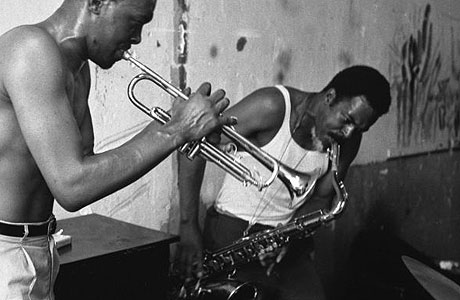
Donald Ayler and Burma

Donald Ayler has passed away.
He died of a heart attack on 24th October.

Best known for his appearances with brother Albert on some of his classic 1960s free jazz albums, he was fired from the band after an alcohol-related(?) breakdown; the emotional effects of this may in turn have contributed to Albert's suicide. He went on to record one album as a leader, a 3-LP set called 'In Florence', in 1981, and also did a session for Amiri Baraka's Jihad Label, which was never released.

His technique was never prodigious (reminiscent perhaps of Ornette Coleman's attempts at trumpet playing, at times), but he made an important colouristic contribution to Albert's work, and his mixture of a strange Spanish tone with blistering free-form freakout was oddly compelling.

By no means a major voice, but he was there, actively participating, when some of the great, unsurpassed music of the twentieth century was being created, and that's more than many can say.

You can find a description of his funeral here: http://www.ayler.org/albert/html/what_s_new.html
More details about the 1981 recording under his leadership here:
http://www.ayler.org/albert/html/donayler.html
A blog post which includes an MP3, 'The Bebop Tune', from that 3-LP set:
http://justforaday.blogspot.com/2006/02/ghosts-alive.html
And a message board thread touching on, among other issues, his breakdown and how it relates to Albert's death:
http://www.organissimo.org/forum/index.php?showtopic=36919&st=15&start=15

Remco Takken, in a review of Albert's 'Bells': "What the critics missed, was what Albert’s brother, Donald, was contributing to that record. Although it wasn’t the debut of trumpeter Donald Ayler- he made his first appearance on disc with Albert on The New Wave in Jazz earlier that year- Bells shows for the first time what Donald was capable of in terms of humoristic and spiritual musical communication.

Albert wanted a trumpet player in his expanding group. So by the end of 1964 Donald took up the trumpet studying nine hours a day for a few months. While being able to follow the breathtakingly sharp improvisations of his brother almost immediately, he never perfected the technique of his trumpetplaying than up to the degree that he needed to accompany Albert’s saxophone.

Donald contributed enthusiastic arranging in turn-of-the-century style, and a Louis Armstrong-era swing to Albert’s writing. The sixties statement that free jazz was in a way a recuperation of early Dixieland music, with all musicians soloing at the same time, is commonly associated with Ornette Coleman’s music. But the music of the Aylers is far more directly connected with New Orleans style jazz than Ornette’s abstract art music. What the Ayler brothers added to furious free soloing, were recognisable hymns and songs. True, those lovely little tunes were set up mainly to be completely deconstructed, and sometimes virtually raped…"


And has anyone else noticed the way that these guys have been forgotten?

...has anyone noticed the way the Burmese crisis just slipped out of the news once the censorship kicked in and no images could get out? Oh well, at least there's Pakistan now - some juicy images for people to look at so that they have something to focus their attention on. And the news teams can get some proper product-shifting in. (Since when has news become a product? And why?)

But just because it's slipped out of the mainstream headlines, and just because hte politicians aren't that bothered (well, I mean, can you imagine that the Americans care that much? I don't see the words "oil" and "Burma" banded around together much, do you?) - just because of this, doesn't mean we should just forget about it. In fact, it makes it doubly important that we keep updated - one way of doing so is this wikipedia entry on the crisis: http://en.wikipedia.org/wiki/2007_Burmese_anti-government_protests

Oppression is just a fact of life for much of the world, or so it seems. But that does't mean we should accept it, or be complacent in its face.

Freedom in music and freedom in the world.