Thursday, August 20, 2026

Creating while Caregiving: Making Time to Make Art


Creating while Caregiving with Romy Natalia Goldberg- Making time to Make Art

Hola, hello, howdy!

Since this week's Creating While Caregiving post is about time management, I will keep my intro brief. Whether you are caring for a kid, pet, spouse or are in any other number of visible and invisible caregiving situations, chances are, your “free” time is limited. Learning to find, defend and maximize time for creative pursuits is a never-ending and ever-changing process. Having a few different techniques in your back pocket can help you keep creating even when you can't touch a pencil or keyboard.

In preparation for this piece I interviewed three of my time-management role models, Jasminne Mendez, Molly Blaisdell and Elle H. Simone. I have watched each create consistently throughout various challenges life and the industry have presented. Hopefully their advice is as helpful to you as it has been to me. 
 
Author and artist Molly Blaisdell recommends a short task list and lots of rewards!

The One or Two List

Like a timed sprint, this method, recommended by Molly, employs a limited scope to encourage success. Instead of time, a “One or Two” list limits your to-do list to, you guessed it, just one or two tasks. Make sure both are bite-sized tasks. Think, “write 300 words,” not, “finish manuscript.” When you accomplish a task, celebrate by rewarding yourself. Choose a reward that is emotionally satisfying like listening to a favorite song or catching up with a friend. You may find your reward is energizing enough to want to work on another list! 
Rewards are very important! Rewards do double-duty, serving as self care and positive reinforcement (bribery). Or as Molly puts it, “Always reward your lizard brain; it is stupid and likes prizes.” Rewards stack the deck in favor of a consistent and sustainable practice.

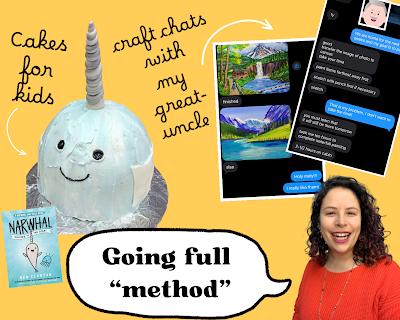
 Going Full “Method”

Even with small task lists and rewards, the brain is lazy and inertia is real. Steer (ok, trick) yourself into engaging consistently in some part of the creative process. Bury the impostor syndrome and fully commit to being a creative person. 
 
Jasminne says: 
“I see almost any task as contributing to my writing practice. I can brainstorm ideas and work out plot points while in the school pick up line or while washing dishes. I come up with one-liners and story ideas while in bed dealing with insomnia or a pain flare and even if I can’t write it all down at that moment I will dictate a note on my phone and come back to it later.” 
Admittedly, children' s book inspiration is easier to come by when your caregiving involves children. Nap and story times present chances to work through a TBR and volunteering at book fairs is a great way to build relationships with school librarians. If your caregiving involves adults, do what you can to match their needs to your creative pursuits. Use time with patients to learn about their hobbies or past grudges (promise to turn old exes into villains). Ask your great uncle for painting tips! 

Author Jasminne Mendez says No secrets. You make it a priority and you do it. Write like you’re running out of time. Write like you HAVE to.

"There are no secrets. You make it a priority and you do it. "  

Boundaries

If you are a caregiver, you may be conditioned to put others' needs before your own. While I focused previously on the importance of building community, it is important to ensure your own needs are met in the process. This can look as simple as setting your phone to Do Not Disturb when writing and limiting social media usage (or delegating management of your account to a friend if necessary). Established artists may find it valuable to create stock answers for common requests like publishing advice. Setting boundaries can be awkward and uncomfortable but it gets easier when you commit to leading a creative life no matter. 
 
 
Everything from birthday cakes to texting my great uncle can be a creative prompt 

 Getting Real about Your Time:

During our first meeting as randomly paired critique partners, Elle, then the ARA for SCBWI North Texas, mentioned having met her monthly writing goal. Meanwhile, I was operating under the soul-crushing assumption that I should be writing all the time. Over the course of the next few years, Elle helped me understand that a structured approach to my time could unlock my creativity rather than suffocate it.

According to Elle, there are two extremes for managing your creative time. On one end, creativity gets very little priority, resulting in more daydreaming about writing “some day” than actual writing sessions. On the other end of the spectrum, creativity is prioritized to the detriment of everyday routines. I am guilty of this, blissfully immersing myself in creative projects only to emerge to a nightmarish mountain of untackled tasks and postponed plans. 
 
Elle recommends: "Take extreme ownership of your time. Offensively plan for life's surprises and overestimate how long things will take 

Being realistic about how much time I truly have for my creative pursuits has involved taking into account that not all “free” time is created equally. Elle has helped me learn to categorize my “free” into a few categories: 

Flex time: 

Her suggestion to “offensively plan for life’s surprises” helps keep creative plans from getting completely derailed by the inevitable illness, schedule mix-ups or emergency.

Self-care: 

Ensure your self-care time is truly restorative. While the reality of caregiving means you will often have to be flexible, your self-care should be non-negotiable. Do not allow your flex time to seep into your self-care time!

Admin time: 

While most artists would prefer to create all day, engaging in commerce at any level, makes you a contract worker and/or small-business owner, both of which mean admin work. While it feels like a pain, remembering to block out routine time for administrative tasks frees up mental energy and time for creativity.

Creative time: 

All this realism can feel a little depressing once you discover how little creative time is available. However, the opposite can be true. I can honestly say that I am now more motivated to make the absolute most of the time I do have. And liberating myself from the damaging idea that I should be writing “all the time” has helped the ideas flow more freely and allowed me to enjoy my family time without being bitter about not writing. 


More about my time management role models:

Jasminne Mendez

Multi-genre author and poet Jasminne Mendez is open online about her struggles with a chronic disease and juggling parenting, writing and teaching. I first encountered her via the #5amwritersclub hashtag, used by writers to indicate they are sprinting at 5am. Bearing bleary-eyed witness to Jasminne’s persistence encouraged me to get my words in, even if it was many hours later. 

Molly Blaisdell / Cece Barlow

A production editor for the International Ocean Discovery Program, author of over 60 books, and neurodivergent mother of four neurodivergent children, Molly has created through every caregiving situation imaginable. When her life gets too chaotic, she will even start dictating manuscripts out loud in her sleep! She truly models incorporating creativity into her daily life, from sharing her experience at local meetings to creating a summer publishing programming for teens. 

Elle H. Simone 

In addition to being the master of time management, Elle has always been my go-to comp title queen and one of the most insightful picture book critiquers around. Watching Elle hit her goals over and over has helped me learn the value of harnessing my creative chaos. I may never find joy in structure but I’m thankful to Elle for helping me learn how to defend my creative time.

UP NEXT!

I hope the advice in this post proves helpful to you! Are there time management techniques that have worked to keep you creating despite caregiving pressures? I’d love to hear about them! 
 
For the final installment of this series I will be discussing lesser represented and invisible caregiving situations and I welcome your comments either here or via my website. 

bye, adios, chau-chowdy!


Read the previous posts in the Creating while Caregiving series:

Picture books that Help Caregivers Feel Seen!

Leaning on your Creative Community


Próximamente este artículo estará disponible en español en La Cometa.

Romy Natalia Goldberg children's book author of THE GOOD NIGHT SHIFT

Romy Natalia Goldberg 

 is a Paraguayan American writer and artist with a love for stories about culture and communication. She has lived throughout the Americas, including in Argentina, where most of her family is from. Her debut picture book, THE GOODNIGHT SHIFT, is an ode to the people, especially caregivers, who help keep our communities running at night. Illustrated by Isabel Roxas, it will be published by Scholastic/Orchard Press in April, 2027 with a forthcoming Spanish translation. To learn more and shout out night shift heroes in your life, visit www.romynatalia.com/the-good-night-shift


Tuesday, August 18, 2026

SCBWI University: The Novel: Crafting a Compelling Middle Grade or Young Adult Manuscript

The Novel: Crafting a Compelling Middle Grade or Young Adult Manuscript


Class is BACK in SESSION! SCBWI will be offering more classes with the SCBWI University Three-Part Series. This series will be focusing on "The Novel," honing in on Middle Grade manuscript writing. You will begin with building memorable characters to building tension to finding the voice of your story! Check out the offerings below!n 

Creating Memorable Characters with Brandy Colbert
September 9, 2026: 1pm-2:30pm PACIFIC / 4pm-5:30pm EASTERN

In this session, we will take a look at characters who linger with us long after finishing a book, the traits and actions that distinguish them from countless others, and ways to create our own characters who spring off the page and into the hearts and minds of readers of all ages.


Building Tension: The Slow Burn with Lamar Giles
September 15, 2026: 1pm-2:30pm PACIFIC / 4pm-5:30pm EASTERN

Edgar Award Finalist Lamar Giles will discuss his approach to writing gripping mysteries that keep readers turning pages well into the night. The session will cover classic story structure, how to use F.A.T. (Feelings, Action, Thought) to subtly propel the narrative, examples from Lamar’s favorite reads, and more. Join us for a mix of lecture, exercises, and interactive Q&A that will leave you eager to share the thrills with your readers!

Say What? Finding Your Story's Voice with Lilliam Rivera
September 22, 2026: 1pm-2:30pm PACIFIC / 4pm-5:30pm EASTERN

Scout Finch. Dorothy. Matilda. We've all fallen in love with these characters and their strong points of view and personalities but how did these novelists cultivate that? A character's voice is such a critical component when writing for children. Through character development sketches and generative questions, this workshop will explore the different ways we can find the story's voice to help bring your narrative to life.


What is SCBWI University?

The world of children’s books is constantly evolving, and staying ahead can be a challenge. SCBWI University is your gateway to mastering the latest industry trends, refining your creative skills, and advancing your career. Whether you're a writer, illustrator, or translator—published or just starting out—SCBWI University provides the expert guidance you need to thrive.

Led by renowned industry professionals, award-winning authors, and celebrated illustrators, our dynamic program empowers you to hone your craft, build meaningful connections, and gain the confidence to bring your stories to life.

Join SCBWI University and take your creative journey to the next level.

How It Works

Each 3-session University course costs $199 for SCBWI Premium Members. University courses will dive deep into an element of the craft of illustrating or writing children’s books. If you can't attend live, video replays of all classes will be available to view until 30 days after the final session. Click on the links below for more information on each course. All courses consist of three consecutive classes taught by high-level children’s book writers, illustrators, editors, agents or art directors.

Thursday, August 13, 2026

Creating while Caregiving: Leaning on your Creative Village


Hola, hello, howdy!

Much like writing, caregiving can be a very isolating experience… but it does not have to be a lonely one. The whole “it takes a village to raise a child” thing is equally true of any piece of art and of an artist themselves, especially when caregiving is involved. In this week’s post I’ll dive deep into ways you can weave your creative practice into your life through the support of those around you, even the very people you’re caring for. 

In my first Creating while Caregiving post, I highlighted the grandmother in LEAVE ME ALONE, whose drive to finish her knitting leads on an epic quest for some peace and quiet. Like Brosgol’s determined MC, a desire to create can compel you to the most extreme circumstances (especially if you’re on deadline). The urge to isolate is real, but, for most people, it is not sustainable. Sure, you can escape to a DIY writing retreat or conference for a bit, but eventually, you have to exit the wormhole. 

Here are three things that have helped me build and grow my community while also caregiving. Obviously, everyone’s life and needs look different, so I’d love to hear what has worked for you!

Be someone else’s cheerleader:

Cheering on others online is an easy and accessible way to become involved in an existing creative community. 

Cheering on others online is an easy and accessible way to become involved in an existing creative community.
Celebrating the successes of fellow creators from the comfort of my sofa. 

  • Engage on social media: Being intentional about what you comment helps show you're engaging with their work in a meaningful way. This takes more energy but will go much further than likes and reposts. Same goes for replying to newsletters. 
  • Be a community helper: Discords, Facebook groups and other online communities offer the networking and community building of in-person events without any of the travel or expense that make in-person meetups logistically complicated for many caregivers. Sharing pertinent industry news, classes, posing interesting questions, and generally adding to a supportive vibe is a great way to build community online. Keep self-promo to a minimum.

Tip: It is tempting to engage with creators who are already established - who hasn’t felt a rush when a well-known illustrator or author likes your post? However, it can be more fruitful to search for a community a few rungs down the ladder. Not because you aren’t worthy but because you’re more likely to find people at a similar point in the creative process as you.

Get buy in from your people:

The creative process is a collaborative one and giving people in your life the chance to be supportive of you is a great way to get their buy-in. Non-toxic family, co-workers and friends can all play a role in your creative journey. Of course, you will get unsolicited advice, so feel free to train the people who matter to provide you with the support you want and need. 

Your significant other:

Calibrate depending on your love language and their strong suits. Acts of service? They can do the Saturday chores so you can have the afternoon to read. Receiving gifts? Keep a running list of classes, books and supplies that will help your craft. You get the idea! 


Cut paper artist Cynthia de la Torre shared photos of a party her family threw. It was themed after book she wrote as a child. Your people will keep you going even when impostor syndrome kicks in 


Your children/dependents/students:

Babies and infants are an infinite source of ideas - just be sure to write them down! As kids grow older, be explicit about your role as an artist or writer and how they can be a part of your team. Ask for their ideas and listen enthusiastically. Be the artist parent or the author auntie that always wants to know what kids are reading, watching, creating. Be sure to promise you will credit children for any ideas you use. 

Parents/elder dependents:

Obviously, the grown ups in your life will provide a different source of inspiration and support. Avid-readers can help you stay current even when you have no time to read. They can also make for great beta-readers. Older adults get a bad rap for yelling at clouds, but they are your source of deep knowledge, crazy stories, and valuable life lessons. Paid services like Storyworth allow you to easily interview loved ones via email, though connecting could be as simple as a weekly scheduled phone call. 

Double duty bonus: If you are burnt out on your own elder dependents, find a friend with interesting parents to swap phone check-in duties with once in a while.

My sprinting buddy, author Rosario Martinez, is one of the pillars of my creative village. 

Get a Sprinting Buddy:

This pairs the concept of working in short focused spurts with simple accountability via text message. I have been sprinting with author Rosario Martinez for the last seven years and as you can see in our text messages above, we keep it simple!

  • Find a buddy with a similar work/life schedule and desire to sprinkle quick bursts of creativity into their day. Ask around your friend group, online forums, and your SCBWI regional meetings.  
  • Agree upon your sprint signal. I alternate between a running emoji and a Forrest Gump gif.   
  • Agree upon a default sprint amount (can be 5-10 mins or 20-30 minutes…see what is doable for you).   
  • When a window of free time arises, send your buddy a sprinting request! Allow 1-2 minutes for a response or just set your timer and dive in. 
  • SPRINT! Eliminate or hide from all distractions and prepare to focus on one creative task. This should be something you can quickly dive into, like sketching or continuous writing. It can help to choose what you will be focusing on ahead of time. 
  • Beep beep beep! When your timer rings you can either check in with your sprinting buddy or, if you’re feeling inspired and have more time, start the timer and sprint again. 

Double duty bonus: Is there someone in your life you need to check in with but don’t have much to talk about? Asking that kooky great-aunt or arty but quiet niece to be your sprint buddy is a low stakes way to maintain or grow a connection while feeding your own creative practice. 

Scheduled sprints might work better for some sprinting buddies. Online programs like Focusmate and a plethora of accountability apps offer the accountability of a sprinting buddy with relative anonymity and less set up “friction.” 

Be persistent! 

Much like finding a good therapist, spouse, or mechanic, it can take time and some false starts to grow your creative community. Critique groups fizzle, writing partners have to take breaks to care for their actual partners, life happens. Don’t get discouraged! Keep reaching out and don’t take cancellations or ghostings too personally - instead keep searching and you will find someone whose creative energy and commitments compliments your own. 

How have you managed to integrate your community into your creative practice? I’d love to hear about it!

bye, adios, chau-chowdy!

Romy Natalia Goldberg is a Paraguayan American writer and artist with a love for stories about culture and communication. She has lived throughout the Americas, including in Argentina, where most of her family is from. Her debut picture book, THE GOOD NIGHT SHIFT, is an ode to the people, especially caregivers, who help keep our communities running at night. Illustrated by Isabel Roxas, it will be published by Scholastic/Orchard Press in April, 2027 with a forthcoming Spanish translation.  


Tuesday, August 11, 2026

SCBWI Resource: How to Create Powerful Stories for Young Readers to See Themselves

So...in proper Leo fashion I must announce that it is my birthday...WEEK! Well, really my birthday month— so I'd love all of the book recommendations and treats! And as an individual who is LEGALLY obligated to celebrate their birthday for the full month, I will be enjoying my downtime by catching up on all of the wonderful resources and materials SCBWI has to offer.

The thing I love about the virtual conference is the Replays, and Airmeet, the new platform used for the conference, supplied us with instant replays. I've already rewatched Making an Emotional Impact: Historical Fiction in a Graphic Novel with Maria Van Lieshout and the Closing Keynote with Brian Selznick

If you weren't able to attend and want to get a taste for what a virtual conference has in store, read some blog posts by Jaime Temairik, Jolie Stekly and yours truly on The Official SCBWI Conference Blog

And remember, you can watch the REPLAYS until September 13th!


Also, in case you've missed it, check out the "How to Create Powerful Stories for Young Readers to See Themselves" webinar, hosted by SCBWI and sponsored by ACA, free on YouTube, where the Nadias (Nadia Salomon, author-illustrator; Nadia Fisher, author-illustrator; Nadia Hsieh, illustrator) share tips on their craft, how to use voice and POV, choosing mentor texts and building stronger narratives! Whether you are crafting picture books or novels, this webinar is beneficial to all!


Thursday, August 6, 2026

Creating while Caregiving: Picture books that Help Caregivers Feel Seen


Picture books to help caregivers feel seen
Have these characters, or any others, given you hope during a difficult caregiving moment?

Hello, hola, and howdy!

Welcome to Creating while Caregiving, a series I am excited to be guest blogging about for the month of August. As an artist, writer, mother of four, active community member and raging empath, I care deeply about this topic. Before we jump in to the first post, a little about myself.

I inked my first book deal, a non-fiction travel guide to Paraguay, midway into my first pregnancy. Ever since, my writing journey has been inextricably linked with caregiving. There have been pregnancies on deadline, feedings made tolerable by group texts about comp titles, and countless trips to libraries and bookstores. There have been manuscripts that doubled as bedtime stories and manuscripts that doubled as therapy after the death of a parent. 

All along, the tension between the duty to care for others and the desire to create for myself has been constant.

Sometimes, I have managed the push and pull well, other times, not so much. Achieving that ephemeral balance involves sacrifices on everyone’s part. In the face of increased pressure to produce on demand, it is essential that we recognize the real cost of creativity and not treat ourselves like robots. As we are all becoming increasingly aware, even the robots need massive amounts of energy to create.

I hope to make this series useful to anyone who is trying to create while feeling the crunch of everyday responsibilities. Over the course of August, I invite you to explore the actual “how” of creating while caregiving. Please feel free to share your comments, suggestions and recommendations! 

Leave Me Alone! By Vera Brosgol (Caldecott Honor Book) 

Picture Books for Caregivers to feel Seen:

While many picture books focus on the magic of childhood, I gravitated towards the ones that acknowledged the drudgery of dishes and diapers. These are the books that made me feel seen on the days when there was nowhere to run, nowhere to hide. Most focus on childcare, since they are picture books, but fellow inductees of the sandwich generation will see their eldercare struggles reflected with a little squinting (just take off your readers).

Leave Me Alone! By Vera Brosgol (Caldecott Honor Book) 


What is your version of a silent, matte black wormhole?

An overloaded grandmother goes to increasingly wacky lengths to escape the chaos of her family. The depths of the forest, the tippy top of the mountain and even the dark side of the moon turn out to have distractions of their own and eventually she ends up stepping into a wormhole in order to find peace and quiet. As we go through the next few weeks of Creating while Caregiving together, it is worth considering: what is your wormhole? 

Drawn Together by Minh Lê and Dan Santat

Drawn Together by Minh Lê and Dan Santat

 The inherent intergenerational awkwardness of a grandparent as an afterschool caretaker is compounded by cultural differences manifest in everything from what to eat, watch and what language to speak. I love that this book recognizes how hard it can be for everyone in a caretaking situation to find their own form of self expression and common ground, from the child, to the grandparent, to the mother, whose joy and relief at the end of the book is palpable. 

A relieved mother at the end of Drawn Together. Anyone who has left a play date or a senior center and thought “yes, this is going to work!” can relate. 

Anyone who has left a play date or a senior center and thought “yes, this is going to work!” can relate to the mother´s joy.

No More Señora Mimi by Meg Medina and Brittany Cicchese

In-home childcare is a delicate balance for all involved; is there any business relationship that requires more trust? Ideally, the bond between child and nanny is a strong and loving one, the only downside of which is the heartbreak that occurs when childcare needs change. This book showcases a loving transition between caretakers. from a beloved neighbor to an equally beloved grandmother. 

At the end we see how abuela's arrival has shifted the childcare dynamic in a way that incorporates and even helps Mimi.
 
It is rare to see any piece of pop culture acknowledge the existence of paid caregivers at all (think of all the nannies cropped out of celebrity family photos). In addition to showing one of society’s hidden caregivers with respect, I also appreciate how this book reaffirms that a mutual dependence within our “village” is a good thing and an important part of the fabric of a society. 
 

The Worst Teddy Ever by Marcelo Verdad

Verdad, Marcelo. Worst Teddy Ever. N.p., Bound to Stay Bound Books, 2022.


Noa wishes his beloved stuffed teddy bear had energy to play like his friends’ stuffies! Readers soon discover the reason Teddy is always tired: unbeknownst to his human friend, this stuffy works the night shift, shooing away would-be visitors, in order to ensure Noa gets a good night’s sleep. 


Teddy sends away another would-be visitor.
One day you're young and the next, you're tired like Teddy. 

We have all been Teddy at some point. 

The Wild Washer Women by John Yeoman and Quentin Blake

Yeoman, John, and Blake, Quentin. The Wild Washerwomen. United Kingdom, Andersen Press, 2009.

A group of overworked and underpaid washerwomen hit their breaking point and rage against the machine/their boss. My own aunts and mother hand-washed clothing in the creek well into their teenage years, so this book also served as an exercise in perspective during hard moments. At the very least, my pile of laundry can be washed by a machine! 

 
Towards the end of their rampage, the washer women meet up with a group of woodsmen and the somewhat predictable ending is offset by gendered role reversals that model equitable sharing of labor. 

Are there books that make you feel seen as a caregiver? I’d love to hear about them in the comments!Until next week,  

bye, adios, chau-chowdy!

Próximamente este artículo estará disponible en español en La Cometa

Romy Natalia Goldberg is a Paraguayan-American author with a love for stories about culture and communication. Her debut picture book, THE GOODNIGHT SHIFT, is an ode to the people, especially caregivers, who help keep our communities running at night. Illustrated by Isabel Roxas, it will be published by Scholastic/Orchard Press in April, 2027 with a forthcoming Spanish translation. To learn more and shout out night shift heroes in your life, visit www.romynatalia.com/the-good-night-shift


Tuesday, August 4, 2026

SCBWI Winners of the 2026 Crystal Kite Awards

SCBWI Winners of the 2026 Crystal Kite Awards

On July 29th, SCBWI announced the winners and honorees of the 2026 Crystal Kite Awards!The Crystal Kite Award recognizes outstanding books by our amazing SCBWI members from all over the world! An award that celebrates books with "exceptional storytelling, imaginative illustrations, and creative excellence," this award is truly special as it is given by their peers, the other creators in our community. 


Atlantic


Winner:
Sparkles for Sunny: A Lunar New Year Story 
Written by Sylvia Chen, illustrated by Thai My Phuong 
(Flamingo Books)


Honor:
Lighthouse Ladies: Shining a Spotlight on Hardy Heroines
Written by Kris Coronado, illustrated by Islenia Mil 
(Clarion Books)


California & Hawaii


Winner:
I AM NOT HAPPY! 
Written by Caroline Perry, illustrated by Sydney Hanson 
(Simon & Schuster Books for Young Readers)


Honor:
Firefly Song: Lynn Frierson Faust and The Great Smoky Mountain Discovery
Written by Colleen Paeff, illustrated by Ji-Hyuk Kim 
(Margaret K. McElderry Books)


Midsouth


Winner:
You Can Sit With Me 
Written by Rachel Tawil Kenyon, illustrated by Tatiana Kasmshilina
(Feiwel & Friends)


Honor:
Henry's Picture-Perfect Day
Written by Jenn Bailey, illustrated by Mika Song
(Chronicle Books)


Midwest


Winner:
STUCK! The Story of La Brea Tar Pits 
Written by Joyce P. Uglow, illustrated by Valerya Milovanova
(Bushel & Peck Books)


Honor:
Maybe Just Ask Me!
Written and illustrated by Katie Mazeika
(Beach Lane Books)


New England


Winner:
Cat Nap 
Written and illustrated by Brian Lies
(Greenwillow Books)


Honor:
Woody’s Word’s: Woodrow Wilson Rawls and Where the Red Fern Grows
Written by Lisa Rogers, illustrated by Susan Reagan
(Calkins Creek)


New York


Winner:
The Trouble with Heroes 
Written by Kate Messner
(Bloomsbury Children's Books)


Honor:
Dinos That Drive
Written by Suzy Levinson, illustrated by Dustin Harbin
(Tundra Books)


Southeast


Winner:
The Blue Jays That Grew a Forest 
Written by Lynn Street, illustrated by Anne Hunter
(Margaret Quinlin Books)


Honor:
A Flea For Justice: Marian Wright Edelman Stands Up for Change
Written by Valerie Bolling, illustrated by TeMika Grooms
(Charlesbridge)


Southwest


Winner:
The Many Misfortunes of Eugenia Wang 
Written and illustrated by Stan Yan
(Atheneum Books for Young Readers)


Honor:
It Started With a P
Written by Brittany Pomales, illustrated by Andrew Joyner
(Flamingo Books)


Texas & Oklahoma

Winner:
Racing the Clouds 
Written by Sydney Dunlap
(Jolly Fish Press)


Honor:
So Many Years: A Juneteenth Story
Written by Anne Wynter, illustrated by Jerome Pumphrey
(Clarion Books)


West


Winner:
I Am We: How Crows Come Together to Survive 
Written by Leslie Barnard Booth, illustrated by Alexandra Finkeldey
(Chronicle Books)


Honor:
The Arguers
Written and illustrated by Corinna Luyken
(Rocky Pond Books)


Australia, New Zealand, and Oceania


Winner:
Grandmother from the East, Grandmother from the West 
Written by Jacinta Liu, illustrated by Freda Chiu
(Lothian Children's Books)


Honor:

 Emmie Builds Something New
Written and illustrated by Marjorie Crosby-Fairall
(Red Comet Press)


Canada & North America


Winner:
The Dog Who Saved the Bees 
Written Stephanie Gibeault, illustrated by David Hohn
(Sleeping Bear Press)


Honor:
Will and Krill
Written and illustrated by Stacey Byer
(Beaming Books)


Europe & Central, South and Latin America & Africa


Winner:
Seven, A Most Remarkable Pigeon 
Written Sandra Nickel, illustrated by Aimee Sicuro
(Candlewick Press)


Honor:
How to Reach the Moon
Written by Nicolás Schuff, illustrated by Ana Sender, translated by Lawrence Schimel
(Amazon Crossing Kids)


Middle East & Asia


Winner:
Under Pressure: Freddie Mercury's Countdown to Fame written by Shyamala Shanmugasundaram, illustrated by Pankaj Saikia
(Niyogi Books)


Honor:
Little Sheku and the Animal Orchestra
Written by Sheku Kanneh-Mason, illustrated by Rekha Salin
(Puffin Books)


Honor:
The Beat of the Dragon Boat
Written by Christina Matula, illustrated by Nicole Wong
(Sleeping Bear Press)


United Kingdom and Ireland


Winner:
Street Puppy, Masjid Cat 
Written by Moniza Hossain, illustrated by Wastana Haikal
(little bee books)


Honor:
Atlas of Mythical Journeys
Written by Emily Hawkins, illustrated by Iryna Dobrovetska
(Wide Eyed Editions)