Showing posts with label NATO. Show all posts

Wednesday, July 8, 2026

NATO issued a six paragraph communique https://www.nato.int/en/about-us/official-texts-and-resources/official-texts/2026/07/08/the-ankara-summit-declaration A big improvement over last year's?  Sure, one para more. 

In the days of yore, I would watch folks at the expert forum side party comb through pages of paragraphs, trying to figure out what the summit addressed usually over 100 issues.  Last year's five para (with one thanking the Dutch hosts) showed that NATO can't come to consensus on much with Trump in the room. 

Let me go through the six, it won't take long.

1.  Usual language about Article 5.  This is entirely empty these days thanks to Trump 2/

There is nothing automatic about A5.  An attack only is an attack if the allies can get consensus.  Trump again demonstrated that while he is around consensus is more than elusive. 

2.  More spending on defense.  This is progress on last year's promise of getting to 3.5% of GDP. 

It does not mean that the alliance agreed to anything new here. But it does reflect less griping about burden sharing. To be clear, Trump will take credit for NATO countries spending more.  And he is right but not in the way he thinks--countries are realizing they will have to fight w/o US

3.  A stronger Europe in NATO.  More language about spending more on defence, modernizing.  Again, does not reflect any new agreement.

4. The Ukraine section: more pledges to give Ukraine money 4 Ukr to invest in its defense and to pay to buy US weapons (US doesn't donate anymore) 5/

Z seems to have done well in his meeting with Trump, but that won't necessarily stick.  I do think that the more Ukraine appears to be winning the war, the more Trump will have a positive attitude.  He always joins the winning side.

5.  The Iran para. No consensus except it would be nice if Iran didn't get nuclear weapons and we'd like to have the strait open. 

6.  The para thanking Turkey.

In sum, the alliance really didn't agree to much, but it survived another Trump summit, so there's that. Maybe summit less often?  ‪Summits are supposed to be like conferences for academics--to force folks to get their work done.  But this summit, like last year's, didn't get NATO members to agree to much. 

NATO has always been a defensive alliance, but the meaning is different now: the threat to its existence is the US.  The allies are trying to keep the alliance intact until the next president, but they have learned that the US will elect every 4-8 years a unilateralist as president (Bush jr, Trump and then Trump again).  Trump does everything he can to erode NATO credibility. 

I keep asking whether NATO is better off with or without the US. With the US, it has capability but little credibility.  W/o the US, it has more credibility but much less capability. 

 So, 3 cheers for the alliance surviving another summit.  And three boos for the tyranny of low expectations.

Friday, June 12, 2026

NATO Is Not Dead, It is Just Pining For the Fjords

 I have been arguing that the heart of NATO, Article V, has been dead for since January 2025.  It took a while for the Europeans to believe it:

Anton Hofreiter, a German lawmaker, said: “NATO’s main problem is that, as long as Trump is president, there is no longer any faith that the U.S. would come to the Europeans’ aid in the event of an emergency.”  NYT

 This quote comes from an article discussing how much US military capability is being withdrawn from Europe:

  • Reducing the number of F-16 and F-15E fighter jets from roughly 150 to 100
  • Reducing maritime reconnaissance aircraft from 26 to 15 and cutting all eight aerial refueling tanker jets previously available to Europe
  • Reallocating a missile-launching submarine and an aircraft carrier, along with several warships and scores of jets that join the carrier’s missions
  • Reallocating one of two groups of bombers previously assigned for Europe’s defense

The most important piece here are the tankers--a scarce capability.  I am waiting for the big shoe to drop--how much army stuff will be moved out, because that stuff is harder to bring back quickly.  The rest could be returned to Europe in a crisis. 

First, we have to remember that the US deployment to Europe is not altruism.  The US has long benefited from stability in Europe AND using Europe as a platform for operations elsewhere (the Mideast).  

Second, deterring Russia is still an important thing--that pivoting from Europe seemed cool in 2013 but not since.  

Third, sure, the US should pivot to the Indo-Pacific, but Trump does not seem that concerned.  He has been willing to waste not just years of missiles and other ammunition but risk and lose a bunch of planes for the Iran war, which, last I checked, is not in the Indo-Pacific.  Plus Trump's statements on Taiwan raise questions about how sincere any move to the Indo-Pacific might be. 

Sure, the Europeans are investing in their militaries now--less because of Trump's hectoring and more because of the Russian threat and American unreliability.  But the Americans have always been the glue.  Can Europe count on the UK?  The UK Defence Minister just quit, so maybe not.  Can Europe count on Germany?  Not yet.  Still unproven and still lacking readiness. Can Europe count on France?  Putting elections down the road aside, it sure seems like that is the best port in this storm--many countries are now developing nuclear sharing agreements with France, something unimaginable only a few years ago.  France has finally deployed some troops to the Baltics (Canada leads in Latvia because France was too busy elsewhere to put troops there), so there is a bit of a French tripwire now.  

A European replacement for NATO is now imaginable but would be much weaker--the US simply has too many unique capabilities, has the most effective military (although politicization of it is reducing that), and has quantity as well as quality.  So, now, the best deterrent of Russian aggression in Europe is ... Ukraine, which is keeping the Russians pinned down.  

Trump is tossing away American influence and limiting future American choices while alienating allies.  And for what?  Not much.  The dealmaker continues to throw away bargaining chips.

and for the title reference, kids, check out this sketch


Saturday, January 24, 2026

The Real Burden-Sharing: The Allies and Afghanistan

 I have always hated the 2% metric--that NATO allies are good ones if they spend the equivalent of 2% of their gross domestic product on their own armed forces.  Input measures always problematic, it was a measure that made bad allies (Greece) look good, and, most importantly, it says nothing of what allies are willing to do with each other.

 What is an alternative metric?  Blood.  And it is very relevant this week as Donald Trump insulted the allies by saying that the US did all of the fighting in Afghanistan while the allies stayed away from the front lines (um, insurgency/counter-insurgency doesn't have front lines like conventional wars, Donnie).  Au contraire, as the allies did much of the fighting in Afghanistan from 2003 to 2009, when the US was distracted by its war of choice in Iraq.  When Obama sent more troops in 2009, then the burden shifted but did not really end until 2014 when NATO essentially pulled out of combat.

Yes, it is true that allies varied in what they were willing to do.  Dave and I literally wrote the book (ebook is on sale) on this as this was our sole focus, unlike other books on NATO and Afghanistan.  I say this not to boast, but just to say that I know whereof I speak on this (ok, a little boastful).  Of course, the facts tell the tale themselves.  This is page four of the Dave and Steve book: 

As you can see, the top five countries, by per capital killed in action from start to 2009, are Estonia (tiny country means tiny denominator means bigger %), Denmark (you know, the folks who own Greenland), Canada (ye olde 51st state), UK, and then .... the US. No accident as Denmark and the UK fought mostly in Helmand, the one of the most dangerous spots in the country (ask the Marines), and Canada fought in Kandahar, one of the other most dangerous places.

Someone else can dig up the post 2009 numbers (see http://www.icasualties.org/App/AfghanFatalities), but the basic pattern will hold--many allies did sacrifice much for America's war.  None of these countries had deep interests in Afghanistan--this was their contribution to the alliance (aside from most staffing AWACS planes over the US in 2001-2) in the aftermath of 9/11 and after the alliance invoked Article V.

But Trump sucks at math and at history (and also has no sense of honor or obligation), so, of course, he gets this wrong.  But we shouldn't.  Oh, and Trump was quite toxic in most of these countries before this week.  Veterans in these, who tend to be right of the center, will absolutely flip on Trump over this.  Which means that it will be very difficult or impossible for politicians in these places to bargain with Trump and to give in to him.

So, the recent past matters, and it is going to bite Donnie on his big behind.
 

Monday, January 5, 2026

Greenland and NATO: Is It All On the Table?

 With the Danes being super-concerned about American threats about Greenland (imagine if someone was making similar claims about Hawaii or Alaska), folks are talking about Article 5 of the NATO alliance.  So much is misunderstood about this key clause--an attack upon one equals an attack upon all. 

Ooops, that is incomplete: a) it requires consensus, like all NATO decisions of any consequences; b) each country can respond as each deems necessary.

In an intra-alliance spat, such as Greece vs. Turkey, which has happened, NATO can't respond because it can't come to a consensus.  So, the Danes could try to bring the issue to the North Atlantic Council, NATO's decision-making body, but the US would block consensus.  Part b is less relevant in this case (very relevant in a certain book, with a sale on the ebook!).  

Of course, the US hasn't attacked .... yet, so A5 is not relevant at all.  

BUT there is something else here: that any failed attempt to invoke Article 5 could break the alliance.  Any member that has been attacked that fails to get help will have good reason to withdraw--what's the point if help will not come when it is requested?  So, the threat to try to get the alliance to invoke A5 is an attempt to say: if you don't support us, the alliance is dead.

This is why countries, when attacked, haven't tried to invoke Article 5--cyber attack on Estonia, Syria hitting Turkey, Russia breaking sea cables, etc--because a failed effort may be fatal to the alliance.

In semi-normal times, one could look at the Danish hints at A5 discussions* as a way to increase the stakes to get more support.  The problem is: these times aren't normal.  Trump might just leap at an opportunity to break the alliance.  His hostility to it is well known, and his ignorance of how most of it works is also well known.  But if his advisers tell him that initiating a Greenland crisis might be a pathway to breaking NATO, Trump might just grab that chance.  

And then Putin's investment in Trump will pay off in the biggest way possible.

This is all scary and awful, but it is not out of the realm of the possible at this point.  The stakes involved in Greenland, where the US is already getting all the access it needs, are huge.  The very foundations of security in Europe and beyond are at stake.  A much bigger deal, ultimately, then Venezuela, which is already pretty important. 


*  Or the Danish PM is referring to NATO to make the obvious point--that there is no need for the US to take over Greenland since it is already under the US security umbrella via Denmark's membership in NATO.  Too bad Trump is a bad faith actor and this bit of reality is irrelevant. 

Sunday, November 23, 2025

Yet More Guns, More Butter

 Heaps of baking today as I spent yesterday at the Diefenbunker, learning more about the Cold War and Canada's role in it.  So, two more episodes of Guns and Butter:

Cream cheese as a central ingredient was a focus today for these recipes, while I talked about the spat between the Democratic officeholders who had served in the military or CIA and Trump over illegal orders. 

I did a second Guns and Butter reel to talk about the aforementioned dipping challenge, the difficulty of rollout cookies requiring a consistent thickness of dough, and, yes, stupid ways to think about burden-sharing. 

Wednesday, June 25, 2025

Five Percent Is a Lie!

 Or perhaps we can call it a polite fiction.  What am I talking about?  Today, the leaders of NATO countries met and agreed to .... very little.  It is probably the shortest communique in history (see 2023 and 2024 for typical end of summit agreements/commitments).  They agreed to new spending targets and not much else.  No Ukraine, no China, no southern front (how to prevent immigrants from going to Italy, Greece, Spain, Portugal), no nothing else.  

And this drives me crazy.  Before I get to the Big Lie, let me explain why I hate this 2% and now 3.5% madness. NATO does not exist to nag members to spend more on their defense, NATO exists to provide security for those in the North Atlantic community (broadly defined).  The 32 members are supposed to work on a variety of security issues, to create greater certainty, to deter Russia and other adversaries, and to reassure the allies.  This involves a lot of issues and lot of challenges.  These summits are like academic conferences--we academics need artificial deadlines to write our papers and leaders need these meetings to force them to reach agreement on tricky negotiations.  That all they got was "historic" commitments to spend more money represents a huge lost opportunity.

The other problem is that % of GDP spent on defense tells us ... that a country spent money, it is an input measure, so we don't know if they spent it well, or whether the country will use those funds to develop capabilities that would help the alliance.  Greece always did well in this measure despite spending mostly on troops aiming their rifles at Turkiye.   Not helping the alliance much especially as Greece never showed up when the alliance needed help.  It is a lousy measure, but it is easy to understand.  It might mean a bit more in the next few years for reasons I suggest below.

But this is life in the Trump era where this summit is a huge success because the alliance still exists.  Woot?  So, maybe we should be happy?  Depends on what you want out of an alliance.

Sure, the first clause of the communique refers to the iron clad commitment of Article V--that each country will respond (as each deems necessary, see the Dave and Steve book) to an attack on any one.  Let's not be too reassured by this since Trump is, well, almost as much as a threat to members as Putin is--given the threats he has made towards Greenland and Canada.  Plus Trump raised doubts about what he thinks A5 means on his flight over.  I am sure I have missed some utterance of his over the course of this day that undermines this "ironclad" commitment.  

Moving on to the big news 5%.  Wow!  Except it is not five percent but 3.5% plus 1.5%.  That is, the countries promise to move from the 2% promise to spending 3.5% of their GDP on defense stuff--planes, ships, tanks, other war material, pay for soldiers, sailors, aviators,etc.  What we usually think of as defense spending.  The 1.5% is spending on stuff that is "defense-related" which can mean pretty much anything--it is pretty elastic.  So, Germany can spend money on infrastructure--roads, ports, railroads, etc that benefit their citizens and that also help the transport of British, French, American, etc tanks, artillery, personnel to the front in the east.  For Canada, this might mean spending on northern ports and infrastructure, subsidies for mining rare earth metals, and other stuff that Mark Carney wants to do and they can call it defense stuff.  So, don't freak out at the 5%Freak out at the 3.5% instead as that would move Canada from spending $60b per year to $150b per year by 2035.  Yowza.  I doubt that Canada will get there (unless the economy tanks as the metric is defense spending/GDP).  But Canada will move in that direction.

Are countries doing this to placate Trump?  The change in the math to 5%? Yeah.  The 3.5%?  Perhaps not so much. The 2% standard was set after Crimea. The war in Ukraine since 2022 has taught NATO countires that 2% is not nearly enough--we all need drones, anti-drone tech, anti-air and anti-missile defenses, heaps and heaps of ammunition of all kinds, and a lot more.  So, the standard was going to shift and should shift (as much as I hate the idea of setting a % input standard).  Why 3.5% and not 3?  Well, part of it may be that the Baltics, Poland, and some others were already at 3% or beyond so they want the rest of NATO to catch up.  Part of it is appealing to Trump AND part of it is figuring out how to build militaries that can operate if the Americans stay home.  Europe and Canada have to develop the capacity to fight if the US ops out. 

Because no one can count on Trump to show up in a crisis, and no one knows what the next Republican will be like, but the Euros didn't like that unilateral Bush that much either. 

One more thing--the additional spending on defence is .... not going to fund American defense contractors.  That may be what Trump expects, but everyone wants a heap of strategic autonomy from the unreliable Americans.  Carney has talked much about how buying 75% of defense stuff from the US is not right.  Monday, he signed a deal with the EU as part of an effort to buy more European defense stuff.  Will this tilt the sub purchase towards Germany/Norway and away from South Korea?  No idea.  But expect other stuff to be made in Europe and then perhaps assembled or something in Canada.

 I am a bit buzzed right now since I have had half dozen media interactions today--lots of concern, confusion, consternation about the big announcement.  Again, the key is this: it is a massive increase in defense spending--to 3.5% of GDP.  The extra 1.5% is just justification for other spending priorities in most cases.

 Let me know if you have questions or additional info.   

Thursday, May 22, 2025

Anticipating the NATO Summit in The Hague: Ambushes and Canaries

 Today, we held an event at Carleton to discuss the upcoming NATO summit at the The Hague. We were asked by the Dutch Ambassador to do so, and it was our pleasure.  Both the Dutch and Polish ambassadors spoke about what they are hoping for, and the academics, encouraged or baited by me, largely focused on the Trump of it all.

Ambassador Vonno of the Netherlands spoke about the 80 years of freedom as we just passed the anniversary of Canada (and the US) liberating the Netherlands and of the important role of NATO in guaranteeing that freedom.  Ambassador Dzielski of Poland spoke of the Ukraine war and its impact on Poland and the need for NATO to stay steadfast in Europe.  

Amb. Vonno
The three speakers were Frédéric Mérand of the Université de Montréal, Aaron Ettinger of Carleton, and Stéfanie von Hlatky of Queens.  I was originally just the emcee but our moderator, Robert Baines of the NATO Association of Canada couldn't make it.  Each had a lot of sharp things to say.  Frédéric focused on more on the European dynamics, Aaron on the US-Canadian relations, and Stéfanie more on the NATO-ness of it all.  

Key points along the way:

  • Frédéric:  
    • Europe needs more contingency planning, 
    • The French were right--that we can't count on the US.
  • Aaron: 
    • Amb. Dzielski
      Time is a big factor here--how do we avoid wasting time.  That muddling through is an approach but it might not get us very far.
    • Canada should continue to be "boring."
    • We can't count on Trump being "transactional" as that is too rational.  He reneges on deals all the time. 
    • The donut strategy may be what Canada has to do again--focus on everyone else in the US and their interests in/with Canada and not focus on Trump.
  •  Stéfanie:
    • The NATO summiteers will probably be focused less on advancing an agenda and more on protecting past agreements.  Try to keep various initiatives alive.  But Ukraine is probably not going to like the outcome as consensus on that will be very hard to reach.
    • Maybe have fewer summits to provide Trump with fewer triggers.   

I mostly just asked questions, but I did chime in here or there, including arguing that Trump is an uncertainty engine and that NATO for so long reduced uncertainty ... until now.   I did discuss how the Europeans hadn't really taken the 51st state thing seriously, but perhaps they mi

ght see us as the canary in the coal mine--that Trump might have some limits to how awful he is.  But if he continues to beat up on Canada, then Europe will know that they have be far warier and be better prepared. The bad news is that canaries in coal mines are often ... dead.  So, Canada might end up paying a huge price before Europe gets serious and united on this stuff.

Finally, Hannah Christensen, who works for us but used to be the key staffer running SFU's NATO Field School (and she often co-runs their podcast), had some concluding remarks.  The big one: she noted that Vance essentially ambushed Europe at the Munich Security Conference, that Trump ambushed Zelensky in the White House, so they might set up a trap at the NATO summit.  Given that I see the 5% discussion to be a pretext to reject NATO, I can't say that Hannah is wrong.  I think she nailed it.  

And that will make for an interesting trip for Stef and me, as we are going to be going to the NATO Expert Forum, which is a side party that happens next to the summit. We have done this a few times before including Warsaw in 2016, Brussels in 2018, and DC last year.  So, look for a blog post or two in late June as we go into very blue rooms and watch as the communique comes out (or not?), specifying what gained consensus.


Oh, and the Dutch embassy was very generous with its gifts--orange stuff including chocolate in orange wrapping paper.

Monday, March 10, 2025

NATO Is Dead, Long Live NATO? Canada Needs a Plan B

 When historians look backwards, February 2025 will mark the rupture of US-European relations.  Vice President J.D. Vance’s speech at the Munich Security Conference, an affront to all Europeans except the far right, was sandwiched by Secretary of Defense Pete Hegseth’s statement that the US would no longer be the primary guarantor of European security and President Donald Trump’s negotiating away all of Ukraine’s bargaining chips with no Europeans present.  The future of NATO is bleak, as the alliance relied on the US security guarantee, and that no longer seems to be in place.  The next German Chancellor, Friedrich Merz, has started conversations about adapting to the end of the US security guarantee by perhaps tying Germany to France’s nuclear deterrent.  The question then is: where does Canada fit as NATO either disappears or becomes something else entirely?   Canada actually has a vote on this and a role—the transatlantic link, the North Atlantic in NATO’s name—can be fastened on this side to Canadian territory instead of American.  While others have focused on investing more in Canada’s military or leveraging its oil, my argument here focuses on a diplomatic strategy. 

What is the threat to Canada?  To be clear, while the potential alliance of US and Russia is most alarming, the most likely threat to Canada and its sovereignty is not an American invasion but yet more economic coercion.  To deal with that, Canada needs help.  Another target of Trump’s territorial ambition, Greenland, has produced an alliance within the alliance—Denmark has gained the support of the other Nordic countries and the Baltics via intense diplomacy.  Canada should exert as much diplomatic effort as it can to get the European members of NATO do something similar—to agree that any further economic warfare directed at Canada by Trump would be met with economic sanctions by as much of the European Union as we can line up.

 There is a natural trade to be made between Canada and Europe. Maintaining a Canadian presence in Latvia and a Canadian mission at NATO helps to keep the alliance going.  It is still a North Atlantic Treaty Organization as long as there is at least one North American member.  The Europeans are already finding challenges in finding a replacement, perhaps predictably so.  Ireland’s neutrality seems to be getting in the way of turning the European Union’s security efforts into a European military.  So, the best shot Europe will have at a unified military effort is through the old machinery at Brussels and the various NATO sub-headquarters throughout the continent.  International relations scholarship asserts that it is far easier to adapt old institutions than develop new ones, which means building on the broken foundations of NATO than creating a new organization.  Canada, as a founding member, gives any post-US NATO legitimacy and a way out for European leaders who are frustrated with efforts to build an EU security organization.

As some have told the Europeans, Canada is the canary in the coal mine.  If Trump engages in a trade war with Canada, Europe is surely next.  Right now, Europe is defending its security by supporting Ukraine.  We need to convince the Europeans that supporting Canada now in these trade wars is the equivalent—better to support Canada’s trade fight now than to have to fight the US directly.

 We are still stuck in the transition as many actors are not quite willing to publicly hedge against the United States.  However, the effort by Trump to push Ukrainian President Zelensky into an awful deal—submit to the Russians and give up 50% of the country’s mineral rights—is teaching European leaders that playing the pandering, transactional strategy to survive Trump 2.0 will not work.  It is time to figure out how to realign our international institutions without the Untted States, it is time for Canada to find like-minded countries to come together to support each other in the fight ahead.  These past few weeks should make it clear to all that the break with the US is coming and coming quickly.

 So, the words of an American founder, Benjamin Franklin, apply now: “We must, indeed, all hang together or, most assuredly, we shall all hang separately.”

Thursday, February 13, 2025

More Unforced Errors, NATO Edition

The only really surprising things about Trump 2.0 has been its pace and the Musk of it all.  But resegregation efforts at home (the anti-DEI stuff) and selling out Gaza were quite predictable.  Alas, so too is the destruction of NATO and the abandonment of Ukraine.  Let me focus on NATO since, yes, I co-wrote a book on it that may no longer be relevant (still my fave book).

Super unqualified and disqualified SecDef Hegseth made it clear to all at his first international meeting:

“I’m here today to directly and unambiguously express that stark strategic realities prevent the United States from being the primary guarantor of security in Europe.” US Secretary of Defence, February 12, 2025. Everything changed today.

[image or embed]

— News Eye (@newseye.bsky.social) February 12, 2025 at 7:43 PM

 To be as clear as I can be, there is no stark strategic reality preventing the US from being the primary guarantor of security in Europe.  Sure, the days of US national strategy documents aiming for the US to be able to fight two large conventional wars and do other stuff as well are long gone.  But guaranteeing European security does not require the ability to fight Russia and China at the same time.  It requires the ability to deter both, and that is something quite a bit different.

Going in the wayback machine, for much of the Cold War, especially the 1970s and 1980s, the US's commitment was not to defeat a Soviet invasion (only Tom Clancy's fiction suggested this), but rather that the presence of large numbers of American troops would commit the US to being at war immediately, and that possibility of that war escalating to a nuclear exchange would be sufficient to deter the Soviets.  

And it worked, as far as we can tell--I haven't looked at the Soviet archives or read post-Cold War stuff on this, but we have more recent evidence: that Putin has not engaged in any conventional attacks on NATO countries despite the flow of heaps of arms into Ukraine.  The US strategy has always been to interdict the flow of arms into the conflict zone--that is what bombing and invading Cambodia and Laos were all about.  But Putin has been restrained--that any conventional attack on a NATO ally would quite likely lead to an American response that might then lead to a process that ultimately could get out of control.  

The strategic reality that changed yesterday was not that the US can't do this anymore (indeed, defense spending is going to go up).  No, the strategic reality that changed is that the US is now led by a guy who wants to be a dictator and is far more comfy hanging out with autocrats than being in a club of democrats.  It is a matter of will not, not cannot.  And, yes, this was predictable--I made a bet last year with someone (I forget who) that NATO would not survive Trump 2.0.

Sure, the Europeans should spend more on defense, but the ironic key to collective security was depending on a single actor's credibility, the US, and not really on a collection of countries with their own convoluted dynamics.  NATO credibility/deterrence was based on a single player.  Can Europe provide a similarly convincing deterrent?  As to misquote Kissinger, who picks up the phone when you call Europe?  The statement that came out yesterday was good, but can the Baltics and the Finns and the Poles count on the resolve not just of Germany or France or the UK but on their remaining simultaneously and continuously resolved?   Oh my.  

While Hegseth is making my 3 months in Europe this winter/spring more interesting, I'd rather it not be so.  None of this was necessary.  I keep saying it didn't have to be this way.  So, one element of the tragedy of all of this is that it is entirely optional, despite what Hegseth claimed.  Indeed, the one thing this thing demonstrates is that a government of Bad Faith cannot be a good ally.


Friday, January 24, 2025

Five Percent? What the F?

 I am not going to address everything Trump says every day because that would be a waste of everyone's time.   But this 5% thing needs some discussion.  Trump is now saying NATO countries need to spend the equivalent of 5% of their gross domestic product on defense.  No one, not even the US is anywhere near that (from NATO):


Yes, NATO countries have agreed to use a crappy metric to urge each other to spend more (tis crappy because input measures suck--you can spend a lot and not get a lot of capability--ask the Greeks).  The last summit urged NATO to consider moving from 2% to something a bit higher but not 5%.  This would require NATO countries to double or even triple their spending, and that is not going to happen.

So, what is Trump thinking?  First, he is bad at math, so he may not understand what he is asking for.  Second, every conversation with Trump about NATO indicates that he thinks of it as a protection racket--if countries pay, then nothing bad will happen to them.  He seems not to understand that the 2% or 5% does not go into the US's pockets or into NATO's bank, but that the money is just more money spent in each country on their respective militaries. Third, is he doing this because he thinks it will lead to these countries buying more American military hardware?  Not sure but most of these countries are already standing in line for F-35s, HIMARS artillery systems, and much of the latest tech made in the US.

I think there are two possibilities here:

  1. Trump thinks every deal anyone makes is exploitative, so he is seeking to revise the NATO deal since it must have exploited the US.  Any deal Donald Trump is not involved in is a rip-off.  So, his resentment engine kicks in.  Remember how upset he was at NAFTA?  Canada and Mexico agreed to a new deal that Trump proposed--since Trump was involved, it could not possibly be exploiting his side (even though the new deal didn't really change anything all that much).  
  2. Alternative, Trump is setting up NATO to fail.  There is no way that NATO countries will get to 5% in the next five years, and most won't even promise to do so.  This will give him the pretext to undermine the alliance further and even pull out.  

I was flummoxed long ago why Trump ran against NATO in his 2016 campaign--did this really win votes?  NATO is popular in the US, more popular now than 10 years ago.  But it turns out that being a populist who seeks to undermine all institutions means attacking NATO.  I don't think Trump is doing this because Putin wants him to do so (Putin wants him to do so), but because Trump senses that his base likes him shitting on international organizations.  He's pulled out of the WHO and out of other international agreements, and it is only the first week of his second term.  

One last thing: three things motivate Trump: attention-seeking, greed, and resentment.  This NATO stuff really hits the first and the third--it always gets headlines, and Trump is still pissed off at those shots of leaders mocking him at past NATO summits.  

I have already bet that NATO won't survive a second Trump term.  I think this move to focus on 5% is the start of a campaign to pull the US out.  Folks might say that Congress fixed that with legislation, but Trump is immune, remember?  What laws have constrained him thus far?  

I hope I am wrong about this, but I tend to be better about predicting consequences than predicting elections...


Thursday, July 11, 2024

NATO Summit, Day 2: Should We Believe Trudeau?

Last panel had Heather Conley, Pres of German
Marshall Fund of the US talk to the Chair of
NATO's Military Committee
 The second day of the summit was mostly anti-climatic.  Unlike most summits, they released the communique after the first day, so we already knew what they had decided.  The second day was dedicated to a meeting of the North Atlantic Council (heads of state version--the key decision-making body of NATO) and Ukraine and a separate meeting of the NAC with Japan, South Korea, Australia (the PM blew it off?!) and NZ).  

So before getting parochial, what did NATO decide?  After all, as I keep saying, summits are like academic conferences--they force folks to do the work. For academics, a conference makes us write the paper.  For NATO, it means coming up with decisions/deliverables:

  • NATO will replace the US as a coordination center for aid going to Ukraine.
  • NATO will set up a command that will also help Ukraine make progress on getting closer to membership.  The key phrase is that there is a short, well-lit, irreversible bridge for Ukrainian membership.  This is not satisfying to Ukraine, but no way will NATO get consensus to add a country that is at war.
  • Lots of agreement that China is using "dual-use" loopholes to help Russia stay in the war, to build new tanks and other weapons, and people are miffed.  And the penalty for that?  None so far.
  • Momentum but no decision to move the standard for how much members should spend of their GDP on defense from 2% to 2.5% or 3%.
    The Ukrainian rep was mostly annoyed by the
    fact that the questioner didn't quite get that
    his country is at war and NATO countries are not.

NSA Jake Sullivan had
nothing interesting to
say.


 Canada finally succumbed to the pressure to hit 2%. Trudeau had pushed off that decision again and again.  I guess they thought they could wear the pressure.  That the Canadian military was also pushing in public for more money made it harder to resist?  So, at the very last moment, after suffering multiple rounds of embarrassing attacks from all kinds of folks (even Mike Johnson, although I kept telling the media that maybe they ought not pay attention to a Christian nationalist who showboated near Trump's NY trial to proclaim Trump's innocence), the Canadian government announced a heap of spending and a commitment to get to 2% by 2032, three years after the 1.76% target in the Defence Update.  

The big news is a fleet of subs.  12?  Noooooo.  They say up to 12 but that is the most bullshit of bullshit.  The Royal Canadian Navy has a hard time staffing the ships they have, and they have only four mostly broken subs.  So, maybe they can get enough personnel together to fill six boats, but 12?  No way.  The letter the Minister of Defence sent out also mentions more, more snow vehicles, more helos for our ships, more missile defence stuff (have they announced they are going along with US ABM stuff since that has been a no-no for two decades?), more air defenses, more arty, better/upgraded tanks and LAVs, more drones of al kinds, and .....

A deal with the US and Finland to build more icebreakers.  Will that count as defence stuff?  I guess.

So far, the people I have talked to have scoffed, that there is no money for this, no ability to actually make the transactions, and so forth.  Yes, buying subs would add a heap of spending to get us closer to 2%.  But by 2032?  How long will it take to actually decide which subs to buy and then to acquire them?  How long will it take for Bombardier to turn their vaporware AWACS planes into real planes? [They apparently exist, my bad]  Tis far easier to dump a bunch of money on recruitment/retention efforts (and I am pretty sure they will do that).  Far harder to actually buy stuff.  One of the big problems is that a lot of this stuff--drones, arty, anti-aircraft, counter-drone--is in high demand since Ukraine has taught all of us how much this stuff is needed.  So, we may be on the wait list for much of this stuff, which means the money doesn't get spent.  Which means falling short of 2%.  

The alternative view is not that the Liberals can't do it, but won't do it.  That they have no intention of keeping these promises.  I don't buy that--they have mostly kept their word on buying stuff--the 2017 Defence Review did lead to their acquiring a heap of stuff.  Canada partly fails to meet 2% because of the denominator--that the economy has been growing, so more spending does not always mean progress on 2%.  Anyhow, this is a trap as the Conservatives will surely cut defence spending since they care mostly about deficits (see Stephen Harper).  Now they will be cutting more? 

It should also be noted that the icebreaker and the AWACS planes would both be partly made in .... Quebec.  So, is this a cynical ploy to get votes?  I don't think so, or else they would have made these decisions much earlier.

Anyhow, these new commitments need to get much attention as it seemed like a half-assed announcement at the last minute so that people would stop yelling at Trudeau.  I read one news story that indicated that the media never got the chance to scrum with Trudeau, the Defence Minister, or the Foreign Minister (or me!) as the three were being kept away from yet more 2% questions.  

And no, it is not a NATO summit unless Stefanie and I can hang and exchange takes on the happenings.

The 75th Anniversary NATO Summit: Big Names, Some News

 I am here in DC at the NATO Summit Public Forum (used to be expert forum, but I guess that was too elite?), and it is hot.  Hot as in DC heat and humidity and in terms of the "action" such as it can be at one of these things.  Like Warsaw in 2016 and Brussels in 2019, the leaders meet in one place and we academics, think tankers, policy advocates, and other NATO nerds (a term used by many including the US Secretary of State) meet close by.  In my prior two experiences, we met in tents in parking lots.  This time, we meet in the conference space of a major DC hotel, next to the convention center where the summit is happening. They grab leaders and their staffers and bring them over to have short sessions--friendly roundtable Q&a, speeches, panels.
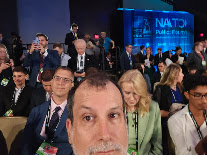
For the first few panels, SRO
This year is different not just in our better accommodations (the tents were fine, very blue, but hotel conference facility is better) and more intense security (lots of secret service folks, their dogs, lots of fencing), but also it is higher level. In the past, we got the 3rd string Americans, 2nd string West Europeans, and so forth.  This time, our first several sessions featured the US Secretary of State, Secretary of Defence, SACEUR (US general that is the head of NATO), and the outgoing SecGen. Many of the other sessions featured Prime Ministers and Presidents from much of Europe (although no Germans, French, or Italians of note).  
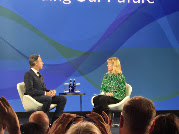
SecState
Of the first batch of folks, the most interesting to me was General Cavoli--SACEUR.  Blinken, SecState, was dynamic and engaging but was such a cheerleader for NATO, he really didn't say much that made me think except now NATO has 1 billion people.  Really?  Oh, and the big news--that the F-16s the Dutch and Danes pledged to send to Ukraine are on their way and they will be flying this summer.  Since it is July, that means soon.  He mostly dodged the "Hungary sucks, what to do about it" question that Heather Conley, head of German Marshall Fund, asked.  

General Cavoli
Cavoli was next, and he was asked about readiness and ability to defend against Russia, and he felt pretty good about that.  Most interesting to me, he was asked about his authorities--could he act without getting permission from the North Atlantic Council, NATO's decision-making body.  Yes, up to yellow, but not red.  Hmmmm.  He is definitely working on improving NATO readiness but kept referring to how much is up to each member nation.  I appreciated the argument that given how the Russians treated the people in the territories they occupied, NATO must defend every inch of allied territory.  
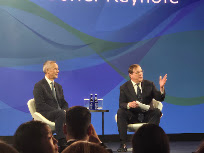
outgoing SecGen
Austin didn't make much of an impression since he just read a speech.  Stolenberg was quite clear about stuff, specifying the new NATO command in Poland aimed at coordinating the support for Ukraine and preparing Ukraine for membership.  The continued language regarding the latter is that membership was a well-lit, short bridge.  No, Ukraine, you are not going to be a member until the war stops, as we don't want to invoke Article V and be at war with Russia. Much focus by the SecGen and others on China's support of Russia--that China needs pay a price for prolonging the war.

The next panel featured a number of PMs and Presidents from Eastern Europe.  Most striking was how the Estonian president was quite clear--there is no such thing as an attack on Estonia as any strike in its direction is an attack on NATO.  The whole "an attack on one is an attack on all" was repeated a lot, maybe aimed at Trump?  Denmark gave all of its artillery to Ukraine since it would be better used there.  Maybe they will do the same with air defense.  That panel also had Senator Risch, a Republican who denied that things would be that different under Trump.

In a subsequent panel, the most interesting speaker was the new British State Secretary of Defence, who started right after the election.  He immediately went to Ukraine to assure them that the Brits would maintain their support.  That NATO is the highest priority for the UK in its defence planning.  The Latvian MinDef said that they  have been attacked by Russia for decades, that it is not so much about Putin's Russia, but Russia's Putin--that it is not the regime but the country we have to worry about.  Ben Hodges, the retired US general, reminded me why retired generals should mostly fade away, as he blasted Biden for delays in support for Ukraine when a) the 8 month delay was due to Republicans, and b) it is legit to worry about what escalation might do.  Easy to say now that the increases in support for Ukraine didn't lead to war with Russia.  I am guessing he was one of the no fly zone advocates that wanted Americans killing Russians.  A major theme--the defense of the UK or another European country starts with Ukraine.

The Nordic panel was fun not just because I have just been to Finland and Sweden, but because the Canadian MinDef, Bill Blair, was on it.  It was my first time being at one of his appearances.  He did fine, and made news: that despite my hate for the 2% nagging and standard--that Canada was one of the most visibile "laggards" in spending enough on defense--it mattered as Canada is announcing a plan today to get to 2%.  Of course, this is late as NATO is going to raise the bar, but still this is significant.  Of course, the questions are: how and really?  How involves at least subs and the really .... is yet to be addressed.   Blair also used his time to blast China for undermining public institutions and election interference.  

The Spanish PM had a Q&A, and it was the first time Gaza really came up.  He talked about Spain recognizing Palestine, and that if we want to defend Ukraine in part because of the need to defend the rules based order, we need to support that same order elsewhere.  Wow and indeed.

Over the course of the day, I got to chat with all kinds of folks, including NATO nerds I had met at previous summits, new folks from all over the place, and the outgoing Canadian Chief of Defence Staff who retires next week.  The day ended with a nice, but very crowded reception at the French ambassador's residence, as one of the hosts of the public forum is the NATO SACT--the unit responsible for "transformation" and usually led by a French admiral or general.  The good was good, a speech by an astronaut was great (she really does not like gravity), and more chatting with sharp people.  

I will write another post focusing on the second day (today) probably tomorrow.


Tuesday, July 9, 2024

NATO Summit Eve and I am the most pessimistic?

I didn't realize that the Foreign Affairs insta poll of "experts" about NATO's future would be published the day before the NATO Summit.  It is a bit embarassing for me, as, well, I got asked whether NATO could survive another Trump administration, and I was alone holding down the extreme end: hells no.

The story is here.  Note that a bunch of people on the positive side basically say that it would be on paper only.  Which actually puts them with me.  

The story contained some explanation/elaboration from some folks but not me.  My email apparently my email with the Foreign Affairs staffer wasn't that interesting.  So, let me explain why I think NATO can't survive another Trump Administration, focusing on three aspects: deterrence/credible commitment, logistics and mass, and European politics.

Before getting into it, let's just postulate a few things about a second Trump administration and about Trump:

  1. Trump thinks that any deal he does not make is exploitative since he projects from his own behavior and outlook--that he wants to rip off any one he makes a deal with.  NATO, thus, is a ripoff since he didn't make it.  Sure, we could imagine a new bargain, a new organization with a new name that does not really change things much like how NAFTA is now USMCA at least to the US.  To Canadians, it is either NAFTA 2.0 or just NAFTA.  
  2. Trump will not have many fans of NATO in his administration.  One of the iron laws of his last administration is that he did actually learn some stuff.  He didn't learn that 2% standard of NATO is not about tithes or protection money, but he almost always replace someone he fired with someone worse.  As the project 2025 stuff indicates, the next Trump crew would be more awful, and in this case, more unilateral, more opposed to NATO, etc.
  3. The GOP will not restrain him since the GOP is now thoroughly his party, and they are craven.

Ok, let's get to NATO:

  • The most important thing the US brings to NATO is the credibility that it is willing to risk its own destruction to deter attacks on allies inside the alliance.  There is one reason why Putin has not dared attack any NATO member.  The US spent much of the cold war trying to convince everyone that this promise would be kept.  Trump doesn't keep promises, and has already said that Putin can attack those who don't pay 2%--so much for an attack upon one equals an attack upon all.  This, the heart of nato, would beat no longer.  Why not? Can't the Europeans do it?  Nope.  More on that below.
  • While many countries provide heaps of capabilities when NATO operates, NATO has very little of its own stuff.   And when it comes to logistics and high tech and the stuff needed to support modern war, the US has a heap of that stuff, and the allies don't have much.  So, the actual capacity to fight would be much, much less if the US either pulled out of Europe or simply stood aside when a crisis develops.  Trump doesn't have to act, he can just not act.  
  • How about the Europeans take over NATO and supplant the US?  Um, sure.  Who is going to do that?  France?  Its ambivalent relationship goes back decades, and the French would prefer for the EU to take over.  Maybe that urge would decline with the end of the US involvement in NATO, but maybe not.  One thing for sure: the French have long said that their nuclear force is not for extending to deter attacks on others.  How about the UK?  While they have a new government, they have much work to do to build bridges with the rest of Europe.  Yes, they have nukes, but would the Poles count on the Brits to deter an attack or respond to one?  They still remember 1939.  Germany? Ha.  Sure, there was a lot of talk of zeitenwende--embracing the watershed moment and revising the outlook and strategy, but that met a brick wall--a law limiting deficit spending.  So, don't count on the Germans to invest so much in their armed forces that they could replace the missing Americans.  Thus far, European attempts to manage their own security have largely failed.  The EU tried to stop the wars in the Balkans, but that required the US and NATO.  

So, no, if Trump becomes president the heart and nervous system of NATO will largely be ripped out with no immediate replacement.  Maybe the EU would eventually develop its defence effort into something capable, but it would not have the strength of NATO.

Repeat after me: a second Trump administration would be catastrophic.  Not just at home but abroad.  

I would love to be wrong about this.  Of course, I would love even more if this argument is never tested.

Thursday, July 13, 2023

Vilnius Summit Review: More Woots Than Not

 Summit success is often a matter of expectations, and, of course, depends on where you sit.  For Ukraine, this may not have been as successful as it would want since they didn't get a fast track into NATO.  But that was an unrealistic expectation.  I didn't expect Turkey to stop blocking Sweden's membership, so my expectations were exceeded and thus huge success.  But the summit is more than just one or two decisions, so I am going to review much of the communique and then the Canadian announcements to figure out how many woots does this summit get.  Of course, since my pals and I didn't get a chance to go to the expert forum side party this year, there is a cap on the excitement--no NATO family dance party for us.

First, as mentioned above, Ukraine didn't get a superfast track to membership, as having Ukraine join while the war is going on would either mean that NATO invokes Article V--an attack has happened against a member and deserves a collective response--or it does not.  In the former case, NATO is now at war with Russia, something that the alliance has rightly been avoiding.  In the latter case, Article V gets eroded as it is not used when a member is attacked in a very serious way.  This is not just a few loose bombs or artillery shells like when forces in Syria hit Turkey.  The question really is how soon after the war would Ukraine become a member, and the answer this time was: very soon.  But it was not more definitive because the alliance requires consensus, and that is all that they could agree to.  I pushed back on twitter about cowardice or manliness.  NATO being at peace while Ukraine has been at war is not great for Ukraine, but the fact that Russia is not hitting the supplies going into Ukraine before they get there is hugely significant.  Expanding the war is not good for most folks, and the risk of nuclear war, which is small but real, is not great even for Ukrainians.  

Second, Sweden is an unalloyed win for the alliance.  It makes defense of the Baltics easier since Sweden sits astride the best ways to reinforce the Baltics in a time of war.  It also means that countries leading the NATO missions in the Baltics, looking for more troops to plus up their battlegroups into brigades (going from 1k to at least 3k) have a robust potential donor to beg (force generation is begging in the words of a NATO military official we cited in our book with the ebook version on sale now!).  It is also a massive defeat for Russia, as Putin has long wanted to break NATO, but finds his aggressions in Ukraine in 2014 and in 2022 have only strengthened and expanded the alliance.  Finland and Sweden would not have asked to join had Russia stayed within its boundaries.  

Ok, onto the communique, which represents a lot of homework and bargaining over the past year, with the summit serving as an artificial deadline to get folks to agree, kind of like an academic conference is designed really to get profs to finally finish their papers:

  • the formation of the NATO-Ukraine Council. This supplants the old NATO-Russia Council which died due to Russia's aggression.  This gives Ukraine much visibility and status and allows the Ukrainians to participate meaningfully in many NATO conversations.  It ain't membership, but it is significant.
  • Finland is now a member, woot!
  • China as a threat--this requires work as some countries (France) want to keep sucking up to China.
  • Lots of stuff on Russia, not recognizing Crimea as Russian, etc.  Naming Belarus and Iran as complicit (although not China).  The language on Russia can't be a partner for now is probably the closest we can get to declaring the NATO Russia Founding Act dead.
  • Lots of stuff about supporting Ukraine, that no need to continue with the Membership Action Plan, which means Ukraine is closer to membership and is increasingly integrated.
  • Some more language about ISIS and terrorism.
  • 2% gets the usual shoutout--making progress but now we recognize that 2% isn't enough.  
  • More forward defense with regional defense plans, more troops at high readiness, moving from battlegroups to brigades in the east as promised last year.
  • Defence Production Action plan--to improve delivery of weapons/ammunition
  • Integrated Air and Missile Defense with emphasis on eastern flank--this represents a response to the roles played by drones and missile attacks in Ukraine.
  • Continued opposition to the Treaty on the Prohibition of Nuclear Weapons since nukes are part of NATO's deterrent strategy.  Not a surprise.
  • No Japan office for NATO since France opposed it.  Consensus decision-making can suck... like how do we dump Hungary?
  • The standing up of a Maritime Center for the Security of Critical Undersea Infrastructure.  This seems in response to Russia primarily monkeying around with cables.
  • Cyber got the longest paragraph, I think, with a new Virtual Cyber Incident Support Capability to help members respond to cyber attacks.
  • Western Balkans get several items--75-78--as tensions are brewing there.  Supporting Bosnia's integrity is directly aimed against Bosnian Serb separatism, KFOR continues to operate and has increased its troop numbers due to violence in the Serb-inhabited areas.  A reference there to conditions based not calendar driven brings me back to my Joint Staff days concern whether exit/reductions are determined by benchmarks (conditions) or milestones (time).  

There was more, but that is the stuff that caught my eye.  So, much progress on some of the most important things, hard time getting consensus on NATO becoming relevant in the Pacific despite clearer language about the threat posed by China.  

What about Canada?  I got asked lots of questions about 2%, and I didn't see anyone put Trudeau in a headlock for not making sufficient progress towards 2%.  Nor did I see Canada making a huge stink about Biden's sending of cluster munitions to Ukraine (a post for another day maybe).  Canada did take part in several announcements--a blueprint for Latvia's defense, a NATO plan for defending the Baltics, and the like.  Trudeau announced sending up to 2,200 Canadian troops to Latvia which is up from the original 450 or so and then 800-1000 that it has been at since last year.  He announced $2.6b in spending on the Latvia mission over the next three years including $1.2b.  I don't know if this is enough to cover the additional costs of sending the larger numbers of troops who have to be rotated every six months, the costs of more infrastructure (barracks, dining hall, training facilities, etc) for not just the more Canadians but the more NATO folks, etc.  

Remember, Canada is the Framework Nation for Latvia, which means it is Canada's responsibility to lead the multinational battlegroup that is now becoming a multinational brigade.  That means providing some infrastructure for those who Canada cajoles to stick around (Albania, Czech Republic, Italy, Montenegro, Poland, Slovakia, Slovenia, Spain, and North Macedonia) and maybe join us (Denmark, Finland, Sweden) to get to 3000+ troops.  Given that there are now eight places for NATO to send troops--the three Baltics, Poland, Bulgaria, Hungary, Slovakia, and Romania--so competition will be fierce to get more troops from some of these countries.  So, Canada has to make the place welcoming and a good training area--which means plenty of ammunition and other logistical support so they can exercise often. 

And no Defence Policy Update.  Which is a disappointment--it is very late.  When will be the next time where announcing it will be handy for the government?  Maybe when parliament is back in session?  ¯\_(ツ)_/¯

So, I think Canada did the minimum to keep the criticism down, but perhaps didn't really do enough to set up the Latvia mission for success.  I don't think getting to 2% quickly is a realistic expectation, but the government could have made it a bit clearer that Canada would be moving in that general direction.  That there have been a heap of commitments made, that the personnel crisis itself needs much money thrown at it, so defence spending should be going up, even if it is not going to increase by 50%.

Overall, the summit went well, the big things happened, the smaller things mostly worked out.  Putin's efforts to divide the alliance keep failing, the media's efforts to set unrealistic expectations and Zelensky's first outburst did not really upset things much.  I am sure many observers would prefer Trump running around, pushing over the leaders of smaller countries.  It would be more entertaining.  But we got enough progress on enough items.  Is it fast enough?  Not for Ukraine.  But a consensus-based organization is not going to move that quickly.  That NATO will soon have something like 30,000 troops forward deployed is pretty amazing.  And definitely not what Putin wants.  


Saturday, June 10, 2023

The Big Lessons from A Week Near the Front

 Tis a dramatic title as we were nowhere near the battlefield, but the atmosphere here is very distinct from the US, Canada, and my last Germany trip.  War is not only nearby but is viewed as close to inevitable.  The perception of risk is quite high.  I kept asking: but the Russian military is weaker than we thought.  They kept responding that Russia can rebuild and can be stupid/risk acceptant again.  I am still a skeptic since that magical line separating NATO and non-NATO seems to be quite powerful.  But I don't pay much of a price if I am wrong--they do.

And then they mention Trump and I get it.  Nobody here wants Trump back, as they know he would be quick to sell them out.  Which, of course, raises the question why Putin didn't attack while Trump was still in power.  Even if he thought Trump would win the election, Putin could have launched the war in December of 2020.  

Anyhow, what else did I learn across the many meetings, the two days of conferences, and much arguing with my colleagues over a Baltic Sea of beer?

First, I have always been on the hill that 2% is a shitty metric.  That the NATO aspiration for each member to spend at least 2% of their GDP is a bad way think about things.  That input measures suck, that Greece is over 2% but a shitty ally.  Well, norms/expectations are mutually constituted--it is not up to me, nor is it up to any Canadian leader to say--this norm is lousy, let's move on.  It, alas, shapes the debates.  I don't think it would be so damaging if it were not for ...

Second, follow up on your promises in a timely way.  Canada has burnt most of its political capital in the region not because of 2% but something that travels with it--not making timely decisions and not delivering in an expeditious manner.  When Trudeau was here over the winter of 2022 and promised to do more. At the last NATO summit, Canad agreed (reluctantly is my guess) to increase the size of the effort in all of the nearby countries including Latvia.  For Canada, that means leading not a Battle Group but a Brigade, which means increasing the Canadian force from 500 and then 800 to 1800.  That is going to stress the hell out of a military that is short of personnel.  It also requires $$$ to build infrastructure so those soldiers can have a place to live.  So, everyone in Latvia is holding their breath, hoping for a decision to be announced in the leadup to the next NATO summit in July.  Minister of National Defence Anita Anand will be at the next NATO Defence Ministerial meeting next week, and she will be asked to make serious commitments.  New money.  NEW MONEY.  I am guessing that this new money will appear in the Defence Policy Update that will be released just before the summit (no accident).  I just hope that the size of this does not disappoint.  I still don't think 2% should be the target, but I do think spending should reflect the commitments that are made, which means it needs to go up.

Third, yeah, I am an advocate.  This kind of trip, where the govt helps us meet people (but does not foot much of the bill--my grants do), raises questions about my independence and those of my colleagues.  Are we just a tool of CAF info ops aimed at the public?  Not really, but the public affairs people do hope that by sharing heaps of info and getting us to talk to the folks here, that we will say nice things about the mission.  They may not get that since some of my colleagues are more skeptical.  I am probably biased in this as I lived the NATO life when I was in the Joint Staff, and I did co-write a book about the organization, so I want it to succeed.  And I do think the Russian government is a force for evil and needs to be deterred.  Defense?  I am not so sure about, but deterred, absolutely.  And NATO is doing that quite well.  So, I am in favor of investing more here.  I don't think it is that problematic for Canada to make this the single major military commitment, although my pals were suggesting that as soon as the war in Ukraine ends, that will become the shiny mission that Canadian leaders will want to join.  Committing to the long run in Latvia does reduce discretion since the CAF can't be at 1800 here and then do much elsewhere.  Does Canada send troops Cold War-style to live here for three years and bring their family along?  Maybe the military would be happy to have only one commitment--that it could say no to peacekeeping ops due to the stress of this single effort?

Fourth, we did go to a Strategic Comms conference, and the group of us mostly, I think, view Canada as being lousy at Strategic Communications.  What is the story here?  What is a good story to tell the Canadian people?  It should not be a story that is the military's to sell.  It should be the government's, and it should be other agencies.  I am not a Strat Comm person or an expert in marketing.  I get that they have a hard time getting media coverage since good news does not make much news, and journalism is facing $ problems, so if they spend on expensive trips, they will go to Ukraine, not Latvia.  But it should not be that hard to create videos, graphics, and such and flood Canadian social media to raise awareness.  Arranging this trip may help, but they can't run lots of these kinds of trips because:

  • most Canadian academics don't have heaps of grant dollars or time to spend on a trip like this
  • so sending the same ones back again and again means having the same voices again and again
  • these trips are a huge time suck for those whose shared their expertise with us.  They were terrific, but they can't do this all the time.
  • they could, you know, pay for these trips, but then we would be seen as tools of the military-industrial-academic complex.  Oh wait, there are folks already making those claims. 
     

 I think the best strategic communications is when you have a good story to tell, which means doing the right stuff, the good stuff.  The contribution/leadership of this multinational force is big, but it needs to be supported.  They need $ and procurement projects that move along.  Trudeau needs to back his promises up with actions.  Sometimes he does that, and sometimes he doesn't.  Doing more here may not win him votes, but it won't lose him votes either.  Indeed, committing to big bucks puts the Conservatives in a pickle--do they want to cut defence spending to get to a balanced budget?

I will probably write more about this as I remember stuff and as we see decisions and announcements roll out.  So, this is what I have thus far.  Let me know what you think.

Third Day of Roundtables: MoDs, Pols, Dips, Oh My


 Enjoying the fresh cc cookies in the United lounge while I await my third leg to get back home, so tis time to catch up on my trip blogging.  This post focuses on yesterday (yesterday was Friday, right? where we meet with folks at Latvia's Ministry of Defence, at their parliament, and at the Canadian embassy, the next post will focus on the bigger lessons/implications.

The MoD briefing started with Ronald Reagan's evil empire speech, so that set the context.  The sense here is that war with Russia may be delayed by Ukraine's stand, but is likely down the road.  The Latvians monitor the Russian messaging at home, and it does not reassure at all. Latvia has shipped off quite a bit of what it had to the Ukrainians because they need for Russia to lose, to learn the lesson (which they doubt the Russians will learn).  Justin Massie asked again whether it might make more sense for Canada just to send its military equipment to Ukraine, and the Latvians said--why not both essentially.  That we need to build up Latvia for that day when the Russians invade and we need to delay that day by arming Ukraine.  Latvia is aiming to spend 3% of its GDP on defense, and I refrained from snarking about how having a tiny GDP makes that easy.  They are quite serious.  The Latvians also made good arguments for why Canada operating in Latvia is good for CAF readiness. 

I asked about how their MoD relates to the military as that is the next Steve and Phil and Ora project, and they said they have a British model (which sounds better than the Canadian model, but Phil will have to find that out fo rus). 

A recurring theme--waiting to hear whether Justin Trudeau will back up the promises made about spending more on the Latvian mission as it moves from battlegroup to brigade (from 1k to 3k).  Finns got mentioned for the first time as a potential new contributor to the multinational group Canada is herding.

The second meeting after a quick fast food lunch (I chose poorly) was at the Parliament where we spoke with an MP and a leader of a think tank (I think).  Lots of fun discussions of Latvian domestic politics--five parties, in govt and in opposition, mostly on the same page.  The Canadians were envious of the MP focus on good governance, not just point scoring.  JC asked about their parliamentary oversight--he is a pal. They are definitely closer to European/German standards--the MPs have security clearances, defense committee is chaired by former defense official, engaged in serious debate.  In other words, tis not Canada.

The big split on defense/foreign policy in the parliament is whether parties lean to US/NATO or lean towards EU.  Any change in government (coalition wrangling going on now) is not going to make much of a difference for the stuff we have been discussing.  

We had heard of Germans and Lithuanians fighting in the media--the Latvians said that won't happen here even if JT falls short.  Was fun to hear a reference to the BattleRhythm episode we recorded earlier in the week

We had an interesting conversation about the gender debate regarding their conscription.  Their draft starts soon, men can be drafted, women can volunteer.  They discussed challenges for absorbing heaps of people.  

We asked about their Russian population, and another recurring theme--the Russian speakers aren't all alike--diverse by age, by what they speak, by social groups.  The very interesting thing was the results of the recent election caused the usually leading party for the Russian-speaking minority to fall short of 5%, which means they don't get any seats.  And they were the one Russian-speaking party that was critical of Russian aggression, so oh my.

The conversation at the Canadian embassy was much different, as we asked tough questions and pushed our own views, rather than just being in receive mode.  Why are we here?  What is our interest?  Just NATO?  Doing this mission does reverse the view that Canada doesn't care about NATO (holy short memory, Batman, they forgot about Kandahar so quickly.  Well, Robin, we did leave combat years before everyone else so....). 

They folks at the embassy did a good job of articulating to us what Canada gets out of the mission, including a better understanding of fighting disinfo since the Latvians get heaps.  The irony, of course, is that Latvia does strategic comms well and Canada .... doesn't.  I mean, we, the group as a conduit for Canadian info ops (more in the next post)?  Not the best way to do strategic comms even if we academics are the most trusted (hey, our suveys say that, really!).

The meeting egan to end as we discussed the best metaphors and analogies.  Did Trudeau propose and ihs now delaying the wedding?  Or are we married, but not really keeping our vows?