
Sunday, 10 April 2016


Monday, 31 March 2014
Back to the Basics (Part 6); Room
(*I'm going to try to do one of these on Mondays)
In this series I would like to give you my insights into those issues in the Racing Rules for Sailing, that nine times out of ten are asked in one of my rules talks, I do for clubs, sailors and/or class organizations, during the winter season.
In a great many rules a boat is entitled to "room". Room to keep clear, room to sail a proper course, room to tack, etc. etc. Even the definition "Mark-room" starts by giving room to pass the mark on the required side.
Frequently I get questions about room involving a specific distance; "If I keep half a meter away from the other boat, do I give enough room?" or "10 centimetres was enough, wasn't it?"
Sometimes I feel almost guilty in having to answer: "It depends". The actual space and time a boat is entitled to when she's been given room under the rules is depending on a number of factors. These factors are all described in the definition of "ROOM";
Room: The space a boat needs in the existing conditions, including space to comply with her obligations under the rules of Part 2 and rule 31, while manoeuvring promptly in a seamanlike way.Let's go over these factors one by one:
Existing conditions;
These include things like wind-strength, wave-height and all other environmental conditions. A boat needs more distance in high wave, hard wind conditions then in no waves and low wind. If there are rolling waves shifting the boat to one side, the distance it needs is bigger then when these waves are not there. But existing conditions also include the boat-type. You can imagine that a laser doesn't need as much room as say, a tornado, or a 12 meter yacht.
Manoeuvring promptly;
A boat is entitled to the room it needs to do the manoeuvre efficiently and promptly. But she does not get more room, if the crew are beginners who need more time and space to, for example hoist a spinnaker, or gybe or any other manoeuvre. The rules make no allowances for incompetent boat handling. If you are still learning you better make sure you do it away from other boats, because mistakes may result in being protested for taking too much room.
In a seamanlike way;
You are allowed to manoeuvre in a seamanlike way; that is to say with sufficient regard for the safety of the boat and crew. The room you are entitled to, is not so small that only, for instance, a crash-gybe, is possible. Especially rule 15 and 16 are interpreted that way. A keep-clear boat must do everything to keep clear, but not so that only an unsafe - "unseamanlike" - manoeuvre accomplishes that. Than the room provided is not enough.
Including space to comply with her obligations under rules of Part 2 and rule 31;
This addition is from the latest rulebook. But in fact it was already more or less done that way for a long time. The middle boat in a three boat overlapped mark rounding has to give mark-room to the inside boat and that means that the outside boat has to give that middle boat room to not only round the mark in the existing conditions, manoeuvring promptly in a seamanlike way, but also room to be able to give room to the inside boat, which is more room than the previous three conditions provided.
If you consider all these conditions, then you can make an educated guess on the distances involved. An experienced sailor can usually tell if a boat takes more room than the definition provides. As a jury-member I usually ask the sailors at the table, if I don't know the boat well enough. And also going out on the water observing the racing boats can tell you a lot.
And finally the principle of last certainty applies. Only when it is quite clear that a boat is taking more room than she is entitled to, can you start concluding that a rule might be broken.
Wednesday, 12 March 2014
ISAF Q&A's; Five new ones!
Q&A 2014.002 B008
As the B indicates, this one is for boats; a clarification on a previous Q&A from 2013, number 017 B005 to be exact. In order to understand the question (and answers) you need at least this diagram:
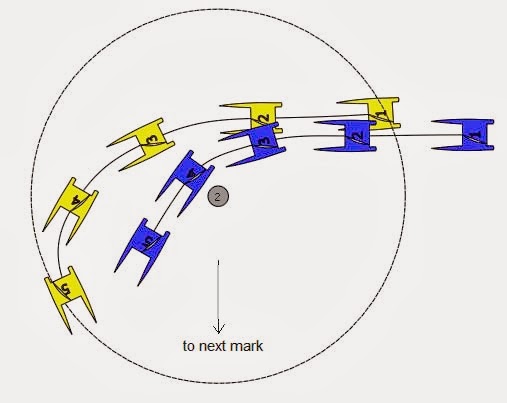 |
| Diagram from Q&A 2013.017 B005 |
Q&A 2014.003 F002
Race committees, please pay attention. The Q&A Panel is putting the hammer down. Results are no longer provisional, final or any other adjective you care to give them: They are, from this day forward "RESULTS". Make it so!
Q&A 2014.004 L002
When it rains, it pours. Race Committee, you are again ordered to change your wicked ways. No more multi-discipline races with boards, boats and what not. They can be harmful to your health and create risk of collision, damage and injury.
Q&A 2014.005 F003
Will they never stop? Again and again the poor line-sighting volunteers get it wrong. Identifying wrong boats under the black flag. No wonder the Q&A-panel has to step in, to sort this mess.
No, wait.. at the end a sailor is also ....
Well, you should find out yourself, I can't bear this any more...
Q&A 2014.006 K002
I'm glad this is the last one. The RC has enough on their plate for now. At least this one is about ties in Match Racing. A favourite subject by far, among the scoring people who are volunteering to do it.
Perhaps a decent flow-chart would help. What do you think?
J.
Ooh, I almost forgot: Here's the link to the updated booklet: ISAF Q&A Booklet
Put it in your library now, before you are caught, not having it.... and the Panel comes after YOU!
Friday, 9 November 2012
RRS 2013-2016; Rule 18.3
(duh, otherwise I wouldn't have had to write this)
I'm not quite sure if the chosen language does not have a much greater impact than first assumed;
Was it the intention of the Rulescommittee to change the rules for boats changing tack in the zone?
This is what the rule is now:
18.3 Tacking in the Zone
If two boats were approaching a mark on opposite tacks and one of them changes tack, and as a result is subject to rule 13 in the zone when the other is fetching the mark, rule 18.2 does not thereafter apply. The boat that changed tack
(a) shall not cause the other boat to sail above close-hauled to avoid contact or prevent
the other boat from passing the mark on the required side, and
(b) shall give mark-room if the other boat becomes overlapped inside her.
This is what the rule in 2013-2016 is going to be:
18.3 Tacking in the Zone
If a boat in the zone passes head to wind and is then on the same tack as a boat that is fetching the mark, rule 18.2 does not thereafter apply between them. The boat that changed tackI have two scenario's for your consideration:
(a) shall not cause the other boat to sail above close-hauled to avoid contact or prevent
the other boat from passing the mark on the required side, and
(b) shall give mark-room if the other boat becomes overlapped inside her.
 |
| Situation A |
 |
| Situation B |
The PC find as fact that Purple had completed her tack (was no longer subject to rule 13) when the other boats (Grey and/or Red) changed course.
Is in the new rules (RRS 2013-2016) the Purple boat breaking rule 18.3?
Leave a comment.
J.
Saturday, 20 October 2012
RRS 2013-2016; Rule 18.2
The wording has changed:
18.2(c ): When a boat is required to give mark-room by rule 18.2(b),The (1) and (2) split is in line with the general change in the way rules are being written. It makes it clear that both apply all the time for a boat that does not have mark room.
(1) she shall continue to do so even if later an overlap is broken or a new overlap begins;
(2) if she becomes overlapped inside the boat entitled to mark-room, she shall also give that boat room to sail her proper course while they remain overlapped.
Why the addition of (2)?
In the current rule book a boat that 'stuck its nose in' was not entitled to mark room and could be shut out by the other boat. As long as that boat was sailing its 'proper course' while rounding the mark, it was exonerated for any infringement of a rule of section A and for breaking RRS 15 or 16. It could luff as hard as it wanted - provided it did so, to sail its proper course. If she did more - sail above her proper course - she still cold shut out the inside boat, but she then had limitations under 15 and 16.
This is now directly written in rule 18.2(c)(2) in the RRS 2013-2016.
The definition of mark-room has no longer 'room to sail her proper course while AT the mark' part - so that needed to be addressed by the working party. They have chosen to write that part into the rule directly. Straight into 18.2(c). A proper choice, in my opinion.
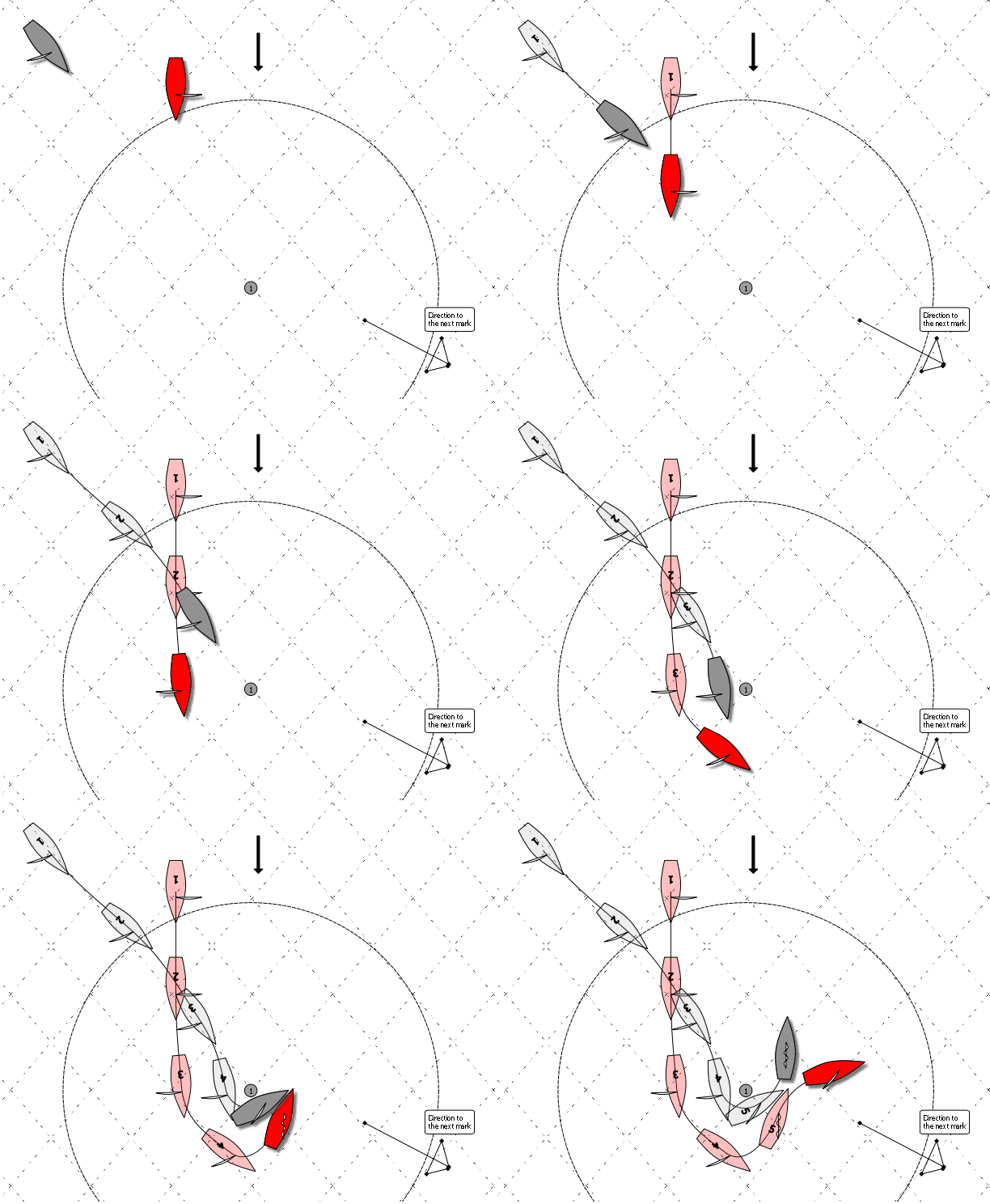
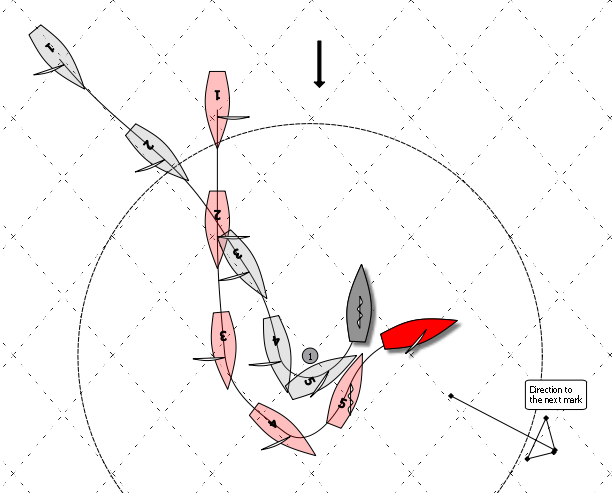
In the current rules Red is entitled to mark-room and may sail her proper course AT the mark. She is however sailing well above that proper course. And therefor no longer 'protected' by the mark-room exoneration for breaking rule 16.
In the new rules this is still the case - only now it is written in 18.2(c) directly. Instead finding this conclusion by way of the definition and exoneration, it's now in the rule.
Grey may try to go inside and she's entitled to a fair cop when caught. Not an entrapment by Red....
Ooh, the other change in rule 18.2 is one from long standing in Match - and Team Racing. To get out of another 'unfair' deal.
18.2(e) If a boat obtained an inside overlap from clear astern or by tacking to windward of the other boat and, from the time the overlap began, the outside boat has been unable to give markroom, she is not required to give it.From the Team Race Call book: E10:
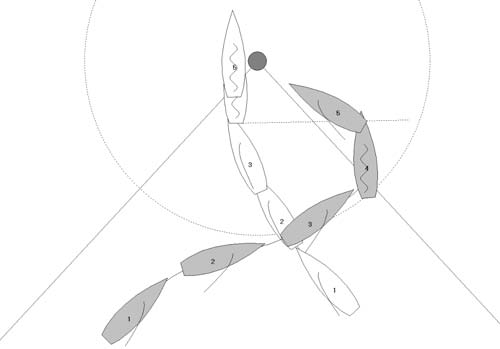
That has now been addressed by the change in 18.2(e).
If White is not able, she doesn't have to give mark-room.
Please leave a comment if you have a different opinion about 18.2.
J.
Next time 18.3. It is slow going, but we will get there, eventually
Friday, 5 October 2012
RRS 2013 - 2016; Mark-room & Tactical rounding
Mark-roomRoom for a boat to leave a mark on the required side. Also,(a) room to sail to the mark when her proper course is to sail close to it, and(b) room to round the mark as necessary to sail the course.However, mark-room for a boat does not include room to tack unless she is overlapped inside and to windward of the boat required to give mark-room and she would be fetching the mark after her tack.
You can leave a mark to port (as asked in the SI) as close as the circumstances permit or at several boat lengths.This is important, because you want to know if you always can make a tactical rounding.
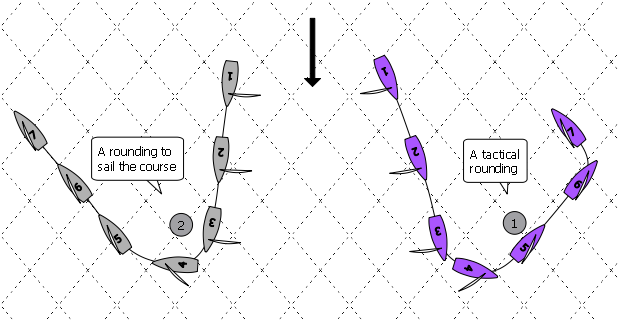

The right to do a tactical rounding however, is solely depending on whether or not you have right-of-way when rounding a mark. If you are the keep-clear boat, all the room you get, is to sail close to it and round it as necessary to sail the course.
Monday, 23 July 2012
(pillow)Case of the week (30/12) - 2

Rule 14, Avoiding Contact
Rule 15, Acquiring Right of Way
Rule 18.2(a), Mark-Room: Giving Mark-Room
Rule 18.2(b), Mark-Room: Giving Mark-Room
If the first of two boats to reach the zone is clear astern when she reaches it and if later the boats are overlapped when the other boat reaches the zone, rule 18.2(a), and not rule 18.2(b), applies. Rule 18.2(a) applies only while boats are overlapped and at least one of them is in the zone.

Summary of the Facts
A and B were both on port tack, reaching to a mark to be left to starboard. The wind was light. At position 1, when A came abreast of the mark she was clear ahead of B but four-and-a-half hull lengths from the mark. B, who had just reached the zone, was three lengths from the mark. Between positions 1 and 2 A gybed and headed to the mark, becoming overlapped outside B. Between positions 2 and 3, after B had gybed and turned towards the next mark, she became clear ahead of A. When B first became clear ahead of A there was about one-half of a hull length of open water between the boats. A few seconds after B became clear ahead, A, who was moving faster, struck B on the transom. There was no damage or injury. A protested B under rule 18.2(b). B protested A under rule 12. A was disqualified and she appealed.
Decision
A apparently believed that the second sentence of rule 18.2(b) applied when the two boats were at position 1 and that B, then being clear astern, was obliged to give A mark-room. As that sentence states, it applies only if a boat was clear ahead when she reached the zone. At position 1, B had reached the zone, but A was well outside it. Moreover, the first sentence of rule 18.2(b) never applied because the boats were not overlapped when B, the first of them to reach the zone, did so. However, while the boats were overlapped, rule 18.2(a) did apply, and it required A to give mark-room to B. During that time B had to keep clear of A, first under rule 10 and later (after she gybed) under rule 11.
After B gybed she pulled clear ahead of A. At that moment rules 18.2(a) and 11 ceased to apply and rules 12 and 15 began to apply. Rule 15 required B initially to give A room to keep clear, and B did so because it would have been easy for A to keep clear by promptly bearing off slightly to avoid B’s transom after B became clear ahead. When A hit B’s transom, she obviously was not keeping clear of B, and so it was proper to disqualify A for breaking rule 12. A also broke rule 14 because it was
possible for her to bear off slightly and avoid the contact with B.
After it became clear that A was not going to keep clear of B, it was probably not possible for B to avoid the contact. However, even if B could have avoided the contact, she could not have been penalized under rule 14 because she was the right-of-way boat and the contact did not cause damage or injury.
The appeal is dismissed, the protest committee’s decision is upheld, and A remains disqualified for breaking rules 12 and 14.
USSA 1962/87

Wednesday, 7 March 2012
Crashing the Gate
The fleet is comprised of eight boats this year and because of the short courses that means that at any given mark there are usually multiple boats involved. Particularly so at the first windward mark and first gate.
(I've left out non-relevant boats to make it a little less confusing)
Here is the static picture of the incident:
 |
| ONE |
Three boats on port and one on starboard, all approaching the leeward gate.
The Grey boat is right of way, Red has to keep clear. Purple is crossing Yellow and keeping clear under rule 10. When Grey enters the zone of the right-hand gate-mark she gets mark-room from all other boats for that mark. Grey can, as long as there are only other port boats and no starboard boat on a collision course, make a 'tactical' rounding. She's not sailing to the mark, but pointing above it to get a better 'out of the mark' position.
Subsequently Red also enters the same zone en gets mark-room from Purple and Yellow. She must however give mark-room to Grey and keep clear as windward boat.
 |
| TWO |
 |
| THREE |
Grey sails another couple of lengths before starting to turn. Remember, she's still doing that 'tactical' rounding. Purple is 'forced' to bear off because of Red. Red is forced in that position because she must keep clear of Grey. Rule 10 is infringed and Grey is forcing Red to do so, but outside the room that mark-room provides.
She cannot be exonerated under rule 18.5. In order to get exonerated Grey should have turned towards the mark much earlier and forget her tactical rounding. As soon as Purple gybed, Grey should have responded.
 |
| FOUR |
Hoping for an opening she continues, but next to the mark sees no path and crashes into the mark, getting stuck on it, with her bows on either side.
 | |
| FIVE |
Purple breaks rule 12.
Here is the animation of the incident:
 |
| ANIMATION |
That's it.
You've just witnessed 20 seconds of an ESS race from an umpires point of view.
Wednesday, 29 February 2012
Seven at the Leeward Mark; Part 3
Again I’ve created a much simpler situation involving three boats:
But this time they are all overlapped. The leeward mark has to be left to port.

In position 2 Red reaches the zone. From that moment Red has to give Purple AND Grey markroom.
Purple however has not reached the zone. And does not have to give markroom to Grey as long as she does not enter the zone. Because for her series score it is beneficial that Grey does not finish in the first half of the fleet, Purple decides to luff and force Grey up. She complies with 16.1 and gives enough room to Grey to keep clear.
In my opinion she is allowed to do this.
If not, this chain would never end. Add a fourth or a fifth boat and they would not be allowed to luff as soon as one boat is in the zone, if - as the argument in our seven boat scenario is commented upon - rule 18 was switched on, between all boats.
Rule 18 is on between Red and the other two, but not (yet) between Purple and Grey.
J.
Monday, 27 February 2012
(pillow)Case of the week (09/12) – 21
(This is an instalment in a series of blogposts about the ISAF Case book 2009-2012 with amendments for 2011. All cases are official interpretations by the ISAF committees on how the Racing Rules of Sailing should be used or interpreted. The cases are copied from the Casebook, only the comments are written by me.)

CASE 21
Definitions, Mark-Room
Definitions, Proper Course
Definitions, Room
The amount of space that a right-of-way boat obligated to give mark-room to an inside overlapped boat must give at the mark depends on the inside boat’s proper course in the existing conditions.
Question
When a right-of-way boat is obligated to give mark-room to an inside boat that overlaps her, what is the maximum amount of space that she must give? What is the minimum amount of space that she must give?
Answer
As the definition Mark-Room states, while the inside boat is at the mark the outside boat must give her room to sail her proper course. If the overlapped boats are on the same tack, mark-room includes room to tack. According to its definition, ‘room’ in this case is the space needed by an inside boat, which in the existing conditions is handled in a seamanlike way, to sail her proper course while at the mark.
The inside boat’s proper course is the course she would sail to finish as soon as possible in the absence of the outside boat. This may entitle the inside boat to more space than she needs for a seamanlike rounding. For example, her proper course may be a track that takes her farther from the mark as she rounds than a seamanlike rounding would so that her speed is not reduced by the tightness of her turn. Note that, according to the definition Mark-Room, an inside overlapped boat that is required to keep clear of the outside boat is not entitled to sail her proper course while sailing to the mark; she is only entitled to sail her proper course after she is at the mark.
The term ‘existing conditions’ deserves some consideration. For example, the inside one of two dinghies approaching a mark on a placid lake in light air will need relatively little space beyond that required for her hull and properly trimmed sails. At the other extreme, when two keel boats, on open water with steep seas, are approaching a mark that is being tossed about widely and unpredictably, the inside boat may need a full hull length of space or even more to ensure safety. The phrase ‘in a seamanlike way’ applies to both boats.
First, it addresses the outside boat, saying that she must provide enough space so that the inside boat need not make extraordinary or abnormal manoeuvres to sail her proper course while at the mark.
It also addresses the inside boat. She is not entitled to complain of insufficient space if she fails to execute with reasonable efficiency the handling of her helm, sheets and sails while sailing her proper course.
ISAF 1969/1

You might also want to read Q&A 2009-022 B005.
And from Rapid Response Match Racing Call 2010/001
Question 2
When does a boat sailing ‘to the mark’ become ‘at the mark’?
Answer 2
A boat that is sailing ‘to the mark’ will be ‘at the mark’ when one or more of the following conditions apply:
- (a) She is no longer able to alter course, in a seamanlike way, towards the mark and pass it on the wrong side.
- (b) Any part of her hull overlaps the mark and she is closer than half of her hull length to the mark.
- (c) She reaches a position where she would usually alter course to round or pass the mark on the required side in order to start sailing the next leg of the course.
Monday, 30 January 2012
(pillow)Case of the week (05/12) – 25
(This is an instalment in a series of blogposts about the ISAF Case book 2009-2012 with amendments for 2011. All cases are official interpretations by the ISAF committees on how the Racing Rules of Sailing should be used or interpreted. The cases are copied from the Casebook, only the comments are written by me.)

CASE 25
Rule 11, On the Same Tack, Overlapped
Rule 14, Avoiding Contact
Rule 16.1, Changing Course
Rule 18.2(b), Mark-Room: Giving Mark-Room
When an inside overlapped windward boat that is entitled to mark-room sails below her proper course while at the mark, she must keep clear of the outside leeward boat, and the outside boat may luff provided that she gives the inside boat room to keep clear.
Summary of the Facts
Two 15-foot (3.5 m) dinghies, IW and OL, were approaching a leeward port-hand mark. IW established an inside overlap on OL well before the boats reached the zone, and OL gave IW space to sail to the mark and then to sail her proper course while at the mark. After IW passed the mark, OL began to luff to her course to the next mark. IW was slower in heading up, and her boom, still well out, touched OL’s helmsman and shrouds. At the time of the contact IW was a hull length from the mark and over 45 degrees below close-hauled. No damage or injury occurred. IW protested OL under rule 18.2(b), and OL protested IW under rule 11.

The protest committee decided that, because IW did not luff to a close hauled course while she was at the mark, she did not sail her proper course during that time. IW did not deny this but attributed it to her boom-end mainsheet rig as compared to the centre-lead rig used by OL.
The protest committee dismissed IW’s protest, upheld OL’s, and disqualified IW for breaking rule 11. IW appealed.
Decision
Rule 18.2(b) required OL to give IW room to sail to the mark and then room to sail her proper course while at the mark. Clearly, between positions 1 and 2 OL gave IW room to sail to the mark. At position 2, IW was ‘at the mark’ and between positions 2 and 3 she was entitled to room to sail her proper course. Her proper course during that time was to luff onto a close-hauled course, and OL gave her room to do so. Therefore, OL did not break rule 18.2(b).
When OL luffed between positions 2 and 3, IW was required by rule 11 to keep clear of OL, and OL was required by rule 16.1 to give her room to do so. OL luffed approximately 30 degrees while moving forward two hull lengths. Even with a boom-end mainsheet rig, a boat sailed in a seamanlike way can turn through 30 degrees and trim her mainsail appropriately while moving forward two hull lengths. Therefore, OL gave IW room to keep clear and OL did not break rule 16.1.
OL could easily have avoided contact with IW, and so OL broke rule 14. However, she is not penalized for doing so because neither boat was damaged, nor was there any injury. IW sailed well below her proper course; in fact she sailed a hull length away from the mark on a course over 45 degrees below close-hauled and, as a result, took much more space than rule 18.2(b) entitled her to take.
Throughout the incident IW was required by rule 11 to keep clear of OL.
Shortly before the contact, IW broke rule 11 by failing to keep clear. It was possible for IW to have avoided the contact, and therefore IW also broke rule 14. However, because IW was entitled to mark-room and the contact resulted in neither damage nor injury, she too can not be penalized for breaking rule 14.
W’s appeal is dismissed. The protest committee’s decision to disqualify
IW under rule 11 is upheld.

Noteworthy: IW was not penalized for taking “too much mark-room”, she was penalized for failing to keep-clear under 11. If she had been failing to keep clear within the space mark-room provided, she would have been exonerated for that. She failed to keep clear outside the room that mark-room provides and therefore was NOT exonerated.
Although the exoneration under 18.5 depends on the boat’s actions, the ‘exoneration’ under rule 14 does not. All boats – r.o.w, with room or with mark-room – regardless of there actions, get a freebie if there’s no damage or injury.
In this rulebook the wording is still ‘a boat will not be penalized’, but in the next rulebook (2013-2016) it will be brought in line with the other rules and ‘a boat will be exonerated’ for breaking rule 14 if there’s no damage or injury.
Wednesday, 25 January 2012
ISAF Q&A 2011 - 027 M014: Eats, shoots and leaves
Eats, Shoots & Leaves - The Zero Tolerance Approach to Punctuation
by Lynne Truss.
From the back cover:

Maybe the title of this Q&A should be: Mark to round; to pass or to leave?
ISAF Q&A 2011 - 027 M014
Question 4
What are the fundaments of the difference between rules 18.5 (a) and 18.5 (b) with regard to rules 15 and 16?
Answer 4
When a boat entitled to mark-room is sailing to the mark, she must comply with rules 15 and 16. However, sometimes complying with these rules means that the boat entitled to mark-room will not be able to actually round the mark. This is why rule 18.5(b), contrary to rule 18.5(a), provides for exoneration for a boat entitled to mark-room that breaks either of those rules while rounding the mark on her proper course.
I thought the best way to illustrate this was by a couple of examples:
Example 1: rule 16
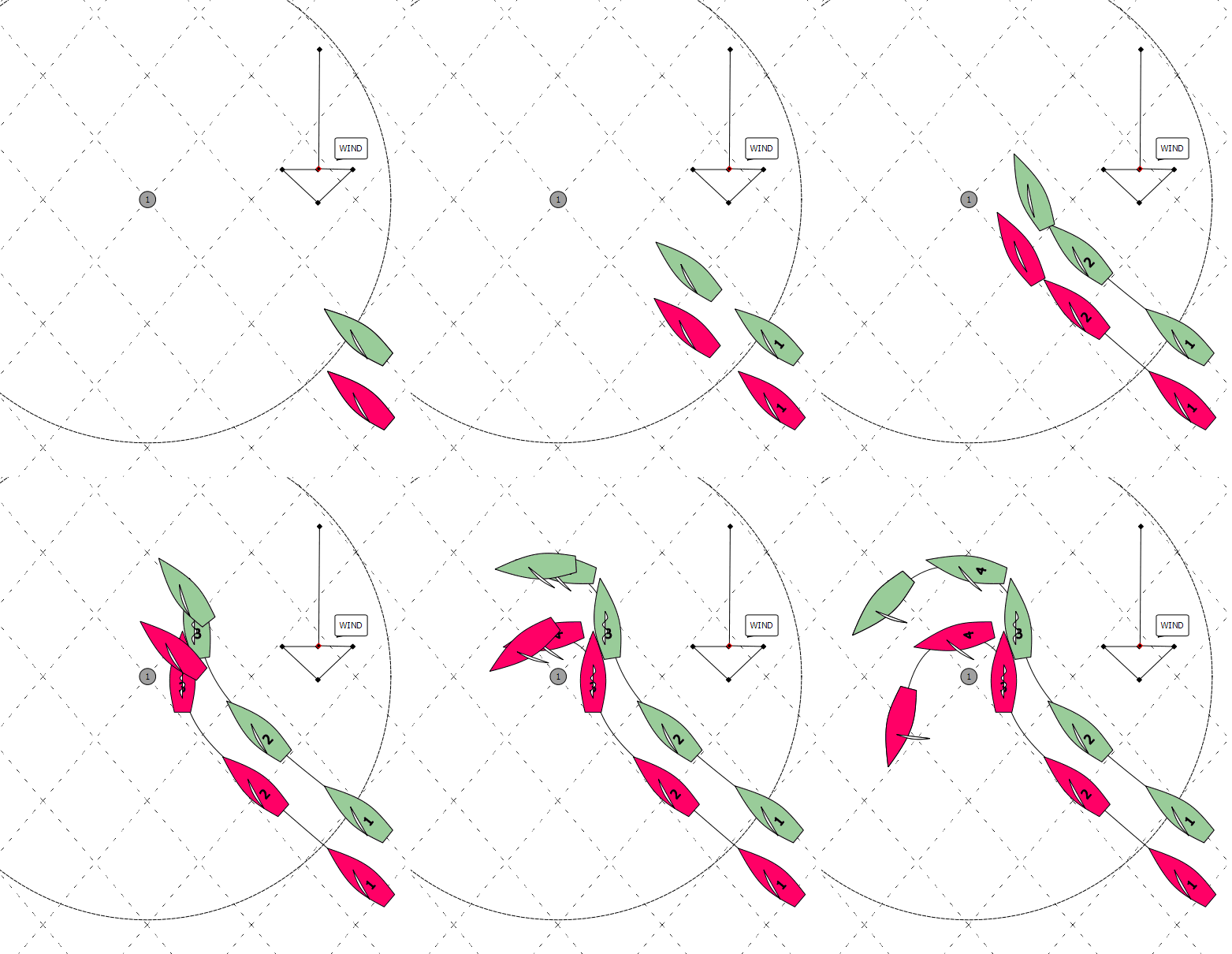
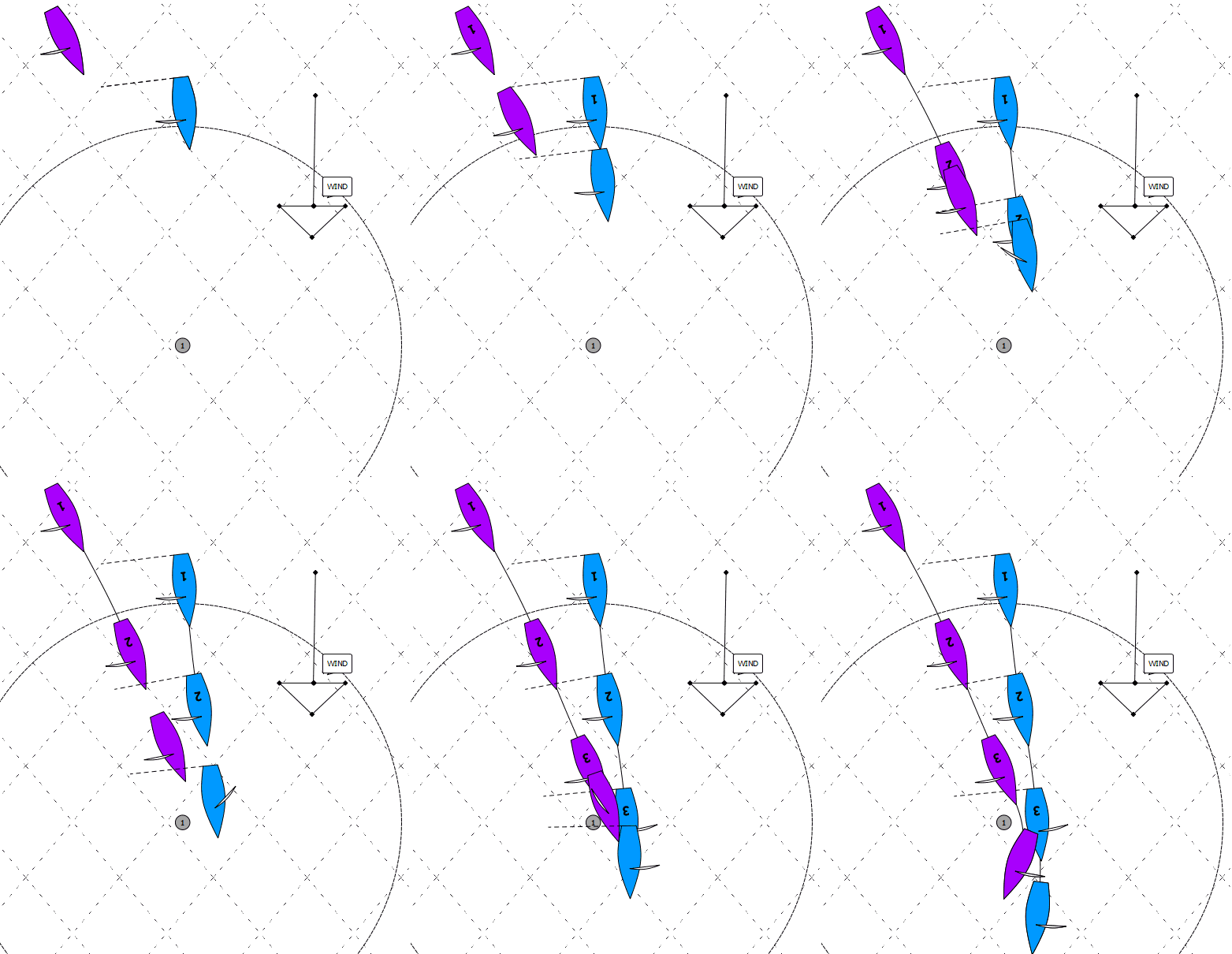
There are big waves on the course. Two boats, Blue and Purple sail toward the leeward mark to be left to starboard. Entering the 3BL zone Blue is clear ahead and gets mark-room.
While sailing toward the mark Purple becomes right-of-way boat under rule 11. Blue is not changing course but gybes between positions 2 and three. Blue becomes right-of-way starboard tack boat. Normally she would be penalized for breaking rule 15, because she does not initially give room to Purple to keep clear. But because she's AT the mark, she gets exoneration under 18.5(b). Had she done the same between position 1 and 2 she would have not been exonerated.
Ooh, before I sign off, if you ever have to change to pick up a copy of Lynne's book, please do. It will change your world forever.
And the panda will be grateful.
J.
Wednesday, 19 October 2011
ISAF Rapid Response Team Racing Call 2011-001
It took some time but, then it's a whopper. The first Rapid Response Team Racing Call in 2011 was published last week by ISAF. The subject is rule 18 and mark-room and how to exploit an "unintentional consequence" in the current rules to gain an advantage for a team.
The Call explains that the way Mark-room is written at the moment, a keep-clear boat can break a right-of-way rule and be exonerated as long as she's doing it within the boundaries of "Mark-room"

RAPID RESPONSE TEAM RACING CALL 2011/001
Rule 18 Mark-Room

Question
X on starboard tack enters the zone of the finishing mark clear ahead of A. X is sailing a course that will leave about half a boat length between her and the mark. After entering the zone X slows down without changing course, and A becomes overlapped to leeward of her. X then bears away to pass close to the mark and there is no longer room for A to finish between X and the mark. A bears away and protests. What should the call be?
Answer
When X enters the zone her course is high of the mark and she is not sailing to the mark within the space allowed by the definition Mark-Room. When X bears away after she becomes windward boat, she is sailing to the mark. X breaks rule 11, but is exonerated under rule 18.5(a). No penalty.
A complies with rule 18.2(b) by giving mark-room to X. If A is unable to respond when X bears away to sail to the mark, A breaks rule 18.2(b). Penalise A. However, if X bears away so that her course will not pass on the required side of the mark, she is no longer sailing to the mark and she is not entitled to exoneration. Penalise X for breaking rule 11.
As soon as X finishes, rule D1.1(d) applies and she can no longer act to interfere with A. She must trim in to a close-hauled course and clear the finishing line.
Published September 26;
This call is valid until 1 January 2013
In normal racing the infringement of rule 11 is usually unintentionally. And the windward boat would finish in front of the leeward boat anyway, so in a fleet race this will have no effect. (Except probably agitate the persons in the leeward boat).
But in Team Racing this can be used as a "weapon" to hinder a boat from the other team, so a team member can finish before the leeward boat.
Be aware however, to make use of it now!
If the submissions of the Rule C working party are accepted this will no longer be possible in the RRS 2013-2016
