Showing posts with label sunlight. Show all posts

Thursday, January 15, 2009

Under Shaded Light - Miniature Rose

by Richard Chew


In this posting, I wish to share some experiences of growing miniature rose under shaded light.


I purchased this miniature rose in beginning Dec 2008 and placed it at my window sill since then.


As I have mentioned in 'Photosynthesis - How many hours of sunlight does your rose need? ' posting, that a rose plant would require a minimum of 160,000 lux hours of light to survive.


Assuming indirect sunlight produces about 30,000 lux (light intensity) in an hour, easily this rose will get about 270,000 lux hours each day (about 9 hours indirect light per day), which is sufficient to fuel growth.


New flower bulbs started to emerge after about a month since I last pruned off the spent flower. However this time, the size of bloom is noticeably smaller and the new leaves texture is lighter than the earliers ones. I believe if the fertilizing is enhanced, the bloom quality may improve.


Though it may not produce the same bloom size when it was grown at more direct sun light, the important thing to note is there is no ill effect or any serious detrimental effect when its grown under shaded light. Despite lacking direct sunlight for more than a month, the bush looks healthy.


And to add on, this miniature rose was never been treated with any insecticide nor pesticide. This goes to show that miniature rose can aclimitised with minimal human intervention and without chemicals. Based on this observation, I can safely conclude that roses have the capability to adapt to its surroundings. The only difference is that the quality of bloom shall varied due to different environment conditions. The important point to note is that growing miniature rose under shaded light do not cause any detrimental effect.


At this point of time, I am inclining to the idea that miniature rose can be grown under shaded light.


Some questions to be considered as these findings are pursued further ...


1. Why are the blooms noticeably smaller? Was it caused purely by lack of direct sunlight?


2. Or the fertilizing dosage was weak therefore contributed to smaller bloom development?


3. Or perhaps both?


In my next prune, I shall increase the fertilizing dosage and examine the size of next bloom in February.


Monday, October 27, 2008

Photosynthesis - How many hours of sunlight does your rose need?

by Richard Chew


How many hours of direct sunlight does the roses require? This is the most common question. I asked the same question when I started growing roses.


After doing some research on plant psychology, I learned that ensuring the minimum hours of indirect sunlight is as important as determining the minimum direct sunlight. The reason is in Malaysia we are blessed with long hours of sunlight, having direct sunlight is not so crucial.


Before we determine the number of hours of sunlight for our roses, we need to understand how and what is the optimum rate of photosynthesis.


A commonly used slightly simplified equation for photosynthesis is:

6 CO2(g) + 12 H2O(l) + photons → C6H12O6(aq) + 6 O2(g) + 6 H2O(l)

carbon dioxide + water + light energy → glucose + oxygen + water

The equation is often presented in introductory chemistry texts in an even more simplified form as:


6 CO2(g) + 6 H2O(l) + photons → C6H12O6(aq) + 6 O2(g)


What this means is that during photosynthesis, the plant will use light energy to manufacture glucose. At the end of this process, glucose is stored for the purpose of plant growth and production of carbohydrate.


2 H2O + 2 NADP+ + 2 ADP + 2 Pi + light → 2 NADPH + 2 H+ + 2 ATP + O2


While knowing photosynthesis is at work during sunlight, there is another process that is at work all the time. This process is known to be light-independent process. That means during night or darkness, the plant will draw energy stored to use CO2 for the production of carbohydrate.


3 CO2 + 9 ATP + 6 NADPH + 6 H+ → C3H6O3-phosphate + 9 ADP + 8 Pi + 6 NADP+ + 3 H2O

This process of respiration happens all day and night.


Another critical factor to take note is that when sun light is very intensed and temperatures rises, photosynthesis rate shall decline. However respiration rate will continue to rise, therefore reduces the net photosynthesis (lower photorespiration - in shaded red below).

Therefore understanding this effect is important to determine the right amount of direct sunlight and at which of part of the day is crucial, especially trying to grow roses in tropical country like Malaysia. As Malaysia weather is known to have average of 32 to 33 degress C outdoors, it is crucial not to over exposed the roses with too much heat. It doesn't harm that much if its for short period, as roses are known to be quite tolerant of direct sun.
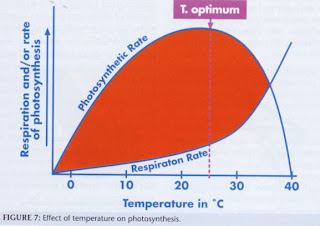


I would prefer to place roses at a location where it can draw direct morning sun for about 2 to 4 hours as temperature is at lowest of the day, and indirect sunlight for 5 to 7 hours. The rose plant must get indirect sunlight from opened sky and not from opened window (or any location that is shielded, it can never grow indoor). In such condition, you provide a controlled temperature environment within 28 to 32 degress C.

A practical way to artificially create this effect is by growing roses next to a wall or a taller tree/plant that will shield your roses from the intensed afternoon sun.


How much light does my roses get?

My garden usually gets direct sun between 10am to 12pm, my estimation is about 100,000 lux (light intensity) at clear sky. It is believed that at this light intensity, photosynthesis will reach light saturation (photosynthesis will cease if reach light saturation of 32,000 lux for upper leave and 100,000 lux for whole plant)

Thankfully Malaysia's weather is usually cloudy, therefore will diffuse the direct sunlight. However it is necessary to take pre-caution if weather is dry and hot for long periods as the plant will be exposed to high temperature thus raise the rate of respiration. That is why, I feel it is necessary to place roses at location that is shielded from hot afternoon sun, but not totally shielded from indirect sun.


Just to ensure that your roses receives sufficient sunlight, especially if your garden has limited space and suspicion of insufficient light, just do a simple calculation.

8am to 5pm - 9 hours x 30,000 lux (indirect sunlight) = 270,000 lux hours

10am to 12pm - 2 hours x 100,000 lux (direct sunlight) x 30% (below upper leave) = 60,000 lux hours

Total is 330,000 lux hours.


In case you are unsure how many lux (light intensity) in your garden, in general you can use 100,000 lux for direct sunlight, 30,000 for indirect sunlight and 5,000 for low light (indoor light. You will need to multiply the ratio of 0.3 (30%) for direct sunlight, as only the leaves below the upper leave will benefit from the sunlight. It is believed that at high intensity the upper leaves will cease photosynthesis due to higher light saturation.

For the plant to survive it requires a minimum of 160,000 lux hours of sun light.

If your light calculation exceeds the minimum of 160,000, your rose should thrive. If you have read some books on rose growing, you may notice that most say that roses require direct sunlight, that is because the weather is different from our tropical weather in Malaysia. Averagely Malaysia outdoor weather is at 32 degrees C, if at direct sunlight, the temperature may increase for another 2 to 3 degrees C, which lower the net photorespiration rate.

Also if the heat reaches the soil, the good bacterias in the soil will also cease their activities thus will affect the plant in the long run. It won't do much harm if exposed for short periods, as it reduces the risk of fungal infections. But if for long periods, the plant roots will deplete in its nutrition as the bacterias stop breaking down the nitrogen components.

You may want to check the earlier posting that is extracted from external site. I posted in this blog, in case you wish to know about plant leaves anatomy, photosynthesis and light.

http://rosegrowing.blogspot.com/2008/10/chemistry-in-shadehouses-ext.html

http://rosegrowing.blogspot.com/2008/10/photosynthesis-leaves-light-ext.html

This posting explains the impact of diffuse light on photosynthesis rate. It dispel the myths of having direct sunlight leads to increased in photosynthesis rate.

http://rosegrowing.blogspot.com/2008/10/large-volcanic-eruptions-help-plants.html

Sunday, October 12, 2008

LARGE VOLCANIC ERUPTIONS HELP PLANTS ABSORB MORE CARBON DIOXIDE FROM THE ATMOSPHERE [EXT]

I extracted this from NASA Goddard Space Flight Center site. I find this discovery interesting as it gives new insight about diffuse light on the efficiencies of photosynthesis rate.

http://www.gsfc.nasa.gov/gsfc/earth/pictures/co2/volcanom.jpg


LARGE VOLCANIC ERUPTIONS HELP PLANTS ABSORB MORE CARBON DIOXIDE FROM THE ATMOSPHERE


New NASA-funded research shows that when the atmosphere gets hazy, like it did after the eruption of Mt. Pinatubo in the Philippines in June 1991, plants photosynthesize more efficiently, thereby absorbing more carbon dioxide from the atmosphere.


When Mount Pinatubo erupted, scientists noticed the rate at which carbon dioxide (CO2) filled the atmosphere slowed down for the next two years. Also during 1992 and 1993, ash and other particles from the volcano created a haze around the planet and slightly reduced the sunlight reaching Earth's surface and made the sun's radiation less direct and more diffuse.


Many scientists previously thought the reduction in sunlight lowered the Earth's temperature and slowed plant and soil respiration, a process where plants and soil emit CO2. But this new research shows that when faced with diffuse sunlight, plants actually become more efficient, drawing more carbon dioxide out of the air.


"There is evidence indicating that the drop in the atmospheric CO2 growth rate was probably too big to be explained by a reduction in respiration alone," said the study's lead author, Lianhong Gu, a researcher at the University of California Berkeley's Department of Environmental Science, Policy and Management.


Gu added that the respiration rates of plants and soil are sensitive to temperature changes. But "in order to explain the drop in atmospheric growth rate of CO2, we would need an average drop in global temperatures of about 3.6 degrees Fahrenheit (2° C), but the temperatures only dropped by about one degree (0.9) Fahrenheit (0.5°C) globally."


Plants take in carbon dioxide during photosynthesis in the day, and release it during respiration at night. But they don't necessarily photosynthesize and respire at the same rates. Since decreased plant and soil respiration could not explain the drop in carbon dioxide entering the atmosphere in 1992 and 1993, Gu and his colleagues deduced that enhanced photosynthesis by plants must be involved.


After Mount Pinatubo erupted, while overall solar radiation was reduced by less than five percent, data showed a reduction of direct radiation by as much as 30 percent. So, instead of direct light, the sun's rays were reaching leaves after colliding with particles in the air.


"Diffuse radiation has advantages for plants," Gu said. That's because when plants receive too much direct light, they become saturated by radiation and their ability to photosynthesize levels off. In the layers of leaves from top to bottom, called the plant canopy, only a small percentage of the leaves at the top actually get hit by direct light. In the presence of diffuse light, plants photosynthesize more efficiently and can draw more than twice as much carbon from the air than when radiated by direct light.


Gu and his colleagues tested the CO2 uptake in various plant ecosystems around the world-including Aspen forests, mixed deciduous forests, Scots pine forests, tallgrass prairies, and a winter wheat field-based on the amount of solar radiation striking the leaves. From these analyses, they generated parameters necessary for evaluating impacts of the Pinatubo eruption. On clear days following the eruption, they found that in all of the ecosystems, photosynthesis increased under the diffuse light.


While large volcanic eruptions are rare, this research has big implications for more regular phenomena such as the effects of aerosols and clouds on an ecosystem's ability to pull carbon from the atmosphere. Aerosols, or microscopic particles like soot or black carbon in the air, occur naturally but have also been increasing due to human activities since the industrial revolution. Gu's research indicates that the maximum uptake of carbon dioxide by plant ecosystems occurs when cloud cover is about 50 percent.


The research will be presented at a poster session of the American Geophysical Union (AGU) Fall Meeting in San Francisco, Calif. on December 14, 2001. A paper will be published soon in the Journal of Geophysical Research.


Aside from NASA, the study was also funded by the National Oceanic and Atmospheric Administration (NOAA), the Department of Energy, and other organizations, through the FLUXNET program.

Editor's Note: AGU Title, Time and Location"Roles of Volcanic Eruptions, Aerosols and Clouds in Global Carbon Cycle"Friday, December 14, 2001, 8:30 AM, Moscone Center Hall