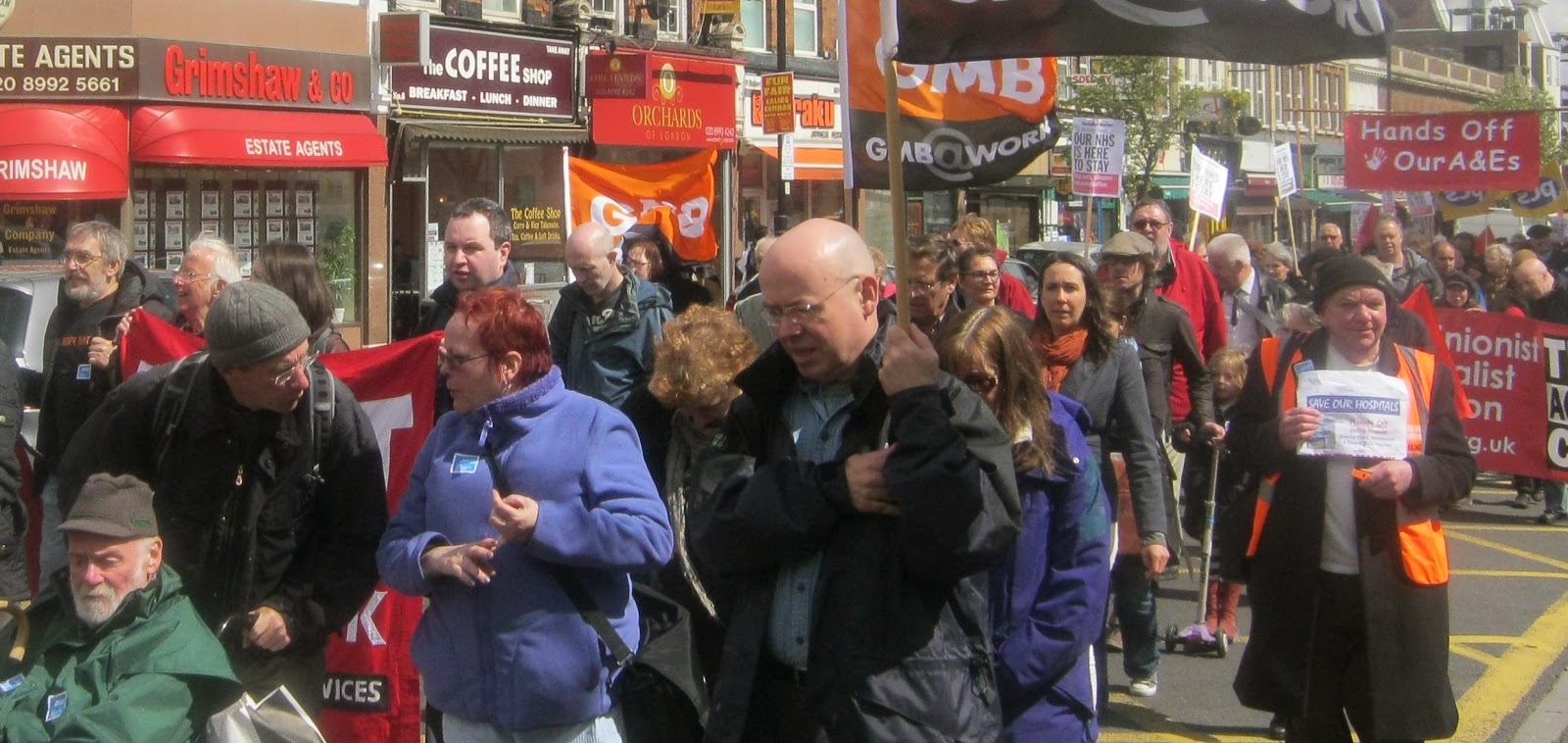
Wednesday, August 19, 2015

Blood Money promised, then postponed.

 THOUGH left-wing politicians like Jeremy Corbyn are often accused by right-wing opponents and media of wanting a return to "the 1970s and 1980s" when supposedly unspeakable things were done by trade unions (such as raising wages), not so much has been said about a real major scandal from that period whose effects are being perpetuated. 

 Thousands of National Health Service patients were inadvertently given contaminated blood products in one of the biggest treatment disasters ever. It is estimated that more than 2,000 people died as a result of the contaminated blood, which infected them with deadly diseases like HIV and Hepatitis C.

In Britain, blood donations have always come from volunteers, and been routinely tested for infections. Between 1970 and 1991, against the advice of many experts, the NHS  imported blood products from overseas, particularly the United States and Canada, many supplied by drug companies that sourced blood by paying people in high-risk groups, such as prostitutes, vagrants and drug addicts, to donate it. In some US states the prison service made millions taking prisoners blood. In other places blood was taken from corpses, but the companies claimed it came from donors. The blood products imported to Britain were riddled with the blood-borne viruses hepatitis C and HIV.


These products were then administered without being screened for the viruses, despite warnings from the World Health Organisation. Patients were duly infected as a result. About 7,500 people, of whom roughly two-thirds were haemophiliacs, are now known to have been given hepatitis C during this period.

Perhaps the most famous victim of this health scandal, Body Shop founder Dame Anita Roddick was infected with hepatitis C by a blood transfusion after the birth of her daughter Sam in 1971. She died in 2007, aged 64, from a brain haemorrhage caused by the disease.


According to an estimate by MPs, who debated the scandal in January, as many as 35,000 victims could have hepatitis C, which is often undetected for years, without yet being aware of it. Around 1,500 of the 7,500 confirmed hepatitis victims have also contracted HIV. Many then unwittingly passed it to their partners.  In the Eighties, when most of these transmissions occurred, Aids was a virtual death sentence. Three-quarters of them died.
It does not end there. Many of those who faced terminal illness were forced into hardship by losing or having to give up their jobs, without being able to claim compensation from the governments who were responsible. Some had to turn to charities, but the process of obtaining help has not been easy.

Philip Wellman says his more than 40-year battle with Hepatitis C has reached “a tipping point” as he faces the winter without heating or electricity. He is unable to afford a plane ticket to see his wife, child and grandchildren in his hometown of Hampstead.

It comes after the 68-year-old was involved in a car crash in the early 1970s and became one of more than 5,000 given “killer blood” transfusions by the NHS.

The tainted batch, like many supplied to patients during the 1970s and 1980s, was imported by the Department of Health from US pharmaceutical companies due to supply shortages.

A recent privately-funded inquiry, led by the government’s former solicitor general Lord Peter Archer, found many batches of this blood came from drug addicts, sex workers and other criminals incarcerated in US prisons. The practice continued, it was alleged, “long after alarms had been sounded”.

With the blood riddled with deadly viruses like Hepatitis C and HIV, more than 2,000 of the infected are said to have since died as a result.

Many were infected at the Royal Free Hospital’s haemophiliac centre in Hampstead and the affair has been branded by MPs as “the last major, unclosed government scandal”.

As campaigners continue to accuse the government of an “enormous cover-up”, Mr Wellman says he is hoping David Cameron will “do the right thing” and give survivors proper compensation.

He told the Ham&High: “What the government did to us, and what they’re still doing to us, is horrendous – people would be in disbelief if they knew the story.
http://www.hamhigh.co.uk/news/health/victim_of_nhs_contaminated_blood_left_in_poverty_as_david_cameron_pledge_expires_1_3889833

In May 1983, researchers warned the Department of Health that it should ban U.S. imports of blood-clotting agents. The warning was never followed up.In August that year, the first recorded haemophiliac died from Aids. Yet countless patients continued to be infected. Although the U.S. finally banned prison blood in 1984, exports were allowed to continue and, incredibly, the NHS continued to buy it.

Even though safer, heat-treated products were introduced in the late Eighties, some doctors continued to use up old, contaminated supplies first. Hundreds more people died as a result. By the time Britain started to screen blood properly in 1991, at least 16 other countries were doing so. In some action was taken over officials and ministers who had allowed unsafe blood imports, whereas here there was not even a public inquiry,  When a privately funded one was set up in 2007, the Department of Health withheld vital papers and would not co-operate. Caroline Flint, then Public Health Minister, claimed  key documents detailing the contaminated blood scandal had been destroyed ‘in error’ by a junior member of staff. Caroline Flint is currently standing for deputy leadership of the Labour Party.

http://www.dailymail.co.uk/news/article-3034412/1-800-Britons-murdered-tainted-NHS-blood-denied-justice-scandal-age.html#ixzz3jIRTOXRE
An investigation was launched by the Scottish government in 2008. under Lord Penrose, the head of court at Heriot Watt university.  It cost almost £12 million and ran to 1,800 pages. when it was published in March. Penrose did not apportion any blame and made just one recommendation: that people who felt at risk should be tested for hepatitis. He said Malcolm Rifkind could have launched screening when he was Minister for Scotland, but had stuck to a UK timetable. Rifkind is today director of a company which won a major NHS contract in Staffordshire despite bidding over the in-house price.
 

Lord Penrose said bungling officials should be judged ‘by conditions that prevailed at the time’ rather than by today’s standards. , The inquiry was  dubbed a ‘whitewash’ by campaigners, who walked out of its unveiling and burnt a copy in front of TV crews.


 http://www.dailymail.co.uk/news/article-3034412/1-800-Britons-murdered-tainted-NHS-blood-denied-justice-scandal-age.html

http://www.theguardian.com/society/2015/mar/25/cameron-apologises-infected-hepatitis-c-hiv-contaminated-blood

http://www.penroseinquiry.org.uk/

http://www.independent.co.uk/news/uk/home-news/penrose-report-blood-scandal-inquiry-branded-a-whitewash-10134095.html

Prime Minister David Cameron apologised to those who had suffered because of the contaminated blood scandal,and promised that the government would make an extra £25 million available to help victims.

But that was before the general election.

It now transpires that this money will not come until next year, at the earliest, and it is to come from existing NHS funds  - in other words the Tories will generously rob Peter from one part of the service to pay Paul -if Paul is still alive.

The government says it wants to consult those affected. But the Haemophilia Society says it has written three times to Health Secretary Jeremy Hunt, and been blanked. (Cash barrier, Private Eye No.1398, August 7-20).

Bill Wright, chair of Haemophilia Scotland, who was himself infected with hepatitis C through contaminated blood products, said there was “real anger” around the delay to the promised funds.
He added: “We have been betrayed on this issue over decades and it is no surprise the UK government is betraying us yet again.
http://www.heraldscotland.com/news/13599918.Victims_of_contaminated_blood_scandal_accuse_David_Cameron_of__betrayal__over_compensation_pledge/

As with past treatment of asbestosis victims, or raising the pension age, the suspicion is that by delaying payment as long as possible, the numbers who die in the intervening period will reduce the costs. And while some bitterly say they cannot afford to bury partners or relatives,  the government may be hoping it can bury the issue away from public sight.


Labels: , ,

Thursday, April 09, 2015

Secrecy, Blacklists and Whistleblowing

 THE FIGHT FOR THE NHS


Charlotte Munro, public service whistleblower reinstated.  Nice to win sometimes.

MORE questions have been raised than are being answered in the run-up to this election, but whoever wins, we should not let them go away.  We're used to politicians telling us how much (of our)money they have thrown to the National Health Service, swearing how much they appreciate the service, and assuring us it is safe in their hands.

We're not supposed to look whose hands are in the till.   That's covered by secrecy, even though it is our business.

At the beginning of this year came the news that an £80 million contract to run cancer scans had been given to a private health firm with a Tory MP on their board, despite a rival NHS consortium allegedly offering to carry out the work for £7 million less.

The NHS Trust that runs Royal Stoke University Hospital in Staffordshire put together a consortium with other NHS hospitals to enter a “competitive bid” for a 10-year contract to run scans across Cheshire, Staffordshire, Shropshire, Liverpool, and Lancashire. The scans, known as PET-CT, are mostly used for diagnosing and measuring cancers.

NHS England, the “head office” of the health service, rejected the bid and awarded the contract to Alliance Medical, a private health firm whose board members include former Tory cabinet minister and Kensington MP Malcolm Rifkind.

Ian Syme, coordinator of North Staffordshire Healthwatch and long-time critic of privatisation, uncovered the original NHS bid by, in his words, “digging through 150 pages of board papers”. His research revealed that the bid from the private provider had beaten the NHS bid. “There’s little or no openness or transparency in these tendering processes, no public debate, no meaningful public scrutiny. Ask for details and you get obstructed by the ‘commercial confidentiality’ excuse.”

He added: “The evidence is stacking up that NHS England have a privatisation agenda and NHS England are at the moment privatising NHS by stealth.”

 Malcolm Rifkind is quitting as MP - and chair of the Commons Security and Intelligence Committee - after being caught offering his services in a cash for access sting.  The same in which Labour's Jack Straw was seeking to provide for his old age. It must be true what they say about people struggling to keep up with the cost of living, and having to take extra jobs. Rifkind has been topping up his MP's salary, earning around £60,000 a year to sit on Alliance Medical’s board, according to public records.

 Alliance Medical has a turnover of around £120 million a year, so this scanning contract, worth an estimated £8million a year, is a significant part of its work. Alliance Medical said Rifkind was not involved in the bid.

Scanners don't come cheap. I remember the public fundraising effort for one at St.George's Hospital in London while I was still working there, the giant crane that had to be used to swing it into the unit; and then the less pleasant news that local GPs could not afford to refer their NHS patients for a scan, while the unit was trying to recoup its cost. The Royal Stoke Hospital's £3 million scanner was bought in November 2013 with donations from Keele University and members of the public. It would have been used if the Trust had won the contract. If not, local campaigners believe the scanner might either remain unused,  or be brought into the private Alliance Medical’s scheme

News of Rifkind's public disgrace brought an opportunity for questions in the House.

PM challenged to clarify Malcolm Rifkind's involvement in £80m NHS deal
By D_Blackhurst  |  Posted: February 25, 2015

DAVID Cameron has been challenged to reveal if disgraced ex-minister Sir Malcolm Rifkind influenced the awarding of an £80 million North Staffordshire NHS contract to a private company.

The Tory MP sits on the board of Alliance Medical, which won the lucrative deal to diagnose illnesses in thousands of patients for 10 years.

The company was chosen by NHS England in favour of a £7 million cheaper bid from a consortium of NHS trusts led by the Royal Stoke University Hospital.

Now the Prime Minister has been asked to clarify Sir Malcolm’s role since he was secretly filmed offering access for cash to a private firm.

Read more: http://www.stokesentinel.co.uk/Rifkind-questions-North-Staffordhire-scanning/story-

Questions asked, but not answered.

Joan Walley (Stoke-on-Trent North) (Lab): Given that it was not possible for me to raise in Health questions or with the chief executive of NHS England in a personal meeting the continuing concerns about the procurement of a PET scanner across Staffordshire, Cheshire and Lancashire, will the Leader of the House give assurances, amid concerns about openness and transparency, that there has been no undue influence from the right hon. and learned Member for Kensington (Sir Malcolm Rifkind) as a board member of Alliance? There are real concerns about the possibility of a monopoly service, which may mean that the contract will need to be referred to the Competition and Markets Authority. Will the Leader of the House find time for a proper, open debate about these continuing concerns?

Mr Hague: The hon. Lady has raised related concerns before in the House. I am sorry that she was not able to do so in Health questions, because there will be no more Health questions before the election; we are entering a period in which some Departments will not have further questions before Dissolution. However, she is still able to ask written questions and to seek answers in every other way through correspondence with Health Ministers. I will draw their attention to the matter that she has raised. As Leader of the House, I cannot give her any assurances about what she has asked, but I know that my colleagues will want to attend to what she has raised in the House today.
That's from Hansard. And here is an extract from the Daily Telegraph on Rifkind:
During Health Questions, Labour MP Jamie Reed asked Jeremy Hunt whether the Department of Health had any contact with Sir Malcolm before the contract was awarded by the government.
Mr Reed asked: “Can the secretary of state explain why the more expensive private sector bid was chosen over the better value NHS which provides these services?
“And will the Secretary of State today confirm, because this is a matter of profound public interest, that no contact took place between his department and the board of Alliance Medical, including at any point with current board member, the right honourable member for Kensington?”
The Health Secretary responded that he admired the Labour MPs "chutzpah" but said "it all behoves him to come and talk to us about privatisation.”
http://www.telegraph.co.uk/news/politics/conservative/11431668/Cash-for-access-scandal-live-Malcolm-Rifkind-to-quit-Parliament.html

Tu quoque, You too, might not be acceptable as an excuse or answer from accused criminals in court or schoolchildren, but government ministers think they can get away with it, as though by answering, or failing to answer, MPs this way they can ignore questions from the general public.

A broader picture of the threat to the NHS in Staffordshire - and where next? - came last month, in a report from the Guardian health correspondent Denis Campbell:


Cancer care for patients in Staffordshire could be cut after it is taken over by profit-driven firms in the biggest privatisation of NHS services yet, campaigners are warning.
Handing the £700m contract to the private sector could see hospices closed, less money being spent on treatment and patients left at risk of experiencing poor care, they claim.

The fears follow the publication on Monday of a secret document prepared by the four local NHS clinical commissioning groups (CCGs) in Staffordshire involved in the outsourcing deal to rouse interest in the contract among private firms. They plan to appoint one company to act as the “prime provider” of cancer services, including diagnosis, treatment and aftercare, with that firm then sub-contracting more services.

Campaigners – including Kate Godfrey, Labour’s parliamentary candidate for Stafford in the general election – claimed the document proves that the winning bidder will be “given ‘discretion’ to design services they would like to deliver, slash spend per patient and propose the payment structures most beneficial to themselves”.
Godfrey also warned that front-line services could be sold off so that “core NHS responsibilities such as radiotherapy, surgery and chemotherapy could be delivered by the private sector, with no mechanism for patients to seek redress following failures of care”.

In addition, she claimed, the winning bidder will be “given freedom to alter or exit any existing contract – for example, funding for much-loved hospice care – without patients given any chance to challenge”.

Meanwhile, seven of the 11 private health firms which have jointly won a £780m NHS privatisation contract – the biggest yet concluded – have links to the Conservatives, Labour research shows.

The seven include three companies which have been criticised for providing inadequate care to NHS patients or care home residents they were looking after. Two of them, Circle and Care UK, have been taken to task by the Care Quality Commission for that while a third, Vanguard, is under fire after 31 eye operations it performed under contract to the NHS last year left patients with continuing sight problems.

For example, Vanguard is majority owned by MML Capital. Rory Brooks, its founder and chief executive, has donated £300,311 to the Tories and gets privileged access to David Cameron as part of the ‘Leaders Club’ of Tory donors.

Care UK’s chairman until 2010 was John Nash, who was made a peer by Cameron in 2013 and is now an education minister in the House of Lords. He and his wife Caroline have given £251,000 to the Tories.

Circle, which recently pulled out of running Hinchingbrooke NHS hospital in what was hailed as a pionerering extension of the private sector’s role, is part-owned by Lansdowne Partners and Odey Asset Management. Their founders, Paul Ruddock and Crispin Odey, have given £843,783 and £241,000 respectively to the Tories, and Odey’s firm another £20,000.
http://www.theguardian.com/society/2015/mar/16/privatisating-nhs-staffordshire-cancer-care-harm-patients-campaigners-say

With privatisation comes more secrecy, to keep the public in the dark, and that's not all.

The health service might seem a long way from the building industry, but with construction companies like Carillion already taking over parts of health and other public services, we see what look like some old customs.  Hospital workers at Swindon complained to their union about bullying, favouritism, and pressure to give bribes to supervisors. And now comes this:

A secret letter from Consulting Association boss Ian Kerr to representatives of known blacklisting companies including Carillion, Skanska and Kier was among new documents published by the Commons Scottish affairs committee.

“Every time we turn over a stone, we discover more evidence of the breadth and depth of the conspiracy to blacklist,” said committee chairman Ian Davidson MP.

Dated February 2005, the letter shows that the Consulting Association contacted firms involved in facilities management in the health service, such as catering and cleaning.

Mr Kerr wrote: “Following last year’s meeting to consider a facilities management meeting I am now able to offer the following dates for a further meeting to cover the healthcare sector. Please circle all dates convenient for you to attend a meeting.”

Former Carillion HR manager Liz Keates, who has been accused of blacklisting 139 construction workers, was one of eight addressed by the letter.

The shocking revelation raises the possibility that NHS whistleblowers were being targeted, with a recent inquiry revealing that thousands of health staff have been bullied and intimidated by managers for raising patient care concerns.

Mr Kerr’s letter has led to renewed calls by unions for a full public inquiry into the blacklisting, which has been promised by Labour if the party wins the general election.

“We know that construction workers and environmentalists were blacklisted,” said GMB national officer Justin Bowden.

“It is quite clear that Ian Kerr and the Consulting Association saw a role for their services in the NHS and questions should be asked whether Carillion and Liz Keates did so as well.

“The British public has the right to know the truth, the whole truth and nothing but the truth about the full extent of blacklisting. Only a full public inquiry will do this.”

The papers cast doubt on Carillion’s claims that it had no involvement with the Consulting Association from 2004 onwards, Mr Bowden added.
https://www.morningstaronline.co.uk/tb9dbef-blacklisting

The government is said to have asked health service employers for protection for whistleblowers. But will that be for those who spy on fellow workers, or report "waste", rather than those who, like the blacklisted building workers, showed concern for health and safety at work, or in the health service, exposed ill-treatment or neglect of patients?

We have seen how government legislation that was supposed to curb big business lobbying has been turned instead to a "gagging law" to inhibit public interest campaigners.

Still, to round off with some encouraging good news, here's one victory, reported on the Left Unity site:
Sacked Whipps Cross hospital shop steward Charlotte Munro has won her industrial tribunal and been reinstated by Barts Health Trust, 15 months after her sacking. Charlotte, who received a warm reception when she spoke at the Left Unity founding conference in November 2013, had worked as an occupational therapist at the Walthamstow east London hospital for 34 years.

When Charlotte raised concerns about hundreds of Barts Trust workers being downgraded and cuts all across East London, she was sacked on trumped up charges of breaching confidentiality. Since she was the best known trade unionist at the hospital, her sacking was a major blow to the confidence of the workforce and their morale at a time of significant attacks on jobs and pay.

The industrial tribunal found in her favour just weeks after the Care Quality Commission found that Barts Health Trust had a culture of bullying, which was part of the reason for it being into ‘special measures’. Charlotte’s victory is also a victory for the local Unison branch and local campaigners who had fought tirelessly for her reinstatement.

Charlotte Munro said:

“I am really happy to be returning to work with my team and the rest of the staff at Whipps Cross Hospital and Barts Health NHS Trust.  And I look forward to being able to contribute to the work I understand is now under way, in response to the CQC report, to bring about improvement in our hospital. It’s vital that Whipps Cross becomes again a hospital of choice for health staff to work in, where they can provide the best standards of health care to our local population, and find a good future.

“Health staff must be able to speak out for their patients and services without fear. They must be free to organise themselves in trade unions and stand as representatives knowing that their rights as a union rep will be respected, and that the role of an independent union campaigning for the interests of the staff, their patients and services is also respected. These were issues at the heart of my case. Its resolution will I hope contribute to building a climate of openness and confidence so needed in our health service.

“I want to thank my union UNISON for its backing and support in taking my case to tribunal, and to thank our highly committed legal team. I have been moved and inspired by the support from colleagues, from health campaigners and fellow trade unionists, and so many other people. It has held me up through some pretty difficult times and brought home that the issues I faced have far wider significance for people. Together we are standing up for what we believe in and this has made all the difference. Let’s continue to do so for the future of our NHS.”

April 4th, 2015

Labels: , , ,

Sunday, December 21, 2014

Not letting A&E be a casualty


IT'S some years now since I was taken ill at the end of  a day  at work, and when the symptoms persisted after I got home, knowing my GP's surgery would be shut, I rang NHS Direct. The nurse who called back advised me to take a cab right away to the nearest hospital A&E.

Living at the time quite near Park Royal, or Central Midddlesex, hospital, I did not bother calling for a cab, but walked over to the A&E where after some time in a busy, crowded and noisy waiting area (so bad the overworked and stressed receptionist could not hear me properly, so any record will show a visit by someone with a similar but differently spelled name to mine), I was seen to, and kept in under observation. After three night's rest which I turned into a week off work I was pronounced well enough, and am here to tell the tale.

A friend whose initially similar symptoms, misdiagnosed as "just a bug" by his GP,  turned out to be something more serious, ended up dying after treatment in the same hospital, a year or two before my short stay. But that is a different story, though it explains why I got the wind up when taken ill.

 The A&E and much else at Central Middlesex has changed beyond recognition since my brief stay. There's a bright new entrance, a bigger, more comfortable waiting area, and better facilities, and the hospital as a whole seems to have grown, with new buildings partly paid for if I'm not mistaken by a so-called Private Finance Initiative (PFI). 

Unfortunately, these things come at a price. If I still lived nearby I'd no longer be able to stroll up the road to be seen there, nor can my former neighbours rush down with their kids when they are injured, nor anyone who has an accident in Park Royal's many workplaces. Even the new bus station handily placed outside the hospital entrance is not much use now. You won't have to wait in a queue at the Central Middlesex A&E anymore, because after cutting back on its services, the health authority has - as people predicted - shut it altogether.  The same thing has happened to Hammersmith hospital too.

As was also predicted -  though not by the authority and experts, it seems - not only are people from Willesden and Acton facing greater difficulty and a longer journey reaching the alternative - Northwick Park hospital in Harrow -but the staff at Northwick Park A&E, which we were told could provide a better service, are having difficulty coping with the increased workload. So wherever you live the result is longer waiting times, more stressed staff, and - as is happening elsewhere -ambulances kept waiting to discharge patients, when they could be going on their next call.


Patients in west London have the longest wait for A&E treatment in the country following the closure of two casualty units.

Each week hundreds wait for longer than the NHS target of four hours, as pressure has soared at the three nearest hospitals.
Critics say axing the casualty units at Hammersmith and Central Middlesex on September 10 has put other hospitals under “unbearable pressure”, with patient care suffering as a result.
Figures from NHS England reveal the trust that runs Northwick Park and Ealing hospitals was the worst in the country for A&E performance in the final two weeks of October.
http://www.standard.co.uk/news/health/waiting-times-at-ae-at-west-london-hospitals-hit-a-record-after-closures-9850531.html

So much for the promise of "centres of excellence" created by concentrating facilities at one site.

Ealing hospital was only saved incidentally after massive demonstrations by local people, and some outspoken health professionals, with support from the council as well.  Where people were slower to wake up and mobilise, the cuts have gone full steam ahead.

Some people in the health service, and in the media of course, seem to think it is their responsibility to make excuses for government and blame the public when things go wrong. So we were told that reducing casualty services to one site would be better for us. Delays in ambulances reaching calls are supposedly explained by people making frivolous calls (though in my experience ambulances are not sent out to anyone who asks, just like that); not to the government reducing the number of ambulance stations, nor to ambulances having to queue to discharge patients at hospitals.
And see: http://www.bbc.co.uk/news/uk-30566207

The other day I saw some jobsworth on TV explaining that the reasons Northwick Park was having difficulty seeing patients in time was that once people know an A&E facility is there they will use it.
Maybe if I were more cynical I'd suspect the idea had been to move the service away from the more centrally placed and accessible Central Middlesex hospital, hoping enough people had no idea where Northwick Park was or how to get there, and a lot of them would not make it.

A couple of years ago, having heard a revealing talk from Dr.John Lister of London Health Emergency about what was happening to the NHS, Brent Trades Union Council of which I am a member decided to commission a report from him, with the aim of alerting people to what was threatened in north-west London. With help from Ealing and other trades councils this was published as a news-sheet.

http://www.healthemergency.org.uk/pdf/NorthWestLondonNHS-UndertheKnife.pdf

Though the Central Middlesex A&E has closed, the fight is not yet over. This week I received a press statement from the Brent borough council;


Independent commission to review A&E closures in West London
2 December 2014

An independent commission, chaired by leading barrister, Michael Mansfield QC, is being set up by Brent Council along with three other local councils in west London, who have been deeply concerned by deteriorating local hospital services.

The closures of hospital A&E services in West London have been followed by lengthening waiting times for residents struggling to get seen at over-burdened neighbouring hospitals. With the expected imminent spike in demand from winter pressures, fears are rising that lives are being put at risk.

Growing disquiet at the knock-on effect on other hospitals, of the closure of emergency services at Central Middlesex and Hammersmith, has also resulted in the surprise announcement by NHS England of its own inquiry into how hospital reconfiguration in west London is being handled. The councils remain concerned about the impact of closing further services at Ealing and Charing Cross hospitals on the remaining emergency services in the region.

Official NHS figures show the trusts that run St Mary's, Charing Cross, West Middlesex, Ealing and Northwick Park hospitals have all failed to meet A&E waiting time targets over recent weeks.

In the three weeks after 19 October, all three hospital trusts dipped below the national target, which says 95% of patients should be seen within 4 hours. Performance at North West London Hospitals Trust, which runs Ealing and Northwick Park hospitals, fell to just 67.8% of patients being seen within 4 hours, the second worst result in the country.

Now, Brent Council along with Hammersmith & Fulham, Ealing, and Hounslow have got together to set up an impartial inquiry to look in depth at the impact local closures are having, and at the implications of further hospital reorganisation proposals, including the planned closure of services at Ealing Hospital and Charing Cross Hospital in Hammersmith.


As well as reviewing the evidence provided by the NHS to support their reorganisation, the commission will be asking others to contribute evidence. It will also commission further research to fill the gaps in existing evidence.

Councillor Muhammed Butt, leader of Brent Council, said: "Our worst fears, about the effects of closing local A&Es before the expansion of Northwick Park was complete, have come true. Brent residents now face the longest A&E waiting times in the country and immediate action needs to be taken to resolve this situation as we are talking about life and death emergency treatment. Further delays to the A&E improvements at Northwick Park will only make the problem worse. West Londoners deserve the best healthcare and this joint review will be vital in shining a light on what has gone on with these botched A&E closures."

Last week, hospital bosses faced tough questions from Councillors at Brent Council's Scrutiny Committee who decided to keep the matter under review.

Michael Mansfield QC last year chaired the Lewisham People's Commission, an inquiry into the proposals to close services at Lewisham Hospital. He has represented defendants in criminal trials, appeals and inquiries in some of the most controversial legal cases in the country. He represented the family of Jean Charles de Menezes and the families of victims at the Bloody Sunday Inquiry. He chaired an inquiry into the shoot to kill policy in the North of Ireland and has represented many families at inquests, including the Marchioness disaster and the Lockerbie bombing. He also represents the family of Stephen Lawrence.

Weekly A&E figures supplied by NHS England http://www.england.nhs.uk/…/ae-w…/weekly-ae-sitreps-2014-15/
RSS
Statistics » Weekly A&E SitReps 2014-15
The Weekly A&E collection collects the total number of attendances in the week for all A&E types, including Minor Injury Units and Walk-in Centres, and of these, the number discharged, admitted or transferred...
england.nhs.uk|By Statistics

Labels: , , ,

Thursday, September 18, 2014

TUC avoids encouraging us


FULL SQUARE for the NHS. Full marks for initiative.

WE seem to be seeing off the celebrity ice bucket craze, touch wood, but an older tradition persists, of pouring cold water on anyone who shows enthusiasm for getting involved and changing things.

Some 15,000 people turned out in Trafalgar Square on September 7 for a demonstration in defence of the National Health Service that began with a group of women in the North East of England deciding to march to London following the route of the pre-war unemployed Hunger Marches. About 5,000 joined them on the final leg of their march into central London.


Next month the TUC is holding its own demonstration on October 18, which should hopefully attract much larger support, particularly with big unions and their resources to back it.  In the week leading up to it important groups of public sector workers particularly are due to take industrial action. But many trade unionists are critical of the way the TUC seems to have retreated from calls for confrontation with the government to almost ritual annual parades.

They also question the decision taken some time back by top officials that the sole theme of the October 18 demo should be "Britain Needs A Pay Rise". Some Brits, the rich and the overpaid bankers, don't need anything of the sort, they are wealthier than ever; whereas the workers who produce the wealth and provide essential services, some of them having to claim benefits even though working, don't think they are going to win a decent rise merely by walking through town asking for it.
That's not why they joined a trade union.

As the TUC leaflet for October 18 states, real wages of full-time workers in the South East of England were £2,500 a year lower in 2013 than in 2010; and in London £3,151 a year lower.  But many have also lost jobs and homes, they are being driven from the capital by soaring rents and benefit capping, they are being deprived of health services, and disabled people are facing the inquisition to try and keep their benefits.

It is necessary to defend all parts of our life, and trade unions must reach out to the unemployed and unorganised, those forced to take casual work and zero hours contacts, those struggling to get and keep a roof over their heads, the young, the old, and the disabled, some of whose own battles with callous authority have been an example in courage and audacity.

Unite community branches are one way of broadening out, and giving more people the chance to get involved, another are good old-fashioned trades councils, linking members of different unions to pursue trade unionism in the community.  In the west London borough of Ealing both Unite Community and the trades council have been active against NHS cuts, and supported protests against the closure of A&E departments at the Hammersmith and Central Middlesex hospitals. 

In preparation for the TUC's October 18 demonstration, Ealing trades council has called a public meeting at the town hall on September 29, with speakers including John McDonnell MP, and Linda Kaucher, a campaigner against the TTIP agreements. Ealing submitted the motion adopted by this year's conference of trades union councils concerning the dangers of TTIP for the NHS.      
 (see also: https://www.opendemocracy.net/ournhs/john-hilary/on-ttip-and-nhs-they-are-trying-to-bamboozle-us)

Trades union councils, trades councils to use their original and easier name, have been around since the 19th century. Though beginning with modest aims like maintaining area wage rates, their bringing together workers from different trades and workplaces also brought a broader, class outlook. It was in 1868, a year after the Second Reform Act first extended the franchise to working men, that the Manchester and Salford Trades Council called a conference at the Mechanics Institute in Manchester which  became the Trades Union Congress (TUC).

Though rapidly outgrown by their offspring, the trades councils did not shrivel or become obsolete. In the 1926 General Strike, the General Council of the TUC confronted the government.  But it was the trades councils in the localities, often with constituency Labour Parties and co-ops, which became Councils of Action, conducting the struggle, sending out despatch riders, maintaining pickets and strike newspapers, and sometimes coming near to taking on the functions of government.
When it is necessary to obtain written permits from the workers' council to take a lorry across Sheffield, or when a 'workers' defence corps' is entrusted with keeping order, we have the beginnings of what historians call dual power.  

While remaining essentially rank-and-file, grass roots bodies, trades councils have not confined themselves to the parochial. Two members of the London Trades Council, George Odgar and George Howells, helped Marx start the First International, though it was Manchester and Salford Trades Council and Birmingham Trades Council which affiliated.

In 1939 it was Stepney trades council (now in Tower Hamlets) which arranged the first exhibition in Britain of Picasso's Guernica, opened by Clem Attlee, as part of its efforts to raise aid for Republican Spain.

In June 1962, Tom Durkin, secretary of Willesden Trades Council (later merged with Wembley to form Brent TUC) arranged for a young South African militant about to return home to address a trades council public meeting in the Anson Hall. It was Nelson Mandela's first big meeting here , his last before returning to capture.

Best known for its support to the Grunwick strikers, Brent trades council is much reduced in strength nowadays, as is its industrial base, but remains aware of its international responsibility, in one of the most diverse areas of Britain. Together with Asian groups we protested Brent North Labour MP Barry Gardiner's invitation of right-wing Indian politician Narendra Modi, (the visit was cancelled). Discovering we had an embassy, that of Cambodia, in our borough, we have also joined War on Want and others campaigning over the treatment of Cambodian textile workers. The adage "Think globally, act locally" might have been invented for trades councils.


Yet trades councils remain the Cindarellas of the trade union movement, short of funds and access to resources, and treated with disdain and suspicion by some full-time union officials, who do not encourage their branches to affiliate. Their attitude permeates down by stealthy whispers and asides, rather than open argument. Campaigning against cuts in west London, a colleague asked one public service branch secretary whether they'd considered affiliating. "Oh no," replied the brother, who'd evidently been briefed. "We don't want anything to do with trades councils, they are all run by Trots!"

Each year the trades councils conference is entitled to submit one motion to the TUC, and to send one fraternal, or sororal, delegate. But the delegate is not allowed to speak or vote on this or anything else, being only there in a honorary capacity. If there at all. A couple of years ago the honour fell on me to atend the TUC in Brighton.  When the chair, Paul Kenny, of the GMB, welcomed the fraternal delegate Bro.Pottins, there was slight applause, but Bro.Pottins was nowhere to be seen, having been relegated to the outer darkness of a distant balcony because I'd only been given a visitor's credential. This might have been simply an administrative mistake, but it was not remedied through the week.

I hear this year's fraternal delegate, Bridgwater postman Dave Chapple of the CWU, was slightly more fortunate,  only managing a seat in the hall because a member of the RMT delegation had not shown up.

It was the late Bob Crow of the RMT union who moved the resolution last year on behalf of the trades union councils, calling for us to be given bigger material support for  campaigning, unions to encourage their branches' affiliations, and our proper representation in the TUC.  This was passed, although TUC officials had "reservations" about the last bit, and one year later it appeared nothing had been done. So this year's trades union councils conference in Cardiff, after hearing from the TUC's Paul Nowak without quite grasping what his "reservations" were, adopted a motion essentially reiterating the call for unions' support and for the right of our delegate to participate properly, and be able to move our own motion at Congress.

Once again, after the tragic loss of Bob Crow,  it fell to the RMT to move this at the TUC, and it was seconded by Matt Wrack of the Fire Brigades Union and supported by my own union, Unite.  Only a couple of smaller unions' delegates spoke against, and they appear to have been misinformed that trades council delegates are not answerable to anyone (we most certainly are) and under the misapprehension that they might somehow be overwhelmed by what is, after all, but one trades council delegate.

I'm sorry to hear that the ship's officers union Nautilus and the Society of Physiotherapists were worried this way, because from what I've seen of their campaigning I think we'd be glad to welcome any members they could send to our trades councils, and they might be pleasantly surprised by how much they have in common with us.

When it came to a vote it looked as though our motion might be carried, I'm told, but then TUC President Muhammad Taj decided to have a card vote, which means that unions are awarded votes according to their paid membership. This time the motion was defeated. It appears that one or two big unions whose delegations had remained shy during the debate, and even abstained on the show of hands, decided to make sure it was defeated.

Unlike the smaller unions whom they had hidden behind, these bigger organisations know the score. They can hardly fear being pushed around or elbowed aside by the puny weight of a trades councils' delegate. Their leaders know, and maybe resent, the fact that trades council activists aren't in it for their careers or privileges.

With many of their members finding themselves in the frontline of local government and NHS cuts these unions  ought to be welcoming and reinforcing the trades councils in every area as allies in the fight, able to unite public service workers with those who depend upon  their services.
 
Unless of course they are not too sure they want any fight, and would sooner see their members isolated and demoralised,  than encourage unity with other workers in the trades councils, whose enthusiasm and outlook might prove infectious. 


Labels: ,

Friday, June 27, 2014

TTIP of the Iceberg that could wreck NHS


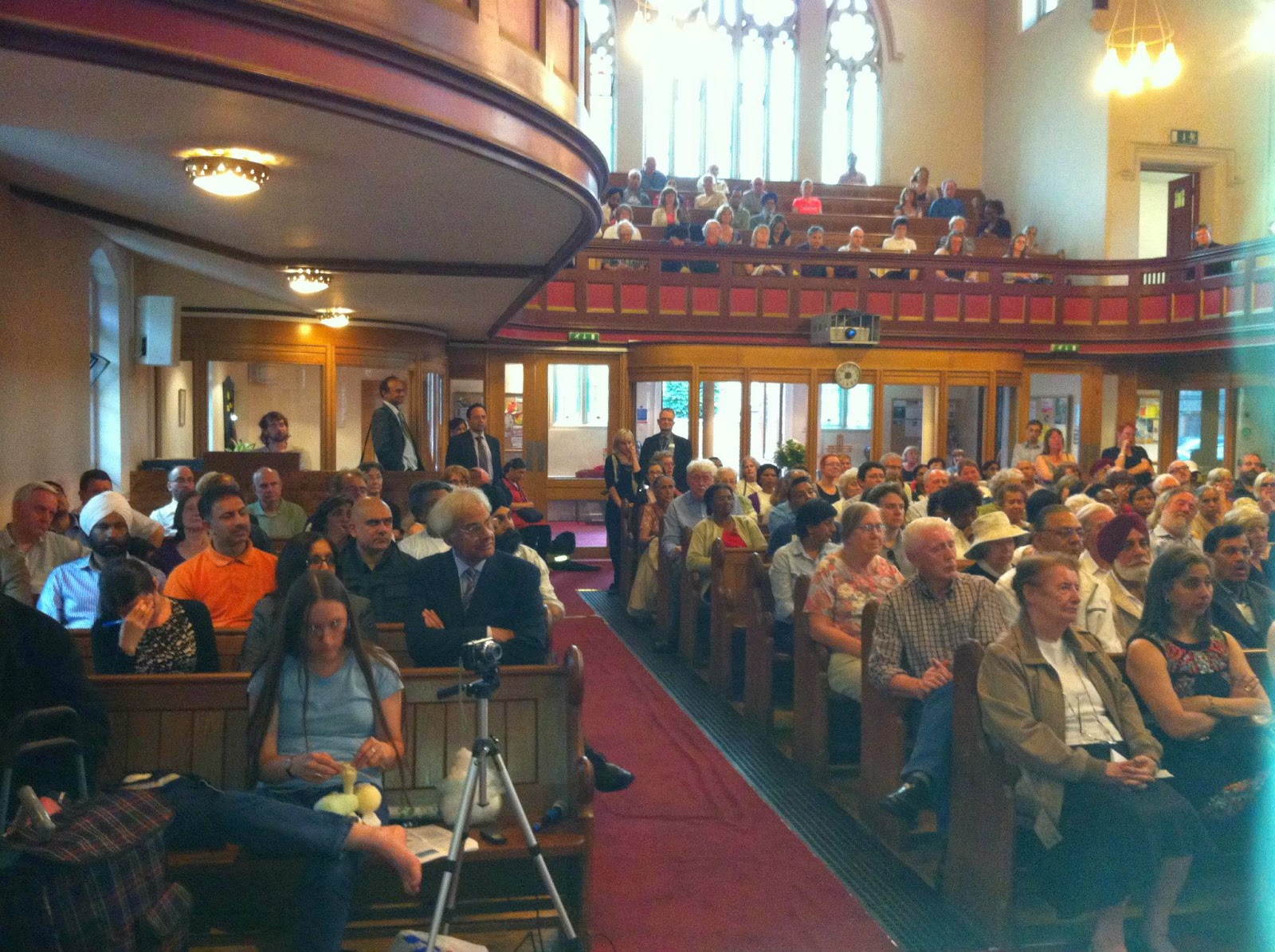
DEFENDING NHS. Public meeting in Hanwell Methodist Church, part of campaign to save Ealing Hospital services. Now Ealing trades unionists have warned NHS is under threat from secret negotiations for Transatlantic Free Trade pact. 
(photo Raj Gill)

IF you had asked me a few weeks ago what I thought about TTIP, you'd have got a blank stare or maybe me turning away thinking you were trying to flog me some finance or insurance scheme.

If you'd managed to tell me the initials stood for Transatlantic Trade and Investment Partnership, I might not have been much the wiser, even if you'd added that this is also called the Transatlantic Free Trade Area.

Governments and their media supporters rely on people like me being lulled into apathy over stuff that we don't think affects us, or distracted by sensationalised trivia, while they get on with doing what they like.

Fortunately, in between the Euro-elections and the FIFA world cup, friends have started to  put me right. This TTIP is not just some technical arrangement concerning tariffs and trade. It would very much affect things that concern me and you.

At its heart is a move to enable big business interests to dominate  countries, not only through influence, corruption and lobbying, but by law. Companies could take elected governments to court over anything which restricted their ability to profit. They could roll back legislation protecting the environment, food standards, workers' rights, safety at work - something of which we have already had a taste in this government's moves to deregulate and cut inspections - and provision of health services.

It is reported today that 'The European Union's trade commissioner Karel De Gucht has denied that the mooted trade deal between the EU and the US will give multinational corporations power over incumbent governments. Speaking at an event in London, De Gucht said that he will "launch a public consultation on exactly how the EU should approach these discussions"'.

http://www.ibtimes.co.uk/ttip-eu-trade-commissioner-launch-public-enquiry-into-fears-over-multinational-power-1454140

We have already seen this Con Dem coalition taking steps to remove laws which get in the way of "fracking" companies. If the Tories and Lib Dems are happy with TTIP, Labour too is arguing that it will bring prosperity and be good for jobs. But the Labour Party admits there could be dangers for the NHS.

'The UK's shadow trade and investment minister Ian Murray has said that Labour will withdraw its support for the controversial Transatlantic Trade and Investment Partnership (TTIP) if safeguards are not inserted to protect public services including the NHS from US investors.

In an interview with IBTimes UK, Murray also said there is "no case" for including investor-state dispute settlement (ISDS) instruments in the free trade agreement between the EU and US.

If included in TTIP, ISDS would allow multinationals to take legal proceedings against EU governments for loss of profits due to public policy decisions.

Asked whether Labour support was dependent on both these items being excluded, Murray replied: "That's certainly the position of the Social Democrat members of the European Parliament, and Labour is part of that. They're very much of the view that the general utilities reservation [which would exempt public services] and ISDS are the red lines for them – and for us as well."'
http://www.ibtimes.co.uk/ttip-labour-will-not-back-eu-us-trade-deal-without-nhs-safeguards-1453082

We have already seen how the last Labour government introduced the Tory idea of Private Finance Initiatives (PFIs), helping open areas of the service to private profit, and saddling hospitals with debts for which cuts are having to be made. With Con Dem policy treating health provision as just another business, the way would be open under the TTIP for big multinational companies to move in, claiming any requirements privileging the NHS were an unfair restriction on their right to profit.  

In the week before Ian Murray spoke to the press, thee annual conference of trades union councils in England and Wales,meeting in Cardiff on the weekend of June 14-15,  adopted this Emergency Motion from Ealing trades council in west London, one of the areas where people are resisting the cuts: 

Emergency Motion 2:
TTIP - The Transatlantic Trade and Investment Partnership

Conference notes EU elections appear to have reinforced the likelihood of the TTIP being adopted, which could be a disaster for the NHS.

If the EU and the US agree to TTIP without excluding the NHS from its provisions, the result could mean the end of the NHS as a public service. Corporations could permanently have the legal right to run health services with or without approval of the British Government. The marketisation of the NHS under the Health and Social Care Act means that the NHS will no longer be categorised as a ‘public service’ and would therefore be included in the provisions of the TTIP which restrict or prevent national governments from determining how industries are run. TTIP can override not only health and safety, but pay arrangements, union agreements and other basic standards. The markets take legal priority.

We endorse the concerns that have been expressed by TUC General Secretary Frances O Grady, and many labour movement figures and health campaigns.

Therefore as secret negotiations on TTIP continue, we call on the TUC and Trades Councils to make this a key national and local campaigning issue in the coming weeks and months. We need to urgently alert the public to this threat to our NHS and as well highlight the dangers of the huge power of transnational corporations under TTIP and other agreements.

War on Want has produced a booklet by John Hilary warning against the TTIP, and called a series of meetings and events around the country as part of a campaign:

8 July, Birmingham, 7pmBerta Wright Room, Carrs Lane Centre, B4 7SX (map) - sign up via Facebook here

9 July, Manchester, 7pmNW UNISON Regional Centre, Arena Point, 1 Hunts Bank, M3 1UN (map) - sign up via Facebook here

10 July, London, 7pmMander Hall, NUT, Hamilton House, WC1H 9BD (map) - sign up via Facebook here

12 July, national day of action: No TTIP! events planned for around the country - sign up here


Make TTIP a national and local campaigning issue, says trades councils' conference resolution

(photo Charlie Pottins)


http://www.ibtimes.co.uk/ttip-eu-trade-commissioner-launch-public-enquiry-into-fears-over-multinational-power-1454140

http://www.huffingtonpost.co.uk/2014/04/02/ttip-us-eu-trade-deal_n_5050117.html

http://www.waronwant.org/campaigns/trade-justice/more/inform/18078-what-is-ttip

Labels: , ,

Sunday, September 29, 2013

Where do the Tories get their ideas?


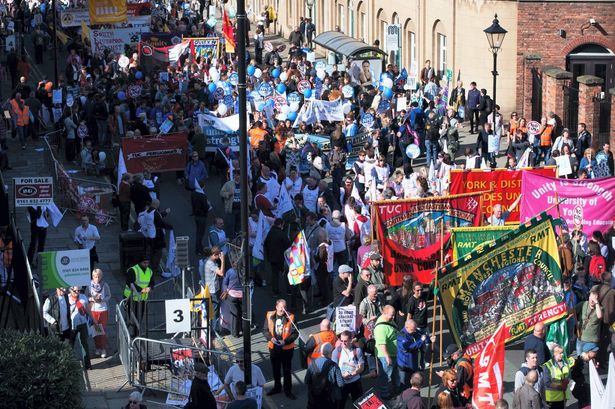
Around 50,000 marched through Manchester in protest at the government's austerity measures as the Conservative Party conference began

WORKING PEOPLE were marching outside.Part of demonstration against Tory Austerity and in defence of NHS. Greater Manchester Police said it was biggest demonstration they had ever had, and no arrests were made but it wasn't to be seen on BBC TV.
  Photo from Manchester Evening News


"FOR HARD WORKING PEOPLE" read the banner greeting delegates arriving at this year's Tory party conference, in Manchester, echoing something said repeatedly at the Labour Party conference in Brighton. Well, they're a little bit rattled, and not too proud to nick a phrase, or anything else.

True enough, I imagine avoiding tax can be hard work, and so can justifying bankers bonuses. If the 50,000 or more (according to police estimates!) people marching outside against austerity and to defend the NHS disagree and don't recognise the Tories as being for them, there were high metal barriers to shield them from view, and security to stop TV from filming the demonstration.

I don't know whether that really explains how so many people filling the streets of Manchester became invisible on the early evening news (though we got a little glimpse later). Not even HG Wells' imagination could run to that, but it's a free country, so we're told, and where would we be without the media?

What we got was David Cameron saying he is "not going to stand by as people's aspirations to get on the property ladder, and own their own home are trashed". Ninety per cent mortgages. It won't lead to a housing bubble, we're assured. Not that house prices are already out of reach of working people. Nor - apart from a woman from the Institute of Economic Affairs - was anyone so rude as to recall the part played by sub-prime mortgages turned "toxic assets" in bringing on the world financial crisis.

We were given clips of Margaret Thatcher for the faithful, championing the "right to buy", but I suppose  it would have been disrespectful of the dead to blame her for so many Brits being so in debt, remember the words "negative equity", or mention how a big proportion of council homes that were sold have ended up in the hands of private landlords. As for new homes being built, a large percentage are now being sold abroad, not for would-be immigrants, dread the thought, but as an investment. 

Of course when Cameron promises to help people to own their own homes, he does not say anything about the increasing numbers who have not got a home, or those whom the combination of bedroom tax, rising rents and benefit capping are driving from pillar to post.  

 For those already on the pavements, who include a large number of ex-services personnel about whom our politicians and papers care so much, we've seen Redbridge police snatching food and sleeping bags from them, and Westminster council is making it illegal to give them food. The government has criminalised squatting but maybe David Cameron will promise the right to purchase your own bit of pavement and cardboard box.     

  But of course the whole point of the claim to be for "hard working people", to promote marriage, and to support those with "aspirations", is that rather than be angry with the rich who are responsible for the mess we're in, we are supposed to find someone worse off and less respectable than us to take things out on. Which is why Cameron and his crew are expected to announce new measures extending workfare, forcing the unemployed and disabled not only to search for jobs that are not there, but to accept work at less than a living wage, or even unpaid, what amounts to slave labour. Those who are in a job are supposed to feel better that someone is making those lazy b.s work, even if we wake up to find that the employer is getting rid of us because he can not only hire someone cheaper off the dole, but get them free of charge because they have to work for benefit.

There have been setbacks for this drive, companies have dropped out because of resistance and bad publicity, but notwithstanding that old slogan I recall that "Conservative Freedom Works!", it is becoming Conservatives Will Make You Work for Free!", and the government's advisers and septic think tanks are saying Workfare is popular!   

Reading about the so-called Policy Exchange which tends this kind of advice, people ask what it is and where it comes from. Something made me do a search linking 'Policy Exchange' with 'LM' and 'Spiked'. Well you never know. And here is one of the little tales this brought to light. I'll call it

Boris and the Handmaid.


Munira Mirza is an Oldham lass who went to Oxford, and the University of Kent, where she studied under Frank Furedi, the onetime thinker of the Revolutionary Communist Party(RCP), and Living Marxism (LM). A lasting association with this particular strain of "leftism" does not appear to have hindered Munira's career. Quite the contrary.

Today she is the Advisor for Arts and Culture Policy of the Greater London Authority under Boris Johnson's Tory mayorality.

According to her former employer, centre right think tank Policy Exchange, “Munira - author of the Policy Exchange pamphlet Culture Vultures - is not a card-carrying Tory member, but is one of a new generation of thinkers behind David Cameron's makeover of the party that is attracting money and fresh ideas.”
http://www.powerbase.info/index.php/Munira_Mirza

It was soon after Munira Mirza joined Boris Johnson's team that the Cuba Solidarity Campaign was told that its Cuba Fiesta stage event was no longer wanted as part of the Rise festival in London. This festival, a hangover from Ken Livingstone's time, when it used to be called Respect (before George Galloway's party took that name), had been used to promote enjoyment of cultural diversity and good relations between communities, but as Mirza told the Cuban campaign, "it is no longer appropriate to have overtly political organisations involved in the programme or in the community area". When it was learned that "United Against Racism" would be dropped from the festival's publicity, trade unions and others who had taken part previously decided to take their support elsewhere.

But Boris' handmaid had set out her ideas beforehand, in a paper arguing that promotion of multiculturalism and emphasis on diversity actually strengthened racial divisions. This was published in 2004 by the Institute of Ideas - an outfit headed by Claire Fox, a former leading member of the RCP and co-publisher of LM magazine. Criticisng the Race Relations Amendment Acts and its requirement on bodies to promote good relations and diversity policies, she also  argued against any special conditions for minorities, and any measures to outlaw religious incitement, treat racially motivated crime differently, or interfere with the "free speech" of such as the BNP.  The Institute of Ideas is particularly keen on free speech. Claire Fox has been a guest on the BBC's "Moral Maze" and "Question Time". 

In 2007, Munira Mirza was one of the authors of Living Apart Together, British Muslims and the Paradox of Multiculturalism in 2007, published by the Policy Exchange, of which she had become  an Associate Research Fellow and for whom she also worked as a fundraiser, having the title Development Director.  Unlike the Institute of Ideas, which shared the old RCP offices with Spiked, the Policy Exchange has always shared offices with conservative think tank CChange (active 2001-2007), of which Dougie Smith, her now husband, was the co-ordinator.  ,

As we've said, Mirza does not seem to have had much trouble combining her links to the "Left" and Right. (But then Claire Fox has said these two terms no longer mean anything). Her association with Spiked!, which enables former RCP types esconsed in the Tory media to keep up their 'radical' pretensions, will have brought her in contact with Brendan O'Neill. In 2006 they co-founded the Manifesto Club, an organisation "with the aim of challenging cultural trends that restrain and stifle people's aspirations and initiative" . Brendan O'Neill too has opposed efforts to counter racism, in sport and other fields,

The report Mirza co-authored for the Policy Exchange, ‘Living Apart together’ included references to work from Josie Appleton, Andrew Calcutt, Kenan Malik and Brendan O'Neill. The last two are both former members of the RCP,  O'Neill, who writes for the Daily Telegraph, has been a supporter of the government's "welfare reform", criticising those who drew attention to the deaths of disabled people who had been passed "fit for work" and lost benefits.

    Munira Mirza's husband Dougie Smith, is a former vice Chairman of the Federation of Conservative Students, and ex-Cameron speechwriter. In this intertwining of libertarian spirits we are reminded of the coincidence remarked in west London, of former RCP general secretary Kate Davies at the Notting Hill Housing Trust, and her partner becoming housing director with Hammersmith and Fulham council, where former FCS figure Harry Phibbs is a prominent councillor.


    http://randompottins.blogspot.co.uk/2010/02/notting-hill-but-not-much-trust.html

    http://randompottins.blogspot.co.uk/2012/08/life-and-death-is-not-game.html 


    Labels: , , , , , ,

    Saturday, July 06, 2013

    Love Labour's Lost

    WHEN a party leadership announces it has sent a report on its internal affairs to police, ahead of it even being seen by the members it is about, we may wonder what it is going to be like in government, assuming it ever reaches that office.

    WHEN it is the Labour party leadership apparently accepting the Tory jibe that trade union influence is a "scandal", and not only attacking the Party's biggest source of funds (biggest in membership as well as the amount it contributes), but the very relationship which gave it birth, we may wonder whether it even wants to win.

    Trade unions have yet to regain the strength they had in the past, when so many workers were employed in industry  (and union block votes were employed more than once by Labour leaders to roll over the Left in the constituencies).  But in the last few years they have started to register a slight growth in membership. And unlike MPs, and despite the hostile media, trade unions seem to be regaining some popularity. They could make a difference at election time in persuading working people it is worth going to vote. Even now Labour's gains in the polls reflects a belief, however mistaken, that it will mean a change, for instance in defending the NHS, and not continue the Con Dem politics of privilege and austerity.

     A report in the Guardian yesterday claimed:
    "Ed Miliband is to review the Labour party's historic relationship with the trade union movement amid calls from senior party figures for him to use a bitter row with the Unite general secretary, Len McCluskey, to break the formal link. As Labour referred allegations about the handling of the process for selecting a parliamentary candidate in Falkirk to the police and procurator fiscal, senior party aides indicated that Miliband would embark on a bold step of reform in the coming weeks.
    The report said Ed Miliband "has made no decisions on whether to break Labour's links with the trade unions, which were responsible for the founding of the party in 1900. But the Labour leader, who raised the possibility of corruption in Falkirk, is understood to believe that he must adopt a consistent approach in tackling 'unaccountable vested interests'.
    Labour Party members may note that it is apparently up to one man, and not the party membership or conference, nor even the national executive, to take this momentous decision!  And we in the trade unions are supposed to need teaching lessons in democracy!

    We may also note that unjust sneer in quotes at unions as "unaccountable vested interests", similar to something Tony Blair said when he was first elected. And though the report goes on to equate the unions with Rupert Murdoch, we remember that Blair went on to bow to Murdoch, and to other billionaires. Unlike them, Len McCluskey has been elected and re-elected, and he is accountable to hundreds of thousands of hard-working people, from dockers to doctors, draughtspersons to refuse disposal operators, who keep this country going, pay their taxes, and if they expect an influence in return for paying the political levy, don't go in for hacking 'phones, buying politicians, or bribing policemen.     

    Len McCluskey was shocked yesterday by the news that Miliband is going to the police with the allegations about irregularities at Falkirk.The union was being "mercilessly attacked", he said "though we have not done anything wrong".

    "I haven't even seen this report. We were told when the inquiry was taking place that any allegations against the people who were being accused of things would have an opportunity to respond. They weren't even interviewed. Unite wasn't interviewed. This is absolute nonsense and I would hope that a calming influence could come into this," he said.
    As he spoke in a hospital car park in Trafford, Greater Manchester, McCluskey attacked the way shadow cabinet members, including Jim Murphy, have attacked the union for "overstepping the mark" in Falkirk.
    "What does that mean? We asked too many of our members to join the Labour party? We should have told them that the Labour party was full up perhaps," he said. "It is a nonsense and I am afraid that the way that this has been handled by Labour party HQ is nothing short of disgraceful," he said.
    http://www.guardian.co.uk/politics/2013/jul/05/labour-police-falkirk-selection-row

    Incidentally, since it wasn't mentioned in that report nor in what I saw on TV, readers might wonder why Len was hanging about in a hospital car park yesterday. He was at the Trafford General hospital to commemorate 65 years since Aneurin Bevan inaugurated the National Health Service on a visit to the same hospital (then Davyhulme Park) on July 5, 1948. The Unite leader spoke at a rally in nearby Golden Hill park to oppose cutbacks in the NHS. You can please yourself what significance to attach to that, but funnily enough my friends in Manchester who were pleased to report Len McCluskey's presence at their event did not even think to mention his row with Ed Miliband over Falkirk. Just goes to show what the media think important and what ordinary people are worried about isn't always the same thing.

    The search for a new candidate in the Falkirk constituency was made necessary when current MP Eric Joyce had to resign the party, and announced he would not stand again. The former Army major had been given a 12-month community order and fined £3,000 after he admitted committing an assault in a House of Commons bar last year.

     But he has not given up politics nor battling, it seems. Accusing Unite of behaving "irresponsibly", he wrote:

    "Stephen Deans, chair of Unite in Scotland and a local shop steward, was installed as chair of Falkirk West constituency Labour party (CLP), which covers about 70% of my constituency. In line with wider Unite policy, he immediately began an extensive recruitment campaign at work – Ineos refinery in Grangemouth, and in a local pub, The Broomhill Inn – the aim being to dominate the selection vote for my successor without persuading existing members to support the Unite candidate, Karie Murphy."
    http://www.guardian.co.uk/commentisfree/2013/jul/05/unite-falkirk-irresponsible-labour

     It is claimed some Unite members received letters welcoming them to the Labour Party without being aware they had joined, Unite having paid their subs to convert affilated to full membership. But presumably they could not have cast their votes without knowing it.


    On June 25 Labour placed the Falkirk party under special measures, and Karie Murphy, who had already stood aside from the selection while it was being investigated, was suspended from the Party last week along with Stephen Deans. Labour's national elections manager Tom Watson MP, in whose office Karie Murphy worked, resigned from the shadow cabinet, explaining : "It’s not the unattributed shadow cabinet briefings around the mess in Falkirk that has convinced me that the arrangement has run its course (though they don’t help). I believe that the report should be published – in full – and the whole truth told as soon as possible so that the record can be made clear. I’ve still not seen the report but believe there are an awful lot of spurious suppositions being written.
    http://socialistunity.com/tom-watsons-resigns-from-shadow-cabinet-letter/
    http://www.huffingtonpost.co.uk/2013/07/04/tom-watson-quits-shadow-cabinet_n_3546279.html

    Watson appears to believe he can do a better job of fighting the Tories from outside the shawdow cabinet team:
    "I wish to use the backbenches to speak out in areas of personal interest: open government and the surveillance state, the digital economy, drones and the future of conflict, the child abuse inquiries, the aftermath of the Murdoch scandal and grass roots responses to austerity".

    Whatever was happening in Falkirk, it may be the focus but it is not the whole story of the row between the Labour leadership and Unite. Some old and discredited names from the last Labour government have been complaining about the union's influence. 
    http://www.guardian.co.uk/politics/2013/may/12/unite-union-accused-manipulation-labour-selection

    An organisation called Progress, founded in 1996 by Liam Byrne, now Labour's shadow Work and Pensions secretary, and fomer Mandelson aide Derek Draper, is keeping up the Blairite legacy with its own annual conference attracting past and present cabinet ministers. It might be considered a "a party within a party", and probably would be challenged as such if was on the Left, which it obviously isn't. Registered as a company, it has received  millions of pounds in donations, mainly from Lord David Sainsbury of the famous grocery family.

    Obviously these are the kind of people you want to get on with if you fancy a career, in or out of politics, and there are still plenty of ambitious careerists and wannabes attracted to New Labour's promise of opportunity in some constituency parties.    

    Some of these have been getting upset about trade union and supposedly "hard left"influence getting in their way. 

    A blogger on the Labour Uncut site complains at how a previously hopeful Anne Fairweather in south London has been relegated from the Party's Euro election list. " Her crime seems to have been to work in business and not be one of the chosen candidates of the unions and the left".
    http://labour-uncut.co.uk/2013/04/15/london-labour-revolt-over-euro-list-grows/

    Further light is shed on why those dreadful union people and left-wingers might not have been happy about Ms.Fairweather's background in business:
    Although Anne was apparently a hard working candidate in the 2009 election, she is seen as politically unacceptable to a large section of Labour’s electoral support as she used to be Head of Public Policy for REC, the trade association for recruitment agencies, and in that capacity had lobbied against extensions of employment rights to Agency workers, both in the UK (PDF) and in Brussels. Given a strong field of candidates no one individual should have a sense of entitlement, and a candidate who had been aligned with lobbyists for deregulation in the employment market should not be surprised if she is seen by many as outside the mainstream of Labour Party values. Anne left the employment of the REC in 2010.

    http://socialistunity.com/falkirk-west-and-the-developing-row-between-labour-and-unite/ 

    Knowing how trade unions like Unite and Labour MP John McDonnell sought to extend employment rights to agency workers, I could imagine there might be some feeling against a lobbyist for the other side, even if she was "only doing her job". But then I am one of those old-fashioned dinosaurs raised on the belief that the labour movement should take sides on workers' rights.

    Here's Labour Uncut again, digging out the enemy, and focusing on Unite:
    Dave Quayle, chair of Unite’s national political committee set out their priorities in an interview for the website of Marxist fringe group, the Alliance for Worker’s Liberty,

        “We want a firmly class-based and left-wing general election campaign in 2015… We want to shift the balance in the party away from middle-class academics and professionals towards people who’ve actually represented workers and fought the boss.”

    Although Len McCluskey has been attacked by some on the Left, often those who only yesterday were buried in the Labour Party themselves, for sticking with Labour, - Unite funds the party to an estimated £8 million pounds - he has made clear that he is not giving the party a blank cheque politically, as seemed to happen under some of his predecessors. He has attacked the Labour leadership's warnings that they would have to continue with cuts, and told Ed Miliband to stop listening to the likes of Blair and Mandelson.

    "I want Labour to be re-elected but Labour will only be elected if it offers a radical alternative, a real alternative to the doom and gloom and misery and despair currently offered by this government,” he said.

    http://www.telegraph.co.uk/news/politics/10012950/Len-McCluskey-Labour-must-reject-austerity-or-lose-2015-election.html

    The contempt with which McCluskey utters the name “Blair” prompts me to ask him about the recent return of the former prime minister to the domestic fray and his warning in the New Statesman that Ed Miliband must not “tack left on tax and spending”. “My message to Ed is to take no notice of the siren voices from the boardrooms of JP Morgan or wherever else he is at the moment,” he tells me. Blair and the other New Labour grandees who have urged Miliband to pursue a centrist strategy are “locked in the past,” he says, describing them as “deniers of what happened in 2008”.

    “It may be easy for these people, who are sitting with the huge sums of money that they’ve amassed now – they’ve done pretty well out of it. Remember it was Mandelson who said he was comfortable about the filthy rich – presumably that’s because he wanted to be one of the filthy rich. But the fact is that under Labour the gap between rich and poor increased . . . that’s a stain on what Labour stands for”.
    http://www.newstatesman.com/politics/politics/2013/04/len-mccluskey-if-ed-miliband-seduced-blairites-hell-be-defeated
    That mention of JP Morgan, the Wall Street bank that once financed Mussolini, is not unimportant. It did not hire Tony Blair a couple of years ago because he is some kind of financial whizz kid. Blair may be a war criminal in many people's eyes, but in Britain as in the EU and the Middle East, he has the chutzpah to go with his Catholic conversion, and knows which palms to grease and which doors to open. Morgans have set their sights on destroying social democracy in Europe.

    The struggle in the Labour Party, wherever it may end, is not seperate from the class struggle, but part of it. And we don't have to pretend Unite is lilywhite pure or Len McCluskey always right to know what side we are on.  


    Labels: , ,

    Wednesday, April 18, 2012

    Druids in Town. A timely reminder.

    http://www.bridgwatermercury.co.uk/resources/images/289278/?type=display https://8564307350080373093-a-1802744773732722657-s-sites.googlegroups.com/site/bridgwaterwestoverweb/news/thedruidsbannerisonthemoveatlast/banner01.jpg?attachauth=ANoY7cphBjfmU0CNXEJD7vfsGncc8dNsN9ZpqfwLNnVablBEt_qBhMjYmu-i35j3USRv8GelsnXGczCo3sp-PGMsmobL08Itb06km3vW8MWT_sQxMwrNcZ4ec_sXI3upNWJZ4ETVKyM91oD_fGpnBhjNa0_-BCULtXrUGh8TdHTwHv_qnkh4Eq8HcySX9azDPgbofAvzbc1Jo1k6vkA9Zp4PyJWhkpIZ3AkwaDxdD4Bu2rvTOaqwbegqSAWd-lupetSxRFO-nvyzLl1Go4L3M5pA7j2ZbbYGWA%3D%3D&attredirects=0
    SILK banner of the Druids, and (right) Dave gets it on his bike.

    IF you have only recently joined the readership of this blog, you may be relieved to know that it isn't all gloom and outrage, as now and then without detracting from our anger against governments and the system, there's news to let us lighten up a little.

    Thanks to friends out West we have the good news that the banner of the Druids has been seen again in Somerset. Nothing to do with bardic robes or Midsummer night's ritual dancing around stone circles, but a bit of fine tradition nevertheless.

    We've remarked before on Bridgwater postal worker Dave Chapple's ability to discover treasure, whether mining the memory of an old Mancunian militant in a care home, or digging out rich history from a heap of old union branch records in the cupboard, and bringing it to life by going to interview a participant.

    This time it was going through the attic at Bridgwater Labour Party's Unity House that Dave, who is secretary of Bridgwater and District trades union council, and Labour councillor Brian Smedley found the colourful silk banner of the Druids Friendly Society, which had not seen the light for over 80 years. Now the banner has been donated to the town by the Labour Party, and yesterday Dave and Brian managed to load it on Dave's post office bike, take it through the town centre and deliver it to the Council Chamber just before the rain came on.

    Dave Chapple said "This wonderful silk banner of the Bridgwater Independent Druids' Friendly Society was made by George Tutill in East London in about 1890 and is now in the care of Bridgwater Town Council at the Town Hall with a real chance it can be displayed for local people to see, if some basic conservation work can be completed. Friendly Societies-still existing today-were in some ways the 18th and 19th century precursors of trade unions and looked after working-class people with sick out of work and funeral benefits."

    Measuring 12ft by 14ft, and complete with carrying poles, brass spearheads and silk cords and tassels in its original box, the banner dates from about 1890 and features designs painted in oils on both sides which show the two sides of its purpose. On one side there is an imaginative picture depicting characters in ancient dress, with Stonehenge in the background, and a Celtic cross, as well as the all-seeing eye often found in masonic designs.

    But the other side shows a man in a modern suit, visiting a family with its sick and invalid breadwinner, and bringing some money. It is inscribed "I was sick and ye visited me".

    At the end of the 19th century 1,145 Bridgwater people were registered with the Druids and this figure had risen to 2,000 in 1917. As Councillor Smedley explains:

    "In those days,before a National Health Service, groups such as Friendly Societies provided sickness, unemployment and funeral benefits for Bridgwater's poor and actually saved families from destitution. This banner and what it stands for should serve as a reminder to today's generations of how ordinary working people organised and fought back against the injustices of of a society stacked against them and brings to mind the struggle that many people continue to face even to this day ."


    https://8564307350080373093-a-1802744773732722657-s-sites.googlegroups.com/site/bridgwaterwestoverweb/news/thedruidsbannerisonthemoveatlast/banner04.jpg?attachauth=ANoY7cpjPqV2ZYg2kTlrlMMMdRnqEDNd3akFO4ujPmMUxQFJUeHCoy9Xr8pyc5ehWJRLDK7Va9a6tbj7rLDu6Gbdf14DSh3Js6419x3ExiFB9bely0wU7g13vu_lRqaKC_XHIerczvLB6ZGvslnHnfDqpyWgkmbbazJRGp_jLcW53wYRVMpAPKvUB74GHyPNNBMuAoWPlv3YD4T3p380PALq6BvFsaDYArbeGdnW3UekB4HKPFkvgQl_UsAdglAq2i0cR7fDYaZ-NWCDtOGlTa0nyZzR5sj03A%3D%3D&attredirects=0


    https://sites.google.com/site/bridgwaterwestoverweb/news/thedruidsbannerisonthemoveatlast

    http://bridgwatertuc.blogspot.co.uk/2012/04/bridgwater-druids-friendly-society-silk.html

    See also, some references to Dave Chapple's historical work:

    http://www.labournet.net/events/0601/suss1.html

    http://randompottins.blogspot.co.uk/2010/02/west-country-postman-finds-hidden.html

    http://randompottins.blogspot.co.uk/2010_06_01_archive.html

    Labels: ,