Showing posts with label stats. Show all posts

Monday, May 03, 2010

Report: The Community Service Desires, Civic Lives of Returning OEF/OIF Veterans
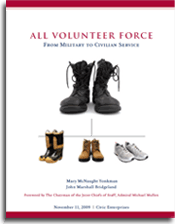
Flush with important skill sets and valuable experiences, military veterans can be counted among a community's greatest assets. Unfortunately, one barrier they face when out of uniform and in a civilian capacity is a feeling of disconnection from the very people they wish to serve.

So says a a 44-page report, All Volunteer Force: From Military to Civilian Service [pdf]. Published last November on Veterans Day by public policy firm Civic Enterprises, it presents the findings of a first ever nationally representative survey focusing on veterans' homecoming transition and civic lives.

The survey found that "only 13 percent of veterans strongly agree their transitions are going well. Yet those veterans who said they had volunteered since returning home had better transitions than those who had not." More:

  • Nearly 9 out of 10 veterans said Americans could learn something from their example of service, yet only half considered themselves leaders in their communities as a result of their military service.

  • Nearly 7 in 10 veterans had not been contacted by a community institution, local non-­‐profit, or place of worship after their return home.

  • 92 percent of OIF/OEF veterans agreed that serving their community is important to them.

  • Veterans said a diverse range of issues was important or very important to them: helping military families (90 percent), being involved with disaster relief (88 percent), working with at-risk youth (86 percent), and being involved with the environment/conservation (69 percent).

  • 7 in 10 non-volunteering veterans said they do not have enough information of meaningful service opportunities.

In extended, a portion of the report's statistic-heavy intro.


Friday, April 30, 2010

The Singular Trails and Trials of Female Combat Veterans

Sharing a handful of recent news reports focusing on the unique military service and civilian reintegration experiences of our women veterans. A good intro for our purposes from Jayme Fraser, Montana Kaimin:

Military policies banning women from the frontline are disappearing as the number of female veterans in the United States nears 1.9 million.

“I think we’re growing up,” Army National Guard Capt. Dawn Gray said. “If you look at other countries, especially Israel, women are not excluded from any combat role if they can physically handle it.”

The role of women in war has expanded significantly since World War II, when women moved into the workplace void left by men going off to war.

“There are only a few places that women aren’t actively assigned and I expect that will change, too,” Gray said.

Female pilots fly combat missions for the Air Force and Navy. Though Army policy prohibits women from the frontline, temporary assignments and test programs, as well as changing dynamics of urban warfare in Iraq, have put more female soldiers into combat.


Tuesday, April 27, 2010

Combat Clips: A Selection of OEF/OIF Veteran Statistics, April 2010

Quick looks at the latest news containing statistics of interest to returning veterans, military families and their caregivers.

First up, Kristin M. Hall for AP:

Brig. Gen. Stephen Townsend addressed the 101st Airborne Division with military brusqueness: Suicides at the post had spiked after soldiers started returning home from war, and this was unacceptable.

"It's bad for soldiers, it's bad for families, bad for your units, bad for this division and our Army and our country and it's got to stop now," he insisted. "Suicides on Fort Campbell have to stop now."

It sounded like a typical, military response to a complicated and tragic situation. Authorities believe that 21 soldiers from Fort Campbell killed themselves in 2009, the same year that the Army reported 160 potential suicides, the most since 1980, when it started recording those deaths.

But Townsend's martial response is not the only one. Behind the scenes, there has been a concerted effort at Fort Campbell over the past year to change the hard-charging military mindset to show no weakness, complete the mission.


Tuesday, April 13, 2010

Latest Military Combat Veteran Suicide Statistics

Military suicide figures recently reported on in the press. First up, Mark Thompson asks in an article for Time magazine, Is the U.S. Army Losing Its War on Suicide?

From the invasion of Afghanistan until last summer, the U.S. military had lost 761 soldiers in combat there. But a higher number in the service — 817 — had taken their own lives over the same period. The surge in suicides, which have risen five years in a row, has become a vexing problem for which the Army's highest levels of command have yet to find a solution despite deploying hundreds of mental-health experts and investing millions of dollars. And the elephant in the room in much of the formal discussion of the problem is the burden of repeated tours of combat duty on a soldier's battered psyche. ...

[T]he service's suicide rate continues to rise (it doubled between 2001 and 2006) while remaining flat in the civilian population, even when adjusted to reflect the Army's age and gender. Last year, 160 active-duty soldiers killed themselves, up from 140 in 2008 and 77 in 2003.


Sunday, April 11, 2010

Chicago Tribune Reports on VA Claims Process Quandary

Headline splashed across the front page of today's Chicago Tribune: The Cost of War.

Analyzing more than 3 million VA disability claims (this figure equals the number of vets receiving such compensation in 2009 -- a jump of 24 percent over the 2003 total), it is the latest in a long line of government and private studies on problems at the VA. The Trib found:

The bulk of the increases didn't come from veterans of the current wars in Iraq and Afghanistan but from those who served years or even decades before. Veterans from the Vietnam and Persian Gulf eras accounted for roughly 84 percent of the rise in spending, which hit $34.3 billion last year.

The surge from past eras comes even as more soldiers than expected are returning home from Iraq and Afghanistan in need of care. With hundreds of thousands of troops still deployed, the VA already provides disability payments to nearly 200,000 veterans from the current conflicts, a number that is expected to balloon during the next 30 years.

The unanticipated crush of claims is exacerbated by the VA's antiquated compensation system, which hasn't been overhauled since 1945. Cumbersome and heavily bureaucratic, the system requires a mountain of paperwork, is based on diagnoses that lag far behind medical advances and runs on a computer system that is so outdated it can't accurately verify whether veterans were deployed.


Are Veterans Who Kill in Combat More Likely to Get PTSD?

Yes. (Not a very surprising conclusion, is it?) Recent research shows this to be true for Iraq War veterans:
[A study led by Shira Maguen of the San Francisco VA Medical Center and University of California-San Francisco] examined the mental health impact of reported direct and indirect killing among 2,797 U.S. soldiers returning from Operation Iraqi Freedom. Data were collected as part of a postdeployment screening program at a large Army medical facility. Overall, 40% of soldiers reported killing or being responsible for killing during their deployment. Even after controlling for combat exposure, killing was a significant predictor of posttraumatic disorder (PTSD) symptoms, alcohol abuse, anger, and relationship problems. Military personnel returning from modern deployments are at risk of adverse mental health conditions and related psychosocial functioning related to killing in war. Mental health assessment and treatment should address reactions to killing to optimize readjustment following deployment. ...

Military personnel who have killed may experience significant shame and/or guilt and need to know that they will be allowed to explore the impact of killing in a safe and supportive environment (e.g., Veterans Affairs). They also may have received criticism or been subject to insensitive questioning by acquaintances, friends, or family members that cause them to be weary of speaking to others about this sensitive issue, especially when they fear others will not understand or judge them for their actions.

Source: "The impact of reported direct and indirect killing on mental health symptoms in Iraq war veterans," Journal of Traumatic Stress, Volume 23 Issue 1, Pages 86 - 90

An earlier study by the same research team shows a similar correlation between killing in combat and increased incidence of PTSD in the Vietnam War veteran population.


Wednesday, March 31, 2010

Combat Clips: A Selection of OEF/OIF Veteran Statistics, Feb/Mar 2010

Recent statistical data found in news reports regarding today's veterans. First up from HealthDay News:

Between 2002 and 2008, nearly 50,000 veterans from the Iraq and Afghanistan wars received diagnoses of post-traumatic stress disorder. But fewer than 10 percent of those completed the recommended treatment of 10 to 12 weekly sessions within four months; the number only grew to fewer than 30 percent over a year, the study authors found.

Some types of veterans are less likely to receive recommended care: males, veterans who are under the age of 25, those who live in rural areas and those who got their diagnoses at primary-care clinics and needed referrals to mental health programs, according to the report published online Feb. 9 in the Journal of Traumatic Stress.

Dr. Karen Seal, the study's head researcher and a practitioner at the San Francisco Veteran Affairs Medical Center, said in a news release that most veterans did attend at least one mental-health appointment. But problems -- including those at the system and personal levels -- led to lack of follow-up.


Saturday, January 16, 2010

Combat Clips: A Selection of OEF/OIF Veteran Study Statistics, January 2010

News clips examining recent PTSD, TBI and other combat trauma or deployment-related study insights. First, Jennifer Thomas for HealthDay via BusinessWeek:

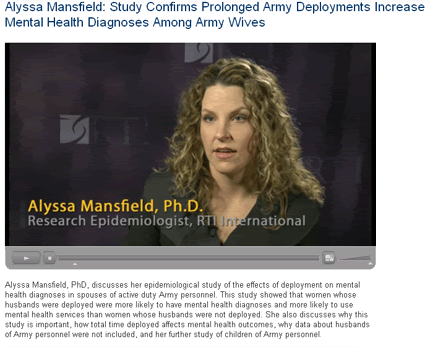
War isn't just tough on soldiers. Army wives whose husbands were deployed have higher rates of depression, anxiety, sleep disorders and other mental health issues than the wives of soldiers who stayed home, a new study shows.

Researchers looked at the medical records of more than 250,000 wives, accounting for most women married to active-duty U.S. Army personnel. Between 2003 and 2006, about 34 percent of the women's husbands deployed for one to 11 months, 35 percent deployed for longer than 11 months, while 31 percent of soldiers were not sent overseas.

Among wives of soldiers deployed for up to 11 months, researchers found almost 3,500 more diagnoses of depression, anxiety, sleep disorders and other mental health issues than among wives who[se] husbands stayed home.


Click on image above to see Mansfield discuss study.


Thursday, January 14, 2010

US Military Responds to Haiti Disaster

"When the freedom they wished for most was the freedom from responsibility, then Athens ceased to be free and was never free again." -- Edith Hamilton (1867-1963), USA

President Obama and our military have begun humanitarian ops in Haiti, and roughly 10,000 troops will be stationed in the area by Monday. While the strain on forces and milfamilies needs to be relieved (and this isn't going to help), we must respond.

David Martin, CBS News:


In extended, preserving a few press reports related to the military's humanitarian work in Haiti right now. The first entry is especially stat and data rich.


Saturday, December 26, 2009

Combat Clips: A Selection of OEF/OIF Veteran Statistics, December 2009

A look at some of this month's news on returning Afghanistan and Iraq veterans. First up, from Gregg Zoroya, USA Today:

About one in four soldiers admit abusing prescription drugs, most of them pain relievers, in a one-year period, according to a Pentagon health survey released Wednesday.

The study, which surveyed more than 28,500 U.S. troops last year, showed that about 20% of Marines had also abused prescription drugs, mostly painkillers, in that same period. ... The survey showed that pain relievers were the most abused drug in the military, used illicitly at a rate triple that of marijuana or amphetamines, the next most widely abused drugs.

About 15% of soldiers said they had abused prescription drugs in the 30 days before they were questioned for the survey. About 10% of Marines said the same thing. Prescription drug abuse is "an issue for American society as well, and we're looking at it from every possible angle," McGuire said.

Painkiller abuse among troops has soared since 2005, the last time a similar study was conducted. The 2005 survey showed that 4% of soldiers had abused painkillers in the previous 30 days, compared with 13% in 2008. Abuse within the previous year was 10% in 2005 compared with 22% in 2008.

Zoroya includes more stats in the full piece, and I've included more recent news clips for you in extended.


Thursday, November 12, 2009

Caregiver Clips: Military Combat Trauma Counseling Statistics, November 2009

This month's clips cover the current state and strain of military mental health counseling in the wake of last week's Ft. Hood shooting. First, from Emily Mullin, Scripps News Service:

Questions are emerging about how a few hundred military mental health counselors are treating thousands and thousands of men and women in the armed forces in Afghanistan and Iraq.

According to official Army figures, 308 military psychiatrists serve 1.4 million active-duty members. On average, 200 behavioral-health personnel - including psychiatrists and other mental-health counselors - are deployed in Iraq and about 30 in Afghanistan.

Dr. Nancy Sherman, a military ethicist at Georgetown University, said the military and mental health care systems in general are "very stressed."

"We are a military fighting two wars at once with a non-drafted army," she said. Sherman said there has been a shortage of military doctors throughout the wars in Iraq and Afghanistan and likely a scarcity of military psychiatrists and therapists.


Wednesday, November 04, 2009

Afghanistan, Iraq Veteran Army Suicide Rate Continues to Climb

The problem is clearly complex.

The reasons are many-fold, as varied and numerous and hard to pin down as are people themselves. But this much we know: Our veterans are turning to suicide at an alarming rate; and, at least for now, all of the programs and outreach and educational campaigns the military and the VA have been throwing at the problem have failed to staunch the tide.

The latest numbers do not provide relief.

Yochi Dreazen, Wall Street Journal:

Sixteen American soldiers killed themselves in October in the U.S. and on duty overseas, an unusually high monthly toll that is fueling concerns about the mental health of the nation's military personnel after more than eight years of continuous warfare. ...

The October suicide figures mean that at least 134 active-duty soldiers have taken their own lives so far this year, putting the Army on pace to break last year's record of 140 active-duty suicides. The number of Army suicides has risen 37% since 2006, and last year, the suicide rate surpassed that of the U.S. population for the first time.

It's important to note that the above figure reflects only Army suicides; it does not include data from any of the remaining military branches or from the VA. And so, if this year's active-duty Marine suicide rate is the same as it has been in previous years (41/2008; 33/2007; 25/2006), expect to add another 30-40 incidents to the above total.

And yet, that figure isn't the full measure, either.


Friday, October 30, 2009

Combat Clips: A Selection of OEF/OIF Veteran Statistics, October 2009

Let's jump right into the data.

First up, VA Secretary Eric K. Shinseki's comments from this week's first-ever joint DoD/VA National Mental Health Summit in Washington, D.C., are noteworthy:

Post-traumatic stress and traumatic brain injury have outcomes as devastating as those from physical injuries, and everyone is vulnerable, Shinseki said, noting that both departments are eager to learn how to better address those injuries through various programs and methods.

The debilitating effects of psychological trauma can lead troops and veterans into a downward spiral of drug and alcohol abuse, homelessness, anger issues, failed marriages and eventually suicide, he explained, noting that more veterans have committed suicide since 2001 than the number of servicemembers killed in Iraq and Afghanistan over that period.

“There is urgency in addressing the mental baggage of war,” he said. “Our newest generation of veterans, returning from the ongoing conflicts, is experiencing increased rates of alcohol and drug abuse and domestic violence as they undergo reintegration at home. While [Iraq and Afghanistan] veterans comprise no more than 10 percent of all veterans being seen for mental health care, they could be in treatment for a very long time if early intervention, diagnosis and treatment are not priorities.”

Although I could have missed it, this is the first time I've seen the volume of OEF/OIF veteran suicides so clearly presented to the American people by a top official.


Sunday, July 19, 2009

Update on OEF/OIF Veterans' Mental Health, VA Benefit Issues

Building upon some of the data-rich news clips shared earlier this week, a few more grafs to consider.

Jia-Rui Chong, Los Angeles Times:

About 37% of veterans returning from Iraq and Afghanistan have mental health problems, a nearly 50% increase from the last time the prevalence was calculated, according to a new study published today analyzing national Department of Veterans Affairs data.

The study, which examined the records of about 289,000 veterans who sought care at the VA between 2002 and 2008, also found higher rates of post-traumatic stress disorder and depression. ... The previous study of national VA data, which examined Iraq and Afghanistan war veterans seeking care between 2001 and 2005, found that 25% of those veterans received mental health diagnoses. About 13% were diagnosed with the anxiety disorder PTSD and 5% with depression.

The new study by Seal and her colleagues, published in the American Journal of Public Health, found that 22% of the veterans in the study had PTSD and 17% had depression. When the researchers compared veterans of Afghanistan from early in the war to veterans of Iraq four years later, they found the rates of PTSD diagnosis more than tripled.


Wednesday, July 15, 2009

Combat Clips: A Selection of OEF/OIF Veteran Statistics, July 2009

I'm always on the look-out for veteran-related stats, and I imagine that many of you are, too. In March 2007, I compiled a master list of data culled from news reports and studies; The War List: OEF/OIF Statistics quickly became (and remains) one of the most popular pages on this blog.

Unfortunately, I haven't had as much time as I'd like these past couple of years to return to it and overhaul it with fresh data. Until that can be done properly and fully, I'll begin occasionally saving and sharing some of the facts and figures I stumble upon during my research that I'd like to ferret away. Welcome to the first dose of random Combat Clips.

As 'cold' and sterile as a sea of numbers can be -- because, of course, the reality is that there is a warm body and full life attached to each of those figures -- taking a broad overview has its merits, too. So, let's get started, shall we?


Tuesday, July 14, 2009

Senate Veterans' Affairs Committee Holds Hearing on VA Gaps in Female Client Care

While most in Washington have been busily paying attention to the Sotomayor hearings this week, the Senate Veterans Affairs' Committee met Tuesday morning to consider the quality of VA care provided to our nation's 1.8 million female veterans.

Some, but certainly not all, of their concerns regarding access to their health benefits reflect the same frustrations felt by their male counterparts. Carrie Wells, McClatchy News:

The Department of Veterans Affairs often fails to provide adequate medical care to female military veterans, five of them told the Senate Veterans Affairs Committee Tuesday.

A Veterans Affairs official agreed.

"At the root is a system that has not been responsive to the needs of women veterans," said Patricia Hayes, the department's national director of women's health care.

The five veterans said women sometimes aren't properly informed upon discharge that health benefits are still available. They described how dealing with government is frustrating and confusing, and that often their unique needs, such as child care and sexual assault counseling, aren't understood by government officials.

"I looked to the VA for help when I most needed it, but never succeeded in completing my enrollment, let alone actually receiving the care I needed," said Genevieve Chase, the founder and executive director of the American Women Veterans organization.

Hayes agreed. "Women don't really know about VA services," she said.

More coverage in extended.

The proceedings, Women Veterans: Bridging the Gap, lasted about two hours and can be viewed in full at the link.


Monday, April 06, 2009

Complementary and Alternative Medicine (CAM) Used at Forts Hood and Bliss, Brain Scan Imaging Detects PTSD Sooner, Migraines and PTSD

  • Acupuncture Today | Weighing the Costs - "Advocates for the integrated approach in the treatment of PTSD at both Ft. Hood and Ft. Bliss were convinced that the traditional methods of treating PTSD weren't long enough in duration, intense enough or comprehensive enough. A program was created that would address all aspects of PTSD and treat the whole soldier. This integrative approach treats many of the symptoms of PTSD that are not addressed through the standard mental health protocols, including cognitive-behavioral therapy and pharmacotherapy. The concept eventually led to the implementation of the Ft. Bliss Restoration & Resilience Center and the Warrior Combat Stress Reset Program at Ft. Hood that incorporated medical massage, meditation, yoga, acupuncture, marital/family therapy and reiki with the standard treatment protocols of cognitive-behavioral and cathartic psychotherapies and pharmacotherapy."

  • Reuters | Brain scans may detect post-trauma stress sooner - "The scans of 42 U.S. soldiers who had served in Iraq or Afghanistan in the recent past showed that, compared with healthy veterans, those suffering from PTSD had marked differences in some areas of brain activity. The study, presented at the World Psychiatric Association Congress in Italy, suggested identifying certain brain patterns could one day help diagnose PTSD before symptoms appeared and better track treatment, the researchers said."

  • PTSD Common in Migraine Patients: Study - "Patients with migraine, whether episodic or chronic, are more apt to have post-traumatic stress disorder (PTSD) than the general population, suggests new research reported in the April issue of Headache. Furthermore, the presence of PTSD in migraineurs is independently associated with greater headache-related disability. 'Taken together, our findings suggest that identification and treatment of PTSD in migraine sufferers is an important and potentially modifiable part of their care that may reduce migraine-related disability and progression to chronic daily headache,' Dr. B. Lee Peterlin and colleagues conclude. In their study of 593 headache patients (mean age 42.2 years; 92% women) with episodic migraine or chronic daily headache, Dr. Peterlin's team found that PTSD was present in 30.3% of those with chronic daily headache and 22.4% of those with episodic migraine. By comparison, approximately 8% of the population is estimated to have PTSD."
More PTSD Combat Diigo links.


Wednesday, March 18, 2009

Congressman Sestak on Veterans, TBI and Brain Awareness Week


Earlier today, Congressman Joe Sestak (PA-07) took to the floor of the House of Representatives to talk briefly about 2009's Brain Awareness Week, which began Monday and continues through March 22.


Monday, March 16, 2009

Congressman Hall's COMBAT PTSD Act Deserves Our Support

Last Monday, Rep. John Hall [D-NY], the chairman of the House Veterans’ Affairs subcommittee on disability assistance and memorial affairs, introduced important legislation that would give vets coping with PTSD easier access to their disability benefits and the treatment they need. Press release:

After visiting with veterans at the U.S. Veterans Hospitals at both Montrose and Castle Point, Congressman Hall announced legislation he has written called the COMBAT PTSD Act: Compensation Owed for Mental Health Based on Activities in Theater. The legislation will remove the onus from any veteran diagnosed with PTSD to have to prove that a specific incident during combat caused his or her PTSD. Hall's COMBAT PTSD Act will make it so that any veteran diagnosed with PTSD who served in combat will automatically have the ability to get treatment and benefits for the service injury of PTSD. ...

The VA's current policy forces veterans to "prove" that a specific stressor during a war triggered their PTSD, even if they have already been diagnosed and been receiving treatment for the condition. Veterans must track down incident reports, buddy statements, present medals, and leap other hurdles to validate to the VA that their PTSD was a result from their war service.

"The current policy violates common sense," stated Hall. "A soldier who does not have PTSD before entering a war, who returns home from war with PTSD, should not have to prove that his PTSD is a result of a specific experience during war. Simply serving in combat can induce PTSD. The wars America is fighting right now have no front or rear lines. Danger can strike in any place, anywhere. It is clear that the current regulations are in need of change."

People are beginning to chime in on the issue.


Saturday, March 14, 2009

Michelle Obama Visits Fort Bragg, Marines 'Cover' Each Other, Yellow Ribbon Program Implemented

  • US Army | First Lady visits Fort Bragg, vows support for military families - "First Lady Michelle Obama paid a visit to Soldiers and family members at Fort Bragg in what was her first tour outside the White House. During her visit, Obama said she was inspired by the spirit of the Fort Bragg community and said she was fully committed to improving support to all military families."

  • MSNBC | Army program helps ease stress of deployment - "Army Reserve's Chattanooga-based 591st Transportation Detachment prepares to implement the new Yellow Ribbon Reintegration Program. All branches of the service have some form of the program, according to Lt. Col. Robin Smith Sr., chief well-being officer for the Army Reserve. The...program was launched "to prepare soldiers and their families for mobilization, sustain the families during mobilization and to help with reintegration with their families, communities and employers upon redeployment," he said. The program began as part of a requirement outlined in the Department of Defense Appropriations Act of 2008 and became even more important as the steep suicide rates were recorded in recent months."

  • Marine Corps News | 'Cover Me' Leaves No Marine Behind - "The Injured Marine Semper Fi Fund, hosted by Marine Corps Base Camp Pendleton, screened the film, “Cover Me,” at the South Mesa Club...March 5, to help raise awareness and educate Marine leadership about combat operational stress. The film’s conception was centered on the Corps’ need to let Marines know it is all right to seek medical help for combat operational stress and in doing so, their careers will not be adversely affected."

  • Richmond Times-Dispatch | For these airmen, it’s about surviving, not flying - "The realistic training exercise, staged in a mock village at the U.S. Air Force Expeditionary Center at Fort Dix in New Jersey, is part of new combat preparedness received by airmen who perform the ground duties that keep planes flying. The convoy's 25 members passed...They learned to "shoot and scoot." They were among 187 airmen at the center to receive advanced training before deployment overseas. The role of the Air Force in Afghanistan is crucial, especially as Taliban forces try to close a supply route through Pakistan's Khyber Pass and Kyrgyzstan seeks to shut a U.S. air base in that country. Nearly 600 airmen have been killed or wounded in Iraq and Afghanistan since the Sept. 11, 2001, terrorist attacks - and 96 percent of them have been on the ground, according to Air Force officials. Their mounting losses - partly due to expanded duties off base - prompted intensive training, begun three years ago, to help the ground airmen survive combat."
More PTSD Combat Diigo links.


Previous/Older Posts Return Home

Archives
2011: Jan Feb
2010: Jan Feb Mar Apr May Jun Jul Aug Sept Oct Nov Dec
2009: Jan Feb Mar Apr May Jun Jul Aug Sept Oct Nov Dec
2008: Jan Feb Mar Apr May Jun Jul Aug Sept Oct Nov Dec
2007: Jan Feb Mar Apr May Jun Jul Aug Sept Oct Nov Dec
2006: Jan Feb Mar Apr May Jun Jul Aug Sept Oct Nov Dec
2005: Sept Oct Nov Dec

Legal Notice

The information presented on this web site is based on news reports, medical and government documents, and personal analysis. It does NOT represent therapeutic prescription or recommendation. For specific advice and information, consult your health care provider.

Comments at PTSD Combat do not necessarily represent the editor's views. Illegal or inappropriate material will be removed when brought to our attention. The existence of such does not reflect an endorsement.


This site contains at times large portions of copyrighted material not specifically authorized by the copyright owner. This material is used for educational purposes, to forward understanding of issues that concern veterans and military families. In accordance with U.S. Copyright Law Title 17 U.S.C. Section 107, the material on this site is distributed without profit. More information.