Home brewing antics can now be found at my other blog; http://gettinggrist.blogspot.com/

Showing posts with label Jacket. Show all posts

Friday, 24 January 2014

Potatoes 2014

I mentioned in an earlier post that the local 'Potato Day' had managed to pass me by all these years. The opportunity to peruse over 80 varieties of seed potato and to purchase, by the individual tuber if required, is a great initiative and I understand these events happen up and down the country at this time of the year.

And I only obtained the information from a bedfellow at the local hospital (they say every cloud has a silver lining) during an unplanned stay last year. Without it, I doubt I would have been any the wiser, as their marketing is hardly state-of-the-art;

You'll need to click  this to see

In my quest to find the perfect jacket spud, I selected the varieties listed below. And, as mentioned in last year's post on the great jacket potato quest, it's not just general size and fluffiness I'm after. They need to perform well on my particular plot, in terms of resistance to disease and pests. I'm fed up of lifting nice big spuds, only to find the calling card of slugs and wireworms all over them.

1. Cara (1976) - the benchmark by which all others will be judged. We've had cracking results from Cara in the past, although the most recent harvest did also succumb to the wireworm holes. But in every other respect, they perform.

2. Picasso (1992) - Bred from Cara, but matures a few weeks earlier. This means the tubers aren't in the ground for quite so long, which to my way of thinking, gives the pests less time to cause damage. The description given by the wholesaler also suggests they grow 'over large' if left in too long. How could I resist?

3. Kerr's Pink (1917) - I thought I'd give an old variety a go. A late maincrop variety, with floury flesh and a good flavour according to the marketing blurb.

4. Setanta (1992) - An early maincrop, apparently one of the most blight-resistant varieties in the UK. It's also a red-skinned variety. It may be coincidence, but in my previous trials, the red potatoes have always succumbed to the least damage by slugs and wireworms, so I'll be very interested to see how these fare.

5. Rudloph (2000) - Early maincrop, which was bred to be so fluffy it needs no fat added when used as a baker. I have seen some reports that tubers can be a shade small for decent jacket spuds, but we'll see. And it's another red variety.

6. Ramos -  I purchased these tubers online. I couldn't find out too much about this variety, but I included it as I had a few from the supermarket the other day and they were outstanding. Whether they will grow well for me, though, is another matter. A white, early maincrop.

The other advantages of buying the seed on Potato Day, is that you get to select the tubers yourself, so you have no one else to blame in terms of size and quality.
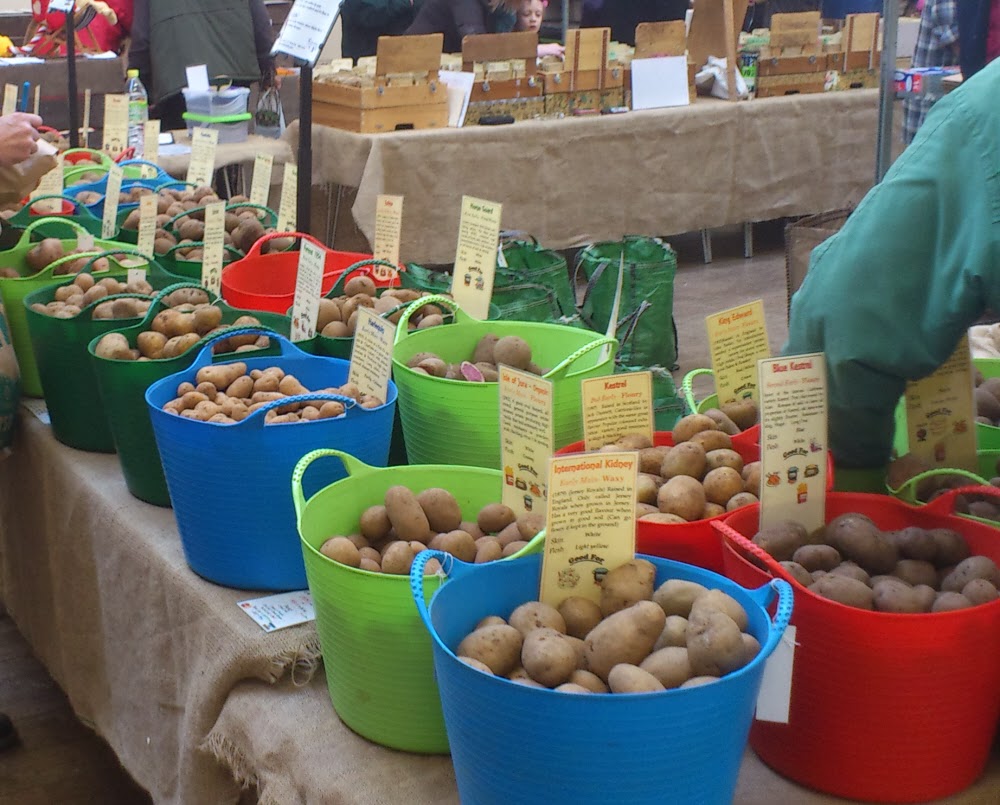
Potato Day!

And at 22p a tuber, they're very cost effective. Hit the link to the Kerrs Pink with Thompson & Morgan and you'll see they want £5.49 for 10 tubers, plus £4.95 P&P. As they say, you do the math.


Friday, 13 September 2013

Jacket Potato - The final result of 2013

Just a quick post to update on my quest for the perfect jacket potato.

Sadly, none of this year's harvest can be considered a winner. The 'Bonnie' I mentioned in the previous post had the best size about them, despite being a second-early. But, wireworm damage meant their use as bakers was limited.

Of the maincrop, the Red King Edward fared best. The Pentland's I grew all succumbed to damage too, whereas the red KE were unharmed. Not a single tuber was lost to slugs or wireworm.

Red King Edward

The downside is that they were not big enough to be considered for jacket spuds. But, they were a nice medium size and the quality of the potato was great. We've used them for wedges, which were excellent, and I'm sure they will perform equally well for roasties too.

So, the quest will continue into 2014. Cara currently set the benchmark and I'll probably do a row of these next year, to which all others will be compared.

Wednesday, 21 August 2013

Jacket Potato - The Quest For Perfection

The results of this year's jacket potato trial have started to roll in.

I planted small quantities of five different varieties, in the quest to find the best jacket spud. More details can be found in an earlier post but it's worth pointing out that it's not just about size and texture. I'm after a potato that can deliver on both of those points, but it also needs to grow well on my allotment, in terms of resistance to pests and disease.

Two of the varieties were second earlies, so I've had chance to evaluate both the 'Osprey' and 'Bonnie'.

I'm a sucker for pink eyes, and the Osprey looked the part in terms of colouring. The yield was good, but it was immediately apparent that these were not going to be suitable for jackets. The tubers were too small.

Osprey

We've had them boiled and as wedges and, to be honest, their texture wasn't what I was looking for, either. A shade too waxy for my personal taste. But, on a positive note, the tubers were completely undamaged in terms of scab, slugs and wireworm. I would expect these good-lookers to do well on the showbench, but the perfect jacket spud, they are not.

Bonnie were next up and wow, what a difference.

We had some really big tubers, perfect for baking and their initial appearance was also agreeable, with a lovely splash of pink.

Bonnie 

The cooked texture of the flesh on these had the perfect fluffiness for jackets, too. So, all in all, a decent spud for baking, especially from a second early. But, it's not all good - while the potatoes size and cooking qualities were good, it was noticeable that many of the tubers had succumbed to damage.

Tiny holes bored into the flesh - I believe these are the calling card of wireworm, the larvae of beetles. Although it's no hardship to peel and cut around the holes to make roasties and wedges, for a nice jacket spud, the potato really needs to be perfect. So while 'Bonnie' has everything else going for it, the wireworm damage is a big minus.

We still have three maincrop varieties to harvest and the results of those will be posted as soon as we've had the opportunity to get them out of the ground.


Saturday, 26 January 2013

The Perfect Jacket Spud

I'm becoming obsessed with potatoes. I mentioned in an earlier post that I'm aiming to find the perfect jacket spud variety. Not just a potato which is suitable in size and fluffiness, but one that grows well on my patch, with few frailties in terms of pests and disease.

Utilising descriptions and characteristics from the British Potato Variety Database, plus some other online resources such as lovepotatoes, many faces of potatoes, and seed potato merchants JBA seed potatoes, among others, I've selected five varieties to go to war with for 2013, none of which I've tried growing in the past.

Second earlies;
Bonnie - detailed description here
Osprey - detailed description here

Maincrop;
Red King Edward - detailed description here
Markies - detailed description here
Pentland Squire - detailed description here


Potatoes!

As we await for their arrival, I have egg boxes put aside for when chitting* commences.

* But is chitting really necessary? The cynic in me reckons the seed companies just want to get shot of their seed potato stocks as soon as possible, so ship them out really early in the year. Far too early to plant, so what do we do with them?

'I know, tell them to stick them in egg boxes for weeks on end, until the ground and weather conditions are suitable for planting. Tell them it's called 'chitting' and it's a necessary part of planting potatoes'.

Yeah right, like anyone's going to fall for that load of nonsense :)

Saturday, 6 October 2012

Talking Tatties


Spuds. If you’ve got an allotment, you almost undoubtedly grow them.

In our house we like jacket spuds, wedges and roast tatties the best. The perfect jacket spud variety, to my mind, is Cara. Big, round and fluffy. And you’ll generally find that if they do jackets well, wedges and roasties are a given.

But, what are they like to grow? I’ve had good results from Cara at the allotment, but in recent years, the harvests have been questionable. I think it’s mainly because they’re a late maincrop – being in the ground so long, they become more susceptible to slug and wireworm damage.

So my quest over the next few years is to find the perfect jacket spud. One that not only fulfils the obvious requirements of size and fluffiness, but also grows well and is less prone to damage and disease. My intention for 2013 is to do less quantities of one variety and trial a smaller amount of a few different ones.

This year, I relied solely on Kestrel. Notwithstanding the fact my spuds didn’t do great in general, Kestrel is not the one I’m looking for. We had some decent tubers, but they were too waxy to be perfect.

Over the next few weeks I’ll be researching online and perusing the seed catalogues to decide what to try in 2013. My pursuit of the perfect ‘spud-u-like’ starts here.