aNt's aNgle:This is a very interesting article on the stray dogs problem which is particularly confronting Indian society. To some extent it effectively quashes claims from fanatical dog activists who wish to see free-roaming dogs thrive in a population shared with human beings. It is far from a "Garden of Eden" reality or utopia which they claim. Read on . . .
From BBC Online:
Do India's stray dogs kill more people than terror attacks?
(Images by Abid Bhat and AFP)In March, the civic authorities in one of India's richest cities made a startling disclosure
in the country's top court: dog bites in Mumbai had killed more people
in 20 years than the two deadly terror attacks in the city - the 1993 serial blasts and the 26/11 attack in 2008.
According
to the municipality's petition in the Supreme Court, 434 people had
died from rabies - a fatal viral infection which is almost 100%
preventable - transmitted by dogs between 1994 and 2015. (In
comparison, the two attacks killed 422 people.) More than 1.3 million
people had been bitten by dogs in the city during the same period.
Animal
rights groups say the comparison with terror attacks is alarmist
hyperbole. But in a country where courts are struggling with a chronic
backlog of more than 30 million cases, it is intriguing that the top
court has been grappling with the issue of stray - or free roaming dogs -
and rabies.
Feral dogs
The reasons are simple: India has some 30 million stray mutts and more than 20,000 people die of rabies every year. Last year, Global Alliance for Rabies Control reported that India accounted for 35% of human rabies deaths, more than any other country.
(A third of Kerala's one million dogs are strays; and
nearly half of the 23,000 people bitten by dogs last year contracted
rabies, say officials.)
Health officials in Kashmir
reported that more than 50,000 locals had been bitten by feral strays
between 2008 and 2012, and that a dozen people had died of rabies during
the period.
More than 1.3 million people were bitten by dogs in Mumbai between 1994 and 2015
A 2012 file picture of a four-year-old boy who was bitten by a dog in Kashmir
Evidence is mixed on whether stray dogs are mainly responsible for biting humans
Man-animal conflict is on the rise. Animal rights
groups say cash-strapped municipalities and irate citizens have been
poisoning, clubbing, beating, shooting and electrocuting strays to
control their population.
Last year, the growing stray dog problem in Kerala and neighbouring Tamil Nadu states inspired extreme measures:
village councils ordered killing of mutts; dog catchers hired by locals
went around injecting the canines with potassium cyanide. In 2012, a
lawmaker from Punjab kicked up a storm when he suggested that stray dogs should be sent to China
and India's north-east - where dogs are sometimes eaten - after a
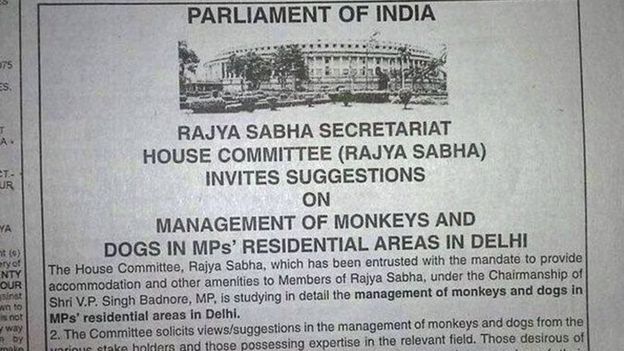
rising number of dog bite cases. A parliamentary committee is actually
"studying in detail the management of dogs" in areas where MPs live in
Delhi.
Killing of dogs has been outlawed in India since 2001. But
that hasn't stopped harried authorities in Mumbai and Kerala from
recommending culling of strays. In 2008, the Mumbai high court allowed municipal authorities to kill dogs that were "creating nuisance". (The Supreme Court suspended the order later.) Since then, the top court has said there will no be no culling of strays, and ordered mass dog sterilisation programmes.
'Dog nuisance'
But are the strays mainly responsible for biting humans? The evidence is mixed. A study of dog bite cases conducted at a hospital in Kerala last
year showed 75% of the patients had been bitten by pet dogs, and only a
quarter had been caused by strays. A 2013 study in 13 Tamil Nadu
schools found that pet dogs accounted for more than half of the dog
bites suffered by students.
But most people believe that the
burgeoning population of strays is to blame for the dire situation: the
Mumbai municipality, in its latest "dog nuisance report", says it has
recorded nearly 100,000 complaints about free-roaming dogs from citizens
between 1994 and 2015.
But groups like Humane Society
International (HSI), who work on animal protection issues around the
world, believe the issue of stray dogs in India is overblown.
"There
are many more free-roaming dogs in Latin America than there are in
India. In some communities in Latin America, there are as many as 50
dogs per 100 humans. The highest rate of free-roaming dogs we have
recorded in India is around 7-8 dogs per 100 humans. By those standards,
I would say that the dog problem in India is way lower than other parts
of the world," says Andrew Rowan, president of the group.
Many of India's stray dogs are looked after and fed by local people
A parliamentary committee is looking into management of stray dogs in Delhi
But then, it is also true that many of India's stray
dogs are owned in a "rather loose way in that somebody is usually
providing for them, and in some cases, even veterinary care". Many
Indian households feed street dogs and taken them into their homes.
Garbage is often blamed for the proliferation of strays although experts
say "there is insufficient caloric density" in rubbish to sustain
street dogs.
"The Indian street dog has evolved into a hardy
species battling an unforgiving environment, both intolerant and loving
humans, and the vagaries of nature. Their ability to thrive in great
numbers in the most trying of conditions has resulted in a problem of
plenty," says animal rights activist Gauri Maulekhi.
Rabies-free
It
is clear that India's sterilisation programme for stray dogs is in
tatters. A labyrinthine bureaucracy, involving many ministries, and
paltry federal funding is mainly responsible. The health ministry funds a
programme run by HSI, spaying 5,000 dogs a month in Haryana, but that
is not enough. A mass sterilisation drive in Jaipur
has fetched rich dividends. Among the states, Sikkim in the northeast
is an outlier: it is rabies-free after all its strays have been
neutered, thanks to a successful government-run sterilisation programme.
It
costs about 1,000 rupees ($15; £10) to sterilise a dog, and it has to
be done at a fast pace to prevent the population from multiplying.
Mumbai's municipality, for example, reckons it will take 13 years to
neuter the more than 100,000 unsterilised strays in the city. "It will
be difficult," says health officer Neelam S Kadam, "to control dog
population by sterilisation alone".
In the end, India needs an
affordable vaccination and spaying programme for its strays. "Mass
vaccination campaigns against rabies targeting entire dog population as
well as carrying out sterilisation programmes by neutering stray female
dogs is the only solution," says Mr Rowan. For too long, India has tried
to manage its free roaming dogs by putting them down brutally, using
poorly trained workers. This, most believe, has to end.
PET+BLOGSPOT is the ONLINE BLOG of the Malaysian Animal-Assisted Therapy for the Disabled and Elderly Association or Petpositive.
Our stories are CURRENT, ACCURATE and RELIABLE.
We offer both local and foreign news on animals, disability and the elderly.
PET+BLOGSPOT was first established in October 2007. Our hits since then are now 250,000 and ever increasing!
PET+BLOGSPOT is updated daily.
Kindly note that views expressed in PET+BLOGSPOT are not necessarily those of PETPOSITIVE.
You may also visit our Webpage by browsing: www.petpositive.org
You can also find us in Facebook under PETPOSITIVE EMPOWERMENT.
Please sign up as a FOLLOWER of this Blog if you haven't done so already in order to show us your kind support for our work. Thank you!
The Subang Jaya Council (MPSJ)
will set up a permanent committee to tackle stray management within its
municipality.
The first meeting will be held in June.
This was after Petpositive had suggested it to the YDP in yesterday afternoon.
The NGOs will include SPCA Selangor and PAWS.
The committee will meet once in two months to brainstorm ideas on how to holistically deal with the street dog issue.
PET+BLOGSPOT is the ONLINE BLOG of the Malaysian Animal-Assisted Therapy for the Disabled and Elderly Association or Petpositive.
Our stories are CURRENT, ACCURATE and RELIABLE.
We offer both local and foreign news on animals, disability and the elderly.
PET+BLOGSPOT was first established in October 2007. Our hits since then are now 250,000 and ever increasing!
PET+BLOGSPOT is updated daily.
Kindly note that views expressed in PET+BLOGSPOT are not necessarily those of PETPOSITIVE.
You may also visit our Webpage by browsing: www.petpositive.org
You can also find us in Facebook under PETPOSITIVE EMPOWERMENT.
Please sign up as a FOLLOWER of this Blog if you haven't done so already in order to show us your kind support for our work. Thank you!
ALL-OUT EFFORT:The estimated
6,800 stray dogs in shelters around the nation will all be vaccinated
against rabies within a week, while other strays are to be rounded up
By Stacy Hsu / Staff writer, with CNA
Stray dogs captured nationwide will be vaccinated against rabies
within a week and free rabies shots are being offered to pets as part of
government efforts to prevent the spread of the disease, which has
returned to Taiwan after more than 50 years.
The government is
stepping up efforts to capture and vaccinate strays in Nantou, Yunlin
and Taitung counties, where four cases of rabies infection in animals
have been confirmed.
Council of Agriculture official Huang
Kuo-ching (黃國青) told 21 animal rights groups at a meeting yesterday that
the vaccinations are being done to prevent potentially infected strays
from attacking and spreading the disease to wild animals, other dogs
orhumans.
The estimated 6,800 stray dogs in shelters around the
county will all be vaccinated against rabies within a week, while
another 30,000 adopted by local animal rescue workers will all receive
rabies shots within a month, Huang said.
The government notified
the World Organization for Animal Health (OIE) of three confirmed rabies
infections on July 17, ending the nation’s listing as being free of
rabies in animals, a status it has held since 1961.
The three
cases were reported in Yuchih (魚池) and Lugu (鹿谷) townships in Nantou
County and in Gukeng Township (古坑) in Yunlin County, and all involved
wild Formosan ferret-badgers.
On July 23, another confirmed rabies
infection in a wild Formosan ferret-badger was reported. Hours before
its death, it bit a man in Singchang Village (興昌) in Taitung County’s
Donghe Township (東河).
Hualien County is offering free rabies shots
to pets, as several mountain townships — Sioulin (秀林), Wanrong (萬榮),
Jhuosi (卓溪) and Shoufeng (壽豐) — are close to Donghe. The shots are
available at township offices.
New Taipei City (新北市) is also offering to vaccinate pet dogs and cats
against rabies for free, as dead Formosan ferret-badgers have been
found in mountainous areas in the city’s Shihding (石碇), Shuangsi (雙溪)
and Sijhih (汐止) areas.
Meanwhile, a consensus reached at an
intra-ministerial meeting yesterday stated that unleashed and
non-vaccinated household pets will be barred from entering national
parks and scenic areas to prevent them from coming into contact with
potentially infected wild animals.
Greater Kaohsiung’s Shoushan
National Nature Park added that it also plans to catch stray animals in
the park’s mountainous areas and clamp down on people feeding stray dogs
and Formosan macaques, a practice that is punishable by a fine of
NT$3,000 (US$100).
The rounded-up animals will first be neutered
and vaccinated against rabies before being transferred to privately run
animal shelters, the park said.
Huang said due to the limited
number of rabies vaccines for human use, the first wave of vaccine
recipients were the more than 300 public-sector veterinarians, dog
catchers, animal shelter employees and animal protection inspectors
working in the mountainous areas of Nantou, Yunlin and Taitung.
According
to Centers for Disease Control Deputy Director-General Chou Jih-haw
(周志浩), a batch of 10,000 shots of human rabies vaccine is set to arrive
next week. The batch from France, set to arrive on Friday next week,
will add to the 1,800 shots already imported and another 700 to be
imported next week.
Chou also urged people not to have contact
with or bring home wild animals, and they should avoid touching wounded
wildlife with their bare hands.
PET+BLOGSPOT is the ONLINE BLOG of the Malaysian Animal-Assisted Therapy for the Disabled and Elderly Association or Petpositive.
Our stories are CURRENT, ACCURATE and RELIABLE.
We offer both local and foreign news on animals, disability and the elderly.
PET+BLOGSPOT was first established in October 2007. Our hits since then are now 250,000 and ever increasing!
PET+BLOGSPOT is updated daily.
Kindly note that views expressed in PET+BLOGSPOT are not necessarily those of PETPOSITIVE.
You may also visit our Webpage by browsing: www.petpositive.org
You can also find us in Facebook under PETPOSITIVE EMPOWERMENT.
Please sign up as a FOLLOWER of this Blog if you haven't done so already in order to show us your kind support for our work. Thank you!
Congratulations are in order to Shalinee Fernandez and Puspa Rani of the Malaysia Independent Animal Rescue for their breakthrough with City Hall of Kuala Lumpur (DBKL).
The local council has graciously extended their hands of cooperation to the animal welfare NGO to work with them on stray management issues together with the Department of Veterinary Services.
I can think of no better marriage than these groups to finally bring about something very positive for unwanted dogs and cats in Malaysia.
Well done girls! Please lead the way to show other animal groups how it is done when one works together with local councils instead of demonizing them all the time.
It is also most shameful to note that even as this positive news breaks, one NGO is trying desperately to tear down the noble and heroic efforts of MIAR in their blog.
They are even trying to run down DBKL. It is clear to me that they are jealous because they never got to have a piece of the action. Shame on them because they clearly do not have the interest of animals at heart in the big picture.
They have always been born losers and will continue to be so unless they repent and change their ways.
In the meantime, Shalinee, Puspa and everyone at MIAR, you have my utmost respect. Please carry on with your great work.
Here now is the latest statement on the event from MIAR:
"TODAY Malaysia Independent Animal Rescue met
up with the TOP OFFICIALS of Dewan Bandaraya Kuala Lumpur (DBKL) as
well as The Department of Veterinary Services Malaysia (DVS) to tackle
the problem of STRAYS IN MALAYSIA.
"This was pursuant to a request by
MIAR to meet them.
"This meeting was primarily to deal with the issue of
DOGS BEING PUT TO SLEEP in the DBKL Pound. WE ARE PLEASED to announce
that DBKL HAS AGREED TO WORK WITH MIAR in allowing these doggies to be
placed for ADOPTION for a LONGER period
of time which TO ENABLE MEMBERS OF THE PUBLIC TO ADOPT THESE DOGS.
"DBKL
has also agreed to work with MIAR on the HYGIENE & HEALTH
CONDITIONS IN THE POUND as MIAR can impart whatever know-how we have as
we have been running our own shelter for awhile now.
"For years animal
rights NGOs have been on the other end of the spectrum furious with DBKL
on the management of strays.
"But what I have realised is at the end of
the day we can rant and rave and show our fury against the Local
Councils in Malaysia.
"The question is WHAT HAVE WE DONE ABOUT IT? HAS
ANY CONSTRUCTIVE ACTION BEEN PUT IN PLACE ALL THIS WHILE?
"At the end of
the day the problem has been unresolved all these years.
"PICKETING/
UNDERMINING/ PUTTING UP A DEMO is fine, BUT WHAT IS IT WE HOPE TO
ACHIEVE IN THE END?
"The dogs are still being PTS every other week in all
pounds in the country. And today MIAR has sat with the people who are
behind the decision making and to our surprise all on what we have heard
about the cruelty of local councils has been blown out of proportion.
"They have been made out to be VILE CRUEL PEOPLE when in actual fact they
are not and they are just caught in the SYSTEM AND THE REGULATIONS THAT
BIND THEM.
And today we sat down and not only spoke about the present
issues but long term plans on a proper shelter instead of a pound where
the doggies will eventually be adopted. We will work together with DBKL
in creating public awareness for these adoption drives.
"We will also be
working with DVS to revive the Trap Neuter Release Method for reducing
the stray population in the long term rather than killing them.
"We will
see this through and are having follow up meetings on all the action
plans. We are being realistic about everything and WE DO NOT EXPECT
OVERNIGHT MIRACLES.
But this is a START and the SUPPORT shown by DBKL
and DVS let's us know that there is HOPE yet for the strays in this
country. MIAR has and will always work with any organization for BEST
INTEREST OF THE VOICELESS STRAYS. TODAY WE ASK THAT YOU LEND US YOUR
SUPPORT IN MAKING THIS HAPPEN. WE CAN TALK ABOUT MAKING A DIFFERENCE OR
WE CAN MAKE A DIFFERENCE. Thank You :-)
Shalinee Fernandez Vice- President MIAR"
PET+BLOGSPOT is the ONLINE BLOG of the Malaysian Animal-Assisted Therapy for the Disabled and Elderly Association or Petpositive.
Our stories are CURRENT, ACCURATE and RELIABLE.
We offer both local and foreign news on animals, disability and the elderly.
PET+BLOGSPOT was first established in October 2007. Our hits since then are now 150,000 and ever increasing!
PET+BLOGSPOT is updated daily.
Kindly note that views expressed in PET+BLOGSPOT are not necessarily those of PETPOSITIVE.
You may also visit our Webpage by browsing: www.petpositive.com.my
You can also find us in Facebook under PETPOSITIVE EMPOWERMENT.
Please sign up as a FOLLOWER of this Blog if you haven't done so already in order to show us your kind support for our work. Thank you!
We often hear views from animal activists - of whom I consider to be one - of the need for stray dogs to be caught, sterilised and placed back into the streets to live out their existence.
It's a term that is called trap, neuter and release or TNR.
Some Malaysian activists have added the letter "M" to include management of stray animals.
What this means they claim is that the dogs that a released are "looked after" by the community.
Whether this is actually being done locally is doubt. Its efficacy, seriously questioned.
Canines in a local pound
The very thought of the idea of TNRM in Malaysia is a living nightmare for local councils whose job it is to control the stray population in order to avoid a health hazard to the general public.
Proponents of TNRM have argued that such practises have been successful in "overseas countries such as in India."
Is that really true?
Well, here is a story that I picked up on BBC Online that provides some startling facts about strays living in communities.
Although it is dated almost a year ago, I can only imagine that the situation is much worse now than when it was first reported.
Readers' views are most welcome.
BBC ONLINE: 13 March 2012Last updated at 03:07 GMT
Why stray dogs are Kashmir's latest threat
By Baba UmarSrinagar
Officials say there are more than 90,000 stray dogs in Srinagar alone
The
streets of Srinagar, the summer capital of Indian-administered Kashmir,
have witnessed much killing in the past two decades of conflict.
However, as the violence has ebbed, residents are facing an unusual enemy - stray dogs.
The canines have been storming its streets, chasing cars,
pulling down bicycle riders and often attacking pedestrians and school
children. In some cases, even soldiers patrolling the streets have
become their target.
Health authorities say 53,925 people - mostly children - have
been bitten by stray dogs in the 10 districts of Indian-administered
Kashmir in the past four years.
Some of the victims have died of rabies. Records at
Srinagar's Anti-Rabies Clinic show 12 dog bite-related deaths in the
last three years alone.
Things have become so bad that the Jammu and Kashmir State
Human Rights Commission has described dog attacks as "violation of
human rights". 'Terrible'
Mudasir Ahmad Wangnoo, a 12-year-old student, is one of the latest victims.
One evening in January, he was attacked by almost two dozen stray dogs, biting him nearly 125 times.
The dogs injured his neck, face and windpipe. Doctors found
perforations caused by the bites in his heart that caused
pneumopericardium- a medical condition in which air enters the heart.
Mudasir Ahmad Wangnoo was attacked by two dozen stray dogs
Syed Sajad Hussain, 40, who rescued Mudasir from the dogs, said the attack was "extremely terrible".
"The incident was similar to one you must have seen on Animal Planet - dozens of hyenas kill a helpless beast," he said.
Fortunately Mudasir survived the attack, but others such as
four-year-old Sehrab Wagay of south Kashmir's Pulwama, succumbed to
rabies last August after being bitten by feral dogs.
"The danger is real," warns Dr Saleem-ur-Rehman, Director of
the Health Department . "On our side we are quick at providing
anti-rabies drugs to hospitals and anti-rabies clinics but municipal
authorities must act."
A count by the municipality found more than 90,000 stray dogs
in Srinagar city. There has been no survey in the rest of the region,
where dog bite cases outnumber those in Srinagar.
Unofficial estimates and local NGOs put the number of dogs in
the valley at more than a million, triggering fears of increasing
dog-man conflict in the next few years if the dog population is not
checked.
Recently, people in the city staged a protest demanding a cull of stray dogs.
Noted poet Zareef Ahmad Zareef, who led the protest march,
told the BBC that after years of "failure", the government had very
little time to act now.
"We have given the authorities a deadline of a few weeks to
end the canine menace. Once it finishes the civil society will handle it
of its own," says Mr Zareef, whose brother had to be given 40
anti-rabies injections after being attacked by stray dogs.
"The government and animal right activists feel we are subhumans."
Caught between animal rights activists, who believe that the
stray dogs should be sterilised, and irate residents, who want the dogs
to be killed, the city's municipality has been grasping for a solution.
'Noise'
They have planned dog shelters, but residents of the areas
where the pounds are proposed have protested, saying that they "won't
tolerate the noise of thousands of barking dogs," says municipal
official Fayaz Ahmad Bala. The municipality is now planning to sterilise
dogs.
There are over 90,000 stray dogs in Srinagar
The stray dog menace has also reached Dachigam wildlife park, home to the hangul, an endangered Kashmiri stag.
Last month, Kashmiri Governor NN Vohra reportedly directed
the police to take "immediate action" to remove dogs from inside the
national park where a paramilitary security bunker is located.
The armed forces have often been accused by locals of using
the dogs as a "first line of security" in the dark against suspected
insurgents or protesters.
The municipality's website even accuses troops of feeding
dogs. Civil rights groups also say the troops are "consciously feeding
canines" and increasing their population to be used as a "tool of
surveillance".
However, paramilitary spokesman Mohasin Shahid rejected the
allegations saying: "Stray dogs are nuisance to troops as well. If dogs
sneak in our camps it doesn't mean we feed them or encourage their
breeding."
Even the army said recently that the dogs were posing
problems for them as well, after one of their soldeirs was injured in a
dog attack.
Meanwhile, residents of Srinagar and across much of the rest
of Indian-administered Kashmir continue to live in fear of the stray
dogs.
Baba Umar is a journalist with Tehelka magazine
TOMORROW: MEET GAY RIGHTS CHAMPION THILAGA
PET+BLOGSPOT is the ONLINE BLOG of the Malaysian Animal-Assisted Therapy for the Disabled and Elderly Association or Petpositive.
Our stories are CURRENT, ACCURATE and RELIABLE.
We offer both local and foreign news on animals, disability and the elderly.
PET+BLOGSPOT was first established in October 2007. Our hits since then are now 150,000 and ever increasing!
PET+BLOGSPOT is updated daily.
Kindly note that views expressed in PET+BLOGSPOT are not necessarily those of PETPOSITIVE.
You may also visit our Webpage by browsing: www.petpositive.com.my
You can also find us in Facebook under PETPOSITIVE EMPOWERMENT.
Please sign up as a FOLLOWER of this Blog if you haven't done so already in order to show us your kind support for our work. Thank you!
MBI with MBPJ - after learning visit with the latter
LATEST! We have just been made to understand that the quote from the mayor saying they do not use lethal injection in putting down the strays is a really a misquote from the newspaper. So please take note. Thank you!
PET+BLOGSPOT SAYS:
UTTERLY UNBELIEVABLE!
Does the good mayor realise the gravity of his statement which has now apparently become his confession?
Animal NGOs will surely start getting rabid over this.
No lethal injection to put down animals? Then how are they killing them? As far as we know, there is no other humane method than using a lethal syringe to put down animals painlessly.
MBI must now immediately declare how the strays are being destroyed!
Any other means than a lethal injection would be tantamount to animal cruelty and action should be taken against the council.
No DVS officers needed when putting down animals? Here's something clearly for the veterinary department to raise their heckles.
MBPJ and MPK hiring dogcathers? No way sir, they have their own animal control officers to do the job which is a much better thing to do as it gives you control on what is being done to the animals.
Yes, of course, the MBI has the right to round up strays or any animals on the street without a leash but the biggest question now is: how is MBI putting down the animals that it catches?
It's really a shame that MBI has sunk to this new low level on stray management - especially after it had visited MBPJ and heard the council's success story of handling its strays.
MBPJ and Petpositive and Noah's Ark Ipoh in MBI
They are handed to PAWS, an animal shelter in which the local council pays RM20 for each puppy, dog, kitten and cat surrended to the shelter.
Last but not least, no intentions of having a pound? This is certainly a negative step backward of any city that wants respects from the world.
PET+BLOGSPOT
Wednesday June 13, 2012
Roshidi: Stray dogs put down and buried properly at landfill by contractor
THERE is nothing inhumane in the way stray dogs are caught and disposed
off in the city, said Datuk Bandar Datuk Roshidi Hashim.
He said Rimbunan Bakti Sdn Bhd, the contractor engaged for the task had acted professionally.
“The same contractor is hired by local councils in Petaling Jaya, Subang Jaya, Seremban, Klang and Johor Baru.
“We employed them because they have experience in catching stray dogs,” he told The Star.
Datuk Roshidi Hashim
Roshidi said the contractor had not used lethal injection to put down the animals.
“The
contractor did not shoot the dogs either,” he said, adding that there
were no bylaws requiring the presence of a Veterinary Services
Department officer when the animals are put down.
He added that the dead dogs were properly buried at the city’s landfill in Papan.
On
Saturday, members of Noah’s Ark Ipoh (NAI) and animal lovers held a
candlelight vigil outside the Mentri Besar’s official residence,
pleading with him to intervene against the purported animal cruelty.
They
alleged that the contractor killed the dogs cruelly while accusing the
council of being insincere in working with NAI to tackle the problem of
strays.
“There is no truth to the claims that the contractor had caught pets owned by the public and killed them.
“Pet
dogs, which were caught, were returned to their respective owners when
in fact, we are not obliged to return dogs that do not have licences,”
said Roshidi.
He also rejected demands for the council to set up a dog pound, saying that it was neither suitable nor effective.
“In
fact, it is much worse and cruel to keep dogs in cages and if some of
them have infections or diseases, this will spread to the others,” he
said.
The council, Roshidi added, was caught in a “Catch 22”
situation as it faced pressure from both the public and animal rights
groups.
“There are many public complaints of stray dogs, especially at market areas, requiring us to take urgent action.
“NAI has to understand that the council had acted in order to prevent untoward incidents.
“We do not want to act only after someone has been bitten.
“Then
we will be blamed for not preventing it,” he said, stressing that only
stray dogs that posed a threat to public safety and hygiene would be
caught.
Roshidi added that he had nothing against dogs.
“There was nothing racial about the action; it was strictly for public safety,” he said.
On
claims by NAI that the council had kept postponing and cancelling
meetings to discuss a solution for the stray dog problem, Roshidi said
only one such meeting was cancelled.
“The Council secretary Datuk
Abdul Rahim Md Ariff, who was given the task to oversee the matter, had
cancelled the meeting due to an urgent personal matter,” he said,
adding that Abdul Rahim had contacted NAI to set up a new meeting date.
PET+BLOGSPOT is the ONLINE BLOG of the Malaysian Animal-Assisted Therapy for the Disabled and Elderly Association or Petpositive.
Our stories are CURRENT, ACCURATE and RELIABLE.
We offer both local and foreign news on animals, disability and the elderly.
PET+BLOGSPOT was first established in October 2007. Our hits since then are now 150,000 and ever increasing!
PET+BLOGSPOT is updated daily.
Kindly note that views expressed in PET+BLOGSPOT are not necessarily those of PETPOSITIVE.
You may also visit our Webpage by browsing: www.petpositive.com.my
You can also find us in Facebook under PETPOSITIVE EMPOWERMENT.
Please sign up as a FOLLOWER of this Blog if you haven't done so already in order to show us your kind support for our work. Thank you!
He wrote in regarding an animal blog that had criticised PET+BLOGSPOT for our post that was published on Tuesday, December 7th, this month.
It was titled "Selangor Exco YB Dr Xavier Jayakumar To Make Spotcheck On MPK Dog Pound". (Click HERE for the link).
The writer wrote in to say that he had also responded to the blog in our defense.
Riche's comments - as well as the blog's post which were printed today - is featured here below.
However, we have omitted the name of the particular blog as well as that of the author.
We thank Riche for his brilliant arguments in his comments to the blog.
At the same time, we would like to point out that the blog concerned was RIGHT in expressing its worry on the circumstances around how a dog that was put to sleep by a veterinary assistant by the local Department of Veterinary Services (DVS) was able to bite the officer.
The blog's point of whether or not the particular canine that bit the person could have in some way been inappropriately handled is also a VALID question.
PET+BLOGSPOT understands through a number of vets that animals biting a veterinarian is not an uncommon affair.
In most cases, we are told, it is often cats that leave a greater injury on animal doctors than canines.
However for the DVS to deny their services to a local council's pound in putting down animals is certainly most UNACCEPTABLE and UNPROFESSIONAL.
Nonetheless, as mentioned in our previous post, it is important to note that the matter has been PROMPTLY RESOLVED BY THE DVS of Putrajaya.
Animal put-downs at the Klang pound by the Klang municipality (MPK) are now back to normal in Port Klang.
They are now strictly managed by the local DVS.
On the claims of cruel handling by pound workers, MPK's Canine Advisory Team or CAT which looks into the welfare aspects of the MPK's treatment of animals, assured readers that the staff in the pound are a caring bunch.
However, if there are any complaints of misappropriate behaviour please send them - with proof - to the following organisations:
1) The new Malaysian Animal Welfare Council in Putrajaya.
2) SPCA Selangor
3) Petpositive at petpositive@yahoo.com
4) The MPK Headquarters.
Finally, Riche makes a great point about no-kill policies by animal proponents who condemn euthanasia practices at dog pounds - but have little or no workable alternatives to offer the local councils.
It's time that these animal rescuers put their foot in where their mouth is at and adopt all the animals in pounds from a sure death.
They can start at the Klang pound in Port Klang.
Re-homing of dogs is totally free-of-charge for those who want to adopt the animals from the pound.
For more information, please click on the December 7th link above.)
Here is the dog blog's comments and Riche's response:
DID THE DVS VET HANDLE THE DOG CRUELLY?
We were disturbed to read this in another blog. Our question is whether the vet had handled the dog roughly as we know for a fact that the pound workers drag the dogs by the neck with their nooses and smash them around. Did this happen on the day the vet was bitten? ---------------------------------
The MPK was suddenly told last week that the local DVS would cease helping the council after an assistant veterinary officer had apparently been bitten by a dog at the pound which he was trying to put down.
However, a quick alert to Datuk Dr Aziz solved the problem within 24 hours.
The good news now is the DVS are back to offer their professional service to the pound.
Canines are put down every Tuesdays and Thursdays at the MPK pound.
---------------------------------
And this person actually says it good news that there is someone to put the dogs down. All these charlatans should bloddy well seek other more humane ways such as mass neutering. However as long as cursed beings intent on strengthening their self interest are around such an exercise is something the local councils will not even look at.
1 comments:
Riche said...
The writer was not being fair when he wrote this comment. The writer, (OMITTED BY PET+BLOGSPOT), is obviously biased towards the organization named Petpositive, which was trying to help the MPK council solve their problem of over crowding at the pound. If the writer feels so strongly against the procedures that the MPK employs, wouldn't it be better for his group, (OMITTED) to rescue all the dogs and cats that are caught by the MPK dog catchers? As mentioned in the Petpositive blog, "The pound is open daily from Monday to Friday from 8am until 8pm for the public to view the animals and adopt them." Incidently, I believe the SPCA Selangor was also present at the CAT meeting with the MPK, based on the picture that was posted in the blog. http://petpositive.blogspot.com/2010/12/selangor-exco-yb-dr-xavier-jayakumar-to.html Is the writer and his group (OMITTED) also biased against them? Should the MPK council also stop catching strays at the whims and fancies of (the group)? Should they also extend a service to the (group) by unloading all their caught animals to (the group's) doorstep? That would certainly solve the problem of over crowding at their pound. The author (OMITTED), mentioned, "Charlatans and cursed beings intent on strengthening their self interest". Perhaps he should look at himself in the mirror and study the modus operandi of his group before labelling others.
End
PET+BLOGSPOT is the ONLINE BLOG of the Malaysian Animal-Assisted Therapy for the Disabled and Elderly Association or Petpositive. Our stories are CURRENT, ACCURATE and RELIABLE. We offer both local and foreign news on animals, disability and the elderly. PET+BLOGSPOT was first established in October 2007. Our hits since then are now 100,000 and ever increasing! PET+BLOGSPOT is updated daily. Kindly note that views expressed in this PET+BLOGSPOT are not necessarily those of PETPOSITIVE. You may also visit our Webpage by browsing: www.petpositive.com.my You can also find us in Facebook under PETPOSITIVE EMPOWERMENT. Please sign up as a FOLLOWER of this Blog if you haven't done so already in order to show us your kind support for our work. Thank you!





 PETPOSITIVE NEWSFLASH!


 Officials say there are more than 90,000 stray dogs in Srinagar alone
 Mudasir Ahmad Wangnoo was attacked by two dozen stray dogs
 There are over 90,000 stray dogs in Srinagar
The stray dog menace has also reached Dachigam wildlife park, home to the hangul, an endangered Kashmiri stag.


 Datuk Roshidi Hashim

