Sunday, August 06, 2006

Day 40 A Triumphal Entry into the City of St. James

Day 40
Lavacolla to Santiago de Compostela--6.82 miles; 0 km. to go
(In all: 780 kilometers or 483.6 miles walking from point to point and not counting local, after-hour walking.)

The medieval pilgrim after cleaning him or herself at Lavacolla continued west and climbed Monte de Gozo (the Mount of Joy) where the spires of the cathedral of Santiago could first be seen. Nowadays, trees and development block the view and the Monte de Gozo is home to a massive holiday camp. For pilgrims, there are something like 2000 beds--free.
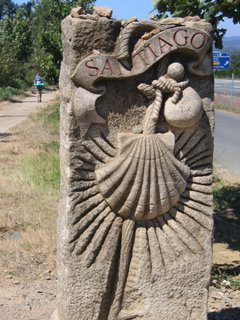
On the outskirts

Down the hill I go, one hour to go. The city approaches. Just by one of the gates of the city is a small park with a guy in a kilt and bagpipe sitting there. He´s waiting to surprise some pilgrim friends who are arriving this morning, and lo and behold, these friends are right in front of me. They hug; they kiss, and the bagpiper pipes us all into the city, right to the cathedral. It is just hilarious, and quite dramatic as well.
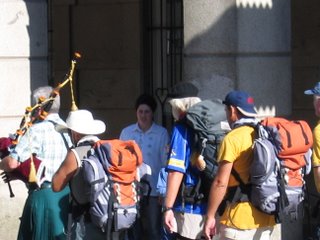
The Irish pilgrims

Edited (Aug. 7) to add: I just learned that the guy on the bagpipe flew down from Ireland especially to surprise his brother, who had walked all the way from Ireland. Evidently, he had done this before when his brother had walked the Appalacian Trail in the U.S. All the pilgrims in town have been buzzing about this grand entry. End edit.
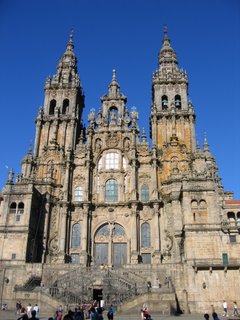
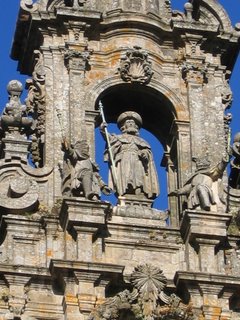
The cathedral of Santiago de Compostela

The cathedral is a glorious piece of architecture, breathtaking for the medieval pilgrim, and really no less so today. Santiago de Compostela receives well over a million visitors a year, plus tens of thousands of pilgrims, and the crowds are intense. Certain pilgrim rituals, such as placing your hand on a marble column--the Tree of Jesse--to give thanks for a safe journey, have long lines in front of them. With hundreds and hundreds of years of people placing their hand on this spot, an indentation with five fingers has worn down the marble.


Around the corner is a special pilgrims´office where I present my credential and receive my last sello, or stamp, to prove I´ve completed the distance. I am given my compostella with my name duly written in Latin--Dnam Pamelam Barrus---Datum Compostellae die 5 mensis augusti anno Dni 2006. Pretty cool.

Our various nationalities and starting points will be announced tomorrow at the daily pilgrims´mass, the highlight which is the swinging of the botufumeiro, or giant censor that takes a number of priests to launch. In the Middle Ages this was done to mitigate the stench of the pilgrims.
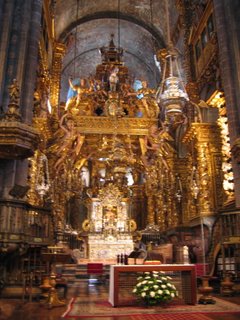
Interior

Pilgrims stagger about town to catch up on gossip and see who has made it. Hey, there´s Stefano, the Italian pilgrim from way back who had to take buses and taxis because of injuries. And there are the English pilgrims!
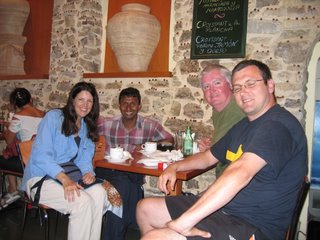
Celebratory chocolate and churros with the English and Indian pilgrims

The big adventure is over; I´ve been decommissioned from my pilgrim status. I´m going to miss the early morning walks and little cafes. There´s a very long list of demands I have to fulfill right now: a foot massage, the Chanel polish, an expensive pair of frou-frou shoes....

Can´t get too philosophical on you guys right now, especially when there´s a line of noisy Germans outside the door waiting for this computer. Thank you to all who e-mailed me and/or left comment messages. They were really appreciated! Am I glad I did this big beautiful journey? Absolutely!

******

Friday, August 04, 2006

Days 38-39 Ánimo Peregrina

Day 38
Melide to Arzua--8.06 miles; 37 km. to go

Apple trees are everywhere in Galicia

One of the fun moments while on the Camino is running into pilgrim friends you haven´t seen in days or weeks. You can be sitting in a restaurant or in a cybercafe and suddenly there is the Irish pilgrim of the Dutch pilgrim. We catch up on the news, where we´ve stayed, who we´ve seen. We´re actually a very gossipy bunch. Although I haven´t seen her since before Burgos, I hear that the Korean pilgrim is just a few days behind.

I haven´t met either one of this pair yet, but I´ve heard about a Mexican pilgrim and a Belgian pilgrim who were traveling together as an item. For reasons I don´t know, they´ve broken up, but the Mexican guy has left messages of endearment for the Belgian girl. I saw one after Villafranca de Bierzo that said something to the effect that she would always be a part of his vida, and I´m sure I see one this morning. It reads "Hermosa, you are my camino now." And it´s dated a few days ago.

Another horreo

Arzua is a noisy, one-street town that´s either under demoliton or reconstruction. It´s also known for its creamy cheese, which is celebrated in a grand festival every spring.

Weeks ago, after I had walked about six days, a map of the Camino ran alongside a wall of a restaurant by my table. I had only gone about one inch and a good three feet remained. Now I look at a map and I think no wonder I´m tired. 480 miles is a long way. The bottoms of my boots will attest to that.

No more tread left

Day 39
Arzua to Lavacolla--16.12 miles; 11 km. to go

Almost! Fate dictates the day as there are very few hotels between Arzua and Santiago, and I had made a vow to sleep in a cowshed before I´d go back to the albergues. Do we do 37 kilometers today or not? At the halfway point the one and only hotel is todo completo. A taxi driver in front is unloading pilgrims´backpacks. Some even belong to cycle pilgrims. These are wusses of the worst sort. I put my nose in the air and continue on.

Needless to say, the feet and I are negotiating furiously. Today´s promise is that I won´t take the bus out to Finisterre--literally the end of the known earth in the Middle Ages--which requires, in addition, a 5-kilometer roundtrip walk. A larger challenge though is riding in a moving vehicle after 5 1/2 weeks of only my own leg power. I´m told motion sickness is quite a common effect. Well, I can celebrate the end of the earth with a g & t looking out at the ocean at Las Brisas in Laguna.

The trail today winds through endless eucalyptus groves and comes out at the end of the runway at Santiago´s airport. I saw my first horse pilgrims today! One of the horses even had a scallop shell on his forehead--very cute.

Horse pilgrims


This poor pilgrim died only one day out from Santiago.

Well, by the airport I find a reasonably priced hotel room. I´m relieved because it just isn´t walking to Santiago, it´s finding a room there on a Friday night, plus there are certain rituals and processing a pilgrim must go through on arrival. The town of Lavacolla, where I am, is traditionally where pilgrims of the Middle Ages washed themselves before entering Santiago. According to my guidebook, this would be the first bath many of them had! Christians used to look down on Muslims and Jews for their frequent bathing customs (Queen Isabella used to brag she only had two baths in her life). Also, and I swear to God this is in my guidebook, Lavacolla used to be called Lavamentula. Lava means to wash--obviously--but "mentula" means phallus and a "colla" is a scrotum. Those stinky medieval pilgrims warrant a place name. Yikes!

Wednesday, August 02, 2006

Days 36-37 In Striking Distance

Day 36
Portomarin to Palas de Rei--15.5 miles; 65 km. to go

Interesting cross along the trail

Just more of the same...

The 12th-century travel guidebook writer, French monk Aymeric Picaud, noted that this particular stretch of the Camino was known as a famous outdoor brothel. I don´t notice any unusual activity going on, but I´ve seen this type of open-air business elsewhere in Spain. In Palas de Rei, Aymeric described the women as harlots who should "not only be excommunicated, but stripped of everything and exposed to public ridicule, after having their noses cut off." Again, I don´t notice the women in town looking particularly slutty. In fact, the people in this town have been some of the nicest in Galicia.

A not-so-scary scarecrow

Another factoid about the area is how common the name Castro is; every other village has Castro in its name. It means hill fort, and yes, Fidel´s parents were from Galicia.

Pilgrims resting in the shade--fun.

Day 37
Palas de Rei to Melide--9.3 miles; 50 km. to go

Back when I was 14 years old, 50-mile hikes were a new fad thing to do, a promotion by the federal government to encourage people to get in shape--an idea that obviously didn´t work. The first annual 50-mile hike in Laguna Beach was announced and my friend Susan Lauterbach and I entered it, much to the scepticism of my father. It took us 18 hours, with pilgrim-sized blisters, an Alonso B. Stagg medal, and our picture in the newspaper for our efforts.

You can hear the debate going on right now. Should the feet and I gut it out to Santiago and get this over with? Technically, I can walk 3 kilometers a day and still make my plane on the 21st. Yesterday the pilgrim hoards were making me so crazy, I was ready to start walking at night. After all, medieval pilgrims used the Milky Way in the days before yellow arrows. But this morning I pass through the town of Melide and see a churreria and stop dead in my tracks. One of my favorite things on earth to put in my mouth are Spanish churros--different from the Mexican ones--and chocolate a la taza. This isn´t any ordinary hot chocolate. It´s like a thick pudding you dip the churros into. I spend the morning in utter bliss and watch pilgrims hobble by.

Chocolate and churros

For the 100-kilometer pilgrims, this is their third day, and sure enough, their feet are swathed in bandages and their knees have braces on them. They look in agony. It must be why there were fewer people on the trail this morning. I decide to call it a day, find a pretty room to slumber in, and enjoy Melide--a real town with real shops and real people doing real things.

Common sight along the Camino: this peregrina is down for the count

Monday, July 31, 2006

Day 35 Double Digits to Go

Day 35
Sarria to Portomarin--13.64 miles; 90 km. to go

The 100 km. mark, iPod on, Spanish pilgrim

It is so crowded out here, solitude is hard to find. Pilgrim newbies, fully decked out with shells, gourds, and walking sticks are setting off on their grand adventure--all 100 km. of it. Some carry stuffed animals, some guitars that hit their bum on every step. Some big groups have matching shirts and/or neck scarves, a la the Junior Woodchucks. They pound up and down the rocky trail with gusto. I´ll give them til tomorrow when they´ll become crippled and lame.

A late start for me this morning reveals a backup vehicle where a man is picking up all the stuff of an Italian youth group. He drives ahead to cook and prepare for them. Just before Portomarin, I spot one couple jumping into a waiting car. These pilgrims are such wimps, it´s beyond belief.

Pilgrim cheat caught on camera

However, the trail is beautiful and winds through one tiny farm village after another. Farm tools that look over 100 years old lie about. Also, I spot my first¨"horreo." Unique to Galicia this thin rectangular structure sits on stilts and is used to dry and store corn. The stilts keep the rats out, and a cross on top calls for divine protection.

Typical horreo

Galicia used to be deep in old oak forests. Its wood was used to build the Spanish Armada. During Franco´s regime much of Galicia´s oak was chopped down to make room for the faster growing and useless eucalyptus tree. But the oak forest still abound, and it´s magical walking through them. My guidebook tells me that it´s common to see "handsome stag beetles" on the trees. How does one know a handsome one from an ugly one?

Another typical Galician town

Galician farmer

Sunday, July 30, 2006

Days 33-34 Velocity x Mass = Momentum

Day 33
Liñares to Tricastela--11.16 miles; 130 km. to go

The hotel that I´ve spent the night in is so typical of cheap roadside hotels that it´s worth a few lines of description. Usually, the hotel is above a bar/cafe/restaurant, and in this case, there´s a market as well. The hotels are always very clean and of recent construction. Plumbing is good; a large-sized person would get stuck in the micro-bathrooms though. Almost always, these places are family-run, with mom and pop hovering behind the scenes and the kids working the cafe, looking totally bored out of their minds. Can´t blame them, surely they´d rather be at the all-night clubs in any large city rather than a dusty village with five houses. Price range 20-30 euros.

The trail gets crowded.

Drive through any Spanish town, you´d think it was deserted or a ghost town where everyone has died off. People come out of their houses like bats around 9-10 at night. It´s not uncommon to hear little kids playing outside the window well after midnight. When you walk through these towns at 7, even 9am, everything is all shut up; people are still asleep. There are no cars driving around. I have to laugh to think of the freeways at home at that hour.

Another beautiful walk today. The pilgrim highway is starting to get crowded with the required 100 km. mark fast approaching. Met a couple of English pilgrims today, and they are hilarious. One has done the Camino four times. I´ve learned a new expression from them: "thunderbox." Gwyn, are you familiar with this term? I´m pretty sure it´s an English invention. :-)

I´m giving another attempt at sleeping in one of the kennels tonight. It may be my last.

Day 34
Triacastela to Sarria--11.16 miles; 112 km. to go

The night of nights. Indescribable? No, I can describe it quite well. A room with 18-20 bunkbeds filled with exhausted pilgrims and their backpacks. A man and his wife in the bunk next to me are snoring like lumberjacks with chainsaws--beyond earplugs, beyond music blasting in my ears from the iPod. It´s 2:30am and I can´t breathe. This is a lunatic asylum. I stumble across the pitch-black room like I´m in a game of Snakes and Ladders and go into the hallway for a few minutes. What to do? What to do? I go back into the room. Some idiot had shut the window, and the respiration from some twenty people, the breath of chorizo, jamon, or whatever the hell they ate the night before is overwhelming. I am so out of here. I grope my way back across the room, scoop up my stuff using the backlight of the iPod to see, and leave. But it´s 2:30am. Where to go? There´s a little room with a washer and dryer. No, too stuffy. A corner of the kitchen floor works. It´s clean. Out comes the Thermarest--the first time I´ve had to use it--and all is well until 5:30 when I wake up to some group having a prayer breakfast. I pack up and leave.

I see two pilgrims in the dark ahead with headlamps and follow them. The headlamps light up the rocks and the cowpies. I think the trail goes up a huge hill. I can´t see and don´t care. Finally the dawn breaks and I forge ahead through the mist.

Typical Galician town

It´s another lovely walk. I reach the civilized town of Sarria, walk into a three-star hotel, and jump straight into a bubblebath and bed. The TV has 24 channels that even have clear reception. Why there´s CNN and Sky News in English! I only venture out to eat and scoot back in.

The numbers of pilgrims have changed dramatically. Where once there were groups of twos or threes and individuals, there are now gaggles of pilgrims and youth groups with support vehicles. What´s known as the "bed race" is about to begin. Pilgrims will now get up at 5am and race to the next albergue to get in line for a bunk. Let ém.

About five more days to go.

Saturday, July 29, 2006

Days 31-32 Into Galicia

I´m on such a foul Internet connection, the last two days will be somewhat abridged.
Day 31
Cacabelos to Trabadelo--12.4 miles; 170 km. to go

Today´s walk is one of the loveliest ones of the Camino (the weather has cooled, which helps immensely). The trail winds through hills covered in grapevines and finally descends into the town of Villafranca del Bierzo. Mountains surround. The town is filled with old mansions and open plazas; a Romanesque church has a Puerta del Perdon. Crossing this door in the Middle Ages meant that a pilgrim too sick or injured to continue on could receive the same spiritual benefits as if he or she walked all the way to Santiago.

The trail continues up a narrow valley, sliced by the Valcarce River. Deep with chestnut trees, oaks, and ferns, all is green and lush.

Rural turismo is promoted int his valley,a nd people rent rooms out in their houses. I find one with a beautiful yard, a swimming pool, and surrounded by woods. Life is good.

Day 32
Trabadelo to Liñares--13.64 miles; 148 km. to go

More murder on the feet


But it's really a lovely walk

Up and up and up and up today. It´s cool and clear, and the scenery is gorgeous, so who cares. Actually, it looks like it´s going to be up and down all the way to Santiago, but today the biggest up part is done. The top of the mountain is known as O´Cebreiro. All the guidebooks warn that the weather can be vicious at any time of the year, even snowstorms in summer.

View from O Cebreiro

Back during the Napoleonic Wars, an English army mutinied after hundreds of them froze to death on this spot. They kind of deserved it though since the soldiers had gone on hooligan rampages in Ponferrada and Villafranca del Bierzo. Anyway, the weather couldn´t be better, so there are no pilgrim Donner party stories to liven up the blog.

I aclso cross from Castilla y Leon into the region of Galicia today, Celtic Spain with pagan overtones. There´s definitely a different vibe in the air. Plus the locals speak Gallega, a language that sounds somewhere in between Spanish and Portuguese. You think you can understand it but you don´t . Gallega music. Gallega TV.

Spanish TV tonight, prime time no less, is featuring the European sychronized swimming championship live from Budapest--pairs, groups. The competition is fierce. Not even ESPN2 at 3am would have coverage like this.

Wednesday, July 26, 2006

Day 30 One Entire Month

Day 30
Molinaseca to Cacabelos--14.26 miles; 190 km. to go

Ladies:
Do you plunge into depression looking at that ghastly cellulite hanging from your bum and thighs in the dressing room mirror? Maybe there´s a slinky new dress you´d love to fit into for the holidays, but you say you just can´t give up that nightly plate of pasta with the creamy sauce or the mega-size chocolate bars? I have got a fabulous diet plan for you. No gimmicks! Guaranteed to work! The fall season is fast approaching, a delightful time to walk the Camino with no crowds, no heat. C´mon over! No reservations needed.

Getting closer

Today marks the one month mark since St. Jean Pied de Port. That´s one month of walking every day. I try to think of similar distances as if I were at home. It´s like walking from my house to South Coast Plaza every day.

Today´s walk leads me through the city of Ponferrada, which has an imposing Knights Templar castle smack in the middle of town. The Templars had a huge influence along the Camino, establishing churches and monasteries. This particular castle sits low near the river and not on top of a hill. It was built to protect pilgrims from bandits. Now it´s mostly covered with scaffolding for restoration efforts.

Templar's castle in Ponferrada

The trail right now is between two ranges of mountains, in the fertile Bierzo Valley. Bierzo is known for its wine, perhaps not outside of Spain. It´s a wonderful walk through happy vineyards and woodland. A big climb lies ahead in about two-days time.

Up the Bierzo Valley

Tonight´s lodging? Refugio (5 euros), hotel room with TV (21 euros). Refugio or hotel? Refugio or hotel? You guess.

Days 28-29 Into the Cantabrian Mountains

Day 28
Astorga to Rabanal del Camino--13.02 miles; 238 km. to go

Astorga is chock full of history as far as Spanish towns go: Roman ruins, ancient pilgrim hospitals, and a Gaudi-designed cathedral, which is now used as a museum. Astorga is also the capital of the Maragatos, a European tribe I had never heard of. It´s thought their origins may be Berber or even Phoenician; no one knows, but they became the traditional muleteers of Spain. Their customs and dress until recent times was always distinct and their society closed. The area here and 45 villages to the west is known as the Maragateria. Since the work of the muleteers has been replaced by that of trucks, many of these little stone towns would have died if not in part from the infusion of money from pilgrims traveling through on the Camino.

Just keep following the arrows

Today´s walk slowly leads up into the mountains, but it´s a gentle climb. My favorite time of day is when I stop for breakfast in some little town that has a bar/cafe open. Today´s bar has excellent coffee and croissants and some Andy Garcia movie on that´s dubbed in Spanish. The French pilgrims are ecstatic that the croissants are just like French croissants. They walk away smiling.

Great croissants here

The famous Cowboy Bar of El Ganso

The sun blazes away and cracks of thunder lead to a downpour just as I´m check into a nice little hotel room. Rabanal del Camino is a beautiful stone village with incredibly intense flies (it must be the heat and then the storm). I can hear a bug zapper electrocute them every few minutes from my room. In the evening I carry on my own massacre so I can sleep in peace.

Day 29
Rabanal del Camino to Molinaseca--15.5 miles; 213 km. to go

Lot´s of pilgrims´landmarks on the road today. It´s a beautiful climb up through mist into the mountains. The first attraction on the way is Foncebadon, a once-abandoned town left to the winds to hollow it out, giving everything an eerie appearance--almost like a ghost town of the Old West. A few people have returned to eke out a living from the pilgrim traffic. The only "shop" in existence sells health foods and plays New Age music. It is also in Foncebadon where Shirley Maclaine in her book (and even the protagonist in a Paulo Coelho novel) had a run-in with wild, savage dogs that appeared out of the mist and charged her. Again, much linear Internet space is given over to the subject of the wild dogs, to the extent that someone could make some money selling dog dazers to pilgrims. I´ve no doubt her experience was real, but that was 10 years ago, and the only dogs around there now are asleep or dead.

Foncebadón
The second pilgrim landmark is the Cruz de Ferro. In pagan times one left small piles of rocks before mountain passes to ensure safe passage. Traditionally, each pilgrim adds a stone, preferably from their home, which casts away guilt, sin, problems, whatever. An iron cross was eventually added to keep the Catholic Church happy.

Cruz de Ferro

Today is July 25, St. James/Santiago´s day. Across from the Iron Cross, they´re setting up for a party of 100s. And sure enough, cars are piling up the mountain at breakneck speeds to celebrate the patron saint. Not far is the highest pass of the Camino at 1517 meters, or almost 4100 feet. There´s still another pass ahead in a few days´time.

Another interesting point along the road this morning is an unofficial pilgrims´refugio kept by "Tomas," who devotes his life to the care of pilgrims. There are no mattresses or amenities (I think you sleep on straw in a barn.) When officials tried to shut the place down, Tomas went on a hunger strike in front of the offices in Leon until they backed off.

Out in front of Tomas's refugio


Villages are made of slate now

Going downhill is hard, and it´s quite a slog. It´s a refugio night, and I´m sleeping in a top bunk near some rafters in sort of a chalet-style building that someone says is a former church. Today I meet pilgrims who have hitched rides, and I am appalled.

There´s even a pilgrim from India. She is in a tizzy because the hospitalero threw a sack of garbage into a can right in front of her. The impudence!! And there are flies!!! She´s from India, and she´s all worked up over the flies (and there are barely any flies here at all). She´s complaining loudly to anyone who will listen that she is going to contact the Spanish ambassador in London to report the conditions of this place.