"Breast is best." How many times have you heard that? I mean,
everyone agrees, right? Breast is best! Except when it isn't. When is that, you ask? Well, let me tell you.
I was not a breastfed baby. My four sisters were not breastfed. My brother was not breastfed. My husband was not breastfed. None of my 13 nieces or nephews were breastfed. My great-niece was not breastfed. (No, I'm not actually that old, but my oldest sister is 53, and her oldest daughter is 28, so I have a great-niece.) We were all healthy, happy, well-rounded children. Until I went to work in an office filled with young mothers who spent their lunch hours hooked up to breast pumps, I never gave breastfeeding any thought. Even then, I never gave it any
positive thoughts. Sure, I heard over and over from the women in my office about how beautiful breastfeeding is. "It's the greatest gift you can give your child and yourself." "It's the most natural, most intuitive thing because it is exactly as God intended it." "It's the greatest bonding experience you can hope for with your child." Blah, blah, blah. But I wasn't a mother yet, and I was skeptical. Really, how "beautiful" is a huge, veiny boob? And you gave your child
life! Isn't
that the greatest gift you can give him or her? And if feeding your child is the "greatest bonding experience" you can have with your child, then why would you deny your husband that bonding experience? No, breastfeeding wasn't for me. I could never envision myself doing it.
And then I got pregnant with my first child, the Monkin. Suddenly, I found myself considering the inconsiderable, that maybe I
would breastfeed. I don't know how or when or why it even popped into my head. Maybe it was a hormonal thing. Maybe it was instinctual. I don't know, but it seemed to make sense for a lot of reasons, and it somehow became my Plan A.
Since everyone had already told me about how beautiful and natural and intuitive breastfeeding is, I didn't really do anything to prepare myself for it, aside from taking the breastfeeding class in the cadre of pre-natal classes offered by my hospital. I mean, you just put your baby to your breast,
et voila! Right? Yeah, no. I quickly discovered at the 2-hour class I took that there is a lot more to it than that. There is a certain way a baby is supposed to latch, and you sometimes have to coax them into doing that. And then there are all these awkward ways that you're supposed to hold your baby. In fact, it's so awkward that you'll probably need to invest in a special little nursing stool and pillow to help you get it just right. Oh, and a breast pump. You'll want to have a breast pump so that you can (a) have a back-up supply of milk for the babysitter and (b) keep your milk supply up. Of course, the best breast pump will run you $300 or so. And watch out for mastitis...and thrush. That's a nasty one because you and your sweet little baby just keep passing it back and forth. To say that I was overwhelmed is an understatement. Breastfeeding was obviously far more complicated than I had been led to believe.
Nearly in tears, I approached the nurse after the class and expressed my doubt about whether I was emotionally and mentally able to breastfeed my baby because it all seemed so...
hard and
unnatural and not the least bit intuitive. "Well," she said, "it
will be hard for you because, from what you've told me about your own family history, you won't have a support network. You'll be out there on an island with no mother or sister that you can call for help and advice.
But there are other networks you can tap into. You
can do it. And, really, it's the most beautiful, most natural, most loving thing you can do for your baby, so you need to do it." Whereas before becoming pregnant, that last statement made me roll my eyes, now it filled me with a bottomless pit of guilt, only like no guilt I had ever felt before...and I'm
Catholic. I cried all the way out to my car and then again when I got home to my husband.
My husband, with no frame of reference for breastfeeding either, said, "Well, we'll just try it. If it works, it works. If it doesn't, it doesn't. It's no big deal." "Yes, but it's the most beautiful, most natural, most loving thing I can do for this baby. I
have to make it work." Yep. Just like that, I had been brainwashed.
"Brainwashed"--I'm sure that word will offend most of you. I'm sorry, but there
is a degree of brainwashing in the baby feeding community. Remember when I said that none of my siblings or nieces or nephews had been breastfed? Well, that's because it wasn't really
en vogue at the time. It wasn't trendy. There weren't clubs and play groups and political movements centered around nursing a child (aside from La Leche, of course, which I remember Suzanne Sugarbaker referring to as "La Leaky" on "Designing Women"). If you breastfed your baby, then bully for you. If you didn't do it, that was OK, too. No one castigated or judged you for your choice. No one really cared
how you fed your baby. Now, though, it's become an "us against them" proposition. There are message points with implications of who is the better mother: The nurser or the Similac mom. (Obviously, it's the nurser, duh!) There are "scientific" studies that "prove" that breastfed babies are better off medically, developmentally, socially, and emotionally. (No one seems to take note of the fact that there's a
huge socioeconomic variable to be considered in the development of a child. No, it's definitely all about the breast milk, isn't it?) There are websites and social media sites and storefronts that push breastfeeding, steeling themselves behind the "reality" that breastfeeding is better for a child. So, yeah, women do get sucked in, and we get sucked in at the most emotionally vulnerable period of our adult lives--pregnancy.
For the last few weeks of my pregnancy, I went back and forth between going with formula and breastfeeding; although, deep down, I knew that I would breastfeed the Monkin. My mother didn't get it. My sisters didn't get it. But I knew that I
had to do it. It was the best thing I could do for my baby.
The Monkin's birth didn't turn out like I thought it would. I ended up having a c-section. It was probably three or four hours before I even held her. When they brought her to me, it was around 2am, and I had been asleep in my bed, pumped full of pain killers and gallons of fluid. I remember that the room was almost pitch dark. I was groggy and had a hard time even sitting up, and then the nurse held out the baby and said, "She's hungry. You're nursing her, right? Call me if you need help." I doubt she'd even made it back to the desk before I called for help. I had no idea what to do. "Hold her this way. Now hold your breast like this. Now push her to your breast." It was awkward and painful and just not working. Naturally, the baby was screaming, either from hunger or general annoyance. My first instinct was to say, "Just give her a bottle," but I didn't. We fussed and fidgeted and tried to latch over and over until the Monkin gave up and went back to sleep. Within a couple of hours, we were at it again.
Over the next four days in the hospital (my blood pressure was a little elevated), I bet eight different nurses and four different lactation consultants tried to help us latch. Every woman who came in to offer help had a different approach. I was so confused. Should I hold the Monkin this way? That way? Should I support the weight of my breast or hold my nipple? Should it hurt the whole time she's on my breast, or should it only hurt for a minute? And speaking of pain, should it feel like glass shards are coming out through my nipple? "Use a breast shield." "Don't use a breast shield." "Let her practice sucking on a pacifier." "Do
not, under
any circumstances, let her have a pacifier." "It may not ever work for you and your baby." "If you give it enough time, it will eventually work for you both." I was so upset and confused that I even refused visitors at the hospital. My mom and dad both begged, "Just give her formula." I dug in my heels. Again, I had to breastfeed her. It was the best thing I could do for her.
We left the hospital on a Saturday. By Monday, the Monkin had lost so much weight that the pediatrician was concerned. The baby wasn't eating enough...she wasn't eating enough because she was sleeping all day and couldn't be awakened to eat...she was sleeping all day because she wasn't getting enough calories to stay awake. Translation:
You're starving your baby. What freshly minted mommy doesn't love to hear that? It was like taking a bullet to the heart. We were sent directly to a local lactation group. No kidding. The doctor even called and made the appointment for us.
The consultant we saw was one of the women we had seen in the hospital. With my two hands and her two hands and even a fifth hand from my husband, we were able to get a decent latch, and the baby nursed for 20 minutes or so with less pain than before. The lactation consultant sent us home with little syringes and instructions to pump and then feed the baby breast milk through the syringe after each feeding.
For the next two days, I spent all of my time either on the couch trying to nurse through extreme pain (due to a latch so poor that it left my nipple pinched flat and white) or attached to a breast pump or trying to wrestle a syringe into my baby's mouth. I was exhausted and emotionally spent, but the Monkins did gain some weight back. We spent another $200 to have the lactation consultant come to our house to try to help us in our own environment, and, again, with the help of an extra pair of hands adjusting the baby's mouth
ad nauseum, we were able to get a single decent feeding. However, when we were on our own with just my two hands or with my husband trying to reach in and help, it never worked right. I started to crack. If it took at least four hands to get a decent latch, then how "natural" could this be for us?
Moreover, nursing the Monkin was so excruciatingly painful that I would almost come out of my seat every time she latched on to my breast. I cried and cried and cried some more. I absolutely dreaded feedings to the point that I would get sick to my stomach when I knew that another feeding was imminent because it was so incredibly painful. And when I wasn't nursing, I was pumping. That meant that the only time I had to bond with the Monkin was the time that I was nursing her, and that was
not enjoyable time at all. I cracked a little more. So much for that incredible bonding experience. How could it be "best" to breastfeed my baby when the very thought of it made me cry?
Then, after about four weeks, I gave up. I would nurse the Monkin in the morning when we woke up and in the evening before we went to bed to try to stimulate milk production, but that was all that I could bear. Otherwise, we fed her pumped breast milk. I pumped for as long as I could, until my milk supply was gone. In all, the Monkin got breast milk for about eight weeks. From that point on, she was a formula-fed baby.
Even after all of that, when I became pregnant with my second child, the Magpie, I decided to give breastfeeding another try. Now a member of a play group where everyone nursed openly at play dates, I again felt the social pressure to nurse my child. Besides, every child is different, and maybe this one would latch on with no problems. I had to do it. Breast is best.
Again, I had a c-section, but because this one was planned, I was able to hold the baby and attempt to nurse her much sooner. At first, the Magpie's latch did seem a little more natural. Within hours, though, my nipples were bleeding. Every time a nurse or lactation consultant came in, she would look at my nipples and wince, commenting, "Wow, that's a lot of damage. Does it hurt when you nurse?" "Yes, like a mother. But it's actually not as painful as it was with my first child." I was trying to convince myself that we could make a go of it this time. However, with each attempted feeding, the latch got worse and worse. Still, I decided to press on even though, once again, I was crying to my husband over all my doubts. Just before we left the hospital, my husband begged me to call the lactation consultants one more time, so I did. When I expressed my frustration and told the nurse of my struggles nursing the
Monkin with tears rolling down my face, she was bold enough to admit
that breastfeeding
isn't always what is best. She told me that
it was OK if it didn't work out and that the Magpie would be perfectly fine
if she was fed formula. She encouraged me
not to forgo those
first crucial weeks of bonding just for the sake of trying to
breastfeed. She said that it was far more important for me to be
emotionally healthy and to enjoy those first weeks of snuggles and
feedings than for her to have breast milk. She was the voice of
breastfeeding that you never hear. Yes, my husband had said everything
that she said a million times before, but somehow, it seemed more
"official" coming from this woman whose job it was to help women and
their babies breastfeed.
We took the Magpie home on a Thursday, at which point she had already lost 10% of her birth weight. By the time we went back to the pediatrician the next day, she had lost a little over a pound. The doctor told us that we would have to supplement each feeding with formula at that point because she had lost 13% of her birth weight. Because of the damage to my nipples, I was only able to nurse one breast at time in order to try to allow the other nipple time enough to heal a little for the next feeding. I started pumping immediately, but I was only producing six to eight ounces of milk a day, and that was on a very good day.
We had to to take the Magpie back for weight checks every other day until she finally got back to a satisfactory weight. The pediatricians encouraged us to see a lactation consultant and continue to try to breastfeed, but when my milk still hadn't really come in by day eight (I was still only pumping about an ounce at a time), I decided that I was ready to let it go. I was just not willing to sacrifice my happiness, the baby's happiness (or health for that matter), or those first precious weeks of bonding again.
The Magpie is four weeks old now and exclusively formula-fed.
Here's the bitch of it all, though:
I still feel like a failure, like I've let my children down. Why do I feel like that? Do you know that in her 26 months of life, the Monkin has only been sick twice? She had a cough that kept her up at night for two nights when she was 21 months old and a stomach bug when she was 24 months old. That's it. She's right on track developmentally, and she regularly outsmarts her father and me. By comparison, she has two little friends who were exclusively breastfed for over a year, and they are sick
all the time. And still,
I feel like I've let my children down by denying them breast milk.
Breastfeeding has become a social and political agenda (another word that will probably make some people cringe) in that its advocates try to hide and marginalize the negative aspects of it in order to protect its status as the "best" and, in their minds, only option for feeding a baby. When was the last time you saw an article on a breastfeeding website that warned about all the problems and struggles that a mother could face? You don't. You only see the smiling pictures and hear all the happy talk that later leaves you to feel like an utter failure and fills you with guilt when it just doesn't work out for you and your child. There's no acknowledgement that, for some women and babies, it simply is not "best" to opt for the breast. In the minds of the breastfeeding community, it's an absolute: Breast is best...end of discussion. Of course, the corollary to that is that if you have to or choose to feed your child formula, then you are not doing what is best for your baby. How is that "natural" or "beautiful"? How is that empowering to mothers? It isn't.
When I was struggling to nurse the Monkin, all I heard from the doctors and lactation consultants was, "You have to keep going. You can't quit. You have to push through and do this." So I tortured myself and robbed my child of those early weeks of bonding because I "had" to. That's precious time that I cannot ever get back. Thank God for that lactation consultant I met in the hospital who gave me "permission" to let go of the notion of breastfeeding the Magpie. I cannot tell you how happy I am now, how happy we
all are--my husband, the Monkin, the Magpie, and me. We're relaxed. We don't dread feedings. We're getting rest (if not sleep). The Magpie is healthy and growing quickly. The Monkin and I have time to play and bond throughout the day. And my husband enjoys coming home from work and feeding the Magpie to catch up on all the baby snuggles he missed while he was at the office. He even happily calls dibs on a "shift" in the middle of the night. (Although, honestly, we can get a good five hours out of our formula-fed baby girl, so there are not many middle-of-the-night feedings.)
I am by no means advocating
against breastfeeding. There are so many reasons to do it if that is what you want to do. I am simply advocating that we should get away from this notion that "breast is best" and the pressure that comes with it because it isn't necessarily true. Breastfeeding might be the way that it was originally intended to be, but there are many situations and reasons that it isn't always "best." And no woman should be made to feel like she isn't doing what is best for her child if she chooses not to breastfeed. What is best for a child is to be fed in whatever manner promotes an overall healthy experience for the family. So when a friend tells me that she's pregnant and asks about breastfeeding, I tell her that I think it's great (and I mean it), but I also immediately tell her that if it doesn't work out for some reason, then it's just as great if she has to formula feed because I don't want her to go through the emotional hell and feelings of guilt that I went through when it didn't work for me. And when a friend tells me that she's pregnant and asks about formula feeding, I tell her as well that I think it's great if that is what she wants to do. I never follow it up with, "But breast is best," because I don't believe that, and I know firsthand of the unfair pressure it puts on a woman.
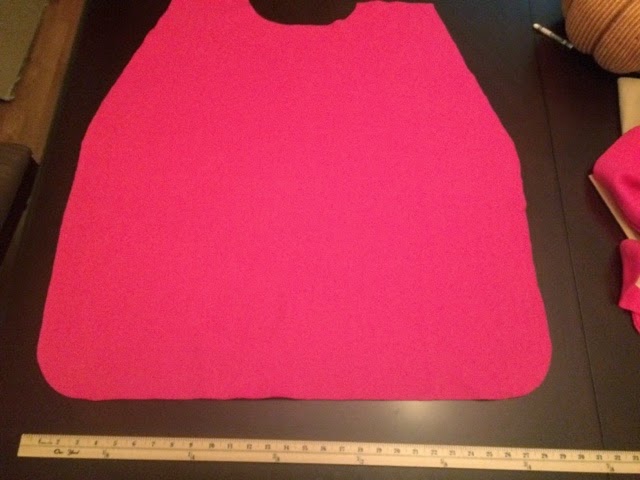
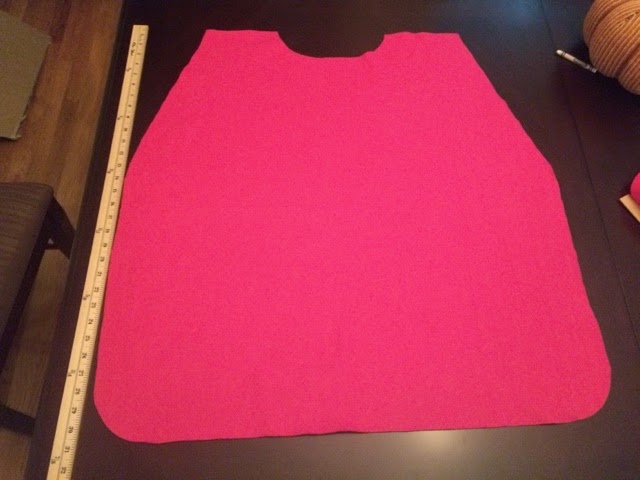 The cape is about 30 1/2" long (which is almost to the floor on my 3yo)...