
Donate to our Longest Day fundraising campaign!
Want to receive email updates? Join our mailing list here

Donate to our Longest Day fundraising campaign!
Want to receive email updates? Join our mailing list here
On March 18, No More Deaths released a searchable map, database, and report documenting the upsurge in migrant deaths in the New Mexico and the far West Texas borderlands. The “El Paso Sector Migrant Death Database” provides the most comprehensive account to date of the past 15 years of migrant deaths along the US/Mexico border in CBP’s El Paso Sector, which includes all of New Mexico, as well as El Paso and Hudspeth counties in Texas.
The El Paso Sector Migrant Death Database comprises a downloadable database and map, similar to the OpenGIS Initiative for Deceased Migrants published by Humane Borders for the state of Arizona, along with a report briefly analyzing this data. We found that:
Demands and recommendations
CBP and the agency’s Office of Professional Responsibility (OPR) have time and again proven themselves dishonest in their accounting of migrant deaths and of CBP-related deaths. In this report, we reveal one small piece of what is missing from their data. But data and transparency will never bring back the lives lost, or stop the ongoing crisis of death and disappearance that is a direct result of US border policy. The only way to prevent the death and suffering that have become so commonplace in the US-Mexico borderlands is to end the policy of Prevention Through Deterrence, abolish the US Border Patrol, and dismantle the border barriers that have divided so many communities. At a minimum, we demand the following:
Approximately 400 asylum seekers waited along the border wall near Sasabe, Arizona yesterday, in hopes of being picked up by Border Patrol.
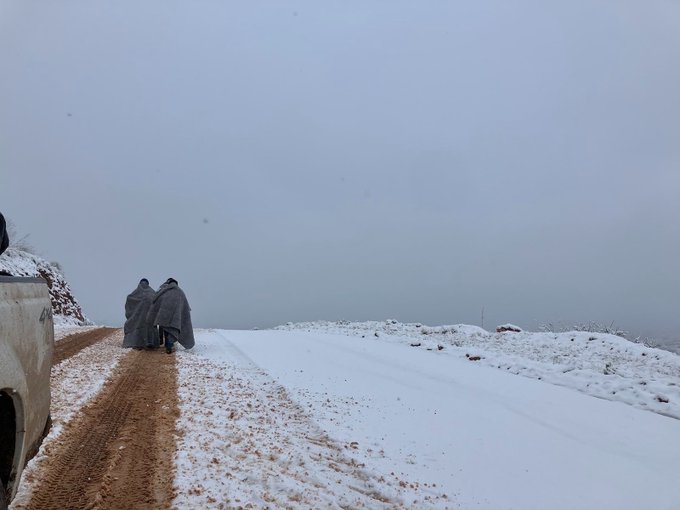
Border Patrol never came. During the night, snow and freezing temperatures set in. By this morning, a few inches of snow had accumulated and humanitarian aid volunteers found hundreds of people still stranded along the wall with no sign of a Border Patrol response.
Volunteers with No More Deaths, Tucson Samaritans, and Green Valley Samaritans began evacuating people to the Border Patrol Station in Sasabe. Many volunteers were detained and threatened with arrest by Border Patrol agents who said that they were informed of the situation but did not plan to drive out to address it. As the snow melted and road conditions turned muddy, volunteer vehicles continued to evacuate people despite threats of arrest in anticipation of more dangerously cold conditions tonight.
Now, Border Patrol is refusing to allow more people into the station to be processed. At the time of writing, there are over 250 adults and children left exposed to the elements outside of the Sasabe station. Despite persisting for over three months, Border Patrol has failed to adequately allocate resources to address this ongoing crisis.
People cannot be left out in such life-threatening conditions. A response must be enacted now to establish adequate shelters, warming centers, and other basic necessities for those who seek safety and asylum in Sasabe.

There is a humanitarian crisis ongoing at the border as we are seeing drastically increased numbers of asylum seekers crossing in remote mountain areas. Customs and Border Protection has not been adequately responding, at times even threatening humanitarian aid volunteers with arrest while leaving hundreds stranded in deadly, hypothermic conditions. No More Deaths / No Más Muertes, fellow humanitarian aid groups, community groups, and individuals have stepped up to help care for them, but the situation is continuing to escalate. The Tucson Sentinel wrote an article that illuminates the suffering and dire need, please check it out here.
Thus far we have re-allocated funds to manage this support, but those funds are running low and our work is far from over. We are asking our community to help us by making a donation today so we can continue to provide blankets, clothing, food, shoes, and other humanitarian aid. Our volunteers are working tirelessly to get these supplies directly to the people in danger of hypothermia and exposure due to the winter weather.
We appreciate our community for continuing to support our humanitarian aid efforts. Without you, it would not be possible to make a significant impact on the crisis. Please email us at fundraising@nomoredeaths.org with any questions.
Want to receive email updates? Join our mailing list here

SASABE, Arizona – Last night, humanitarian aid workers scrambled to triage and support 300 asylum seekers stranded along the border wall east of Sasabe, Arizona. A winter storm blew in, dumping rain upon the hundreds of men, women, children, and babies left without adequate shelter in the remote location. Recognizing the urgency of the situation, volunteers notified Border Patrol that they would be driving asylum seekers to the Sasabe substation to be processed, to get them out of the life-threatening cold.
Volunteers were told that this was illegal. Meanwhile, Border Patrol agents refused to send personnel to the area, citing road conditions and limited space in vehicles as the reason for their lack of response. They advised volunteers to call 911 if there was a medical emergency.
The message from Border Patrol was loud and clear: you’re on your own.
Despite the constraints of providing humanitarian aid in a place where cell phone service is limited and the nearest ambulance is two hours away, humanitarian aid volunteers did place multiple calls to 911. Through the rainy day and the frigid night, no emergency services arrived. “Without us volunteers everybody would have died. Everybody would have died,” one volunteer responding to the situation said. “With no tarps, no rain gear, no food, and no water, 300 adults, elders, and children could have died from exposure. We were a group of 8-15 volunteers triaging 300 people, trying to prevent hundreds of deaths. We cannot keep this up. We are not meant for this. We need bigger resources and responses.”
There are still hundreds of people stranded along the wall, waiting to be picked up by Border Patrol.
TUCSON, Arizona – On November 14th, No More Deaths released Separate and Deadly: Segregation of 911 Emergency Services in the Arizona Borderlands. The report is the latest installment of Disappeared, a four-part series that examines Border Patrol’s role in the crisis of mass death and disappearance in the U.S.-Mexico borderlands.
Separate and Deadly analyzes the Pima County Sheriff’s Department’s emergency response system and the segregation of 911 calls in the border region. The findings of the report shed light on a discriminatory system in which vastly different responses are allocated to callers based on their perceived citizenship status. For people migrating through the region, their distress calls to 911 are customarily transferred to Border Patrol – an agency that has already demonstrated a deadly negligence when it comes to emergency response and rescue.
From the report:
“In March 2018, a man contacted 911 eleven times over the course of ten hours. He was lost and alone. As the hours passed, his condition clearly deteriorated, and his voice began to fade. It appeared that Border Patrol was not actively searching for him… Pima County dispatchers continued to transfer his call to Border Patrol every time he called… The county’s own Search and Rescue team was never notified, and the county never activated a search for him. Eventually the man stopped calling. The outcome of his case is unknown.”
The No More Deaths team reviewed thousands of 911 calls and took testimony from humanitarian aid volunteers, in addition to other relevant data sources. In 99% of the calls where the caller was presumed to be undocumented, no intake or assessment was conducted, in 68% of the calls the dispatcher lacked fluency in Spanish to be able to communicate effectively and 50% of the callers were given no notice before being transferred to Border Patrol.
“Not only is call segregation based on presumed immigration status unlawful, the consequences of such practices are deadly,” says Parker Deighan, one of the report’s contributors. “The findings of this report raise serious questions about the county’s complicity in the ongoing crisis of death and disappearance.”
In 2023 alone, the remains of 175 people have been found in Arizona. Countless more remain disappeared.
Tucson.com | Emily Bregel | December 3, 2025
order agents raided a migrant-aid camp near Arivaca last week, entering private structures without a warrant and arresting three people who were receiving aid there, volunteers with the group No More Deaths said.
Continue readingThe Intercept | Ryan Devereaux | December 2, 2025
The raid on humanitarian aid providers on the U.S.–Mexico divide late last month was the first where Border Patrol entered structures without a warrant.
Continue readingKJZZ | Alisa Reznick | December 2, 2025
The humanitarian group No More Deaths says Border Patrol agents entered their aid camp along the U.S.-Mexico border and made arrests at the end of last month — marking the first time since 2020.
Continue readingArizona Luminaria | Carolina Cuellar and Rafael Carranza | December 1, 2025
No More Deaths group says agents waited outside for an hour before breaking in structures at Byrd Camp in what the group calls a new escalation.
Continue readingTucsonSentinel.com | Paul Ingram | December 1st, 2025
Border Patrol agents raided the No More Deaths camp near Arivaca, Ariz., on Nov. 23 and arrested three people without a warrant to enter the private property, the humanitarian organization said Monday morning
Continue readingDavid Ulloa Jr. – Arizona Republic – 28 October 2025
The recent CBP data measures “enforcement outcomes, not migration flows,” Mónica Ruiz House, a spokesperson for No More Deaths/No Más Muertes, said in a written statement regarding the recent CBP data.
“Decades of border militarization have shown that intensified enforcement pushes migrants to cross through increasingly remote and dangerous areas to avoid detection,” Ruiz House said. “As a result, official apprehensions may decline even as crossings persist and become less visible in official datasets like this one.”
¡Bienvenido! Considere una contribución para el trabajo de No Más Muertes. • Welcome! Please consider a contribution to the work of No More Deaths.

Done mediante cheque • Donate by check instead
Solo suscríbase a la lista de correo por ahora • Just subscribe to the mailing list for now


