Has it ever occurred to you that one of the stories about Abraham Lincoln most revered for cuteness turns out, actually, to be a fairly damning indictment of women participation in politics not to mention of the nineteenth amendment?
In the wake of the numerous victories by socialists, Glenn Reynolds quotes Kyle Smith ("Don't underestimate the value of looks. El-Sayed won in part because he's good-looking. Mamdani won in large part because he's cute.") and links to the far more damning assessment of The Patriarch Tree:
The Party of College Educated White Folks Craving Swarthy Foreign Guys — it’s not really about health care policy or “affordability” or whatever. @TheDemocrats are now a BDSM cult organized around some kind of weird masochistic Mandingo fetish.
Let us go through the history of one country, the United States, and see to what extent women have suffered under the of oppression of men and their "toxic" hyper masculinity — along with how men have neglected the wisdom of females.
Notice that there are two facets to the issue here: A) that far from being excluded from society — at least political society — women certainly had their voice to share; and B) their propensity for choosing a good candidate for a good reason is highly to be desired.
What follows is a couple of stories — one of them famous — in which many would say the tendency to vote for looks (even over half a century before women has the vote) turned out to be rather positive. Still, there is a problem when looks seem to be the only value one species is looking for.
In his book about "Danish blood in the American Civil War", To War for Lincoln (I Krig for Lincoln: Dansk Blod i den Amerikanske Borgerkrig), Anders Bo Rasmussen quotes some of the letters written by a Danish-American chief quartermaster after the Battle of Pea Ridge (Elkhorn Tavern).
In Arkansas one finds "the most beautiful women" one has ever seen, wrote Captain Ferdinand Winsløw during his unit's occupation of Batesville. He said that he and several Northern officers managed to "convert several sessesh ladies" to the Union cause, thanks less to their weapons than to their "good looks."
Voters converting to Lincoln or to the Union cause? Because of what? Because one or several of them is/are (more) handsome? Again, a good thing in this particular case (at least in my eyes) — but hardly what you want in a voter.
Let's take America's most famous president, and concentrate on two aspects — from 1860 and from 1858. Although the story of a little girl writing to Abraham Lincoln asking him to grow a beard is well-known (probably less so in today's school system), the content of the letter is clearly overlooked, as is its significance — which turns out to be: nothing less than astounding.
What does it say for women's oppression versus men's allegedly ignoring of the females in their lives when an 11-year-old Grace Bedell can write the following letter?
I will try and get the [all four of my brothers] to vote for you you would look a great deal better for your face is so thin. All the ladies like whiskers and they would tease their husbands to vote for you and then you would be President.
The wives and the daughters can, and do, "tease" their husbands and their brothers to vote for their preferred candidate (and that only on the basis of their looks)?! Whether it is the women themselves voting or their menfolk following their instructions, what does that say for about their participation in the electoral process, not to mention about the independence of men along with the latters' alleged oppression of the female sex?! Although in this case, the result of the optics turned out to be rather positive — with the victory of Abe Lincoln — one can hardly deny that it still puts a huge question mark on women's participation in elections and politics.
A couple of years earlier, during the Lincoln-Douglas debates (attended by entire families, i.e., with both men and women present along with their children), the pro-Railsplitter banner at one of the rallies read
Westward the star of empire takes its way —
the girls link-on to Lincoln, their mothers were for Clay
The Republican procession into Charleston, Illinois, for the 4th debate on September 18, 1858, was lead by a band, followed by a carriage carrying Old Abe, followed immediately after by 32 girls (one for each state) in a "mammoth car" draped in white silk and muslin, bedecked with wildflowers, and emblazoned with the Lincoln enscription above ("Westward thy star of Empire takes its way" is the way another report had it, "thy Girls Link-on for Lincoln / Their Mothers were for Clay"), followed in turn by a maiden on horseback with a sign "Kansas — I will be free" along with an endless line of teams "filled with men, women, and children" extending behind them "across the prairie as far as the eye could reach" in a cloud of dust.
What possible reason could there have been to use a sign (not to mention the 32 young girls) underlining which candidates were favored by a significant number of American women, of all ages, in the current generation as in the previous generation, were for, if it wasn't the fact that their opinion had (a lot of) significant value?

Let us go further back (almost four score and seven years earlier), to the American Revolution: One letter written during the Spring of 1776 as the Constitutional Convention prepared to cut all ties with Britain is often taught to schoolchildren in shortened form: Abigail Adams's admonition from Massachusetts to her husband in Philadelphia to "Remember the Ladies."
In her letter written three months before the signing of the Declaration of Independence, the wife of John Adams writes that
"in the new code of laws which I suppose it will be necessary for you to make, I desire you would remember the ladies and be more generous and favorable to them than your ancestors. Do not put such unlimited power into the hands of the husbands. Remember, all men would be tyrants if they could. … That your sex are naturally tyrannical is a truth so thoroughly established as to admit of no dispute."
What is much more rarely taught to schoolchildren is the reaction of John Adams, and no wonder, since it turns out to be… a bout of hilarity:
"I cannot but laugh … Depend upon it, we know better than to repeal our masculine systems. Although they are in full force, you know they are little more than theory. We dare not exert our power in its full latitude. We are obliged to go fair and softly, and, in practice, you know we are the subjects. We have only the name of masters, and rather than give up this, which would completely subject us to the despotism of the petticoat"
"In practice, you know we are the subjects"!
Doesn't that sound like a far cry from the women as oppressed class, not liberated until, at the very earliest, the 19th amendment in 1920?!
No wonder that Sarah Hoyt writes that
THE US IS THE FIRST MATRIARCHY TO CLAIM THAT WOMEN NEED LIBERATION
As for Sigmund Freud (of all people), during his 1909 (and only) visit to the United States, the father of psychoanalysis complained that American women “lead the men around by the nose, make fools of them, and the result is a matriarchy … In Europe, things are different. Men take the lead. That is as it should be.”
In any case, if we are to listen to a great deal of Americans of the 19th century as well as of the 18th century (female as well as male), then it seems that the whole women/wives-victims-of-the-evil-men/husbands is not only highly overblown but is in most cases close to 180º false. And — to say the least — their capacity for judgment in voting can only be described, at least much of the time, as: highly dubious.
Again, John Adams: "… in practice, you know we are the subjects [;] repeal[ing] our masculine systems […] would completely subject us to the despotism of the petticoat."
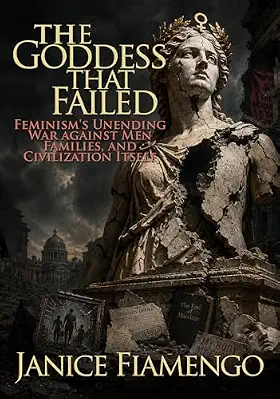
Update: In The Goddess That Failed: Feminism's Unending War against Men, Families, and Civilization Itself, Janice Anne Fiamengo writes in the foreword (free on Amazon and on Substack's Fiamengo File, thanks to ADJ) that
Feminism
poses a threat to everything good in western culture, perhaps
especially to women’s capacity to love, reason, and exercise
self-restraint.
I
was an adherent of feminism before I became a critic.
… Unlike
others who have criticized feminism’s excesses, I contend that although
there are some moderate feminists, there was never a moderate feminism
inspired by reasonable goals and untainted by anti-male fanaticism.
Feminism did not go wrong at some point in history, whether after the
Second Wave or before, whether in anti-sex or pro-sex zeal. It was
always rooted in resentment and envy, warped by utopian longings and
false notions of female moral superiority.
Decades of feminist grievance-mongering and accusation have led
inevitably to our present time of ceaseless complaints, anti-western
causes, hysterical accusation, rampant divorce, a declining birthrate,
millions of abortions, and anti-male cruelty. Feminism has undermined
and will continue to undermine the stability and viability of all
western societies.
True,
there are many varieties of feminism, not all of them agreeing on every
point: … Such distinctions do not concern me because none makes a real difference.
None escapes the victim mentality: the belief that the history of humanity
up until the present moment has been a history of (privileged, white)
men oppressing women and other innocent victims; and that because of
their alleged greater suffering and moral innocence, particular care and
attention must be paid to women and to their unique capacity for
empathy and social justice.
No
version of feminism escapes the binary logic whereby the world is
divided up into (sometimes intricate, overlapping) categories of
oppressor and oppressed, victim and victimizer, to be treated
differently and valued differently according to their identity category.
Because
it thinks in terms of groups and divides the world into innocent and
guilty, feminism is incapable of devising universal principles or
pursuing individual fairness or freedom. It is distorted by its victim
thinking, incapable of extending empathy to those feminists see as
oppressors, and incapable of demanding accountability from those
feminists see as victims.
… The
notion that men have always had a good time and women always suffered
as a result of men’s actions is of long standing. Perhaps it is even
embedded in female psychology as part of an ancient survival mechanism.
Also baked into our cultural fabric is the tendency
of women to sympathize more with other women than with men; and of men
to sympathize more with women than with other men.
These
natural proclivities on the part of both men and women provided fertile
ground in which feminist ideas about blame and innocence could take
strong root, stirring up women’s anger and resentment, provoking men to
self-doubt and shame.
Beginning in the eighteenth century in the west, women spoke and wrote
vehemently about how their men had betrayed them, and men turned against
their fellow men in disgust, anxious to show that they were not a party
to the betrayal.
In the nineteenth century and even more strongly in the twentieth, men
were easily persuaded to support laws and programs to benefit women even
when those programs disadvantaged men. The history of affirmative
action tells of decades during which white men have accepted overt,
unjust discrimination almost without a murmur.
Even today, over a century after women achieved full legal
equality with men and half a century after the implementation of
affirmative action hiring programs as well as ceaseless female
empowerment campaigns, many women are still angry and many men are still trying to make amends.
It
must be stopped. … It’s
unlikely that non-feminist women alone will be able to defeat their
crazy feminist sisters. This will have to be a joint venture between men
and women, firm in its resolve, clear-eyed about the stakes, unshaken
by public shaming or self-doubt.