EDWARD D. HOCH “Day of the Wizard.” Simon Ark. First appeared in The Saint Mystery Magazine (UK), August 1963. Reprinted in Chase, September 1964; and Locked Room Puzzles, edited by Martin H. Greenberg & Bill Pronzini (Academy Chicago, 1986). Also included in the collections The Judges of Hades and Other Simon Ark Stories and Funeral in the Fog (2020).

   Simon Ark is the quirkiest of Ed Hoch’s many recurring series characters. A review of one of the aforementioned collections in another blog  described him this way: “Simon Ark is not your typical detective. He scours the Earth searching for the Devil, either the actual Devil him/herself or his agents, and has been doing so for nearly 2000 years since he was a Coptic Priest in Ancient Egypt. Allegedly.”

   I have read several of his adventures but far from all of them. I believe that most (all?) of them Mr. Hoch wrote toward the beginning of his writing career. That may be the reason I found the opening pages a bit more sprightly — if perhaps even quite sparkling — than the slower but still very solid tales he wrote as time went on.

   This one begins at the end of World War II, as a military plane containing a merry crew and a special cargo crashes near the shore of east Africa. Seventeen years later a hunt for the plane finally begins, starting with a hunt for Simon Ark. In the process of luring him away from whatever activity he may be doing, the wiles of a street magician in Cairo are used. An empty box, large enough for a person to stand in, is locked under the gaze of many reporters, who are asked to return the next day.

   At which time they find, of course, the body of a girl. Drugged but not dead, but she has no idea how she managed her way into the locked and sealed empty box. For me, this was the crux of the story, and it’s a good one. The solution is simple, buy only once you know. What I found interesting is that the contents of the plane are very cleverly not revealed. I has to read the end of the story a second time, and I am relatively sure I didn’t miss anything.

   I’m not not sure if what goes on in what takes lace in the desert once the plane is found hold up all that well, but the one with thr girl in the box does. It’s a zinger!
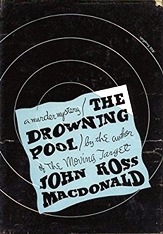
ROSS MACDONALD – The Drowning Pool. Lew Archer #2. Knopf, hardcover, 1950. Reprinted many times, in both hardcover and paperback. Film: Warner Bros., 1975, starring Paul Newman.

   PI Lew Archer is hired to investigate an anonymous note sent to Maude Slocum’s husband 9accusing her of adultery], intercepted before he could read it, but one that could ruin a marriage. Yet it’s also one hardly worth saving, as James Slocum’s daughter has her own dark secrets .

   Then the grandmother is pushed into a pool, and Archer refuses to be pushed out of the case, More murder — and a suicide — occur before the ends are finally tied up, including verification of the real murderer, Smartly done, an early work of a craftsman.

   I liked the line, after Archer overhears some particularly nasty conversation: “I felt as if I’d been listening in on a microphone built into the walls of the hall.”

Rating: ****

— September 1969.
A 1001 MIDNIGHTS Review
by Art Scott & Bill Pronzini


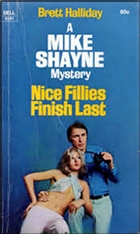
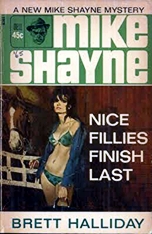
BRETT HALLIDAY – Nice Fillies Finish Last. Dell, paperback original, 1966. Reprinted several times.

   Around 1958, Davis Dresser cut back on his writing and the Halliday by-line was passed along to various ghosts. A number of mystery writers-including Dennis Lynds, Mike Avallone, and James Reasoner-have produced the Mike Shayne novelettes in Mike Shayne Mystery Magazine. As to the novels, Ryerson Johnson did a couple of them, and Robert Terrall wrote two dozen.

   Terrall is a fine writer, a more subtle and accomplished stylist than Dresser, and his Shayne novels deserve attention. He injected new life into a rather played-out series, and came up with fresh story material. Some of the books find Shayne mixed up in international intrigue; and several have interesting gambling and sports backgrounds — this one, for instance.

   Tim Rourke gets a tip from a rummy at the harness track that someone’s planning lo pull off a complicated multi-race betting coup. Rourke’s source turns up dead, apparently from accidentally swilling wood alcohol. He tries to investigate, but winds up in the hospital, courtesy of an angry jockey who didn’t appreciate Rourke’s questioning of the jockey’s hot-pants wife. Shayne has to come in and sort it out. There’s interesting development of sexual motivations and tensions among the characters. Terrall is exceptionally skilled in handling such material.

   Other noteworthy Shayne novels: Bodies Are Where You Find Them (1941), The Corpse Came Calling (1942), Blood on Biscayne Bay (1946), Framed in Blood (1951), Fit to Kill (1958-Terrall), At the Point of a .38 (1974-Terrall).

   Testimony to Shayne’s popularity in the Forties and Fifties is a series of seven B films starring Lloyd Nolan as Shayne, among them Sleepers West ( 194 l ), based on the novel Sleepers East by Frederick Nebel, and Time to Kill (1942), based on Chandler’s High Window; Hugh Beaumont (Beaver Cleaver’s father) also staffed as Shayne in five additional B’s in the late Forties.

   Shayne had his own show on the radio, on and off from 1944 to 1952, with Wally Maher, Jeff Chandler, and Robert Sterling playing the detective in three different incarnations. A Michael Shayne TV series featuring Richard Denning aired in 1960-61. And after twenty-nine years, Mike Shayne Mystery Magazine ceased publication in 1985.

———

   Reprinted with permission from 1001 Midnights, edited by Bill Pronzini & Marcia Muller and published by The Battered Silicon Dispatch Box, 2007.   Copyright © 1986, 2007 by the
Pronzini-Muller Family Trust.

A 1001 MIDNIGHTS Review
by Art Scott


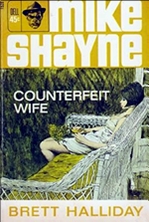
BRETT HALLIDAY – Counterfeit Wife. ZiffDavis, hardcover, 1947. Reprinted in paperback a number of times.

   Mike Shayne, the durable private eye from Miami, has hung in there for an unusually long career (in part with the aid of ghost writers — see the next entry). The appeal of the character seems rooted in the straightforward approach originally laid out by Halliday (Davis Dresser). Shayne is a tough, direct character, not tricked out with gimmicks, not given to guilt complexes or excessive philosophizing.

   The stories are fairly complicated. with a fun complement of fights, shoot-outs, mobsters, and slinky dames. Add to that a loyal secretary (Lucy Hamilton), a wisecracking newshound (Tim Rourke), a sympathetic cop (Will Gentry), a nasty, stupid cop (Peter Painter), a lot of two-fisted drinking, and you have all the elements. Mike Shayne is the Generic Private Eye.

   This crackling adventure from Shayne’s middle period (after the death of his wife, while he was shuttling his home base between New Orleans and Miami) starts with the big redhead about to board a late plane to New Orleans when a nervous man, desperate to get on the flight, gives Shayne two hundred-dollar bills for his ticket. A woman claiming to be the man’s wife shows up a bit too late to catch him. Curious, Shayne follows her to a roadhouse and buys her a few drinks.

   The bar owner pulls a gun on Shayne, demanding to know where he got one of those big bills; he and the woman try to escape in her car, which is promptly wrecked. Tums out the money is counterfeit, there’s a dead kidnap victim in the trunk of the car, the cops want Shayne for the murder of the man who took his apartment … and the narrative barrels on from there.

   Dresser’s nuts-and-bolts style isn’t particularly elegant, but it gets the job done. There’s one terrific action sequence in which Shayne, naked, armed only with a liquor bottle, manages an escape from the counterfeiters, who were about to take him for a ride. One of the best of the Shaynes, helped considerably by the absence of simpering, kidnap-prone Lucy Hamilton.

———

   Reprinted with permission from 1001 Midnights, edited by Bill Pronzini & Marcia Muller and published by The Battered Silicon Dispatch Box, 2007.   Copyright © 1986, 2007 by the
Pronzini-Muller Family Trust.

ANALOG SF – February 1968. Editor: John W. Campbell Cover artist: Kelly Freas. Overall rating: ***

HARRY HARRISON – “The Horse Barbarians.” Serial, part 1 of 3. The book version (as Deathworld 3) was previously reviewed on this blog here.

WALT & LEIGH RICHMOND “If the Robot Fits,,,” Is the interconnectivity of computers possible? It takes a boy to answer. (2)

POUL ANDERSON “Look! I See You!” Flying saucers, atmospheric plasmoids, and Hopi Indians. How to join the Galactic Federation. Ho-hum (3)

JACK WODHAMS “The God Pedlars.” How can the benefits of despotism be guaranteed? Can an efficient system of checks and balances be established? Oh, to be a god! (4)

W. MacFARLANE “Optimum Pass.” Part of a series. This is not sufficiently connected as to make sense, (1)

— September 1969.

POUL ANDERSON “Third Stage.” First published in Amazing Stories, February 1962. Reprinted in Space Pioneers, edited by Hank Davis & Christopher Ruocchio (Baen, paperback, 2018). Included in several collection of Anderson’s work.

   When this gripping tale of misadventure in the space program in the US in 1962, the aforementioned space program had not been around for very long – a fact you should keep well in mind while reading it today. Two man are in a their small cabin in soace (the third stage) investigating the levels of radiation in the Van Allen belts surrounding the Earth. The information they gather will be a key to the future of the program – will it even be able to continue? — so the data they record is crucial; there is no doubt about that.

   But that part of the story is overtaken by even bigger problem. A jet to be used for the delicate maneuvering of their craft’s journey has frozen over. The solution is easy, sort of. All that one of the two men on board needs to to go out of their vehicle and clear the jet by hand. Th downside of this solution is that the man who goes outside will die from the exposure to the radiation he will not be protected from.

   Of of the two men, who be the one to go out? To be a hero, but doomed to a slow ugly death. Both men are still young, with families watching and waiting, as is the entire country. The decision us sent higher and higher upstairs until it reaches the president. This is not the end of the story, though. I will not say more, but if other means fail, I believe is available to read online.

   It’s worth searching for. Poul Anderson is not one of my favorite SF writers, but he nails it this time, including what might have been among the first stories in which the media gets in the way of the story they are telling. When I used the word “gripping” in the first line of this review, I meant it.

A 1001 MIDNIGHTS Review
by Bill Pronzini


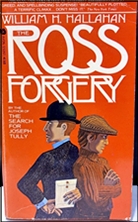
WILLIAM H. HALLAHAN – The Ross Forgery. Bobbs-Merrill, hardcover, 1973. Avon, paperback, 1975.

   The Ross Forgery, Hallahan’s second novel, is an unusual bibliomystery with a compelling and ingenious premise. New York typographer Edgar Ross, one of those brilliant but unsuccessful types, is approached by tycoon Emmett O’ Kane, who wants him to create a forgery of a nineteen thcentury folio by Thomas Wise. O’Kane’s stated reason: to show up a fellow collector and tycoon from Texas named Thomas Long Pickett, who has the world’s most complete collection of Wise pamphlets.

   Wise — a real person — was a famous British bibliophile who amassed one of the largest private libraries of the century; he also published, over a forty-year period, some fifty first editions of obscure works by major Victorian writers.

   It wasn’t until just before his death that those “first editions” were revealed as forgeries and Wise was unmasked as the greatest literary forger in the English language. But what O’Kane wants isn’t just a forgery; he wants a forgery of a forgery that doesn’t exist — a brand-new nineteenth-century Wisc pamphlet, created from scratch, that will be good enough to fool an expert and an expert’s scientific equipment.

   This seemingly impossible task is one that Ross, under normal circumstances, would never even have considered. But it so happens he is into the Mafia for $5000, the result of a penchant for gambling too often and not too well. So for a fee of $100,000, Ross promises O’Kane that he will somehow do the impossible.

   With the help of Michael Townsend, an English professor at St. David’s Academy for Young Men and a bibliophile of no small expertise, Ross sets out to design a “historically accurate facsimile” — a twenty-eight-page, 1881 Peppercorn Press pamphlet of “A Lodging for the Night” by Robert Louis Stevenson.

   The methods (all authentic) and machinations by which Ross and Townsend re-create the long-lost typeface and special ink and paper used in the 1880s make for fascinating reading. But that is only one aspect of this novel’s considerable appeal. Ross’ s efforts to keep the Mafia at bay and to find out what he suspects are hidden motives on O’ Kane’s part are two other major plot threads; a shadowy game of deceit and deception that includes murder is yet another thread.

   Hallahan’ s construction, which utilizes constantly shifting viewpoints and the narration of seemingly unrelated events, is both straightforward and devious — a fictional sleight of hand that, when all the components finally dovetail, reveals a stunning and violent surprise ending. The Ross Forgery is no forgery when it comes to high-quality suspense novels: It’s the real thing.

   Hallahan’s other thrillers have strong occult themes and fall outside the purview of crime fiction. Among these are The Search for Joseph Tully (1974) and The Monk (1983).

———
   Reprinted with permission from 1001 Midnights, edited by Bill Pronzini & Marcia Muller and published by The Battered Silicon Dispatch Box, 2007.   Copyright © 1986, 2007 by the Pronzini-Muller Family Trust.

ROBERT WALLACE – The Corpse Parade. The Phantom Detective. First published in magazine form, December 1937. Reprinted as a paperback by Regency / Corinth in 1966.

   A series of evil murders stalks the streets of New York City. The victims are all connected with the automotive and trucking industries, the bodies found with amputated arms, being dragged behind ambulances, fire trucks and buses. Richard Van Loon, alias the Phantom Detective, answers a summons from publisher Frank Havens to find the secret behind the sinister threat posed by the ring of bloody killers.

   The cover [of the paperback] reveals how the arms [of the victims] come to be missing – not the work of the giant Ethiopian’s scimitar, but of a fantastic guillotine. The explanation is better than the story itself, which with its mistakes and flaws, never getting interesting in spite of the furious action.

Rating: *

–September 1969.
My Top 10 PI Novels, by Tony Baer.


         — One per author; private = no police detectives:

The Maltese Falcon
Long Goodbye
Galton Case
8th Circle (Ellin)
No Good from a Corpse (Brackett)
Solomon’s Vineyard (Latimer)
Death in a Bowl (Whitfield)
Last Good Kiss (Crumley)
Taste of Ashes (Browne)
I, the Jury

WARREN MURPHY “Another Day, Another Dollar.” First published in Murder on the Run: Stories from the Adams Round Table (Berkeley, hardcover, February 1998). Reprinted in The Shamus Winners: America’s Best Private Eye Stories, Volume II: 1992-2009, edited by Robert J. Randisi (Perfect Crime Books, 2010).

   To start with, if the guys who run the Private Eye Writers of America want to call this a PI story, I’m not going to argue with them. It’s close enough, even though the leading protagonist is a middle-aged black woman who works on the line in an automobile factory. I don’t think anyone who works there knows why she stepped down from the secretarial pool there to work down there, but the reason is an easy one.

   She needed the money. Money she used to raise her nephew. Money to make him the man he is. Or was. He and his wife have been found murdered. Strangled. What she does not understand is why there is no mention of their young daughter. The police do not even seem to know of her existence. And it is the life of the youngster who is the focus of her own life from that point on.

   She takes a leave of absence from her job, and does what a PI would do, once hired. Find the girl. Which of course she does. With a vengeance. I wondered in the beginning how Mr. Murphy, best known as being the co-anther of the tough guy The Destroyer series, could get away with writing about the adventures of a middle-aged black lady. But that he does. Whether it’s a PI story or not, it’s one worth reading. No doubt about it.

Next Page »