Showing posts with label Wild Cards. Show all posts

Monday, February 27, 2012

One Eyed Jacks

This is more of an acknowledgment than anything else. I read One Eyed Jacks over the summer and since I plan to start stepping back into the Wild Cards series, I want to at least mention this volume of one of my favorite series. You can also consider this part of my occasional posts covering what I read while in Texas. Very occasional posts, at that.


One Eyed Jacks is the eighth (out of 21, so far) novel in George R. R. Martin’s Wild Cards shared world milieu. Sadly, it is one of the least successful so far. While each book has something I don't care about (like the Ti Malice storyline of Down and Dirty), most are strengthened by some aspect that I adore. One Eyed Jacks is missing that bit of specialness.  Plus, One Eyed Jacks has more Tachyon and Blaise (not a good thing in my book). Also, jumpers. The jumpers are a group of aces who can “jump” their consciousness into the bodies of other people and completely take them over. Conceptually, it’s a fascinating idea because if you consider that they can also take over other aces and the accompanying powers, there’s a lot of damage these little bastards can do with minimal personal repercussions.

Thing is, there are repercussions because when the jumpers pick on the wrong aces or the wrong people, somebody is going to come looking for answers. In this case, Blaise. Yes, that damned Blaise – the sociopathic son of Dr. Tachyon and who perpetually has storylines I find intensely uninteresting. I’m sure others take nasty delight in the appearance of any Blaise storyline. Wild Cards has plenty to offer. While I enjoyed how aspects of the Jumper / Blaise story resolved, it’s just more Blaise with the suggestion that he will continue to take a prominent role in the coming volumes.

Other storylines in the novel feature Jerry Strauss, once The Projectionist who was trapped in the body of a giant ape, now Mr. Nobody, working as something of a private investigator in love with his brother’s wife; Dr. Tachyon’s new chief surgeon Dr. Cody Havero; and The Oddity. Stephen Leigh’s Oddity story “Sixteen Candles” is a poignant and painful story. It’s also damn good.

While I want to see how the jumper concept works itself out, One Eyed Jacks did not have me clamoring to pick up Jokertown Shuffle to get the next installment of the story.

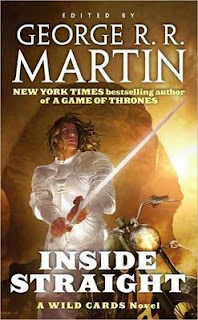
Despite this, Wild Cards remains an impressive achievement of shared world collaboration. George R. R. Martin has done well to keep it going over the years, even if there is the occasional dip in quality. If you’re looking for a starting point for the series and shudder at the thought at starting with the first book and slogging through twenty more volumes, start with Inside Straight. It may be the eighteenth volume, but it serves as a reintroduction to the world with a new cast of characters and new story arcs. I highly recommend it (and the whole series).


Previous Wild Cards Reviews:
Wild Cards (bk 1)
Aces High (bk 2)
Jokers Wild (bk 3)
Aces Abroad (bk 4)
Down and Dirty (bk 5)
Ace in the Hole (bk 6)
Inside Straight (bk 18) 
Busted Flush (bk 19)

Sunday, December 19, 2010

the rare side of Wild Cards

George R. R. Martin has a Wild Cards related post and he gives a bit of an overview of where things stand for readers looking to get a hold of the earlier volumes of the series. As George mentions, the first book was published in 1987, and there have been four different publishers involved.  This is a longer excerpt than I normally quote, but it really covers the trouble readers may have with some of the later books.  George's post has prettier pictures than mine, and more paragraphs of joy.


Which is where things get complicated. With that long a history, some of the volumes are naturally much harder to find than others. The original twelve-volume run from Bantam can usually be found via ABE.books or ebay at reasonable prices, but the three volume "Card Shark" series that followed, published by Baen Books, is considerably more challenging, especially the third and concluding volume of the triad, BLACK TRUMP. If you do find it, it will likely cost you a lot more than it originally sold for.

That being said, even BLACK TRUMP is easy to find compared to the two hardcover originals published by iBooks when they brought the series back after a seven-year hiatus -- DEUCES DOWN, a typical Wild Cards book with stories by various hands, and DEATH DRAWS FIVE, John Jos. Miller's solo WC novel. DD5 was published only one week before iBooks went bankrupt and closed up shop. As result, to the best of our knowledge, only 600 or so copies ever got into the bookstores. (Was that the total print run, or are there more sitting somewhere in a warehouse? No one seems to know, and there's no one left at iBooks to ask). In the years since, and especially after Tor and INSIDE STRAIGHT kicked off the second coming, demand for the book has steadily risen, along with its price. It has become the Holy Grail of Wild Cards collectors.

He's not kidding with Death Draws Five.  If you can find a copy under $80 right now, you've found a good deal.  It's the only book in the series I don't own.

I got lucky with the paperbacks and, no lie, found almost the complete set in one glorious trip to Uncle Hugo's - including all three volumes of the Card Sharks trilogy.  Didn't realize those were on the rare side.  I later received Deuces Down as a gift.  Which leaves Death Draws Five.  Every time I check in at Uncle Hugo's, I am prepared to lose bladder control should I see a copy on the shelf.  I am prepared to snatch that copy, clutch it close, and call it "my precious".  That copy just hasn't shown up yet. 

I knew that there was an e-book of Death Draws Five available, but I've only read through the first seven books (plus 18-20), so just reading it isn't a priority at the moment.  My library also has one precious copy, if it came to that.  I just want a full collection in print editions. 

Tuesday, August 10, 2010

Fort Freak Excerpt: Rat Race


Y’all,

Since I know you are readers of discriminating taste and, as such, are avid fans of BOTH Cherie Priest and the Wild Cards series; you will be very interested to check out an excerpt of “The Rat Race”, part of Cherie Priest’s contribution to the next Wild Cards novel: Fort Freak.  You know you want to.  It’s okay.  We won’t judge. 

Priest’s authorial excitement is also rather delightful. 
I was going to wait until this afternoon to blog this, but I lost my saving throw vs. self-restraint – so here goes! It is with great and terrible squee that I present part one of The Rat Race … an introductory sample of Wild Cards XXI: Fort Freak, live on George R. R. Martin’s website.
[:: Snoopydances like a Snoopy ::]
(Fort Freak is a production of the Wild Cards consortium, edited by Mr. Martin. It is slated for publication in the summer of 2011.)

Monday, January 18, 2010

Wild Cards: Busted Flush


Busted Flush
George R. R. Martin (editor)
Tor: 2008

The end of Inside Straight featured many of the new characters introduced in that volume joining together to form an organization of superheroes. The organization is called The Committee and is an arm of the United Nations. The UN sends the Committee to troubled areas across the globe to help out as they can.

Busted Flush continues in the Wild Cards tradition of telling a story as a “mosaic novel”. Busted Flush is told with a series of short stories written by different authors and each builds to a large and complete story.

As always, there are a few things going on in this novel: New Orleans is on the cusp of being ravaged by another tornado and a small group of Committee members are there to help, a civil war in Africa, an oil embargo in the Middle East, and an unexplained nuclear explosion in Texas.

These events seem unrelated, and they are, except that as the various members of the Committee get involved they all tie together before the novel ends in a stunning confrontation.

One of the great strengths of the Wild Cards series is the excellent characterization. Yes, the action and the plotting is equally note-worthy (certain television writers would do well to pay attention and see how it is done), but where Wild Cards lives or dies is in how well written the characters are. Melinda Snodgrass delves into the character of Double Helix, a teleporter who can change between male and female and is used as an assassin by competing agencies. The character was introduced in Inside Straight and while Noel (Double Helix) was used, it isn’t until Busted Flush that the character is really fleshed out. The other major character introduction here is Niobe, occasionally known as the Genetrix. Niobe looks like a joker, has a tail, but is actually an ace. For Niobe sex always leads to giving birth to a clutch of little potential aces and jokers, and the newly hatched aces are in command of their powers right from birth. Niobe’s story is consistently heartbreaking, as is her meeting of a young boy named Drake. Drake is the only survivor of the nuclear blast in Texas. There is more to that story.

The point here is that the characters are so well written they consistently come across as regular people who just happen to have incredible powers. The other aspects of Busted Flush are just as strong.

Busted Flush is a wonderful entry to the Wild Cards series and is the second volume of the Committee Triad (which concludes with Suicide Kings). This is a series which very much deserves to be read. Just go back and read Inside Straight and you’ll be good to go.


Reading copy provided courtesy of Tor Books.


Previous Wild Cards Reviews:
Wild Cards (bk 1)
Aces High (bk 2)
Jokers Wild (bk 3)
Aces Abroad (bk 4)
Down and Dirty (bk 5)
Ace in the Hole (bk 6)
Inside Straight (bk 18)

Monday, November 30, 2009

Wild Cards: Ace in the Hole


Ace in the Hole
George R. R. Martin (editor)
1989

The 1988 Democratic National Convention is host to the events of this sixth Wild Cards novel and politics is in the air. Ace in the Hole is the novel which has clearly been planned for several volumes now. Senator Gregg Hartmann is one of the leading candidates for the Democratic nomination. Readers of the first five volumes, and specifically the last two volumes, know Hartmann as Puppetman, a hidden ace with mind control powers and one which feeds on the fears of others. Puppetman is everything people have feared from aces, that one would take control of Washington and would be able to control the minds of others.

Here’s the thing: despite the somewhat sinister nature of Puppetman, Hartmann himself has consistently come across as a man who could be a good President, one who could be good for America. Readers have had viewpoint chapters from Hartmann’s perspective in previous novels. Hartmann is the sympathetic ace with a potential dark side.

On the other side of Hartmann is Reverend Leo Barnett, a fundamentalist Christian with a serious problem with those infected with the Wild Cards virus. Barnett seems to be the major “wild card” in this political race, not to pun too heavily on the series title. For those sympathetic to the jokers who actively suffer from the virus and to the aces who have been given great power (and great responsibility?), Barnett is a seriously scary man and his ascendency to the Presidency would be a cause for mourning (and running).

This is just the overarching political conflict of Ace in the Hole and while it is a major part of the novel, it is not the whole thing. Those who have read from the beginning will welcome the return of the Golden Boy Jack Braun, and there are various assassination plots unfolding – not to mention the very real threat of violence at the convention. Mixed in with the major story arcs with national implications, the smaller characters really shine here. The Golden Boy is one who does well with his page-time and his reflection on his history is quite poignant. Another is Demise, the man who can kill with a look. The continuing presence of Dr. Tachyon is less successful and his is a character who is beginning to wear out his welcome.

In short, Ace in the Hole is a deeply tense novel filled with intrigue and danger. This is one of the strongest novels of the first six and it is likely due to the political thriller aspect to the novel. The entire first act is setting up the Chekovian “gun in the first goes off in the third” idea. At some point the tension is going to boil over and when it does, the reader really has no clue how things are going to go down and who will be left standing. There are a variety of ways Ace in the Hole could conclude, and each of them would lead to a number of story arcs that could play out in the subsequent volumes. There is a sense that anyone could die and that anything could happen, that this election could change everything.

Written by Walton Simons, Victor Milan, Melinda Snodgrass, Stephen Leigh, and Walter Jon Williams, Ace in the Hole is a standout volume in the Wild Cards universe. By the end readers will be wondering how Martin and company could top that ending, and where Martin will take them next.


Previous Wild Cards Reviews:
Wild Cards (bk 1)
Aces High (bk 2)
Jokers Wild (bk 3)
Aces Abroad (bk 4)
Down and Dirty (bk 5)
Inside Straight (bk 18)

Thursday, August 06, 2009

Wild Cards: Down and Dirty


Down and Dirty
George R. R. Martin (editor)
1988

Down and Dirty is both companion novel to Aces Abroad, as well as sequel. It takes place between October 1986 and June 1987. Aces Abroad was set between December ’86 and April ’87. I mention this because Down and Dirty mentions it, and it is pertinent to the story being told here. Down and Dirty opens just before the WHO world tour of Aces (the events of Aces Abroad), shows the situation back at home during the tour, and then expands and develops the story with the return of those Aces.

Back at home there is a gang war in Jokertown between the Shadow Fists and the Mob. We get the perspective of Rosemary Muldoon, a prominent District Attorney by day, but the don of the Gambione Family by night. Inherently the Mafia perspective is the more sympathetic one. We see the killers of the Shadow Fists and we see Rosemary trying to survive. Also, through Muldoon the reader learns of the murders of the other mafia dons – leaving Rosemary as the only surviving don. It’s mob warfare at its best.

There’s a lot going on in Down and Dirty. Besides the gang violence, we’ve got a very strong introduction of The Reverend Leo Barnett, an outspoken church leader about how the Wild Cards virus is a punishment for the sins of the Jokers. Morally, Barnett is despicable, but as a character – he’s great. The Turtle attempts to fully give up his life as a hero. Croyd Crenson returns with two powerful new transformations (one of which will have long reaching ramifications). The disgusting Ti Malice from Aces Abroad makes an appearance, and for me, is completely out of place here. That storyline only tangentially intersects with the two main stories of the novel (gang war and Croyd), but Ti Malice is such a gross little parasite that my stomach turns a bit. This is perhaps my biggest problem with Ti Malice – that beyond any possible story contribution I just wish the character was off the page. When the WHO tour returns Tachyon steps back into a prominent role in figuring out the new Wild Cards plague. Oh, and there’s a Buddy Holly story that really doesn’t have a place here but is utterly delightful and so I can’t complain.

There’s a LOT going on in this novel.

An argument could be made that too much is going on in Down and Dirty, and I couldn’t really argue against it. Except that Down and Dirty is such a well written mosaic novel that I did not want to put it down. For my money (and I did pay for this), Down and Dirty is the strongest of the first five novels (with Jokers Wild a close second). There are fewer stories here that don’t succeed and several stories that are some of the best written in the series thus far. Roger Zelazny’s “Concerto for Siren & Serotonin”, Arthur Byron Cover’s “Jesus Was an Ace”, and Melinda Snodgrass’s “Blood Ties” are standouts. Not to mention “The Second Coming of Buddy Holley”, by Edward Bryant and “Mortality”, from Walter Jon Williams.

George R. R. Martin, as editor, has a huge task in putting all twelve stories together and weaving them into a coherent whole. Martin is as successful as possible, which is to say that this is a crazy big job and some of the parts (excellent as they are) do not fit perfectly. With that said, the parts that don’t fit are so good that Down and Dirty is stronger for their inclusion despite the fact that they fragment the core stories. Except for that Ti Malice crap. I still hate that little parasite. The rest of it, though – freaking awesome. I very much recommend this book, though I don’t know that this is the place to jump into the series. Either go with the first volume (Wild Cards) of the eighteenth (Inside Straight). But you’ll want to get to Down and Dirty. Trust me.

Previous Wild Cards Reviews:
Wild Cards (bk 1)
Aces High (bk 2)
Jokers Wild (bk 3)
Aces Abroad (bk 4)
Inside Straight (bk 18)

Monday, July 06, 2009

Wild Cards: Inside Straight


Inside Straight
George R. R. Martin (editor)
2007

If this is your first time, welcome to Wild Cards. If you’ve been here before, welcome back to Wild Cards. Inside Straight is the eighteenth volume in the long running series. If you’ve never read anything in the Wild Cards universe before, don’t worry. Don’t feel intimidated because there is no need to go back and read the first seventeen novels before you read Inside Straight. New readers can just right into Inside Straight and understand everything about the story without having read a single previous volume. This is a perfect place to start your Wild Cards experience. Long time readers will be rewarded with side references to long familiar characters and events but new readers will not feel lost.

Consider this to be Wild Cards: The Next Generation.

A little background: in 1959 an alien virus was unleashed on Earth. Those infected had a 90% mortality rate. It is said they drew the Black Queen. 9 out of 10 survivors developed a wide range of physical abnormalities and were called Jokers. Jokers tended to be shunned and ended up living in enclaves within major cities. The most famous of those was called Jokertown and was in New York City. That lucky 1% of all victims of the Wild Card virus developed a wide range of super powers. They are called Aces.

What makes Wild Cards different than other superhero stories is that the people who become Aces are just that, people. They have the same base desires or potential for heroism than any average person already contains within. Some did become heroes, some criminals, and some are just regular folk going about their business without getting too involved in the world at large. That was 1959. The intervening decades wrought social and political changes both great and small. The Brooklyn Dodgers never left New York. Fidel Castro played major league baseball and never became a dictator. A character introduced in Aces Abroad (book 4) is assassinated at the beginning of Inside Straight after uniting nearly the entire Arab world as one nation, the Caliphate.

By the time Inside Straight rolls around, Aces and Jokers are old hat. There are two generations who have never known anything but the transformed world with Aces, Jokers, and the Black Queen. There is a decreasing number of people who were even alive when the virus was unleashed.

That’s the background to Inside Straight and much of this is revealed in little pieces for the new reader. Again, this is a perfect entry point to the series.

The assassination at the opening of the novel is a major plot point, but it does not really come up again until midway through Inside Straight. The first half of the novel introduces a new set of Aces to the reader through a reality tv show: American Hero.

The first thought of many readers might be to groan at the idea of a reality show based around Aces competing against each other, but let’s be realistic. Though the introduction of the virus caused certain events and situations to change, overall the world follows basically the same path – and that includes the rise of reality television. In such a world, of course there would be a reality show based around a superhero competition. There’s probably also some shlocky FOX show regarding marrying a Joker, but that’s not this book. Happily.

It’s a perfect way to introduce the major characters and give background on some minor ones. The first half of the novel introduces the characters and reality program, shows some competition and the backstories of a handful of characters, and does an excellent job in rebooting the Wild Cards franchise without once contradicting or erasing anything that happened in the past. These are new characters with new lives and they are getting on with their business. Some are shallow, some are misunderstood, some are morally solid, and some are not. Just like regular people. Regular people who just happen to have superpowers.

The second half of the novel begins to return to fallout of the assassination and draws in some of the new characters we’ve been introduced to.

That’s Wild Cards and that’s Inside Straight.

The other thing to note about Inside Straight (and the franchise as a whole) is that this is considered a mosaic novel. It has a variety of authors writing their own stories which all build to a coherent whole. It provides different perspectives on the characters and the story.

The writers of Inside Straight are Daniel Abraham, George R. R. Martin, Carrie Vaughn, Melinda Snodgrass, Ian Tregillis, Michael Cassutt, Caroline Spector, John Jos. Miller, and S.L. Farrell. They bring us characters like Jonathan Hive, Stuntman, Curveball, Rustbelt, The Amazing Bubbles, Earth Witch, Brave Heart, Drummer Boy, Wild Fox, Spasm, Toad Man, and The Candle (and quite a few more)

Of particular note is the work of Daniel Abraham, Carrie Vaughn, Michael Cassutt, Caroline Spector, and Melinda Snodgrass (the Noel story).

These aren’t the characters longtime readers of the series know and love, but there are appearances by Peregrine and The Golden Boy, as well as references to Jetboy, The Turtle, Fortunado, and others. This is actually part what makes Inside Straight work so well. The novel is self contained but feels like it is a part of a much larger world with characters who have their own lives and may not intersect with these characters, but we know they’re out there.

For what it’s worth, my favorite character is The Amazing Bubbles. Thanks to Caroline Spector for that. Earth Witch a solid #2.

I very much recommend Inside Straight to both fans of the series as well as to new readers. I’ve only read the first four volumes of the series before jumping into Inside Straight. I picked up just fine.

It’s good.


Previous Wild Cards Reviews:
Wild Cards (bk 1)
Aces High (bk 2)
Jokers Wild (bk 3)
Aces Abroad (bk 4)

Sunday, June 07, 2009

Used Book Haul

I picked up a crazy number of books this weekend. See, Dreamhaven Books was having a garage sale, so I had to check that out. Though - from reading that post, I didn't actually see a garage. There were extra books set up inside the main store, so I wonder if I missed something. Hmm!

From Dreamhaven
Electric Velocipede #4
Duck-Footed, by Joe R. Lansdale (I thought this was out of print, but apparently not)

Then, because that's how I roll and I wanted to show off the delights of the Used Book section of Uncle Hugo's, I stopped there, figuring I'd get one or two books.

Forty Thousand in Gehenna, by C.J. Cherryh
Merchanter's Luck, by C.J. Cherryh
Jhereg, by Steven Brust
Wild Cards, by George R. R. Martin

That's where I thought I was going to stop. The Cherryh and Wild Cards was book club edition hardcovers. Jhereg was a well read mmpb. But, since anytime I go to Uncle Hugos I check to see if they've got any Wild Cards books in stock (the HC was just a bonus). For the first time in about a year of bi-monthly visits, they did. I bought them all. Except for book five, which I already own.

Jokers Wild (3)
Aces Abroad (4)
Ace in the Hole (6)
Dead Man's Hand (7)
One Eyed Jacks (8)
Jokertown Shuffle (9)
Double Solitaire (10)
Dealer's Choice (11)
Turn of the Cards (12)
Card Sharks (13)
Marked Cards (14)
Black Trump (15)

So, now I own copies of all the Wild Cards novels except Aces High (2), Dueces Down (16), Death Draws Five (17) and Inside Straight (18). I expect to pick up a copy of Inside Straight soonish. The crazy thing is that when Tor starts reissuing the original series with new editions, I'll probably pick those up, too.

It's more than I planned to buy, but the odds of my finding all those books in one place again and almost completing the full set were quite small.

Tuesday, May 12, 2009

Fort Freak!!

A Wild Cards announcement from GRRM.

Fort Freak and its cops and detectives have figured in many of our older Wild Cards stories, albeit usually in the background. But with this new volume, we're finally going to tell the stories of the brave men and women who walk the mean streets and strange alleys of Jokertown, and the unique and dangerous challenges that face.

FORT FREAK is the title, and Tor will once again be our publisher. The lineup of contributors for this one includes Cherie Priest, Melinda M. Snodgrass, David Anthony Durham, Stephen Leigh, Paul Cornell, Kevin Andrew Murphy, Mary Anne Mohanraj, Victor Milan, and John Jos. Miller. The featured characters will be a mix of old favorite and new creations.

Woooooo!

Ahem.

Thursday, April 30, 2009

new old Wild Cards

Now that's news I like!

According to George R. R. Martin the first three Wild Cards volumes will be reprinted by Tor. Given that the early volumes can be a pain to find, this is great news. I'd totally buy that.

To make it more interesting, the first volume will be a Director's Cut, with three new stories (including one from Carrie Vaughn). Now, I'm not entirely sure how I feel about that. I thought the volume was fine as is and I don't know how these will blend into the volume. That said - cool!

Either way, we'll have some new old Wild Cards. Hopefully they do well and Tor reprints the full set.

Wednesday, April 22, 2009

Wild Cards!!

Oh. My. God.

While the details are still in the bag for whatever is going to happen in the future for Wild Cards, George R. R. Martin has announced who some of the new writers joining the world are.

David D. Levine
Cherie Priest
Mary Anne Mohanraj
David Anthony Durham
Paul Cornell

I'm sure some will have different reactions to this, but Cherie Priest AND David Anthony Durham? My fanboy heart just skipped a beat.

I knew about Priest already, but Durham is news to me. Welcome news, if you couldn't tell.

Hoo, can't wait to see what they bring us next.

Which reminds me to get cracking. I've read the first four, have Down and Dirty at home, and I'm debating also jumping in on the new breed with Inside Straight (since I have a review copy of Busted Flush sitting on my shelf). I've heard that Inside Straight is a good point to enter the series because it doesn't require prior knowledge (though it doesn't hurt)

Saturday, December 13, 2008

Wild Cards / Busted Flush Interview

Over at the Fantasy Hotlist, Pat has an interview with the ten contributors to the new Wild Cards novel Busted Flush.

It's a good one for Wild Cards fans. I've read the first four and have the fifth (Down and Dirty) waiting on my bookshelf. I need to get cracking so I can get to the newest volumes. I have an ARC of Busted Flush, but I kind of want to read them in order.

So, check out the interview and then check out the books.

Monday, September 08, 2008

Wild Cards: Aces Abroad

I’ve come to realize something from having now read the first four Wild Cards novels. They are very hit or miss, even within a single volume (as mosaic novels there are multiple story-threads written by multiple authors).

Aces Abroad
takes a contingent of delegates from the United States on a world-wide tour to examine the conditions of aces and jokers across the globe. The Contingent includes a Senator (Gregg Hartmann, himself a hidden Ace named Puppetman), several notable Aces (including the disgraced Golden Boy Jack Braun, the one who “named names” in the HUAC trials of the 50’s), the alien Dr. Tachyon, and a handful of jokers from New York City. The trip is half publicity, half investigation.

The background for this world is that in the 40’s an alien virus hit Earth and infected parts of the population, most notably in New York. 90% of those infected died horribly. 9.9% mutated into deformed men and women called jokers (the virus is called the Wild Cards virus), and the remaining .1% became Aces, normal humans with super powers. The jokers were relegated by choice and by societal disgust into ghettos, the New York ghetto was called Jokertown. The world was just like ours, up until the virus struck. After the virus there have been certain changes from history’s path (Fidel Castro played professional baseball and never led a Cuban revolution, the Dodgers stayed in New York), though quite a bit continues to mirror our world (HUAC, AIDS).

In other corners of the world jokers are treated horribly, as any malformed person might be in a third world nation.

There are storylines here, Gregg Hartmann’s gradual increase into power and worldwide acclaim, a charismatic Muslim fanatic is a Middle East power and will likely feature in future volumes, Peregrine’s romance and pregnancy, Tachyon’s guilt, and the connecting thread of the “Journals of Xavier Desmond”, the “mayor” of Jokertown.

Overall Aces Abroad is one of the stronger volumes in the series, though it is only volume four. But, some of the entries in Aces Abroad fell flat. Generally these were the stories which were such a side-show that they only tangentially tied into the larger narrative being woven in Aces Abroad. The stories which were the A or B stories of Aces Abroad were the most successful.

Once again, Mr. George R. R. Martin has put together a solid volume of Wild Cards stories and once again he leaves me wanting to get to the next volume, in this case Down and Dirty. This isn’t a perfect book, and few are even without the limitation of having so many authors working at one time, but Aces Abroad is still worth the time. The first Wild Cards novel was a bit of a scattershot, but things have improved and solidified since then.


I don’t know how common this is, but I saw the TOC of the newest Wild Cards novel Busted Flush (#19), and George R. R. Martin is not contributing a story. Now, I know he is the series editor and this is his baby, and he is busy working on A Dance with Dragons and all, but generally Mr. Martin’s contributions are the strongest parts of Wild Cards. At least, this is the case with Aces Abroad. Granted, I don’t expect him to contribute to the volumes which are complete novels written by a single author, but I look forward to his work in the other books. As I said before, I’ve only read four of the volumes, so perhaps he has taken previous steps away and this is not unusual, but it is disappointing all the same.


(after writing that last paragraph hours ago, I did some digging and after volume #5, Mr. Martin only makes three more appearances in Wild Cards as a writer. Come back, George, come back!)

Sunday, August 24, 2008

On Deck

In lieu of actual content, here's what I think I'll be writing / reviewing in the next week or so:

Wild Cards IV: Aces Abroad, by George R. R. Martin (editor)
The Wreck of the Godspeed, by James Patrick Kelly
Renegade, by L. Timmel Duchamp

Plus, a link-laden post on Shadow Unit giving all of the Season One related content in one place (besides the actual Shadow Unit website), and probably a bunch of short fiction.

I'm going to start on some of the World Fantasy Award nominees so I'll cover the nominated collections one story at a time and as I can get to the nominated stories I'll highlight those individually with a category wrap-up to follow.

The reviews will come first, though.

Thursday, January 17, 2008

Quick Takes: Elizabeth Bear, Kage Baker, George R. R. Martin


New Amsterdam, by Elizabeth Bear: New Amsterdam is something of a mosaic novel. Bear links several stories together so that each story builds where the previous one left off and enriches the overall experience, but each story is complete itself. Together, the stories of New Amsterdam feel more like chapters than separate entities. New Amsterdam opens in the late 1800’s with a story of a man making his way via dirigible from the old world of Europe to the new world of America, only this is an America which is still an English colony, where New York is still New Amsterdam, and magic and vampires are real. The choicest detail I found was that magic was as much a science as anything else and a character is a noted ThD (Doctor of Thaumoturgy). There is a formality to the language, or the storytelling, as if Bear was placing the novel in a tradition of a late 1800’s story. This is difficult for me to explain, but a feeling I had. Meanwhile we are introduced to the vampire and private detective Sebastian, and to the Crown Investigator Irene Garrett. Together they make a fascinating pair as they investigate various supernatural crimes with ties to the local government of New Amsterdam (initially). New Amsterdam required a bit more work to read than the average Elizabeth Bear novel (not that Bear’s novels are even remotely average), but this is due to the formality of the prose rather than the content of the stories. Interesting distinction, and while I would like to read more about Sebastian and Irene Garret, I think I would rather read about them on a per story basis, rather than a book.


Black Projects, White Knights, by Kage Baker: As much as I loved the four Company novels I have read from Kage Baker, and as high as my expectations were going into this collection of Company short stories, I was disappointed. Familiar faces flitted in and out of the stories, from Joseph and Lewis, to Kalugin, to Mendoza. Perhaps because these stories were tied to the Company milieu I expected Baker’s Company short fiction to expand our understanding of the characters, their situations, and the overall landscape. Outside of the Alec Checkerfield stories, I do not believe the stories did so (though the story of Lewis excavating a tomb was superb). I suspect that what I brought to the stories is what hampered my enjoyment of them. I was unable to read the stories as discrete piece of fiction, and because of the inherent tie to The Company, most disappointed. I am quite sure that some feel Baker’s Company short fiction is superior to her novels, but based on this first collection I cannot agree.


Wild Cards: Jokers Wild, by George R. R. Martin (editor): This third entry of the Wild Cards series brings the final showdown of Fortunado, Dr. Tachyon, and The Astromoner. Like the previous two volumes Jokers Wild is a mosaic novel. Unlike the previous two volumes Jokers Wild is a straight out novel rather than a series of interlocking short stories. Jokers Wild is still written by a team of writers and edited by George R. R. Martin, but there is a greater flow to the story here because there is one main storyline running through the entire novel rather than having various short stories jump around. This has made Jokers Wild a stronger work than the first two and a far smoother reading experience. Here we get to follow particular characters over the course of the novel and while it is difficult to remember who some characters who were only referenced earlier are, the characters who take center stage here really get to shine. In particular, that woman (Jennifer) who can phase through solid matter, and Spector (the one who can bring death by looking in your eyes) especially stand out. The main selling point of the Wild Cards series (besides the talent involved) is that this is a superhero story where the heroes are real people with real problems and the same varying shades of morality that the rest of humanity has. It is also interesting seeing the changes wrought after the Wild Cards virus was loosed.

Wednesday, January 02, 2008

A Dance with Dragons update and sample chapter

George R. R. Martin has posted a new sample chapter from A Dance with Dragons. Previously he had been rotating a Tyrion and Daenerys chapter. Now we have a Jon Snow POV chapter to enjoy. Unlike many others I have been avoiding the sample chapters because I want to get the full reading experience when I can get the book in my grubby little hands, but that's just me.

Martin has also posted a status update for the book, probably the last one until the book is finished. Martin mentions that there is a new POV character. A character which has never had a POV chapter and was featured in the first set of Ice and Fire miniatures.

Does anyone know if there was a miniature made of Hodor? That’s all I’m sayin.

The real news is that Martin believes a Fall 2008 publication is realistic pending completion / delivery by Summer 2008.

He then closes with a suggestion to check out Hunter’s Run and Inside Straight. Already in my plans, even though I’m only on Jokers Wild (Wild Cards Book 3). I want to check out the new one before 2012 (by which time there may be another dozen new WC books out, for all I know), and Hunter’s Run is a planned read. As is Dreamsongs: Volume 2, The Armageddon Rag, and Windhaven.

What else ya got?

Monday, November 19, 2007

Wild Cards Interview

George R. R. Martin points to an interview he did with SFF World earlier this year regarding his Wild Cards series. It’s a great interview, and only makes me more excited to read the rest of the Wild Cards volumes.

Monday, July 30, 2007

Quick Takes: Barr, Roth, Martin


Endangered Species, by Nevada Barr: The fifth Anna Pigeon mystery novel takes place down on protected land in a Georgia delta. Anna Pigeon, National Park Ranger, is working fire crew during the dry season. For several weeks worth of work she can collect a good deal of overtime for what is typically a low action posting. There is the usual Ranger Banter and Barr does an excellent job in giving us enough detail to get a feel for the setting. When a plane crashes in the preserve and the initial investigation points to tampering, Anna begins her own investigation inside the ranger family. If the Anna Pigeon novels were not set inside the National Park system and the park rangers, I do not believe they would be nearly as interesting, but the setting is its own character and brings new threats and new ways to look at crime. Five mysteries in, the Anna Pigeon series is worth a look.


The Breast, by Philip Roth: Someone has been reading a bit too much Kafka, I think. This is Philip Roth version of The Metamorphosis. Instead of turning into a giant insect, Dr David Kepesh wakes up one morning to discover that he has transformed into a giant, 155lb breast. Yes, a breast. See the title. The novel takes us through Kepesh's understanding, relapse into near insanity, desires, and eventual acceptance. The Breast covers most everything one would expect with a man turning into a giant breast. Is it any good? If you like this sort of thing, I guess so. It must have been somewhat successful for Roth to write two more Kepesh novels. The Breast is short enough, so even if this isn't your cup of milk and you are only reading The Breast as a Roth completist, it won't take up too much time. It's a work of imagination, that's for sure, but Roth has written novels far greater than this one later in his career. It's a blip on the radar of Philip Roth. Notable that he wrote it and what the literary experiment was, but as a novel? Pass.


Wild Cards, by George R. R. Martin (editor): Here we are - the series of "mosaic novels" which has been distracting George Martin from working on his epic A Song of Ice and Fire. I hoped like hell that this would be good because if not, I'd have been really disappointed in Martin for taking time away from his masterpiece to work on these. Wild Cards is the first novel of seventeen published (with three more on the way). All but two of them are "mosaic novels", meaning that multiple authors share the writing duty and build an ongoing storyline which weaves throughout the novel. One book, many writers. I cannot speak for the future Wild Cards offerings, but Wild Cards had a bit more of a feel of an anthology of related works than a true mosaic novel. Each chapter is a story by a different author: Martin himself, Howard Waldrop, Melinda Snodgrass, Roger Zelazny, etc. Because this sets the stage for future offerings, perhaps the construction can be excused. The "chapters" are really dependent stories. Characters pop in and out of various stories, sometimes in major roles, sometimes just as a name or a face. It works, and it is fascinating, but like I said, I'm not sure it is really a mosaic novel in a true sense.

So what is this Wild Cards thing anyway? It is a shared world, a serious work of comic books in a novel form. During the second World War an alien landed on Earth trying prevent his race from testing a virus on the humans. He is not successful and the Wild Card virus is released. For those infected the mortality rates look like this: 90% die. 9% mutate into "Jokers", horribly disfigured humans who are permanently transformed into near monsters. The lucky 1%? Aces. Their mutation is being given super powers. Some can fly, have great strength, read minds, and a variety of other super powers. Some aces are deuces, though, they have worthless powers.

All of this is set in the backdrop of our history. Much of what goes down from WWII on still happens, just with different causes. The McCarthy hearings still occur, but it includes the aces as well as the communists. Historical figures pop up in the appropriate moments, but things are different. Castro never comes to power in Cuba, aces become involved in politics, and I suspect the farther away from Ground Zero we get, the more likely things will be different.

Wild Cards is deadly serious. It may have comic books in its origins, but the execution is all drama. Sure there are powers, but this is graphic violence, language, action, romance (and the lack of). These are not kiddie stories, but they are well told stories.

This first volume feels more like an introduction, but there are some good stories here and it sets the stage for the future stories and I can hope that with the bar being raised that the future Wild Cards novels have exceeded this bar.

It’s a satisfactory introduction. Now what can Martin and company do with it?