Showing posts with label Viewing Notes. Show all posts

Wednesday, March 26, 2014

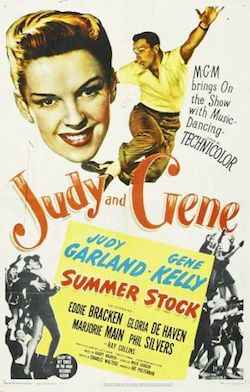
Viewing Notes: SUMMER STOCK (1950)

Summer Stock, 1950, d. Charles Walters
scr. Sy Gromberg, George Welles
with Judy Garland, Gene Kelly, Eddie Bracken, Gloria DeHaven

Conventional Wisdom has it that there's little to see in Summer Stock but "Get Happy", which, shout hallelujah, is in itself a hell of a Thing to See anyway, even if it was patched in three months after principle photography and found its famous costume among Minnelli's cast-offs. And yet!... There's also a silent Gene Kelly partnered with a squeaky floorboard and discarded newspaper, gliding and hopping and inventing 100 rhythmic gags to an instrumental reprise of "You, Wonderful You" like he's a permagrinning Buster Keaton. And there's the tour de force fight-n-flirt deconstructed-square-dance between Judy and Gene. And Kelly going at tornado speed through a cramped country kitchen, up on the table and practically pushing the fourth wall out past the edge of the set in "Dig Dig Dig Dig for Your Dinner". And, and, and Eddie Bracken and Marjorie Main out comic-relieving Phil Silvers without breaking a goddamn sweat. Point being that's at least enough to justify looking at something for an hour and forty minutes.

That plot, with Judy (as Jane) trying to run the family farm while her sister's crazy showbiz pals (led by Kelly as Joe) rehearse in the barn, recalls the Mickey & Judy pictures of yore, and maybe Oz, too. Ironically-ish, the Major Theme involves Judy coming to understand that putting on a show is for reals hard work, just like farm chores, and her sister gradually emerges as a sort of villain whose diva behavior (ahem, sleeping too late, disappearing during rehearsals, running up expenses) threatens to ruin the show. However troubled Garland was during production on Summer Stock (i.e.: Troubled), she does the buoyant optimist thing, the tough-talking can-do! thing, and the cute funny nervous motormouth routine and there's not a crack in her armor on screen.

So you've got this slick, bright-hearted, colorful kids-puttin-on-a-show-in-the-barn throwback with a classic roadblocked-courtship plot, at least two truly great numbers and several really really good ones. This being Garland's final film for MGM, perhaps we have a phantom ache for a grander (or more grandiose) send-off — a whole 120 minutes of "Get Happy". The loss in underrating Summer Stock, I think, is that if MGM musicals are a thing with you, then second or third tier is really not so far from the top shelf. This is rather a primo example of that particular dream machine doing what it did in 1950.

Under a pink spotlight on a darkened stage, Joe tries to explain his show to Jane. Nestled in the functional segue dialogue before the romantic confession number "You, Wonderful You", Summer Stock offers possibly the simplest, wisest of explanations for the existence of the musical itself. It's a throwaway moment, sweet and slight, and — in spite of all well-documented effort behind Summer Stock — it is effortless.:
JOE: We're trying to tell a story with music and song and dance, not just with words. For instance, if the boy tells the girl that he loves her, he doesn't just say it. He sings it.
JANE: Why doesn't he just say it?
JOE: Why? Oh, I don't know. But it's kind of nice.

Viewed on: 3/19/14 — DVD (Warner/TCM, Region 1)

Monday, October 07, 2013

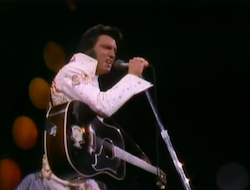
Viewing Notes: ELVIS: ALOHA FROM HAWAII (1973)

Elvis: Aloha from Hawaii, 1973, d. Marty Pasetta
with Elvis Presley, J.D. Sumner & the Stamps Quartet, The Sweet Inspirations, The TCB Band, The Joe Guercio Orchestra

January 14, 1973: Elvis Aron Presley performs a benefit concert in Honolulu with a setlist fairly representative of a typical early '70s show. Broadcast Live! Via Satellite! to most of the world, Aloha from Hawaii eventually aired in the U.S. on April 4, 1973. Resplendent in the white rhinestone American Eagle jumpsuit (saving the spreading of its bright blue-lined cape for the finale), Elvis is freshly 38 years old, deeply tanned and helmet-coiffed, tosses out one hundred scarves, accepts two hundred leis from the audience, and pours about ten thousand years of pain and passion into this unforgettable show. Aloha is comfortably Elvis' last indispensable film/television appearance; there was to be one more TV special, 1977's Elvis in Concert, which was taped two months before his death, and veers between ghoulish and tragic — often wrenching in its humanity, but frequently difficult to bear. And so Aloha is the restless heart and sweaty soul of the MOR-rock sound Vegas act era, and Elvis' pinnacle late-period performance.

After a preliminary weird "satellite" beeping-accompanied montage of Elvis' name in every language of the Earth, the man touches down in a helicopter and greets fans, accompanied by the 1965 studio track "Paradise, Hawaiian Style." And I bring this up, because while the song is not inappropriate, and the title number is not the worst song from that film (I rather like it as a lazy fantasy travelogue), it is drawn from the period representing the absolute nadir of Elvis' film career. Any shuddery memories of Tickle Me aroused by this dispatch from the pit are wiped as "Also sprach Zarathustra" wells up over images of local traditional dance and drum performance groups warming up the crowd outside the Honolulu International Center auditorium. In the '68 Comeback Special, Elvis counteracted this phase of his career with a dismissive joke about forgetting how many movies he's made, and reclaimed his image by reinvigorating his R&B classics. In Aloha, he blares Richard Strauss' fanfare announcing the dawn. A sun, rising.

Given this context, but really due to the performance itself, looking at the special as a summation of where he is right at the moment of 1973, each song seems to examine an aspect of Elvis' career, personal life and relationship with his audience. This is, for instance, a definitive performance of "An American Trilogy", the thematically complex medley that moves through nostalgic minstrelsy to folk spiritual to Christian hymn built out of an abolitionist anthem, and Elvis guides it through every turn with the required bombast and/or sensitivity, as if drawing together everything he has ever learned about American music. The towering rendition of Marty Robbins' "You Gave Me a Mountain", wherein Elvis inflates the sad-sack country weeper into a personal despair-anthem like an inverted "My Way", is like a promise to himself and us and God and everyone that though there is no way on this Earth he's going to make it in the end, here in Honolulu he's going to try with every fiber of his being. When he'd do "Mountain" for Elvis in Concert, it would be with far different results: though he's smiling and surrendering, there's no way he's getting over that mountain and he knows it.

There is a little bit of everything on the buffet, but the beefiest material in the show are the big operatic ballads and From Elvis in Memphis era angst-rockers. The 2004 Deluxe Edition 2-DVD set preserves the entire "rehearsal"/backup concert of January 12th (taped in case of broadcast mishap), during which Elvis staggers around and mumbles non sequitur stage patter. He'd do this out of pure musical delirium even in the '50s, but at the rehearsal show seems a little out of it, whether due to fatigue, energy conservation, or other factors. While not as tight as it could be, the rehearsal is not a disaster by any means and occasionally during this show he gets that faraway look in his eyes, loses himself in a song — or even just part of a song — and gives over to the sheer power of the music. He nails "Burning Love" to the wall, for example, despite forgetting the words and swapping verses around to compensate; Elvis stands like a shoreside Easter Island moai as that tidal wave of a song crashes over him. Likewise, during the broadcast "Suspicious Minds" — in blazing arrangement, greatly sped up from the studio version— Elvis drops far too many lines while screwing around with fans for my taste. So here again, I personally prefer the rehearsal performance of "Suspicious Minds," silly crowd-teasing fuck-aroundary near the end notwithstanding. Thankfully, during both shows he offered that sublime alteration to the bridge: "You know I never lied to you/ No, not much...". The ideal Aloha experience is certainly the uninterrupted show of January 14th (also presented on the Deluxe DVD), but for the sorts of reasons above, the slightly off-kilter rehearsal of January 12th is not to be dismissed.

Those in the 21st Century seeking kitsch in Aloha will typically locate it in the costuming and lung-bursting crooning (and, if I may be so bold, "Welcome to My World", which has never been anything but unrefined schmaltz that Elvis was never able to redeem). But in 1973, "Hound Dog" was a 21-year-old song, and Elvis' recording was nearly that old itself. The '50s hits were the nostalgia act portion of the show, both for audience and artist. There is a common complaint that Aloha pays some disrespect to these classic gold records, as the formerly lean-and-mean rockers are loaded up with full orchestration, and Elvis tends to goof around the most during the older numbers. These oldies are simply not as dangerous as when they first bared their claws to the world, and given the venues and style in which Elvis was performing cannot be given the same kind of new lease on life as the ferocious '68 Comeback. Instead, he connects in a more physically intimate way with fans while lightly teasing the pre-'68 material that might seem a bit quaint in '73, as if reaffirming and reminding them that these silly old songs are the basis of this highly devoted fan/artist contract. Make no mistake, The Hillbilly Cat is my favorite Elvis phase as it is yours, but in Aloha we're not listening to records, we're watching a show, and this show radiates an enormous amount of goodwill.

Where playing it straight counts the most, Elvis plays it straight, introducing his respectful take on "I'm So Lonesome I Could Cry" as "probably the saddest song I've ever heard." He would rarely screw around during perennial opener "See See Rider". When he closes with "Can't Help Falling In Love" from Blue Hawaii, there is no doubt: he is singing it straight at you, you personally, and what you find there is between you and Elvis. As a Hawaiian loanword in English, aloha means hello. Aloha means goodbye. Aloha means peace. Aloha means love.

Viewed on: 10/7/13 — DVD (BMG/Elvis Presley Enterprises; Region 1)

Saturday, September 21, 2013

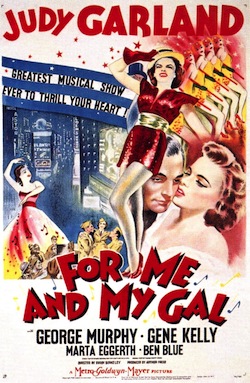
Viewing Notes: FOR ME AND MY GAL (Berkeley, 1942)

For Me and My Gal, 1942, d. Busby Berkeley
scr. Sid Silvers, Fred F. Finklehoffe, Richard Sherman
with Judy Garland, Gene Kelly, George Murphy

For the most part For Me and My Gal is a by-the-numbers vaudeville backstage musical tracking the romantic travails of up and coming singer Jo Hayden (Judy Garland) and born-in-a-trunk Harry Palmer (Gene Kelly); he's a smoothie and she's guarded, and they make a natural team, see?! The Good Ol' Days of Vaudeville shtick takes a turn for the bleak/weird/propagandistic when WWI breaks out and Harry is drafted, and rather than proudly march off to war like a God-fearing American patriot, he turns draft dodger and has to deal with the consequences. The consequences are everyone thinks he's a piece of shit! Obviously the point is that no matter what the circumstance, fighting for your country when called upon should take all precedence over career and romance. So in the last act Harry needs to face that at various points he's been an opportunist with no loyalty to the ideals of nation, love, and Judy, and scrape together some small measure of dignity. Anyway, in the cinematic highlight Busby Berkeley winds up much flinch-baiting suspense as Harry works up the courage to mutilate his hand so he'll fail his military physical. Will he use his dressing room door jamb? Nah, it's gotta be the obligatory steamer trunk, it's got to be, case… CLOSED. Yikes!

Otherwise, Berkeley stages the production numbers as realistically small-scale and sedate (our heroes are on the route to the big time, so in these sub-palatial theaters we're not going to be craning up into geometric starbursts of kicking legs). In his first screen role, Kelly does one athletic baggy pants comic dance, and in their first pairing he and Garland do peppy renditions of a handful of jazz standards, mostly can't miss material like "Ballin the Jack" and the title number.

The musical highlight is Garland's rendition of "After You've Gone," and, of course, no disrespect to Sophie Tucker, Jolson, Nina Simone, or Fiona Apple, for that matter, but Judy milks it dry. "Owns It," I believe they say. The text is already in the "Some of These Days"/"96 Tears"/you'll-be-sorry family. Judy's singing it just as her character has both figured out that she's in love with her vaudeville partner and also he's, er, breaking up the act and plus he doesn't know how she feels about him. So holy shit, she's got story material to work with, and right in the middle you can feel the moment she realizes what she's Really Singing About and instead of crumbling, channels it into the song. Then she kind of spookily makes with the Get Happy right in time for the big finish and turns it back into something bombastic and cheerful. So the performance effectively encompasses every possible reading of the lyrics, save for blind rage and threat. Judy is a magnifying glass for concentrating a song's emotional rays and frying any ant in her path alive.

Viewed on: 9/21/13 — DVD (Warner/TCM; Region 1)

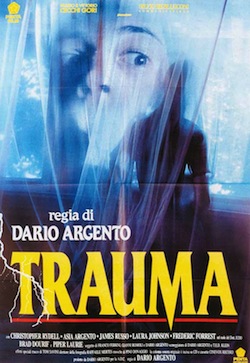
Viewing Notes: TRAUMA (Argento, 1993)

Trauma, 1993, d. Dario Argento
scr. Argento, T.E.D. Kline
with Asia Argento, Christopher Rydell, Piper Laurie

Looking at this mostly for research on a larger project about the problems, pleasures and classification of post-Opera Argento, so we'll bypass the topic for now. Here we see Argento making his first American feature (after directing half of 1990's Romero collab Two Evil Eyes), probably history's only giallo set in Minneapolis. Like Deep Red (1975; blood), Tenebrae (1982; dark), Do You Like Hitchcock? (2005; thriller history and grammar, voyeurism, Hitch cultism) and Giallo (2009; duh redux), Trauma has one of those on-the-nose titles that announces the auteur is going to investigate a pet theme to the hilt and head on. Nearly all of Argento's stories trace an exploding arc of bloody chaos backward to its origin at the scene of some damaged psyche's inciting incident: it's always about trauma. Sometimes that trauma belongs to the killer, sometimes the detective/investigator, sometimes something in-between. In Trauma it rains down on the just, unjust, and all of Minnesota alike.

Not that everyone is specifically, personally born in pain in Trauma's world, but it is a slasher with a decapitation theme as its murder gimmick and it opens with a montage of paper models depicting the French Revolution. The Reign of Terror's guillotine recurs in the 20th century midwestern US as hand-held motorized garrote always used in the rain. The wound of history is open from the start, unhealed and forever purging the current moment into existence, the heavens a-weep!

David (Christopher Rydell) and Aura (Asia Argento) meet morbid-cute when he spots her about to jump off a bridge and talks her down. He's a recovering drug addict and local TV news art director, and she's an anorexic teen daughter of Romanian psychics, who have settled in Minneapolis, as Romanian psychics do. These are our protagonists, both troubled and traumatized, with David covering the Anima-Impaired Artist-Detective duties while Aura picks up the Highly Sensitive Paranormally-Gifted Girl torch from Suzy in Suspiria and Jennifer in Phenomena. In short order, Aura is reluctantly remanded to her creepo psychiatrist (Frederic Forrest), her weirdo mom (Piper Laurie) conducts a spooky seance that goes terribly awry, and everyone starts getting decapitated. And as her parents are murdered and she screams in the rain, Aura witnesses the requisite subtle clue that is misunderstood/ignored/repressed/forgotten.

As the Killer goes about the business that the black-gloved must go about, the victims are largely medical professionals, which would seem to put the physically and mentally not-okay Aura somewhere near the center of the crosshairs. And surely David and Aura become further enmeshed, variously investigating and being further victimized, as that is how slasher/mystery business is supposed to play out. And surely the stalk-and-slash setpieces will be the primary spectacle (Brad Dourif's head severed by a necklace/elevator assault, then plummeting toward the camera in a complex quote fusing Vertigo and Deep Red), and they are excellent and lively when graded against typical American thrillers of the period, if less dazzling in the company of classic period Argento murders.

In this phase of Argento's cinema it is as if the fairy tale logic of the Three Mothers films has seeped into his gialli, which are more traditionally locked into genre strictures. Even Argento's earliest thrillers are atypical Art Gialli, but with Phenomena, Trauma, Stendhal Syndrome, this free-associative strain has fully deformed the narratives. Puzzling themes, apparently unresolved subplots, and inexplicable vignettes jut out at right angles from the main trunk of the plot. Trauma's mystery practically plays out in the background as the film is increasingly preoccupied with the afflictions of its fragile split-focus protagonists.

Protecting Aura from having her head sliced off would not seem directly linked to treating her anorexia, much as the enigma of the eponymous disorder of The Stendhal Syndrome is not readily tied to that film's primary plot about serial rape and identity disintegration. In David's determination to save her, it all gets bound up together, his life crumbles around this white knight rescue fantasy, and he relapses into drug addiction and despair. (It does happen to all rather be bound up together, actually, Bad Doctors being the epicenter of the Headhunter, the eating disorder, the drug abuse, and so on and so on.)

As the mystery works its way back to the originating trauma, a disastrous birth ending in death, the protagonists move toward death/rebirths (Phenomena's insect theme returns, focused on the butterfly/soul connection, here also constituting an Eros and Psyche motif). Along the path, the film considers Aura's anorexia from various angles. Firstly, there is Aura herself: hostile and tormented, defensive and closed off, placed in the abyss between broken mirrors. Her capacity for trust demolished, she pushes back when offered any assistance, and with good reason: her damaged existence has been sculpted largely by the authority figures (mother, doctors) claiming to help her in the first place. Every helper is corrupt, every savior is suspect, including David.

As David's concern for Aura grows, a coworker provides a clinical Freudian psychological profile, claiming that subjects supposedly all experience the same recurring incest dream: a horror/wish/memory in which the father looms, about to close in for a kiss. Even if it were accurate, the one-size-fits-all description of a personality type does not address origins of the disorder, practical medical issues or treatment, and is presented as a prurient pop psych diagnosis (and this information, apparently, is all from daytime talk shows).

After this crash course, David wanders Minneapolis and sees every street haunted by the specters of anorexic girls, the dead, dying and unreachable. This mournful passage moves from the abstract diagnosis of a Problem in Modern Society into a deeply felt sadness, as David begins registering the helplessness of caring about someone who you are not equipped to aid. Still later, after Aura has disappeared again, David is broken and strung out, and stands before a store window displaying John Everett Millais' painting Ophelia. As the designated artist figure of the film, he draws the connections between the drowning young woman driven to madness, the troubled teenager he loved, and himself. The image is of Ophelia at the last moments of melodious lay, it depicts a scene that is described but unstaged, and gives it back to Ophelia. Drowning but not drowned, floating away but afloat. At this, his lowest point, drowning in self-pity, David reaches an empathetic epiphany, and reflected in the window glass, he catches a glimpse of a clue that will lead him back to Aura.

Trauma's closing shot pans right across the final crime scene, past cops sneering at the embracing protagonists, moves down the suburban street and up to a second-story balcony. A reggae ensemble is playing up there, crooning a variation on David and Aura's final dialogue, that nothing can now go wrong, that someone will be loved. And a tall, terribly thin woman we have not seen before dances as the band plays, and she is Anna Ceroli, Asia Argento's two-years-older sister (born to Daria Nicolodi and sculptor Mario Ceroli). And as the credits roll over this mysterious, somehow reassuring image, the upbeat Caribbean dance music crossfades into Pino Donaggio's aching Julee-Cruisesque ballad "Ruby Rain" (The title evokes blood and precipitation, and those lyrics?: "I miss you/ so badly… tears are nothing in the rain/ jewels of pain…"). The camera pushes in on Anna, suddenly bathed in a blown-out golden flare, hair billowing in a wind that has risen from nowhere, just Anna swaying and twisting and dancing in the inexplicable light, in the loveliest, most lyrical of all Argento's closing shots.

The closing credits fail to announce it, but, you have, of course, been watching Trauma.

Viewed on: 9/21/13 — DVD (Anchor Bay; Region 1)

Tuesday, September 17, 2013

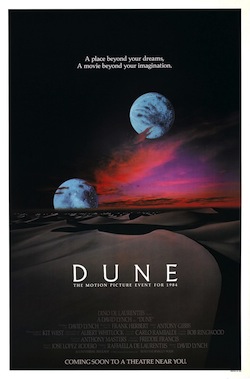
Viewing Notes: DUNE (1984, Lynch)

Dune, 1984, d. David Lynch
scr. Lynch, from the novel by Frank Herbert
with Kyle MacLachlan, Francesca Annis, Kenneth McMillan

David Lynch dreamwalks through Frank Herbert's information-dense universe in highly graphic, lushly soundscaped style, everything melting and dissolving into everything else. When the Sleeper awakens, you can't be sure the dream is actually shaken off. As to the frequent charges of incomprehensibility, certainly it helps to walk in familiar with the novel, it helps to watch it more than once, or it helps to have spent some time with other Lynch movies. But otherwise I dunno. The finer points of the plot are spelled out in expository dialogue, plus mix-n-match narrators detailing the SF mythology, plus whispery voice over to elaborate on internal character motivations. If anything, this over-articulation is the least typically "Lynchian" thing about Dune, although the actual mechanics of this info-dumping are frequently disorienting, rather inventive, and occasionally lyrical, as in the mysterious opening close ups of Princess Irulan (Virginia Madsen) fading in and out against a star field like a spaced-out angel.

The splendor of Dune isn't in any kind of traditional pulp-cover outsized imagery of impossible fantasy vistas, but images of water rhyming with billowing sand, human hands in distress and palms open in triumph, close-ups of mouths, the dust becoming spice becoming worm becoming consciousness pried open, as it grasps the chain of connected meaning. [Note: That is a hell of a grandmaster move for a head movie to make btw, as the drug reveals itself by transporting you through the revelation of the drug revealing itself: the Trip is about the Trip.] Where some thoughts have a certain sound and we travel without moving, that's in a dream, in music, and in cinema. Dune is the slow blade that penetrates.


Hot Spots the Lynch obsessive ought watch for:

-The plot hinges as much on conspiracy among the powerful and the training and formation of the superbeing hero as it does visions, emotions and spiritual revelation. This more abstract information is conveyed through expressionistic sequences like avant-garde shorts unto themselves (the Box of Pain, the Water of Life, etc.). The most spectacular of those (and the trippiest by far, if that's what you're here for) is the sexualized Space Folding sequence. These are not all freak-out moments. Paul's waking dream as he stares into the Arrakis night and whispers inside his head "Where are my feelings? I feel for no one" is a melancholy passage as the initiate has stripped away his attachments to body and name and begins one of the most chilling phases of divestment of self.

-Speaking of, Dune is probably ground zero for those combing Lynch's work for direct reference or indirect evidence of the impact of Transcendental Meditation; personally, I suggest the interested continue patiently trawling for the bigger fish.

-A ghastly hole ripped in Jürgen Prochnow's cheek provides the aperture for the signature Lynch ominous push into a black hole.

-Eraserhead-esque effect of a planetary sphere blowing apart in eggshell shards.

-Highly Problematic Depictions of Homosexuality!

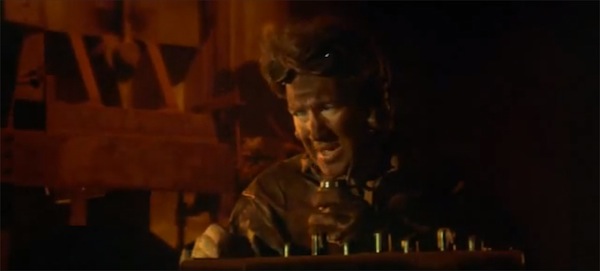
-Not his best performance or even a fully delineated character, but Lynch's cameo as a spice miner probably fits him most perfectly. He's facing certain doom as a sandworm closes in on a spice mining facility, but looks like he's loving it down there in the industrial inferno amongst the massive, clanging machinery. He doesn't want to leave!

Viewed on: 9/17/13 — Theatrical Cut DVD (Universal; Region 1)

Tuesday, September 10, 2013

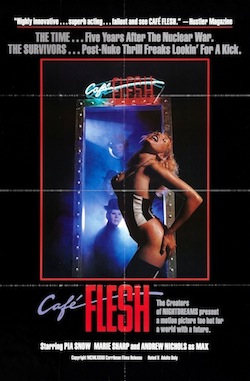
Viewing Notes: CAFÉ FLESH (Rinse Dream, 1982)

Café Flesh, 1982, d. Rinse Dream (S. Sayadian)
scr. Sayadian, Herbert W. Day (Jerry Stahl)
with Andrew Nichols, Pia Snow (Michelle Bauer), Marie Sharp, and Kevin James as "Rico"

Rinse Dream (née Stephen Sayadian, whose masterpiece is this or the pretty-much-the-same-thing-but-not-porn Dr. Caligari [1989]) made this ambitious cult post-apocalyptic SF porn satire that looks like a Devo video with a killer droning synth jazz soundtrack from Mitchell Froom.

The mean-spirited, highly effective idea is that an audience of diseased Sex Negatives can find no release and only watch the creepy onstage antics of the Positives who perform at Café Flesh. The Bomb made it so that if Negatives try to experience human sexual contact, they start barfing painfully (I guess?). Meanwhile, Positives, being 1% of the populace, are such a commodity that they are forced to perform.

So, see, that's YOU! You in the raincoat, watching Café Flesh itself and getting your Gaze totally Subverted! The "backstage musical" approach frames all the sex acts as stage performances, which are all elaborate bizarro production numbers ("the guys in baby drag were a bit much"), but look, it's not Busby Berkeley or anything. These imaginative, already off-putting sex shows (the best one has a guy with a giant pencil on his head and a secretary chanting "do you want me to type a memo?") are constantly interrupted by close ups of Felliniesque pervs licking their sweaty chops and bugging their eyes out like Dan Clowes drawings. The entire affair is based in humiliation, frustration, and desires thwarted, which is, of course, some people's Thing.

XXXpensive production value as these things go, and every performance is terrible, including Richard Belzer doing a dumb jive-talk routine.

Viewed on: 9/10/13 — via VCI's terrible VHS-sourced-lookin' DVD

Monday, September 09, 2013

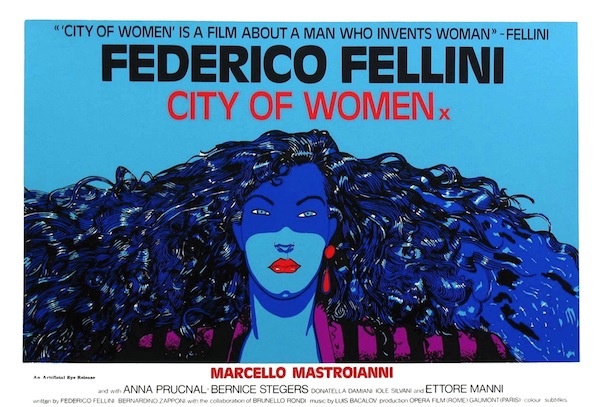
Viewing Notes: CITY OF WOMEN (Fellini, 1980)


City of Women, 1980, d. Federico Fellini
scr. Fellini, Bernardino Zapponi, Brunello Rondi
with Marcello Mastroianni, Donatella Damiani

Fellini does that thing where he dresses up Marcello Mastroianni like himself and then sends him to peep in on The Girls' Room circa 1980. It starts with a dream and a train tunnel, ends with a dream and a train tunnel, and in between visits sundry alien landscape sets swarming with women of all kinds. The problem, if it's not obvious, is that the women are Kinds. If these obscure objects of desire are, as usual, something between Jungian archetype and cartoon sketches of types, that is par for course. So again, Fellini's dream-self avatar pulls out his mental Rolodex of Women I Have Known, thumbing through the cardboard girl-shapes like a flip-book, trying to get them to all exist in simultaneous space-time. Where that happens is dreams and reverie.

And in dreams, don't you know, he loves them all, all the time, always did. And I dare say, this wistful affection is the reason this isn't disgusting but sort of tragicomically sweet. The second reason is that this Fellini-stand-in, "Snàporaz," specifically, is befuddled, out of touch, and impossibly easily distracted — the picture is gently teasing him throughout, and even in fantasy the Women do not take him seriously. Finally, the reason this is beautiful and true is that he actually knows all of this: not a problem with the film but the problem with which the film is concerned. In 8 1/2 terms, City of Women is the Guido's Harem sequence fully kitted out into a Satyricon of its own, as we might say Amarcord expands the Saraghina reminisces into a whole town.

Key episodes: Led down the rabbit hole by a casual sexual encounter in the train's WC, Snàporaz somehow ends up at a freeform feminist symposium in a packed-to-the-gills hotel/commune. This stuff is great because Fellini demonstrates an understanding of second-wave feminism, or at least presents its tenets more or less accurately. Snàporaz wanders through these lectures and pep talks with nonplussed fascination, and even claims he "understands" what is being discussed, even when he ends up in a room of women chanting "Castration! Castration!" Point being that neither Snàporaz nor Fellini takes The Feminist Hotel to be a house of villains, exactly; it is, kind of shockingly, more about how none of these people are remotely concerned with making a middle-aged womanizer feel comfortable in their midst because that's exactly what they're not here to do. This is all a useful illustration of the dangers of confusing the Fellini Alter-ego for an idealized self image, or even Fellini Proper, if you catch my drift.

The stylish showstopper eye-popper sequence sees Snàporaz hitching a ride with a carload of stoned, disaffected fashion plate teens who drive aimlessly through the abstract rural nightscape like an Argento taxi. Marcello-Guido-Snàporaz perches atop like those crammed-with-papparazzi La Dolce Vita joyrides to the dawn but now in Toby Dammit's gold Ferrari of Doom, multiplied into a squadron of punk clown cars and barreling toward techno hell.

Finally, the psyche slides down an infinitely regressing plush chute, breezing past ancient formative crushes, erotic infatuations and masturbation fantasies and lands in a cage to be judged by the court of the City of Women. And he finds out, Snàporaz, and Fellini, and maybe you too, exactly where that City is located, where that tunnel leads. Tunnels go inside.

And finally, here is yet another example where Ebert's (Hot Air) Balloon Rule fails.

Viewed on: 9/9/13 — Blu-ray (Masters of Cinema; Region B)