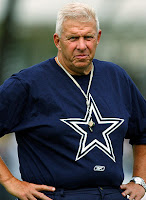
Going back through
Bill Parcells' book "
Finding a Way to Win" last night and came across some really great stuff:
On preferential treatment for great players: "Great players are special simply because they do more for the team than the rest. Their greatness may buy them preferential treatment in some areas. On the field, they may toss the book aside at times and play on instinct.
They've earned the right to take changes -- to be flexible -- because they've proved that their judgment is sound.
Consistency is overrated. A leader is obligated not to be consistent, but to be right -- to do what's best for the organization."
On his personal interviews with potential draft picks: "A half hour of candid conversation tells more about people than a mountain of statistics. For starters, I might ask them to name three or four of the most important things in their life. Family or religion often top the list, which is fine; football doesn't have to be number one. But football better be in there somewhere or I'll deduce that this guy isn't all that interested in the job."
On focusing on a player's strengths rather than his weaknesses: "It's easy to downgrade people by dwelling on their weaknesses. It's harder to look at them with fresh eyes and identify their strengths -- and how they can help the organization to function."
On adapting to technology: "If the competition has laptop computers and you're still using yellow legal pads, it won't matter how long and hard you work -- they're going to pass you."
On what will destroy a team: "Three things can ruin any organization. One is your competition. The second is public perception, as shaped by the media. If you're always seen in a negative light, your group's morale will likely go under -- along with your performance. The third factor?
Division from within -- and this is the greatest threat, hands down. The first task of leadership is to promote -- and enforce -- collective loyalty, also known as teamwork."
On how a head coach differs from others in the organization: "The head coach is unique in two ways. He's the one person who sees the big picture down on the field. And he's the only one whose fate is totally wrapped up in winning. If the team loses too often, the head coach will be gone."
On how performance impacts confidence: "Confidence is only born of demonstrated ability. A team's collective mental state is ruled by the psychology of results. In other words, past outcomes dramatically affect the group's attitude going into the next game. A team teaches itself what it is on the field, in action."
Remembering that what happens in the locker room stays in the locker room: "Washing dirty laundry in public is probably the quickest way to divide your team from within. The only honest meetings are private meetings. Our [weekly team meetings] are exclusive. Only players and coaches are invited, and our privacy is sacred; even our owner is barred. Secretaries, trainers, equipment men, the PR director -- one of them sets foot in that room. I know how
gossip turns into rumors, and rumors into controversies, and we've already got enough of those."
On the coach's role as a teacher: "Be a teacher, not a drill sergeant. I might overcoach a player, might discuss things a little longer than necessary, but he'll know that I appreciate his problem, and that I'll do my best to help solve it.
To teach, you have to listen as well as talk. When we experiment with something new in practice, our players' feedback is invaluable, especially from veterans who are honest about any problems they're having."
On what sets disciplined people apart: "(1) The capacity to get past distractions. (2) The willingness to condition mind and body for the task at hand. (3) The ability to keep your poise when those around you are losing theirs.
 At the NFL Scouting Combine, teams interview up to 16 players a night. The interview, writes SI's Peter King, "has become more and more important to the decision-making process."


 Posts

