Monday, April 27, 2009

The ratite clearing house post


Darren's post on my emu dissection pictures inspired me to bring all of my ratite blogging together in one place, for the convenience and edification of all.


There's the original emu dissection post and and the immediately subsequent rhea dissection posts (two links). Note the striking difference between the comparatively large, normally-folding wings of the smaller rhea (below) and the silly twig-wings of the much larger emu (above).


Emus use their inflatable throat pouches to make booming calls. I was fortunate enough to witness this and engage in a bout of reciprocal burping with an emu at the Merced zoo, which I covered here.


Later on I posted briefly about kiwis. Also, people loved the gross photos enough that I felt compelled to share pix from dissecting a hyena, which is not a ratite but also flightless and still pretty cool.


Finally, I bought together my biological and then-nascent astronomical obsessions and turned some of the emu gore into a planet.

If you find anything dead, or get to cut something up, or have some other cool interaction with the natural world, post it and tell the world!

Labels: , , ,

Monday, November 24, 2008

Whale dissection


Not one I was in on, sadly. Nope, this is just the latest example of me using this "blog" as a dumping ground for links to cool stuff. Get yer gore on.

Labels: , ,

Sunday, January 21, 2007

Hyena dissection


I got to help dissect a hyena today. Unbeknownst to many, Berkeley has a hyena colony. It was started two or three decades ago with ten spotted hyenas (Crocuta crocuta). Four or five of those founding members are still alive, but they're all in zoos now. However, 34 of their offspring are still here, in large and well-hidden outdoor facility that many long-time Berkeley residents and students know nothing about. It is easily the largest concentration of hyenas anywhere in the world outside of Africa. As Forrest Gump said, "That's all I got to say about that."
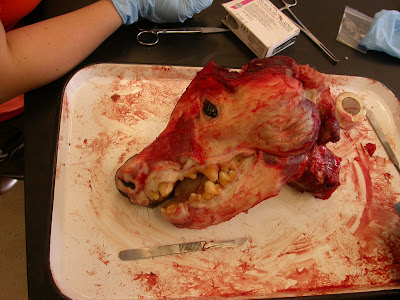

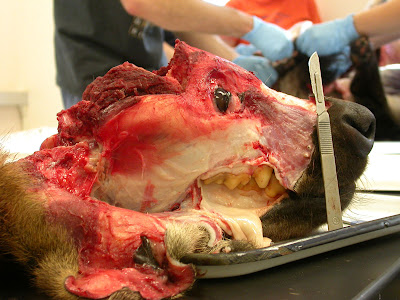
This hyena is a 15-year-old female named Kodiak. According to Walker's Mammals of the World, spotted hyenas have lived to the age of 41 in captivity in captivity, but in the wild many hyenas do not make it past their 15th birthday. So as hyenas go, Kodiak had had a long and happy life. Unfortunately, she developed a dental abscess that eventually caused her to stop eating, and she was euthanized. Other researchers had dibs on the brain and internal organs, so we got her brainless and eviscerated. It would have been cool to dissect the whole head--evidently hyenas have wacky big sinuses for carnivores--but beggars can't be choosers.
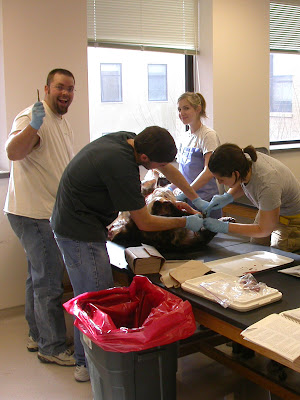

The beast came to us through the kind offices of my good friend Alan Shabel, who is in Tony Barnosky's lab and works on many aspects of African ecology, especially the paleoecology of robust australopithecines. Alan mainly wanted the bones, and we needed to get the animal torn down in a single day. The first step was to skin it. Above I am working with (l. to r.) Russ Dedon, Ashley Lipps, and Sally Pine. Ashley and Sally were also present for the rhea dissection, but Sally was sick and couldn't scrub in. This time she was feeling great and anxious to get her hands dirty.
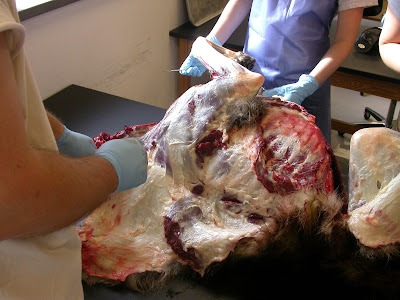

Here the skin is coming off. There was a lot of subcutaneous and intermuscular fat, and some pretty thick fascia over the muscles as well.
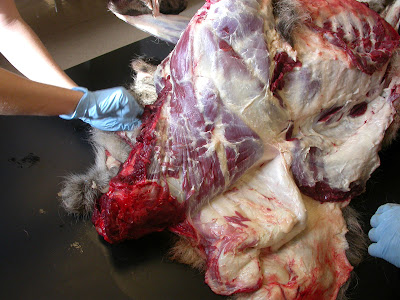

This animal was just terrifyingly muscled. Put your hands on either side of your head and clench your jaw, like you're biting down on something. Those muscles you feel bulging on the sides of your head are your temporalis muscles, the primary jaw-closers. The temporalis muscles on this hyena were as big around as my wrists. Hyenas eat bone, literally chew it up, and they have the muscles and teeth to make that happen.

Above you can see the headless neck sticking out to the left. The neck was like a fifth limb, only larger and more heavily muscled than any of the rest. Honestly, this thing's neck was almost the size of one of my thighs. I've seen lots of dead dogs and cats, and I've never seen anything like it. It was like the neck of a small horse had been grafted onto the body of a large dog.
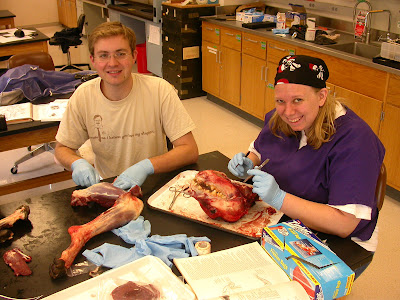

After we skinned the animal we started detaching limbs to speed up the skeletonizing process. Here fellow Padianites Randy Irmis and Sarah Werning are working on their respective chunks. Sarah was here for the rhea but Randy missed it, much to his chagrin. He was in Argentina at the time, chasing early dinosaurs. Probably a fair trade.


More piecemeal dissection: (l. to r.) Betsy Bamberger, Jeannie Bailey, and Alan working on limbs.


While the rest of us worked on the head or limbs, Russ and Sally defleshed the axial skeleton. It's a slow and thankless job, but they don't look too put out.
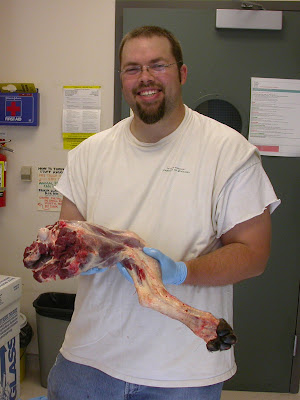
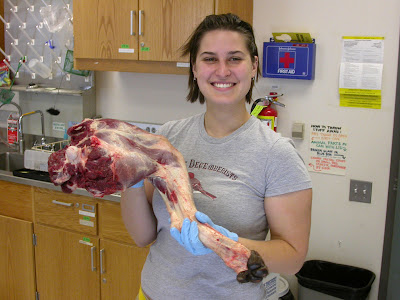

It's funny how the apparent size of an object changes depending on what you place it next to. This hyena leg looks a little more impressive in Sally's hands.
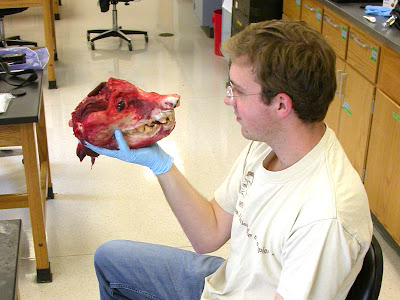

Alas, poor Kodiak. We knew her, readers. A bitch of infinite hunger, of most excellent construction; she hath devoured me in her imagination a thousand times; and now, how devoured in my imagination she is! My curiosity rises at it. Here hung those lips that have laughed at me I know not how oft. Where be your yelps now?

Labels: ,

Thursday, December 14, 2006

Rheality


Back in action: Ashley Lipps, Ryan Carney, and Jackie Moustakas. Oh, and a Greater Rhea (Rhea americana) that had the good grace to expire in a convenient time and place. Thanks, dude.

By the way, Darren Naish blogs on just about everything interesting in the world, and that includes ratites from time to time. Right now he has weird Mesozoic mammals and Baikal seals. Head on over and give him a look.


Drew Lee gets brutal. We tore this animal all the way down. By the end of the day we had three or four biohazard bags full of feathers, fat, muscles, and viscera, and several large plastic bags full of bones and extremities. Ryan Carney took a wing, I got the neck, Drew and Sarah took the long bones, and the feet, dorsal vertebrae and ribs, and synsacrum are in the freezer waiting for us to make some kind of science out of them. I'm sure we'll think of something.


Here's a wing. Oddly large--compare to the emu in the previous post, which weighed more than twice as much as this animal--but emaciated-looking (not actually emaciated, that is, just very lightly muscled). Check out those wacky feather tracts on the forearm.


Ryan Carney does cool stuff determining the ranges of motion of bird and dromaeosaur forelimbs. We put this wing through its paces, about 90 different ways.

As usual, I've got gobs more to say about this. But that will have to be a story for another day.

Labels: ,

Wednesday, December 13, 2006

Rhealize, foo'!


Today we started dissecting a rhea. As you can see, the appearance of a big dead bird brings anticipation and joy to all. Left to right: Sarah Werning, Ashley Lipps, Drew Lee, and Jackie Moustakas.


One of the great things about dissecting a ratite is that there are lots of jobs. It's a good group activity.


From left to right by cranium position: Simon Sponberg, in from the Full lab to observe; Ryan Carney, Mastema frontman, anarchist, and agent of the state, who provided the bird; Padianites Katie Brakora, Drew, Sarah, Jackie, and yours truly.

Present but not pictured are Padianite Brian Swartz and interested undergrad Sally Pine, who were photographing the event (many thanks to Sally for taking these photos, in fact).


The bird came to us with no head. I squeezed the neck like a toothpaste tube to try to get out any gross fluid before I skinned it. I was thinking blood. I had forgotten about the esophagus, and what actually came out was a thin unpleasant light tan gruel that smelled like slightly rotten stomach contents, which I'm sure it was. It continued to plague us throughout the afternoon.

TONS more to say about this bird and the fun we had tearing it down, already, and we've got a whole 'nuther afternoon of dissecting lined up for tomorrow. Stay tuned!

Labels: ,

Tuesday, December 12, 2006

Emu dissection

Not much time to chat now, just posting pictures of an emu dissection for the edification of colleagues. Full description to follow.


This is what you start with: 100 pounds of dead bird.


Should mention that I did this in the anthro anatomy lab at UC Santa Cruz a couple of years ago. Richard (above left) runs the lab and was kind enough to let me scrub in.


First step: pluck the bird. Here I'm stuck with the butt end.


Here's what a peeled ratite looks like. The amount of fat and gore is impressive. The birds carry big fat pads on their backs.


We saved all the fat and weighed it. Eighteen pounds of adipose. On a bird that weighed just over 100 lbs. Suddenly I don't feel so bad.


Rewind a sec. Here's the inflatable throat pounch from the outside...


...and again from the inside. Here we've cut along the dorsal side of the trachea and I'm holding it open. That gap is the opening of throat pouch. Several of the cartilage rings that support the trachea are incomplete. I'd seen drawings of this in books, but the real thing was much cooler (as is usually the case).


Yep, that's a hand claw on a living theropod. Pretty darn cool.


Same thing sans skin. I had thought that only male ratites have claws, but this bird was a female. Seasoned Vectorites will recognize this as the starting point of my planet-making tutorial.


Unfortunately, I couldn't stick around for the whole show. These were the totals when I left.

More to come on big dead birds very soon.

Labels: ,