Tuesday, August 18, 2026

Flora and Fauna: six days of Alaska

Our first port call brought us to Ketchikan, where we had arranged for a trip to the Alaska Rainforest Sanctuary.  This is a privately held enterprise, not a government-sponsored park.  Nevertheless, I found it an excellent experience.  An elevated boardwalk provides a great vantage point to see foliage and wildlife.  For the more adventuresome, there is ziplining at the top of the forest.


The temperate rainforest setting is beautifully eerie – perpetual fog, but not cold, with moss or lichen growing on anything stationary.  


red elderberry

Salmonberry - fruits like raspberries, in several colors.
Yes, there is a black bear in there.
This is the best photo I have of salmonberry.

Everything was dripping wet.

A lichen called Old Man's Beard


Salmonberry, with its colorful raspberry-like fruits was common. It’s edible for humans and bears, although the guide told us the fruits taste sour.  But it felt wrong to me to disturb the forest by tasting one.


Our guide Basil instructed that if we saw a bear, we should not shout, “LOOK!  A BEAR!” but rather silently raise our hands up in the air (like bear claws), shake our hands around, and point to where we spotted the bear.   We had been told ahead of time to not bring any food. No flash photography.  It seems a good practice for humans to not draw attention to themselves when in the presence of a bear, although I gather that black bears are less threatening to humans than other bear species.


The easiest way to spot a bear is to watch for movements in the ground foliage.  We saw at least three black bears, possibly more, although they might have been the same bears in different spots.   How thrilling it was to see the bears making their way through the forest!  


Mother bear


two bear cubs, about 1 1/2 years old


More fauna in the Rainforest Sanctuary: a bald eagle and a Sitka black-tailed deer.  We saw bald eagles at every stop.  Bald Eagles are no long an endangered species, but are still protected under the Migratory Bird Treaty Act and the Bald and Golden Eagle Protection Act.

When we were off the elevated boardwalk,
the guide gave us extra instruction on what
to do if we encounter a bear.
Mainly: don't run.


bald eagle

bald eagle

Sitka black-tailed deer.  In Pennsylvania
we only have white-tailed deer.

This website has a much better photo of bald eagles, and explains how the Orange Menace’s regime (of course) reduces incentives for private companies to use practices to protect birds.  


Layers of trees

The first solo car trip I took without my wee children (at the time I had two) was in Nova Scotia.  I rented a car in Halifax and drove northeast for two hours to a small town for a family event.  There were no other cars on the road, and I seemed surrounded by nothing but trees for miles and miles.  


When it comes to tree population, Alaska was Nova Scotia on steroids.  While hardly setting foot in the Tongass National Forest, I am grateful for its existence.


We chose well for our activity in Juneau - a photo safari.  I was just getting re-acquainted with my “fancy” camera.  Anya, our guide with Gastineau Guiding Company, allowed us time to soak in the atmosphere and choose our photo subjects, rather than rushing us along.


Among the excursions it is good we did not do in Juneau are:

Dog sledding on Mendenhall Glacier 

Seaplane

Self guided jeep tour

Bicycle tour

Bike and Brew


Anya pointed out interesting plants along the Trail of Time.  The Northern ground cone, which rather strangely grows not on a pine tree but right from the ground, is parasitic and does not do photosynthesis.  


Devil’s Club (“Oplopanax horridus” - what a great scientific name!), has medicinal uses but we were warned to stay away from those nasty-looking thorns.  


Northern ground cone

Devil's Club

lupine wildflower near Mendenhall Glacier

The Trail of Time also showed us a stream with sockeye salmon cavorting.


salmon in stream


Our photo safari included a trip aboard Captain Rob’s small vessel (only 14 people!) for whale watching.  That was when Anya revealed her camera with an enormous lens.  I was glad I had brought my 55-200 mm zoom lens, which I had not used for maybe 10 years, but recognized I was in the presence of photography gurus.  


That's the Common Household Husband
standing at the bow of the boat.
Anya is just to the left of him.
I could not stand in the bow for fear of 
provoking extreme vertigo.


Here are a few of the 200+ photos I took of whales and the surrounding scene.


Captain Rob said the people in that small boat
on the left were breaking the rules of
the Marine Mammal Protection Act by being
too close to the whales.


Humpback whale tail and mountains

Whale spouts

These whale were working cooperatively
on getting dinner ready.
The birds follow along for a treat.

Dorsal fins and spouting


In Icy Strait Point we noticed pine trees with cute little pine cones -the Lodgepole Pine.  The tiny cones are actually male pollen.   The white flowers are spirea - a bush we have in our own garden here at home.

Pine tree with teensy "cones", and
white spirea flowers


This is my one photo of fireweed flowers, which are ubiquitous in Southeast Alaska.  Alas, we only saw the big fields of its striking bright color from afar.  Anya told us of a famous Alaskan saying: "When fireweed turns to cotton, summer is soon forgotten."


All rights reserved for photos and text.  This means just look, don't copy.


Posts in this series:

Alaska: rocks, fjords, and water 


Seattle: West Coast whirlwind


Monday, August 17, 2026

Rocks, fjords and water: six days of Alaska

We got on a big boat for six days for the most pampered sea-going ever, along the Inside Passage by Southeast Alaska.  Two weeks later, my inner ears still think they are on the ship.

The biggest surprise of this trip was waking up early Thursday morning, July 30, to a teal-colored sea with ice chunks in the water, and cliffs on all sides, filled with untouched wilderness.  Specifically, part of Tongass National Forest.  


We were in Endicott Arm, a fjord near Juneau, approaching Dawes Glacier. 

A magical experience.  In 1980, back when Congress did some useful things,

it declared this a protected wilderness


This sort of trick photo is a panorama
of the surrounding mountains as we approach
Dawes Glacier


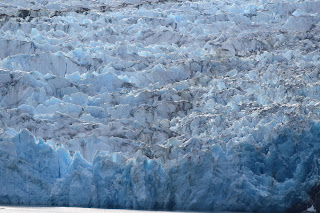
Dawes Glacier in the early morning.


We did not get close to the glacier.
This is the best I could do with my 200 mm lens.

Fun fact: if you search for “songs about fjords” you will get some references to Viking Ancestral songs.   I guess “Arm” is the much less exotic English word for fjord.  If we added a “j” it would seem more vikingish.  Arjm. But I am here to tell you that the Vikings do not have a monopoly on fjords.


I think geologists might have fun in this place.  The only thing I learned about the rock formations is that glaciers are actually moving and grinding against the rock, which creates gravel, seen when the ice melts.


An interesting geological line across the rock face.
No idea what it means.

Different sort of bubbly cliff face

Gravel.  Left by a glacier at an earlier time?

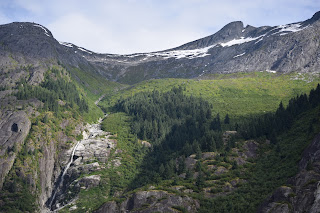
The place was replete with waterfalls.


huge chunk of ice, as we leave Endicott Arm

While Endicott Arm was perhaps the most visually stunning scene, there was so much more.  A few days earlier, our first stop was Ketchikan, the rainiest city in the U.S.  We doubled down and went to a rainforest sanctuary.  Eerily beautiful, and extremely damp. (More on the flora and fauna of that place in a later post)


Rocky stream below, zipliners in the tree above,
and rich foliage everywhere.

another glacier, on our way to Juneau


After leaving Endicott Arm/ Dawes Glacier, we saw several more glaciers along the way.  Docking at Juneau, we went on a photo safari trip, starting with a walk on the “Trail of Time” through the forest toward Mendenhall Glacier.  There were markers to show where the limit of the glacier was in earlier years – it was many hundreds of feet or maybe miles larger.  

The limit of Mendenhall Glacier in 1916.

stream below a foot bridge

The Common Household Husband
photographs Mendenhall Glacier
(just look at the pleasant sky!)

closeup of Mendenhall Glacier


In the early 2000s, my parents went to Alaska.  For their entire lives, my father was always

egging on my mother to do things she felt were dangerous, such as careening along in a

little Toyota on a one-lane road in the Karakoram mountains, with no guard

rail (not shown here).  Or taking a helicopter to the top of a glacier.  I was not

as brave as my mother.  I was quite content to view the glacier from afar.


My parents, on the TOP of Mendenhall Glacier

This.  This, folks, was the scenery for whale watching
 near Juneau.  More on that later.


Icy Strait Point (near Hoonah) is a destination created by the cruise lines.  It

may be mainly tourist shops, but had areas of quiet calm. 

Pier supports and reflections

Icy Strait Point pebbly beach


When on the ship, we had plenty of time to relax and read.  I was reading Chasing Alaska: A Portrait of the Last Frontier Then and Now, by C.B. Bernard, which opens this way:

Southeast Alaskans call it a sucker hole when a patch of blue opens in the clouds and suckers you into thinking the sky is clearing. Tourists fall for them regularly.

This might be one such sucker hole.


Sucker hole in the clouds

In truth, the weather was stunning the whole time - fog and rain in Ketchikan, blue skies over Endicott Arm, steely gray skies (just like home!) in Icy Strait Point, and a glorious mix of sun and clouds while in Juneau.  


There was endless water, in all forms: ocean, fog, clouds, rainforest, waterfalls, snow, ice.


Bottled water, Tlingit style

Sunset and bits of snow on the mountain top


At sea.  Water, water everywhere.

All rights reserved for photos and text.  This means just look, don't copy.