On my profile I have answered the question Something I can't find using Google with The lyrics to the version of "Bluer than blue" we sang in highschool jazz. It isn't that you can't find lyrics to the song. The problem is that there are many songs out there with that name, that have unrelated lyrics.
Well my question has been answered. Someone who was in my high school jazz choir found my profile, emailed me, and emailed her memory of the lyrics. Courtesy of Lisa Schmidt, here they are:
Bluer than Blue
Once I thought the world was ours to share
Always knew there'd be someone to care
Now I realize
Promises were lies
Wish I'd find the one who really loves me
I'm feelin' bluer than blue
I'm all alone and feeling bluer than blue
My baby left me, now I'm cryin' like a fool
I want somebody who will love me
Oh well I'm bluer than blue
I'm all alone and need somebody that's true
Looking around to see if you'll come back to me
I want somebody who cares
Guess I've learned my lesson / Broken all the rules
Well, you know I try to recall
One thing I am certain / Love's a game of fools
You're never ready when loneliness calls
Bluer than blue
I'm all alone and need somebody that's true
Hanging around and hoping you'll come back to me
I want somebody who cares
[Here there was a vocal interlude, where we all went "doo, doo do dooo, doo wop etc."]
Guess I learned my lesson / When we started kissin'
Well, you know I try to recall
One thing I am certain / love's a word for hurtin'
You're never ready when loneliness starts calling [key change]
Bluer than blue
I'm all alone and need somebody that's true
Looking around to see if you'll come back to me
I want somebody who will love me, come on baby love me
Can't you see I'm lonely?
I want somebody who's gonna care [she's bluer than bluuuuuuuue]
Thank you Lisa!
Now a bit of reminiscing. When I was in choir, Canada did something really good. What they did is arrange for a variety of regional competitions, some of which would qualify you for the nationals. In those competitions each choir had 15 minutes to do a prepared set. Then one of the judges would come up and work with the choir for 15 minutes. Then the choir would go back stage and be given a workshop. I have no idea if they still do it, but I can't praise it highly enough.
The point of this was not the competition, though that was serious, but rather that it taught the teachers how to teach better. This quickly made everyone better. A lot of the choirs were simply amazing. I had the fortune to be at Esquimalt when the choir teacher, Eileen Cooper, began really going through this system and got mentored by the choir teacher at Argyle. In the time we were there, we went from a mediocre choir using instrumental mikes and with no idea how to really hold them to being among the top high school jazz choirs in the country. To this day I believe that I was only tolerated because it was so hard to find baritones who were willing to be part of the choir.
But be that as it may, most of my positive memories of high school involve choir. And as a parent it has been wonderful that I am able and willing to sing for my kids.
Monday, November 15, 2010


Tuesday, October 26, 2010
Practice poker online for free
I enjoy playing poker. I'm not that good, but I do OK in small home games and I enjoy myself.
Recently I've been having a lot of fun playing online for free. How, you ask? Well go to http://www.fulltiltpoker.com/, sign up for free, get a free account, and start playing with play chips. Work your way up to the level you've got skills for, then have fun.
Now everyone's first reaction when I tell them this is that people play really stupidly when they are playing online for free. It isn't worth trying.
But this is not necessarily so! When you play on Full Tilt you can reload to 1000 play chips every 5 minutes. And at the bottom tables people play like complete donks because they can with impunity. However there are a lot of different buy-ins. As you move up, the skill level increases. So you get a gradation of skill from ridiculously soft at 1/2 up to a boss level of 50K/100K. At the latter level typical buy-ins are 4,000,000. The game I just looked at had 2 players, each with about 25,000,000 in front of them. You can't play that game unless you've managed to earn your way to that level. Anyone who does that has legitimately beaten a *lot* of other players, and put a lot of time in. Do you think those people play poorly?
If you've got basic skills (easily acquired), it isn't hard to beat the easy "donk" levels of free poker online. Then you can move up to more fun levels that require more skill. And once you can play poker well? Well, then you can buy in with some confidence about your skills (at least for low level play) and enjoy both the game and the money you're making at it.
Here is a data point. My sister read a couple of books, went online, got a free account, worked her bankroll up to a few hundred thousand and was playing at the 100/200 level. Then she began playing for money, entered the WPS, and look what happened.
So if you find poker fun, and want to practice, you can online for free. The only thing you'll lose is your time. Which isn't a cost if it is fun for you.
Recently I've been having a lot of fun playing online for free. How, you ask? Well go to http://www.fulltiltpoker.com/, sign up for free, get a free account, and start playing with play chips. Work your way up to the level you've got skills for, then have fun.
Now everyone's first reaction when I tell them this is that people play really stupidly when they are playing online for free. It isn't worth trying.
But this is not necessarily so! When you play on Full Tilt you can reload to 1000 play chips every 5 minutes. And at the bottom tables people play like complete donks because they can with impunity. However there are a lot of different buy-ins. As you move up, the skill level increases. So you get a gradation of skill from ridiculously soft at 1/2 up to a boss level of 50K/100K. At the latter level typical buy-ins are 4,000,000. The game I just looked at had 2 players, each with about 25,000,000 in front of them. You can't play that game unless you've managed to earn your way to that level. Anyone who does that has legitimately beaten a *lot* of other players, and put a lot of time in. Do you think those people play poorly?
If you've got basic skills (easily acquired), it isn't hard to beat the easy "donk" levels of free poker online. Then you can move up to more fun levels that require more skill. And once you can play poker well? Well, then you can buy in with some confidence about your skills (at least for low level play) and enjoy both the game and the money you're making at it.
Here is a data point. My sister read a couple of books, went online, got a free account, worked her bankroll up to a few hundred thousand and was playing at the 100/200 level. Then she began playing for money, entered the WPS, and look what happened.
So if you find poker fun, and want to practice, you can online for free. The only thing you'll lose is your time. Which isn't a cost if it is fun for you.
Wednesday, August 25, 2010
Piaget Water Level Test
Many years ago in a dentist's office I read an interesting article in a magazine. It talked about how there were questions that were specific to certain adult genders. In particular until puberty there was no measurable difference in performance on the question, but after puberty there was a large difference. As examples they offered a verbal question that women do well on, and a question where they drew two cups, one tilted, and asked people to fill in the water level if both were half full. (Artistry not required.) Men do well on this. Most women don't. And education doesn't matter, women who graduate college do worse than men who drop out of high-school.
I botched the verbal one due to something that looked silly to me, got the male one, and dismissed the article as garbage. Then a month later it came up in a conversation with my girlfriend, and she got the men's question wrong. I couldn't remember the one that women do well on. This made me curious, so I asked my mother the same question and she got it wrong. I can call my mother many things, but unintelligent is very much not among them. As an example, when she was at Stanford in the 50s they gave her a battery of ability tests. The only one she was not in the top 1% on was manual dexterity.
(Side note for married men. Do not rush to give your wife this test. I've started many marital fights that way, and I have never tracked down a question that women do better than men on. I know there is one, and I know that at 19 I couldn't do it, but I don't remember what it was and have never encountered another.)
Since then I've learned that this question is called the Piaget Water Level Test. The background on this is that Piaget found that children typically gain specific mental abilities at specific ages that are tied to specific growth spurts. And so he collected examples. For instance there is a specific age at which children learn that people who were not present would not have seen what they did, and another at which children learn that when you pour water into a tall thin glass you don't have more than you used to. And as he collected examples, he eventually offered the water level test. Which, oddly, men gain the ability to do during our last growth spurt, puberty, and most women never do.
I've seen various estimates for how well people do on it. One was that 90% of men can do the task, and only 30% of women. That seems to be a good fit with my experience.
An interesting side note. It is widely noted that there is a large gender imbalance within programming. But I've found through experience that programmers I know, whether male or female, have a 100% success rate on this question. I have no idea what to make of this tidbit, but I find it interesting.
Incidentally for those wondering what the answer to the question is, the water level is horizontal to the ground. The most common answer among women I've asked is to draw the water level parallel to the bottom of the cup. The second most common answer from women is to realize that there is a trick, and to draw the water level tilted twice as much as the cup. When the correct answer is pointed out, women recognize it as very obvious. I imagine that their feeling is much like how I felt after botching the verbal question that I blanked out of my memory.
BTW if anyone knows of any question with the reverse gender characteristics, I've been looking for it for over 20 years. It is frustrating - I know that at least one such question exists, but I've never found it.
I botched the verbal one due to something that looked silly to me, got the male one, and dismissed the article as garbage. Then a month later it came up in a conversation with my girlfriend, and she got the men's question wrong. I couldn't remember the one that women do well on. This made me curious, so I asked my mother the same question and she got it wrong. I can call my mother many things, but unintelligent is very much not among them. As an example, when she was at Stanford in the 50s they gave her a battery of ability tests. The only one she was not in the top 1% on was manual dexterity.
(Side note for married men. Do not rush to give your wife this test. I've started many marital fights that way, and I have never tracked down a question that women do better than men on. I know there is one, and I know that at 19 I couldn't do it, but I don't remember what it was and have never encountered another.)
Since then I've learned that this question is called the Piaget Water Level Test. The background on this is that Piaget found that children typically gain specific mental abilities at specific ages that are tied to specific growth spurts. And so he collected examples. For instance there is a specific age at which children learn that people who were not present would not have seen what they did, and another at which children learn that when you pour water into a tall thin glass you don't have more than you used to. And as he collected examples, he eventually offered the water level test. Which, oddly, men gain the ability to do during our last growth spurt, puberty, and most women never do.
I've seen various estimates for how well people do on it. One was that 90% of men can do the task, and only 30% of women. That seems to be a good fit with my experience.
An interesting side note. It is widely noted that there is a large gender imbalance within programming. But I've found through experience that programmers I know, whether male or female, have a 100% success rate on this question. I have no idea what to make of this tidbit, but I find it interesting.
Incidentally for those wondering what the answer to the question is, the water level is horizontal to the ground. The most common answer among women I've asked is to draw the water level parallel to the bottom of the cup. The second most common answer from women is to realize that there is a trick, and to draw the water level tilted twice as much as the cup. When the correct answer is pointed out, women recognize it as very obvious. I imagine that their feeling is much like how I felt after botching the verbal question that I blanked out of my memory.
BTW if anyone knows of any question with the reverse gender characteristics, I've been looking for it for over 20 years. It is frustrating - I know that at least one such question exists, but I've never found it.
Thursday, August 19, 2010
Analysis vs Algebra predicts eating corn?
I like learning about odd connections between disparate things. This probably is the oddest example that I know.
Broadly speaking, mathematicians can be divided into those who like analysis, and those who like algebra. The distinction between the two types runs throughout math. Even those who work in areas that are far from analysis or algebra are very aware of the difference between them, and usually are very clear on which their preference is. I'll delve into this in more depth soon, but for now let's just take it for granted that this is a well-known distinction, and it has meaning for mathematicians.
Back when I was in grad school there was a department lunch with corn on the cob. Partway through the meal one of the analysts looked around the room and remarked, "That's odd, all of the analysts are eating corn one way and the algebraists are eating corn another!" Everyone looked around. In fact everyone was eating the corn in one of two ways. One way was to munch over the length of the corn in a straight line, back up, turn slightly, and do another row across. Kind of like how an old typewriter goes. The other way was to go around in a spiral. All of the analysts were eating in spirals, and the algebraists in rows.
There were a number of mathematicians present whose fields of study didn't make it clear whether they were on the analysis or algebra side of things. We went around and asked, and in every case the way they ate corn matched their preference. Since then I've made a point of amusing myself by asking mathematicians I meet whether they prefer algebra or analysis, and then predicting which way they will eat corn. I'm probably up to 40 or so by now, and in every case but one I've been able to correctly predict how they eat corn. The one exception was a logician who claimed to be exactly on the fence between the two. When I explained the corn thing to him he looked surprised, and said that he had an unusual way of eating corn. He went in loose spirals! In other words he truly was a perfect combination of algebra and analysis!
If you have even a passing familiarity of probability, it is clear that despite how unbelievable it initially is that the type of mathematics you prefer is connected to how you eat corn, it is pretty much certain that there actually is a very strong connection. If you believe, as I do, that this difference is connected to how we think about other things, then there must be some odd connection between how we like to understand the world and how we eat corn. Why is another matter.
How do I explain the distinction between algebra and analysis? Well the best way to understand it is to ask you to study advanced mathematics. You will have to take many courses with the word "algebra" in the name, and others with "analysis" in the name. By the time you're done you'll have experienced the difference, and you'll be clear on which you prefer. Odds are you won't do that, but that is the most reliable way to come to understand it.
If I have to wave my hands and explain it, I would explain it like this. In algebra there are sequences of operations which have proven to be important and effective in one circumstance. Algebraists try to reuse these operations in different contexts in the hopes that what proved effective in one situation will be effective again. By contrast an analyst is likely to form an idiosyncratic mental model of specific problems. Based on that mental model you have intuitions that let you carry out long chains of calculations that are, in principle, obviously going to lead to the right thing. Typically your intuition is correct to within a constant factor, and you're only interested in some sort of limiting behavior so that is fine.
If you don't know any advanced math, the odds are about equal that my explanation is going to mislead you as to give you an idea what I am talking about. You'd be better off figuring out your preference by looking at how you eat corn. That said, the distinction carries through into other subjects that I've learned about. But not in a clear and obvious way.
For instance I've noticed the difference cropping up in programming. The distinction is often hard to explain. There are a wide variety of programming techniques, and most programmers have only really learned a few. Some of those techniques appeal to analysts, and others to algebraists. But if you've only been exposed to techniques that are a good fit for one, then how do you know which you'd prefer? Worse yet, when two programmers talk and have different experience bases, how can they tell whether their natural intellectual tastes are similar or different?
Let me give some examples. Upon my first encounter it was clear to me that object oriented programming is something that appeals to algebraists. So if you're a programmer and found Design Patterns: Elements of Reusable Object-Oriented Software to be a revelation, it is highly likely that you lean towards algebra and eat your corn in neat rows. Going the other way, if the techniques described in On Lisp appeal, then you might be on the analytic side of the fence and eat your corn in spirals. This is particularly true if you found yourself agreeing with Paul Graham's thoughts in Why Arc Isn't Especially Object-Oriented. There was a period that I thought that the programming division might be as simple as functional versus object oriented. Then I encountered monads, and I learned that there were functional programmers who clearly were algebraists. (I know someone who got his PhD studying Haskell's type system. My prediction that he ate corn in rows was correct.) Going the other way I wouldn't be surprised that people who love what they can do with template metaprogramming in C++ lean towards analysis and eating corn in spirals. (I haven't tested the last guess at all, so take it with a grain of salt.)
Going out on a limb, I wouldn't be surprised to find out that where people fall in the emacs/vi debate is correlated with how they eat corn. I wouldn't predict a very strong correlation, but I'd expect that emacs is likely to appeal to people who would like algebra, and vi to people who like analysis.
And now to wrap up, why would how we eat corn say something how we think? Here is what I think.
When you pick up a piece of corn on the cob, you have two cues for how to eat it. The first is that the corn is laid out in very nice rows. How can you not follow the lines that are laid out for you? The other is that as you eat, your teeth scrape down the corn. If you twist your wrist, you'll eat more efficiently. Why would someone want to eat inefficiently?
My best guess is that the cue you notice and follow reflects a natural tendency about how you tend to think in general. And this tendency is tied to such things as what kind of math you prefer or what programming techniques would prove interesting for you.
Broadly speaking, mathematicians can be divided into those who like analysis, and those who like algebra. The distinction between the two types runs throughout math. Even those who work in areas that are far from analysis or algebra are very aware of the difference between them, and usually are very clear on which their preference is. I'll delve into this in more depth soon, but for now let's just take it for granted that this is a well-known distinction, and it has meaning for mathematicians.
Back when I was in grad school there was a department lunch with corn on the cob. Partway through the meal one of the analysts looked around the room and remarked, "That's odd, all of the analysts are eating corn one way and the algebraists are eating corn another!" Everyone looked around. In fact everyone was eating the corn in one of two ways. One way was to munch over the length of the corn in a straight line, back up, turn slightly, and do another row across. Kind of like how an old typewriter goes. The other way was to go around in a spiral. All of the analysts were eating in spirals, and the algebraists in rows.
There were a number of mathematicians present whose fields of study didn't make it clear whether they were on the analysis or algebra side of things. We went around and asked, and in every case the way they ate corn matched their preference. Since then I've made a point of amusing myself by asking mathematicians I meet whether they prefer algebra or analysis, and then predicting which way they will eat corn. I'm probably up to 40 or so by now, and in every case but one I've been able to correctly predict how they eat corn. The one exception was a logician who claimed to be exactly on the fence between the two. When I explained the corn thing to him he looked surprised, and said that he had an unusual way of eating corn. He went in loose spirals! In other words he truly was a perfect combination of algebra and analysis!
If you have even a passing familiarity of probability, it is clear that despite how unbelievable it initially is that the type of mathematics you prefer is connected to how you eat corn, it is pretty much certain that there actually is a very strong connection. If you believe, as I do, that this difference is connected to how we think about other things, then there must be some odd connection between how we like to understand the world and how we eat corn. Why is another matter.
How do I explain the distinction between algebra and analysis? Well the best way to understand it is to ask you to study advanced mathematics. You will have to take many courses with the word "algebra" in the name, and others with "analysis" in the name. By the time you're done you'll have experienced the difference, and you'll be clear on which you prefer. Odds are you won't do that, but that is the most reliable way to come to understand it.
If I have to wave my hands and explain it, I would explain it like this. In algebra there are sequences of operations which have proven to be important and effective in one circumstance. Algebraists try to reuse these operations in different contexts in the hopes that what proved effective in one situation will be effective again. By contrast an analyst is likely to form an idiosyncratic mental model of specific problems. Based on that mental model you have intuitions that let you carry out long chains of calculations that are, in principle, obviously going to lead to the right thing. Typically your intuition is correct to within a constant factor, and you're only interested in some sort of limiting behavior so that is fine.
If you don't know any advanced math, the odds are about equal that my explanation is going to mislead you as to give you an idea what I am talking about. You'd be better off figuring out your preference by looking at how you eat corn. That said, the distinction carries through into other subjects that I've learned about. But not in a clear and obvious way.
For instance I've noticed the difference cropping up in programming. The distinction is often hard to explain. There are a wide variety of programming techniques, and most programmers have only really learned a few. Some of those techniques appeal to analysts, and others to algebraists. But if you've only been exposed to techniques that are a good fit for one, then how do you know which you'd prefer? Worse yet, when two programmers talk and have different experience bases, how can they tell whether their natural intellectual tastes are similar or different?
Let me give some examples. Upon my first encounter it was clear to me that object oriented programming is something that appeals to algebraists. So if you're a programmer and found Design Patterns: Elements of Reusable Object-Oriented Software to be a revelation, it is highly likely that you lean towards algebra and eat your corn in neat rows. Going the other way, if the techniques described in On Lisp appeal, then you might be on the analytic side of the fence and eat your corn in spirals. This is particularly true if you found yourself agreeing with Paul Graham's thoughts in Why Arc Isn't Especially Object-Oriented. There was a period that I thought that the programming division might be as simple as functional versus object oriented. Then I encountered monads, and I learned that there were functional programmers who clearly were algebraists. (I know someone who got his PhD studying Haskell's type system. My prediction that he ate corn in rows was correct.) Going the other way I wouldn't be surprised that people who love what they can do with template metaprogramming in C++ lean towards analysis and eating corn in spirals. (I haven't tested the last guess at all, so take it with a grain of salt.)
Going out on a limb, I wouldn't be surprised to find out that where people fall in the emacs/vi debate is correlated with how they eat corn. I wouldn't predict a very strong correlation, but I'd expect that emacs is likely to appeal to people who would like algebra, and vi to people who like analysis.
And now to wrap up, why would how we eat corn say something how we think? Here is what I think.
When you pick up a piece of corn on the cob, you have two cues for how to eat it. The first is that the corn is laid out in very nice rows. How can you not follow the lines that are laid out for you? The other is that as you eat, your teeth scrape down the corn. If you twist your wrist, you'll eat more efficiently. Why would someone want to eat inefficiently?
My best guess is that the cue you notice and follow reflects a natural tendency about how you tend to think in general. And this tendency is tied to such things as what kind of math you prefer or what programming techniques would prove interesting for you.
Tuesday, August 3, 2010
How did pterosaurs get so big?
The pterosaurs got going something like 230 million years ago. They died out with the dinosaurs 65 million years ago. Over their history they came in all sizes, from Rhamphorhynchus who was the size of a sparrow to Quetzalcoatlus with a wingspan of variously estimated as being 30-40 feet. Spread out it was a similar size to a t-rex, and on the ground its estimated height was close to a giraffe's. The largest bird ever, Argentavis was much, much smaller than that.
However the birds arose about 150 million years ago. Feathers were a big advantage in flight, and over time the birds took over a lot of what the pterosaurs were doing. But the pterosaurs did not go away. Instead they wound up being in niches for very big flying animals. This is competition through specialization, which I talked about some time ago when I discussed the Neanderthals.
This coexistence provides evidence that birds were generally better fliers, but there was a niche for very big fliers that the pterosaurs were better at. The question I'm curious about is why the pterosaurs were better at being big fliers than birds were.
I have a theory. But before I can explain it I need to provide some background.
Wings have evolved in vertebrates three times in pterosaurs, birds, and bats. All three started with the basic vertebrate limb structure and found different ways of constructing a wing out of it. In both bats and birds the arm bones form part of the wing. Now an important fact about vertebrate bones is that different bones grow at different rates as you grow. In particular arm bones start off shorter and catch up later. The result is that in birds and bats, babies have the wrong proportions for their wings to be useful. Therefore baby birds and bats can't learn to fly until they have achieved a significant fraction of their full size.
Pterosaurs were different. Their wings were entirely constructed from wrist and hand bones. (Fully half the wing was supported by an elongated 4th finger.) Hand bones stay in proportion your whole life. Comparisons of fossils of pterosaurs at different ages in the same species verifies that their wings always had good proportions for flight. Furthermore we have fossils from baby pterosaurs that died miles out at sea, which is direct evidence that they flew young.
What does this have to do with the eventual size of the animals? Well birds cannot learn to fly until they are near full growth. Which means that they need intensive care from their parents until they reach that growth. This care is a significant fact of life for bird species, and is why most types of birds have both parents providing care. Unlike most mammals where the mother is generally capable of taking care of young on her own. The larger the bird is, the harder this care is to provide.
By contrast pterosaurs were probably able to take care of themselves at a much younger age, and smaller size. Which means that they were free to grow for a lot longer, to a lot larger size, without unduly taxing their parents. (In truth we don't have any data indicating how much or little parental care baby pterosaurs got. But I suspect it was less than birds get.) And, I believe, that is why they were able to get so much larger than birds.
Random trivia I came across in preparing this post. The reason bats can't fly during the day is that their wings are vulnerable to sunburn. There is evidence that pterosaurs had a protective layer so they didn't have this issue. Also birds have stiffer wings than bats do, which provides better lift and less maneuverability. Pterosaurs had more joints in their wings than birds do, but didn't have finger bones inside of the structure of their wings like bats, which suggests to me that their wings would have been somewhere between.
And my whole train of thought was started by watching National Geographic - Sky Monsters. If you're interested in pterosaurs, it is a worthwhile video.
However the birds arose about 150 million years ago. Feathers were a big advantage in flight, and over time the birds took over a lot of what the pterosaurs were doing. But the pterosaurs did not go away. Instead they wound up being in niches for very big flying animals. This is competition through specialization, which I talked about some time ago when I discussed the Neanderthals.
This coexistence provides evidence that birds were generally better fliers, but there was a niche for very big fliers that the pterosaurs were better at. The question I'm curious about is why the pterosaurs were better at being big fliers than birds were.
I have a theory. But before I can explain it I need to provide some background.
Wings have evolved in vertebrates three times in pterosaurs, birds, and bats. All three started with the basic vertebrate limb structure and found different ways of constructing a wing out of it. In both bats and birds the arm bones form part of the wing. Now an important fact about vertebrate bones is that different bones grow at different rates as you grow. In particular arm bones start off shorter and catch up later. The result is that in birds and bats, babies have the wrong proportions for their wings to be useful. Therefore baby birds and bats can't learn to fly until they have achieved a significant fraction of their full size.
Pterosaurs were different. Their wings were entirely constructed from wrist and hand bones. (Fully half the wing was supported by an elongated 4th finger.) Hand bones stay in proportion your whole life. Comparisons of fossils of pterosaurs at different ages in the same species verifies that their wings always had good proportions for flight. Furthermore we have fossils from baby pterosaurs that died miles out at sea, which is direct evidence that they flew young.
What does this have to do with the eventual size of the animals? Well birds cannot learn to fly until they are near full growth. Which means that they need intensive care from their parents until they reach that growth. This care is a significant fact of life for bird species, and is why most types of birds have both parents providing care. Unlike most mammals where the mother is generally capable of taking care of young on her own. The larger the bird is, the harder this care is to provide.
By contrast pterosaurs were probably able to take care of themselves at a much younger age, and smaller size. Which means that they were free to grow for a lot longer, to a lot larger size, without unduly taxing their parents. (In truth we don't have any data indicating how much or little parental care baby pterosaurs got. But I suspect it was less than birds get.) And, I believe, that is why they were able to get so much larger than birds.
Random trivia I came across in preparing this post. The reason bats can't fly during the day is that their wings are vulnerable to sunburn. There is evidence that pterosaurs had a protective layer so they didn't have this issue. Also birds have stiffer wings than bats do, which provides better lift and less maneuverability. Pterosaurs had more joints in their wings than birds do, but didn't have finger bones inside of the structure of their wings like bats, which suggests to me that their wings would have been somewhere between.
And my whole train of thought was started by watching National Geographic - Sky Monsters. If you're interested in pterosaurs, it is a worthwhile video.
Tuesday, July 6, 2010
Dozenal glyphs - a modest proposal
A proposal that shows up every so often is to use dozenal arithmetic. The idea is simple, in base 12 more fractions work out very conveniently. You can easily divide things 3 and 4 ways. This is frequently convenient, and is why we often sell things in dozens. It is also why the much maligned Imperial system sneaks factors of 3 (3 tsp in a tbsp) and 12 (inches in a foot) in various places. And there are numerous minor benefits, such as the fact that the multiplication table becomes significantly simpler and therefore easier to learn.
When the French created the metric system, they based it on factors of 10 everywhere. They even went so far as to try to measure angles in gradians (a quarter circle had 100), and to use decimal time. The world as a whole rejected decimal angles and times, but has adopted decimal metric everywhere else. Which is very convenient for scientists, but is hard to divide into thirds and somewhat inconvenient for quarters. Furthermore the persistence of both systems results in occasional annoyances like the fact that in daily life we usually prefer to measure speed in km/h, but for energy and power calculations the units only work out properly if you measure in m/s. Resulting in an annoying factor of 3.6 that shows up converting between them.
The other day I read An Argument for Dozenalism that made many of these arguments. Nothing new. However it made the interesting point that ideally a dozenal arithmetic would have its own set of glyphs. It suggested that 0 and 1 could be kept, but everything else should be changed. In my opinion that argument is correct, it is very confusing if 21 sometimes is 5*5 and sometimes 3*7, which makes a mixed dozenal and decimal world harder than it needs to be. But this raises the interesting question of what a logical dozenal set of glyphs might look like.
I've amused myself with thinking about this, and I have a proposal for a set of glyphs that are (mostly) unused, easy to learn, quick to draw, and are much more logical than existing ones. All have a vertical line in the middle. At the top there is a choice of a hook starting on the left, a straight end, or a hook starting on the right. At the bottom there is a choice of a hook ending on the left, straight down, on the right, or bending right to cut across the vertical line. This gives 12 possibilities. By incrementing the bottom first, and the top when you get a carry, you get a sort of a 3,4 base. Which means that a glance at the glyph tells you immediately its sign mod 4. A glance at the top tells you whether it falls in the range 0-3, 4-7 or 8-11.
So instead of the current system of 10 random symbols to memorize, you get two simple rules. While at first it seems bizarre, it grows on you quickly. And it gives you a very quick way to tell whether a given number is written in decimal or dozenal. To get a sense what it looks like, take a look at the 12 times table (my apologies for the handwriting - my none too good penmanship gets worse when I'm using a mouse pad to draw with):
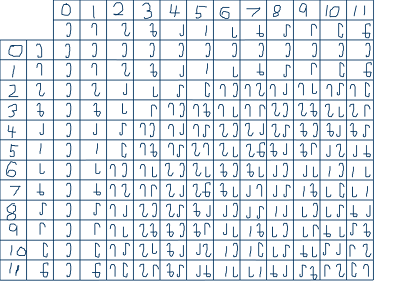
Note in particular how regular the patterns are for 2, 3, 4, and 6. Doesn't this look easier to memorize than the decimal times table? As an exercise try writing out your favorite sequences. Whether you're writing out squares, powers of 2, or primes you'll see that more patterns leap out at you in dozenal, making them easier to learn.
So there is my humble contribution to a dozenal future.
(In other news, I now have a patent to my name, though in fact it is owned by a previous employer. By the standards of the patent system, it is not a particularly bad patent. But if I had my druthers, it would have never been filed. Ah well.)
When the French created the metric system, they based it on factors of 10 everywhere. They even went so far as to try to measure angles in gradians (a quarter circle had 100), and to use decimal time. The world as a whole rejected decimal angles and times, but has adopted decimal metric everywhere else. Which is very convenient for scientists, but is hard to divide into thirds and somewhat inconvenient for quarters. Furthermore the persistence of both systems results in occasional annoyances like the fact that in daily life we usually prefer to measure speed in km/h, but for energy and power calculations the units only work out properly if you measure in m/s. Resulting in an annoying factor of 3.6 that shows up converting between them.
The other day I read An Argument for Dozenalism that made many of these arguments. Nothing new. However it made the interesting point that ideally a dozenal arithmetic would have its own set of glyphs. It suggested that 0 and 1 could be kept, but everything else should be changed. In my opinion that argument is correct, it is very confusing if 21 sometimes is 5*5 and sometimes 3*7, which makes a mixed dozenal and decimal world harder than it needs to be. But this raises the interesting question of what a logical dozenal set of glyphs might look like.
I've amused myself with thinking about this, and I have a proposal for a set of glyphs that are (mostly) unused, easy to learn, quick to draw, and are much more logical than existing ones. All have a vertical line in the middle. At the top there is a choice of a hook starting on the left, a straight end, or a hook starting on the right. At the bottom there is a choice of a hook ending on the left, straight down, on the right, or bending right to cut across the vertical line. This gives 12 possibilities. By incrementing the bottom first, and the top when you get a carry, you get a sort of a 3,4 base. Which means that a glance at the glyph tells you immediately its sign mod 4. A glance at the top tells you whether it falls in the range 0-3, 4-7 or 8-11.
So instead of the current system of 10 random symbols to memorize, you get two simple rules. While at first it seems bizarre, it grows on you quickly. And it gives you a very quick way to tell whether a given number is written in decimal or dozenal. To get a sense what it looks like, take a look at the 12 times table (my apologies for the handwriting - my none too good penmanship gets worse when I'm using a mouse pad to draw with):

Note in particular how regular the patterns are for 2, 3, 4, and 6. Doesn't this look easier to memorize than the decimal times table? As an exercise try writing out your favorite sequences. Whether you're writing out squares, powers of 2, or primes you'll see that more patterns leap out at you in dozenal, making them easier to learn.
So there is my humble contribution to a dozenal future.
(In other news, I now have a patent to my name, though in fact it is owned by a previous employer. By the standards of the patent system, it is not a particularly bad patent. But if I had my druthers, it would have never been filed. Ah well.)
Wednesday, June 9, 2010
The stock market thinks Microsoft has just under 4 years left
(I posted this basic analysis at http://news.ycombinator.com/item?id=1417156, which was a discussion of this Newsweek article, and then decided that it was interesting enough to call out for additional attention.)
Those of us who pay attention to finance know that the market tends to be more accurate than any individual person. So sometimes it is worth analyzing what the market is saying about different companies.
If you look at the stock market, it clearly saying that Microsoft's future doesn't look as bright as Google's or Apple's. That's why Microsoft is worth a P/E of about 13, while Google is worth one of 22 and Apple is worth one of 21.
The market projection gets substantially more stark when you subtract current book value to find how much the market values future revenue. (Book value is what all of the company assets would be worth if it was broken up and sold today. For Microsoft this is largely made up of their cash reserve.) Microsoft's market cap is 221 B, their book value is 46 B, and therefore 175 B of their market cap is projected future earnings. Their current profit is 46.28 B/year, and that works out to the market valuing them at their current earnings stream projected over a bit under 4 years.
For Google the equivalent exercise says a market cap of 154 B, and book value of 38 B so 116 B of market cap is projected future earnings. Their current profit is 14.81 B/year, which translates into the market valuing them at their current earnings stream projected over a bit over a decade. (10.4 years.)
For Apple the equivalent exercise says a market cap of 225 B, a book value of 39.4 B for 185.6 B of market cap due to projected future earnings. Their current profit is 17.22 B/year, which translates into their current earnings stream projected over a decade. (10.8 years.)
So the projection that Microsoft is walking over a cliff in a few years while both Google and Apple have a decent future. The market is perfectly aware that a lot changes in 10 years, and so they heavily discount any projections out that far. But the market is more likely to be correct for near events.
Now admittedly I've never liked Microsoft. But this isn't just claimed by some random haters on the Internet. This is the consensus of the stock market, which is based on a lot of informed people putting their money where their mouths are. This is worth thinking about.
(I took all figures for this from http://finance.yahoo.com/q/ks?s=msft, http://finance.yahoo.com/q/ks?s=goog and http://finance.yahoo.com/q/ks?s=aapl. I got book value by multiplying book value / share times shares outstanding.)
Those of us who pay attention to finance know that the market tends to be more accurate than any individual person. So sometimes it is worth analyzing what the market is saying about different companies.
If you look at the stock market, it clearly saying that Microsoft's future doesn't look as bright as Google's or Apple's. That's why Microsoft is worth a P/E of about 13, while Google is worth one of 22 and Apple is worth one of 21.
The market projection gets substantially more stark when you subtract current book value to find how much the market values future revenue. (Book value is what all of the company assets would be worth if it was broken up and sold today. For Microsoft this is largely made up of their cash reserve.) Microsoft's market cap is 221 B, their book value is 46 B, and therefore 175 B of their market cap is projected future earnings. Their current profit is 46.28 B/year, and that works out to the market valuing them at their current earnings stream projected over a bit under 4 years.
For Google the equivalent exercise says a market cap of 154 B, and book value of 38 B so 116 B of market cap is projected future earnings. Their current profit is 14.81 B/year, which translates into the market valuing them at their current earnings stream projected over a bit over a decade. (10.4 years.)
For Apple the equivalent exercise says a market cap of 225 B, a book value of 39.4 B for 185.6 B of market cap due to projected future earnings. Their current profit is 17.22 B/year, which translates into their current earnings stream projected over a decade. (10.8 years.)
So the projection that Microsoft is walking over a cliff in a few years while both Google and Apple have a decent future. The market is perfectly aware that a lot changes in 10 years, and so they heavily discount any projections out that far. But the market is more likely to be correct for near events.
Now admittedly I've never liked Microsoft. But this isn't just claimed by some random haters on the Internet. This is the consensus of the stock market, which is based on a lot of informed people putting their money where their mouths are. This is worth thinking about.
(I took all figures for this from http://finance.yahoo.com/q/ks?s=msft, http://finance.yahoo.com/q/ks?s=goog and http://finance.yahoo.com/q/ks?s=aapl. I got book value by multiplying book value / share times shares outstanding.)
Subscribe to:
Posts (Atom)