Showing posts with label weapons. Show all posts

Thursday, September 28, 2017

Air-Dropped Torps

This is a very good article about the USN Mk13 torpedo, which was the Navy's primary torpedo for aerial attack. After giving a historical overview, it goes into the Argentinian attempts to use their stored Mk13s during the Falkland War.

Highly recommended.

Monday, February 8, 2016

Why USN ASUW Warheads Are Tiny

I got into a post on that on my other blog.

I'm posting a link to it here, in case anyone is interested.

Thursday, October 23, 2014

Slugging It Out, Toe-to-Toe

This is a test of a replica 17th Century naval gun against the hull of a warship.


First off, that's the smoke from just one long gun. The Vasa carried 48 24-pound cannon. While broadsides were not a common tactic in the early 17th Century, the line-of-battle tactics soon evolved and you might have had a ship pounding another with broadsides of 30 guns or more.

Second, note the damage wreaked by that iron cannonball. Besides the ball itself, the splinters thrown from the inside of the hull would have caused fearful damage to the gun crews of the ship so hit.

Tuesday, May 1, 2012

Target Shooting at Sea

One of the things that was occasionally done was to inflate something very large, like a weather balloon, and drop it over the side. It could then be used as a target at longer ranges.

So one day, a ship I was riding on did that. I was riding it to conduct and observe some tests.[1] Since the ship was independently transiting, I didn't have much to do, so I went topside to watch the shooting.

One of the weapons that the sailors were shooting at the balloon was a M-79 "Bloopergun".

They were firing blue rounds.[2] The balloon was off the starboard side at maybe 300 yards or so and the ship was steaming around the balloon in sort of a lazy circle. Most of the sailors were missing to the left of the balloon.

I said something to one of my fellow shipriders along the lines of: "That thing is a big as a barn and they can't hit it."

The gunner's mate senior chief must have overheard me, for he spun around, fixed me with his patented Goat Locker Stare and said: "Maybe you'd like to give it a try, Ma'am."

"Thank you, Senior Chief, I'd like that." So I went over there and he gave me a fifteen second checkout on the controls of the M-79. I checked to make sure that the windage adjustment was centered, then I shouldered the weapon, aimed and fired.

The dummy warhead splashed right in front of the balloon. The senior chief's jaw dropped and he said something along the lines of: "Goddammit, Lieutenant, how'd you do that?"

"Easy," I said, as I handed the Bloopergun back to him. "The balloon isn't moving, the ship is. So you gotta lag the target, not lead it."

Don't ask me about recoil, I don't remember it kicking that much. What I should have done, though, was to ask for the cartridge case as a souvenir, and I didn't do that.
____________________________
[1] Never you mind what kind of tests. If I were to tell you, I really would have to kill you.
[2] The projectiles were inert.

Friday, November 18, 2011

Oops!

One of the target drills practiced with the 5" naval rifles found on most of the tin-can Navy was an anti-surface target shoot. Basically, an ocean-going tug would tow a target sled; the warship participating would lock its fire-control radar onto the target sled and shoot it with BL&P[1] rounds.[2]. A spotter on the tug would watch for the splashes and impacts of the rounds on the sled and grade the ship on its accuracy of fire.

The target sled was tracked by radar in Gun Plot, where a fire controlman (FC) would designate the radar blip of the target to the gunfire control computer. The gunfire control computer took in the ship's course and speed, the target's course and speed, as well as the wind and other factors to generate a firing solution. It was normally an easy exercise, it was a full-up test of the gunfire system. A failure usually meant that something was broken or out of calibration. A failed exercise was usually followed by a CASREP.

The Spruance class introduced a more-computerized fire-control system, the Mk-86, that was designed to have a faster reaction time against small, fast-moving patrol boats. So in the late `70s, one of the then-new Spruance-class destroyers was taking part in an anti-surface gunfire exercise. The target sled was deployed and the range was clear.

The ship opened fire on the target. The Mk-86 tracked the target, tracked up the tow line, and fired on the tug. Accounts differ on the number of times that the tug was hit before the ship was able to cease fire, but it was apparently more than once. The word was that one 5" round went into the Goat Locker.[3] Nobody was injured by the shelling.

The immediate fix was to double the length of the towline anytime that a Mk-86 equipped ship was to shoot at a towed target. The other fix was to require that the ships also optically track targets in gunfire exercises.[4] Depending on who you talked to, the story I heard was that the coaxial TV camera for the gunfire radar was either out of commission or not installed at the time of the incident.[5]

Lore has it that the tug was unofficially awarded a Purple Heart by the destroyer's captain.
___________________________________
[1]BL&P stood for "blind, loaded and plugged". BL&P projectiles had no fuzing and they were loaded with an inert material to make them weigh as much as war rounds. The projectiles were painted blue and they weighed over fifty pounds.
[2] 5" guns used "semi-fixed" ammunition. "Semi-fixed" meant that what appeared to be the cartridge case was the powder casing, the projectile was loaded separately. The powder case also weighed over fifty pounds. The other types of ammunition were "fixed" (like small arms ammunition) and "bag" (the powder was in silk bags), used in battleships and pre-war cruisers.
[3] A/k/a the Chief Petty Officers' Quarters.
[4] This was SOP in the earlier Mk68 GFCS, as the gunfire director itself was manned.
[5] I'll go with "not installed."

Tuesday, March 9, 2010

Mines

Mine warfare has been around for well over a century. But first, a definition: I define a "mine" as "an explosive device triggered by the passage of a ship".

Mines actually go back a lot further than a century. There were attempts to make working mines in the 18th and early 19th centuries. The problem was how to trigger them, as before the invention of the percussion cap, the only practical way to detonate a mine was to attach it to a ship and light a fuse.[1] Even the invention of percussion caps did not make mines very feasible, as the firing mechanism had to be something that was both waterproof (black powder and water do not mix) and crushable (to fire the cap). Command-detonated mines were tried, but they had problems with water seeping in along the wires and disabling the charge.[2] Mines became practical when explosives less susceptible to moisture were developed.

There are three basic types of mines and three basic methods to place mines. The types are contact, pressure and magnetic (there are also hybrids, which can be both pressure and magnetic). The three methods of placement are bottom, moored and drifting.

Contact mines are the ones that you always see in old war movies: Big round iron or steel balls with something like 200lbs of high explosives. A ship or sub would contact it and have a hole blown in her side. Bottom contact mines required very shallow waters; they were most commonly used as an anti-landing craft defense. Drifting mines are heavily frowned on by the Hague Convention of 1907, but that has not prevented their being used.

Moored contact mines were typically laid from minelaying ships. They were rolled off the stern of the ship. The anchor section contained the cabling and the wheels for being rolled off. The cable would pay out to the desired length and anchor the mine.


Ideally, the length of the cable would be set so that the mine was submerged, both so that the mines were harder to avoid and that they would not be detonated by fishing boats and other small craft. Moored contact mines can be laid in very deep waters. It is possible to lay them so that the mine case is targeted towards submarines.

Magnetic mines are triggered by the passage of large chunks of metal, namely, ships and submarines. Pressure mines are triggered by the hydrodynamic pressure generated by a passing ship. These mines can be very sophisticated and may include counters so not just the first ship to pass by will trigger them. More specialized are acoustic mines, which will activate on the acoustic signature of a particular class of ship. There was development of mines which incorporated homing torpedoes, the USN version was called CAPTOR.

Mines were first laid by specialized ships, but now are laid primarily by aircraft, at least for USN usage. They can be laid by submarine, but that requires cutting into the torpedo load, which submariners hate to do. When laid by aircraft, an enemy will attempt to spot the splashes to aid in demining. As a result, it is common practice to drop mine cases that are filled with cement as dummies. This also works because few ship captains are willing to try a minefield.[3]

Mines could be used defensively (to keep opponents away) and offensively (the "North Sea Mine Barrage"). The threat of mines was often enough to prevent a naval force from moving into an area.

I will cover mine countermeasures in another post.
_________________________________
[1] The modern equivalent is a "limpet mine", which is attached by a frogman.

[2] Similar issues bedeviled the first undersea telegraph cables.

[3] I was told that when the Navy mined Haiphong Harbor, most of them were dummies. That might be bullshit, though, as it was a naval aviator who told me and they are famous for being bullshit artists.

Monday, October 12, 2009

AAW Part V- the Weapons, Chapter 2

(Part IV)

(N.B. I am not considering 5" and 76mm guns in this discussion. Nothing has fundamentally changed there since the development of the VT fuze) during the Second World War.

Very short range defense against incoming missiles, or "point defense", was initially a crash program within the Navy, which became very interested in point defense in 1967, following the sinking of an Israeli destroyer after it was hit by a number of Styx missiles.

The first system was pretty slapdash, but it worked. It was the "Basic Point Defense Missile System" or BPDMS. It was a system that would have made McGyver proud and it was developed and implemented at near-record speed for a non-hot war procurement situation.

BPDMS took eight Sparrow missiles, straight from the stocks for F-4s, and put them in a trainable box launcher.[1] It took two of the nose radars from an F-4 and mounted them on a separate hand-slewed mount. There was a little CRT in the mount with an eyepiece so the operator could press his face to it (avoiding showing light at night and keeping rain off it). When it was turned on, the operator would be told, by sound-powered telephone, where the target was. He would slew his radar rig to that and elevate it as necessary. The missile box would automatically train and elevate to follow the radar director. The operator would both acquire the target and fire at it.

The disadvantages were obvious. BPDMS relied on a man, standing outdoors, to work it. At night, in the rain, in the cold, whatever the weather, somebody had to be at the director in order for it to function.

NATO Sea Sparrow got rid of the human-operated director;

NATO Sea Sparrow also began the process of "navalizing" the Sparrow missile to make it better suited for shipboard requirements. BPDMS,as I mentioned, had taken the issue Sparrow as used by fighters. That was fine for a crash program, but it was not optimal, so a naval variant was developed.

NATO Sea Sparrow, however, was not suitable for ships much smaller than a destroyer (though BPDMS had been installed on frigates). The Phalanx Close-in Weapon System, CIWS, was developed for smaller ships, though it has been installed on everything up through aircraft carriers. The idea of CIWS[2] was to have a system that could be welded to the deck in short order, if necessary, with only lines run to it to provide for electricity and command capabilities.

CIWS can be fully autonomous, though it can also accept designation from CIC. CIWS has its own tracking and acquisition radars in the white dome. The gun is a 20mm gatling gun which when loaded for wartime, fires sub-caliber (saboted) depleted uranium projectiles which are supposed to smash into an oncoming cruise missile and cause it to blow up.[3] CIWS was often referred to as "R2D2".

CIWS worked. Some navies went for a larger gun, such as Goalkeeper, but the larger systems require penetrating the deck to mount part of the works below the deck, which limits where the mounts can be placed.

The last line of AAW defense is, of course, damage control.

[1] You may see references that say that BPDMS used a modified ASROC box launcher. Those reference are full of shit. The BPDMS launcher box system was a lot smaller than ASROC.
[2] CIWS is also a generic term for any close-in defense system.
[3] There is a potentially serious problem with this idea. A CIWS kill will take place between 300 and 500 yards. Eastern-bloc antiship missiles were designed to disable large ships and it is highly likely that they use some type of shaped-charge. Detonating one a few hundred yards from a destroyer might still sink it. Even if the thing blows up omnidirectionally, the shrapnel has a good chance of fucking up the ship's radars.

Sunday, September 20, 2009

AAW Part IV- the Weapons, Chapter 1

Parts 1, 2, and 3)

Air defense weaponry fell into five basic categories: Airborne interceptors, long-range missiles, medium-range missiles, short-range missiles, and point defense. Let's consider each in turn.

Airborne interceptors were basically the Combat Air Patrol, launched from the carrier. CAP could be airborne, or ready on deck in various alert states. Ready 5 would have the aircrew sitting in the aircraft, hooked up to the catapult and with the engines turning. In Ready 15, the engines were shut down. Ready 30 would have the crew outside of the aircraft and the aircraft near the catapult. Ready 45 and Ready 60 would have the crew in the ready room below decks.[1]

The king of the airborne interceptors was the F-14 Tomcat. The Tomcat carried a powerful radar system, the AWG-9, and the Phoenix missile.

The Phoenix was a serious long-range AAW weapon. Given that the F-14 might have been flying a few hundred miles from the carrier battlegroup and then that the Phoenix itself had a range of something on the order of a hundred miles or so, the F-14/Phoenix weapon system had the capability to engage Soviet Naval Aviation cruise-missile shooters before they reached firing range.

Phoenix's main limitation was that it was not a dogfighting missile, it was a missile that made the F-14 into a flying guided-missile ship. Phoenix was designed for a general hot war, where the only aircraft in the sky would be Ours, Theirs, and Civilians Stupid Enough to Fly Through a War Zone.[2] It was not designed for a limited-war environment where the rules of engagement required visual target identification. Phoenix could only be carried by F-14s, so once the F-14s were retired, so was the Phoenix missile.[3]

Talos was the first long-range shipboard AAW missile.


Talos was a monster in its size. The missile itself was not a rocket, it was powered by a ramjet. It was akin to firing an unmanned aircraft at a target, as the missile weighed something like 7,000lbs and was 35 feet long (give or take). Originally, Talos had a range of 50 nautical miles, the later versions doubled that. The warhead was either continuous rod or nuclear. Talos was so huge that ships carried them both ready to use and, to save space, more missiles were unmated, with the booster, the sustainer and the warheads all separated.

Only one ship, the USS Long Beach, was purpose-built to fire Talos; it was also the only one to shoot them during wartime at a live target (two North Vietnamese MiGs). All the other Talos shooters were rebuilt heavy-gun cruisers from World War II. They were ugly ships; the missiles came out from the deckhouse onto a launcher sited where the first 8" gun turret had been. The missile radars were where the superfiring gun turret had been.

Talos was retired around 1980 as were all of the Talos shooters except Long Beach. She was converted to fire Terriers. The Talos missiles left in inventory were converted into flying targets and all were eventually used up for that duty.

Terrier started out as a medium-range missile, with a maximum range of 20nm. It was, like Talos, a two-stage weapon, but the second stage was powered by a rocket motor. Terrier was also a large weapon, but nowhere near as large as Talos. It was employed by DLGs, which, in 1975, were redesignated as either DDGs or CGs. The warhead was either continuous rod or nuclear, though unlike Talos, the weapons were carried assembled.


To save space, though, the fins were not added to the missiles until they were on the rail in the missile house behind the launcher.

Tartar was a short-range single-stage rocket, basically the front half of a Terrier. It was fired from Adams class DDGs, Brooke class FFGs, and Perry Class FFGs.

Some Knox class FFs had two Tartars in their ASROC launcher box. Tartar had a range of 10nm or so and only had a continuous rod warhead.

Talos, Terrier and Tarter were sometimes referred to as "the T-birds". All functioned about the same way: They rode a beam towards the target and then homed in from the radar reflections as the ship's missile illumination radar shined on the target ("semi-active homing"). They were always "tail-chasing" the target; they were flying towards where the target just had been. Range against a crossing-target was piss-poor. Worse, the ships could only have as many missiles in flight as they had radars.

Terrier was replaced by the SM-1/2ER missiles, Tartar by the SM-1/2MR missiles, though the ships that used them were still referred to as "Terrier ships" or "Tartar ships". The Standard missiles did away with beam-riding, instead steering the missiles towards their target by a datalink that could predict an intercept position and fly the missiles there, using semi-active homing for terminal guidance. That, along with better rocket motors and more powerful boosters for the ER series greatly increased the range of the missiles. The datalink system also permitted the ships to have many missiles in flight at one time per fire-control radar system. The latest models of SM-2MR have a range almost the same as the later models of Talos, while the SM-2ER can fly even further.[4]

There was concern that at some firing angles, the SM-2ER booster could erode the ship's deck, but I do not know if it was ever addressed. During the late 1980s and early 1990s, the steam-powered Terrier ships were given a "New Threat Upgrade" to their missile systems in overhauls that cost over $50 million each to permit them to employ the then-latest variants of SM-2ER. Unfortunately, the Cold War ended soon after the NTU upgrades were put in service and the steam-powered Terrier ships were almost immediately retired.

All of the steam-powered Terrier and Tartar ships have since been scrapped or sunk. The fucking Navy couldn't be bothered to save a single one as a museum ship to the Cold War.[5]

[1] All this is from old memory, so if I'm wrong, meh.
[2] The latter two groups you could shoot at.
[3] During the reign of the Shah, Iran purchased F-14s and Phoenix missiles. They may still have some missiles left.
[4] SM-3ER is designed for ballistic missile defense. This is why.
[5] The Adams-class DDGs were also all scrapped or sunk. Only the German Navy, which had three built here (and customized to their own needs), saved one. The Navy saved numerous ships from WW2, but only the USS Barry and the USS Nautilus, which is historic in its own right as the world's first nuclear sub, were spared.

Sunday, December 28, 2008

ASW Weapons, the Conclusion

(Parts One, Two and Three)

The SQS-23 and other Korean-War era sonars, as I mentioned in Part 3, had the capability to detect and track submarines far outside the range of Hedgehog. The US Navy, among others, experimented with larger spigot mortars and rocket-thrown depth charges. Weapon Alpha was one that was largely unsuccessful.

All such weapons had the same problems; there was an unsatisfactory dwell time between the time the rocket was fired and the time the depth charge had sunk to the correct depth and detonated. All of those were predicated on the somewhat ludicrous idea that a submarine commander, knowing that he was being tracked by a destroyer, would hold a steady course and speed.

The answer was ASROC, for "antisubmarine rocket."

As you can see here, ASROC was a rocket which was fired from an eight-cell box launcher. The launcher itself used recycled deck mounts from 3"/50 guns. The rocket itself was a dumb, ballistic, solid-fueled rocket motor. Aiming was done by training the launcher and elevating the two-cell box with the ASROC to be fired. It worked out to be far more accurate than you might think.

On ships with Terrier (later, SM-1/2 ER) launchers (the DDG-37s, CG-16s and CG-26 class ships), ASROC was fired from the missile launcher. Each ASROC loaded was one less Terrier that could be carried. As the main mission of those ships was anti-air warfare, ASROC and ASW were the bastard stepchildren.

The business end of ASROC started out as a Mk.44 torpedo:


The Mk.44s proved to be unsatisfactory (among other things, it was slow) and were fairly rapidly replaced by the Mk.46. The torpedoes were active homers; they had a very high frequency sonar set. For guided weapons, they were the first true "fire and forget" weapons of the surface navy.

For close-in work, the torpedoes were also fired from deck-mounted launchers. Triple-mounts were added to a lot of ships:


The Knox class had twin mounts on either side of the after deckhouse, which were built into the deckhouse just forward of the LAMPS hangar.

ASROC also had a nuclear depth charge variant. This was the only live test, fired in 1962, before the Atmospheric Test Ban Treaty came into effect:


The nuclear ASROC worked like an old rocket-thrown depth charge, but with a hell of a bigger bang. The dumb-rocket version of ASROC left the fleet in the early 1990s when the ships with SM-1/2 ER or box launchers were all retired. A vertical-launch ASROC was eventually developed for use in current warships, though it reportedly was a pretty troubled development program.

ASROC could reach out several miles. But once again, the sensors outranged the weapons. The SQS-26 sonar, through either "bottom bounce" or "convergence zone" modes, could detect and track submarines way the hell out. The first solution was the Drone Anti-Submarine Helicopter, or DASH.
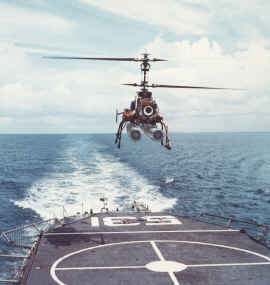
The concept of operation of DASH was simple: Fly the thing out until the markers from the sonar operator tracking the submarine and from the radar operator tracking the DASH converged, then drop the torpedo. Repeat if necessary (later models of DASH carried two torpedoes), then fly back to the ship for more fuel and torpedoes.

In practice, DASH didn't work so well. The drones were legendary for crashing and the DASH program was axed.

But that still left the problem that ships could track submarines further out than they could attack them. The answer was to provide ships with manned helicopters, the Kaman Seasprite, SH-2F LAMPS Mk 1:

LAMPS stood for "Light Airborne Multi-Purpose System," though a lot of sailors referred to it as "Lousy Air Mail and Passenger Service," for the best thing that the helo could for morale was to go get the mail from the carrier. The two drop-tanks you can see on this helo could be replaced by Mk. 44 or Mk. 46 torpedoes, though taking off a drop-tank reduced the in-flight endurance by 30 minutes. The red/white hashmarks outline the location of the sonobuoy launcher.

Late in the 1980s, LAMPS Mk.1 was replaced on the Spruance and Perry class warships by LAMPS Mk.3, which flew the SH-60F. The SH-60 program was supposedly the first aircraft procurement program where the prime contractor was not the airframe manufacturer (Sikorsky), but the electronics package manufacturer (IBM). Those ships were supposed to be able to hold two SH-60s. I never saw more than one LAMPS on a ship at a time and I think I maybe saw one SH-60s.

LAMPS would go out to the location of the submarine as determined by the active sonar track and stream a towed bird that contained a magnetic anomaly detector, the "MAD Bird." There were several different patterns the helo could fly to develop a track on a submarine; once the helo tracked it, it could drop a torpedo.

LAMPS also required a lot of people. The air detachment for LAMPS had three or four pilots and about 20+ sailors, with the senior officer being the head of the Air Department. More than one ensign or JG division officer in the other departments had more sailors and equipment to maintain than those four officers in LAMPS, which lead to the standard complaint of: "I know what they do to earn their flight pay, but what do they do to earn their base pay?" The corrosion control program for the helos required that they be frequently washed with fresh water (the fresh water usage of the LAMPS detachment routinely led to the Chief Engineer threatening violence upon the Air Boss).

LAMPS pilots were certifiable. Take a look at the photo of this Knox-class FF and note the size of the flight deck:


Now imagine trying to land a helicopter on that deck, at night, with the wind burbling around the superstructure and the ship rolling a bit. The LAMPS pilots did that, and the flight deck on a Garcia class FF was even smaller. They had to be nuttier than a jar of Planter's.

LAMPS became even more important when surface ships began to be fitted with towed array passive sonars (TACTASS, for Tactical Towed-Array Sonar System). If conditions were right, a towed array could be towed below the thermocline layer, down where submarines could hide from the hull-mounted sonars of ships. LAMPS were fitted with a launcher that fired off sonobuoys; little floats that dropped hydrophones deep into the water. The buoys had radio transmitters that send the signals to the LAMPS helo, which relayed them to the ship's sonar shack, where the signals were printed out on a frequency analyzer that was surplused from the P-3C upgrade program.

Sonobuoys came in several flavors. The ships had to pay for them and, as the ones with dumb omnidirectional hydrophones were the cheapest, those were the one used the most. There were sonobuoys with active pingers, but they were both costly and, as they alerted a sub that it was being hunted, not preferred.

Sonobuoys were used to localize a contact gained from the towed array. Once the contact was localized, the LAMPS helo would be vectored in for a MAD search. Once the helo had a MAD contact, then it was up to the three crewmen in the helo (two pilots and a sensor operator) to gain an attack solution and kill the submarine.

Wednesday, December 3, 2008

ASW Weapons; Part III

As I discussed in Part I and Part II, depth charges had several drawbacks. Chief among the drawbacks was the requirement that an escort prosecuting a submarine contact had to lose contact prior to launching her depth charges.

The Royal Navy had the lead on this problem, once again. They developed a "spigot mortar" that would launch a pattern of mortar bombs, each of which had a warhead of approximately 35lbs of high explosive. This became known as the Hedgehog. The mortar bombs were loaded onto rods; the bombs each had a cylindrical well along its center axis so that the bombs slid down and rested on the rods.


The early Hedgehog mounts were roll-compensated, but they could not be trained more than a few degrees to either side (moved from left to right) by tilting the mount, so the ship herself had to be aimed at the submarine. Later mounts were fully trainable. The mortar bombs themselves were launched in pairs at very short intervals, back to front, so that the bombs that fired at higher arcs were launched first (they had a longer flight time) and thus all of the mortar bombs would hit the water nearly simultaneously. The launchers' rods were set so that the bombs hit in a pattern, usually oval or circular, at a distance of 200 yards. The bombs would sink fairly rapidly.

Unlike depth charges, Hedgehog mortar bombs were contact weapons. Unless the submarine could hear the sound of the bombs being launched, she would not know that an attack run was underway, as escorts would also make non-firing runs to refine their targeting solutions. The time it took to reload the Hedgehog mount was usually less than it took to reposition for another firing run.

Hedgehog did have some of the same drawbacks as depth charges, in that the ships had quantities of high explosives on the weather decks. The launcher crews had to work topside, sometimes in far less than ideal conditions. At least one warship was lost when the stored Hedgehog bombs blew up because of faulty fuzing. They were also dumb weapons with a fairly long time between firing and impact, often close to half a minute or more, depending on the depth of the submarine.

Hedgehog nonetheless was a very lethal weapon when employed by a skilled crew. The USS England (DE-635) sank six Japanese submarines in 1944 in a period of 12 days.


Hedgehog was effective, but it still required that the escort close to the submarine's position in order to attack it. World War II sonars operated on sound frequencies around 14-30 KHz; many were "searchlight" sonars, such as the QGB sonar that transmitted a beam on one bearing; the sonar head was steered by the operator. The high frequency meant that the sonar head was small, it could be mounted on smallish ships, but because it was a searchlight system, searching for submarines was a matter of luck. The high frequency also limited the range.

Sonars developed into true search sonars that could transmit an omnidirectional beam. The QHB sonar transmitted an omnidirectional beam, but because it operated between 20 and 26 KHz, its range was limited. The early 1950s-vintage AN/SQS-23 sonar operated at 5 KHz, which greatly increased the detection range, but which also required a much larger sonar dome. The increased detection range of sonar sets like the SQS-23 meant that the escorts could track submarines far outside of the range of Hedgehog.

Clearly a longer range weapon was needed.

Sunday, October 26, 2008

Small Arms Weapons Training

Up until the 1980s or so, small arms training on ships was pretty much an afterthought. If you had an in-port watch assignment that meant you may have to carry a weapon, you were shown how to load and unload it. Then you were given a chance to "familiarization fire" it. When the ship was steaming independently (not in formation), a group of sailors were assembled on the fantail with a gunner's mate. If your assignment meant you had to carry a .45, the gunner's mate loaded it (with five rounds in the magazine) and handed it to you. You then pointed the weapon aft of the ship and fired off all five rounds.

If you managed to hit the ocean, you passed.

That, for obvious reasons, was not very satisfactory.

The next plan was to qualify on full-sized silhouette targets. The targets were supposed to be set at 25 yards. You then fired 30 rounds; ten at slow-fire, ten at timed fire, ten at rapid fire. (Definitions here.) If you finished up with 20 holes in your target, you were qualified.

That had its own problems. Few ships, other than carriers, had a place where you could set up a target, move back 75 feet and not either have fallen over the side or have something in-between the shooter and the target. So the smaller ships had to use a shore-side rifle range to qualify.

That raised a lot more problems. Nearly every non-engineering petty officer on every ship had to qualify with a .45, as the Petty Officer of the Watch post in port was an armed watch. All of the sailors on the security teams had to qualify with a .45, M-14 rifle and riot shotgun. Half of the officers had to qualify with a .45. So possibly a hundred or more sailors from each ship had to shoot for qualification on a yearly basis, and even in a small port, that meant that several thousand sailors had to qualify.

The base pistol ranges were not set up for that amount of use and they quickly became overwhelmed. There might be a seven month waiting list, which was unsatisfactory to the ships.

So they began to find creative solutions. If a chief on one of the ships was a member of a gun club, he would make a deal with the club to use their range in exchange for the ship providing a large tin of coffee or a work/cleanup detail. Some ships found informal ranges in national forests that were usable during the week.

Meanwhile, the bases had begun programs to expand the hours and the sizes of their ranges, only to find out that the demand was evaporating. The solution most base commanders adopted was to forbid the use of civilian ranges for "liability concerns." That was an order that was widely ignored.

Ultimately, the Navy adopted reduced-sized silhouette targets that were suitable for ten-yard ranges. Most ships had small helicopter flight-decks; the target holders were set on the edge of the deck and the shooters stood on the other side of the flight deck. So as long as the ship was off on its own, they could qualify a lot of people rapidly.

There was some talk about starting to send teams to a "Hogan's Alley" sort of advanced training, but I don't know if that ever became a reality.

Tuesday, September 30, 2008

ASW Weapons; Part I

At the turn of the 20th Century, a new development was coming into the naval scene: Steam turbines. Until then, the fastest screw-driven (ships are driven by screws, boat and airplanes use propellers) ships might approach 20 knots by the use of triple-expansion steam engines. Those engines used large pistons and crankshafts.

At the close of the 19th century, the Royal Navy unveiled a very fast boat named the Turbinia at the Fleet Review which was put on for Queen Victoria's diamond jubilee. Turbinia was the first successful craft driven by a steam turbine. Turbinia could reach nearly 35 knots, making her almost twice as fast as any other craft afloat.

During the era when the steam turbine was being developed, torpedoes were being developed. The first craft to carry torpedoes were light, fast boats. Somewhat larger ships, almost as fast, but more heavily armed, were developed to protect large capital ships from the threat of the torpedo boats; these ships were known as "torpedo boat destroyers." Torpedo boats would be used in wars through the Second World War. Torpedoes were also launched from larger surface ships, the Japanese "Long Lance" was the best in the world and was an extremely effective weapon. Torpedoes came into their most renown use as an antiship weapon launched from submarines, for they could be fired from periscope depth, giving the submarine the greatest possible concealment.

However, there was, at first no weapon specifically designed to fight a submarine. Gunfire was ineffective against a submerged submarine; shooting at the periscope was akin to trying to hit a broomstick at 500 yards with a rifle. And so, the first practical ASW weapon was developed: The depth charge.

The first depth charges were little more than cans filled with explosives. In a day when most buildings were heated with coal-fired furnaces, the furnaces had to be routinely cleaned of its ashes, which were put into large steel cans, or "ash cans." The depth charges were about the same size; they became known as "ash cans."
The early depth charges ones had 50lbs of explosive; by the end of World War I, they had up to 600lbs. The technique was simple: Go to where the submarine was and roll the charges off the stern of the ship. The depth charges had a delay timer, often set by depth, to prevent blowing the stern out of the water. If the skipper had an idea which way the submarine was heading, he could try to "lead" the submarine.

In order to get a wider pattern, the Y gun was developed. The Y gun threw two depth charges, one to either side of the ship.

The K gun threw one depth charge:


In the event that a submarine attacked the escort, the drill was to charge directly at the submarine at high speed (steam turbines, remember), which presented a narrow target for the sub to shoot at. If the sub was on the surface or had its periscope up, the bow guns of the destroyer would shoot at it to force the submarine below the surface. The subs of the day ran on diesels while on the surface and on batteries when submerged. The subs had to run slowly on batteries in order to conserve power, so if the destroyer could get to where the submarine was last seen (the "datum") very quickly, the destroyer would lay down a pattern of depth charges. If the submarine submerged too slowly the destroyer would ram it.

Depth charges killed in two ways. One was by concussion, which you have no doubt seen in any number of old war movies. But if the depth charge was close enough, the sub would be shattered. When an underwater charge detonates, it blows a circular bubble in the water as wide as water pressure will allow. The bubble then collapses to its center and bounces back out; this cycle repeats until it runs out of energy. But if as the bubble expands it touches a solid object, like a submarine, the bubble will collapse onto that object and blow the living shit out of it.

But there were serious drawbacks to the use of depth charges.

(To be continued)

Thursday, September 18, 2008

Naval Gunfire Support

Navy frigates, cruisers and destroyers all are equipped with naval rifles, also referred to as "guns." "Guns" are what the Army and landlubbers refer to as "cannons." Since the retirement of the last of the WW2 8" gun cruisers in the 1970s, and until the introduction of the Perry Class FFGs, FFs, DDs and CGs all carried 5" guns. Now FFGs have 76mm guns and 5" guns are on DDGs and CGs.

Those guns are "dual-purpose" guns, which means that they can shoot at targets both on the sea and in the air. Dual-purpose guns were developed after WWI when it became clear that ships might need to shoot at airplanes. That avoided having to add large guns solely for anti-aircraft uses, which helped to reduce the growth in topside weight. The more weight added above the main deck (actually, above the center of gravity), the less stable a ship is.

Besides shooting at other ships and at airplanes and now missiles, the guns are also used to provide supporting fire to Marines on the beach. That is the naval gunfire support mission, or "NGFS."

NGFS is primarily indirect fire, in that the ship does not spot and direct its own fire. Naval gunfire spotters do that and they were often naval officers (but not always). Being sent to duty as a gunfire spotter, at least in the post-Vietnam peacetime era, was a clear sign that one had royallly screwed the pooch, that one's career was over. Back then, the Navy was not going to send an up-and-coming young surface warfare officer to go play with the Marines and live in the dirt and eat bugs. But if you were a fuckup and you were either too dumb or too stubborn to submit your resignation towards the end of your first sea tour, off you went to play jarhead.

So let's think about how you actually do spotting. If you are the observer, what you have is a land map, a compass, a pair of binoculars and a radio. You would radio the ship, give your grid position (it was in your best interests to be particularly accurate), give the range and magnetic bearing to the target, describe the target, tell the ship what type of shell to fire and then tell them when to shoot.

So it would be something like "Ship, observer target line zero-six-six, range one two zero zero, target: trucks in open, VT frag, over.". The radio talker in the ship's Combat Information Center would read that back to the spotter. If it was correct, the spotter would say: "Fire when ready." The NGFS team in CIC would plot the observer's position and determine the range and bearing to the target. The range and bearing would be called down to Gun Plot, read back to CIC, and then a round would be fired. When the round was fired, the R/T talker would call out "Shot" and then, five seconds before impact, would follow that with "splash, out."

The spotter would then call back corrections from his point of view, with all distances in meters: "Left five zero, add two zero zero, fire when ready." That had to be corrected by what probably should have been called a "gunfire plotting board," but which everyone referred to as a "Comanche Board." These were two coaxial bearing rings, each with a clear plexiglas surface inside the ring, so that the inner ring's surface was on top of the outer ring. The surfaces were marked in a grid pattern, with each line representing ten meters. The outer ring would be turned so that its grid were aligned on the observer-target line, the inner ring was turned so that its grid were aligned on the ship-target line. The grids were different color, often black and red. The center point was the aiming spot for that round.

The CIC plotters would plot "left 50, add 200" on the observer grid, note what that correction was on the ship's grid and call that down to Gun Plot for another spotting round. Ideally, the third round would be close enough and then the ship would commence area fire. The two common rounds used were VT frag, against troops, tanks and trucks, and White Phosphorus, against troops. VT frag would not do much damage to tanks, but what it did was force the tank commanders to drop inside and "button up," where it is harder for the tank commanders to see what is going on. You might get really lucky and blast off a radio antenna from a tank, break a tank's tread or smash a vision block.

Until a few years ago, most Atlantic Fleet ships did their NGFS training at Vieques, Puerto Rico. Bloodsworth Island in Chesapeake Bay was also used, but infrequently, due to the prevalence of civilian boats in the Bay. If I remember correctly, it was not permitted to shoot anything other than inert shells at Bloodsworth, while live ordnance was permitted at Vieques. NGFS is no longer done at Vieques, I have no idea where live NGFS training is done, if it is indeed done at all anymore.

Sunday, May 25, 2008

The Fuze that Saved A Battle

In my last post, I mentioned the VT fuze. Before I get to the VT fuze and its importance, a short discussion of fuses is in order.

The earliest cannon projectiles were round shot. They were solid balls, first of stone, then of iron. Somewhere along the way, some enterprising person wondered if there was a way to combine the heavy throwing capability of a cannon with the blast effects of a hand grenade. Hand grenades, back then, were little more than containers packed with gunpowder. The grenadier would light a fuze on the grenade and throw it towards the enemy.

Obviously, stuffing a projectile with a lit fuze into a cannon barrel that has gunpowder at the other end is not a good idea. The early fuzes were little more than just that, the fuze would be lit by the combustion of the propellant charge, with the time to detonation determined by the length of the fuze. This had its drawbacks, so the impact fuze was developed. Depending on whether the shell was fuzed at the nose or at the base and how impact-resistant the fuze was, a projectile could be fuzed so that it detonated on impact or afterwards, to allow for penetration. Clockwork fuzes (also known as "mechanical timed fuzes") were also used to set projectiles to go off prior to impact, in order to spray shrapnel over a wide area. (In a throwback term to earlier days, setting a MT fuze is called "cutting the fuse").

This was about the state of fuze technology during the First World War. Still, fuzing was unreliable, I have seen estimates that a third of the shells fired on the Western Front did not detonate. As a result, the "Iron Harvest" continues to this day. Old shells, even from as far back as the Civil War, can still kill, as their fuzes have deteriorated and can be very unstable.

Timed fuzes were used against aircraft; the gunners would set the timers to go off at a set altitude. If the setting was wrong, the fuze would detonate the shell too high or too low. The Germans addressed this problem by having an airplane fly parallel to the Allied bomber formations and radio back the altitudes.

Timed fuzes were fine against level bombing attacks carried out at medium and high altitude, but they were useless against dive bombers. For a mechanical timed fuze to work. the gunner would have to estimate at what altitude the dive bomber would be when the shell reached the dive bomber, a near impossible task.

The answer was what was known as a "variable time fuze" or "VT fuze," which was a code name that did not reveal the true nature of the fuze, as every nation with antiaircraft artillery had timed fuzes. The VT fuze was a proximity fuze.

The VT fuze was a miniaturized radar set. That may sound like not so much of a big deal, but this was in the days before transistors had been invented. It was a huge advance to that point to have a radar set that was small enough to be installed in an airplane the size of a bomber. What the Navy's scientists and engineers had to do was develop a vacuum-tube range-only radar set that could not only fit in the fuze of a 5" shell, it would survive the massive G-force of being shot out of a cannon. And then, having solved all of those problems, they had to mass-produce them.

The only project that was deemed to be more critical than the development and production of the VT fuze was the development of the atomic bomb (a version of the VT fuze was used in the atomic bomb).

VT fuzes were used to shoot down Kamikazes and V-1 missiles. Without the VT fuze, the American death toll from Kamikazes would have been far higher. As it was, during the Battle of Okinawa, 34 ships were sunk, most by Kamikazes. The Navy had 5,000 sailors killed (the Army and Marines lost 8,000).

Whether the Kamikazes would have been able to cripple the Okinawa and Iwo Jima landing forces if the Navy did not have the VT fuze is a debate best left to the alternate history folks. But there is no doubt that VT fuzes saved thousands of American lives.

Saturday, May 17, 2008

Caliber and Other Musings

Naval rifles (what landlubbers refer to as "cannons") are traditionally designated by the diameter of their bores and by caliber. But in this instance, the "caliber" designation is nothing like civilian firearms.

Caliber, for a civilian (or Army) firearm, has some passing resemblance to the bore diameter. It varies, usually for marketing reasons. A .357 magnum can trace its bore diameter back through the .38 Special, the .38 Long, the .38 Short and all the way back to the .36 of the Colt Paterson revolver. A .30 rifle has a bore diameter of .308", a .303 has a bore diameter of .311". A 7.62mm rifle can have a bore diameter of .308" (NATO) 0r .311" (Russian). A .44 is really a .43 (.429"). And so on.

Caliber, for naval rifles, is the length of the bore from the breech to the muzzle divided by the diameter of the bore. The main guns of an Iowa-class battleship had a caliber of fifty, which meant that the length of the gun barrel itself was 800 inches (16"x 50); the designation of a 16" gun was a "16'/50". A common small-caliber gun in use up until the 1970s was a 3"50, which meant that the gun barrel was 150" long.

The 3" round was the largest one-piece round (known as "fixed ammunition"), in that the projectile was mated to the cartridge case. The 5" has a separate projectile, the cartridge case contains only the powder ("semi-fixed ammunition"). The old 8" and 16" guns used bagged powder, a method of powder handling that dated back to at least the 18th Century. The last versions of the 8" guns used powder in cartridges. So did the light-weight 8" gun project of the the 1970s, which was canceled thirty years ago.

The predominant medium caliber gun through World War II was the 5"/38. (When the projectiles were fitted with one of the technological wonders of the war, the VT fuse, the 5" guns wiped out most of the Kamikaze attacks. ) The ships built from the 1950s on were fitted with guns that had longer barrels: 5"/54s. The 5"/54 Mk.42 had provisions for local aiming with positions for one or two gunners. The Spruance-class destroyers were the first to be equipped with the Mk.45 5"/54, which eliminated the gunner's position. A new version of the Mk.45 that sports a 5"/62 gun is supposedly in use, which has higher chamber pressures and would have been able to throw a new rocket-assisted projectile (RAP) out to 60 miles.

When I first heard about this project, I was dubious. The Navy experimented with 5" RAP back in the late `60s and early `70s. RAP was renown for having two problems. One was at the extended range, you couldn't hit a damn thing with it. Second was when you added in the rocket parts, you were left with a something which was not a hell of a lot more powerful than a hand grenade, which made the RAP the world's most expensive grenade launcher.

So, to get around those problems, the idea became to basically throw a GPS-guided rocket out of a 5" gun. The projectile was going to be a lot longer and heavier than a standard 5" rounds, which of course meant that it would take up more space in the magazine and it would be much slower to load. Because the projectile being thrown out was a lot heavier than a standard round, the cartridge cases contained more powder. As any rifle wildcatter knows, more powder means higher chamber pressures and shorter bore life.

Apparently, it didn't work very well and the project has been recently shitcanned.

Friday, April 4, 2008

Boomity, Boomity, Boomity

Everything you wanted to know about fire control (aiming the realllly big guns) but were afraid to ask. This was back in the days of gear-driven analog computers, nothing digital about this stuff.