

Today, around 21,000 children died around the world. This daily tragedy, from poverty and other preventable causes, rarely makes headline news.
Latest world news
World
South Africa’s Anti-Immigrant Violence Slows SDG Goals, Rips Apart Africans’ Free Movement Call
- Inter Press Service
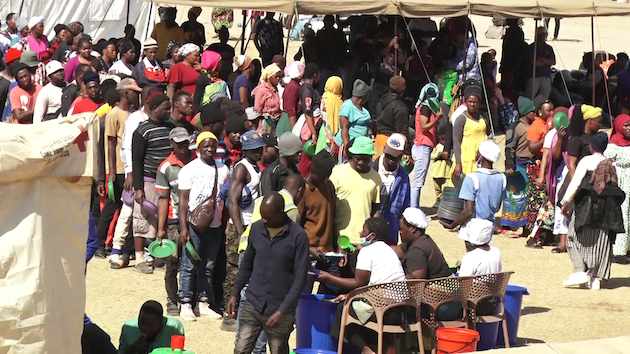
BLANTYRE, Malawi, August 25 (IPS) - When the Malawian government announced the conclusion of the repatriation of its citizens trapped in anti-immigrant violence against foreign Africans in South Africa on August 12, 2026, it had brought home 56,723 nationals, according to data from the Department of Disaster Management Affairs.
The Plastics Treaty Process Needs Greatly Improved Observer Participation at this Critical Point in the Negotiations and Beyond
- Inter Press Service
GENEVA, August 24 (IPS) - In 2022, the United Nations Environment Assembly mandated an Intergovernmental Negotiating Committee (INC) to develop a global, legally binding instrument addressing the full life cycle of plastics, from production and product design to disposal. After the resumed fifth session adjourned without consensus in Geneva in August 2025, the divided process moved into informal consultations before INC-5.4 in March 2027.
GEF Proposes $140 Million Program to Strengthen Drought Resilience
- Inter Press Service

DAR ES SALAAM, Tanzania, August 24 (IPS) - For pastoralists in Arvaikheer — a village in Mongolia’s dry central plains — rain can determine whether there is enough grass for cattle to roam, whether waterholes are replenished and whether families make it through another dry season. But as climate change makes rainfall increasingly unpredictable, even a wet season may no longer provide water and pasture needed to sustain people and livestock.
Can restoring land create jobs? These young entrepreneurs are proving it
- UN News

From Ecuador to Bangladesh, a new generation of entrepreneurs is turning land restoration into economic opportunity. Whether repurposing agricultural waste, building greenhouses or deploying AI-powered sensors, they are showing, with support from a United Nations-backed initiative, that restoring land can also generate income and improve livelihoods.
100 days of Ebola and the race to stop the spread
- UN News

A hundred days after the Bundibugyo Ebola outbreak was declared, the Democratic Republic of the Congo (DRC) is facing an epidemic of an unprecedented scale and efforts must grow to contain the spread in the eastern region and across borders, UN agencies warned on Monday.
Gaza: Children still at risk despite drop in acute hunger
- UN News
Among tent cities pitched on the rubble of destroyed homes in Gaza, children are, by one measure, finally getting enough to eat. By another, however, many of them may never fully recover, according to a new study by the UN Children’s Fund (UNICEF) released on Monday.
Two UN peacekeepers killed in South Sudan ambush
- UN News

Two UN peacekeepers have been killed and a total of seven people injured after unidentified gunmen ambushed a patrol in South Sudan’s eastern Jonglei state on Monday.
Security Council LIVE: Civilian suffering grows in Russia-Ukraine war
- UN News

Spiralling drone and missile attacks on civilians in the ongoing Russia-Ukraine war will be in the spotlight on Monday as the Security Council meets at 3pm (local time) to hear the latest reports from UN officials about the situation on the ground. UN News app users can follow our live coverage here.
Global food supply has become ‘collateral damage’ in conflicts: Secretary-General
- UN News

The disruption of maritime traffic in the Strait of Hormuz, Black Sea and Bab al-Mandab Strait has worsened hunger crises and must immediately end, UN Secretary-General António Guterres said.
Security Council LIVE: War, hunger, flooding escalates in Sudan
- UN News

The Security Council is currently hearing top UN officials brief on the latest updates about war-torn Sudan as escalating conflict, drone strikes against civilians, displacement, hunger and flooding affects millions and UN agencies strive to deliver lifesaving aid. UN News app users can follow our live coverage here.
- More stories…
Climate
The Plastics Treaty Process Needs Greatly Improved Observer Participation at this Critical Point in the Negotiations and Beyond
- Inter Press Service
GENEVA, August 24 (IPS) - In 2022, the United Nations Environment Assembly mandated an Intergovernmental Negotiating Committee (INC) to develop a global, legally binding instrument addressing the full life cycle of plastics, from production and product design to disposal. After the resumed fifth session adjourned without consensus in Geneva in August 2025, the divided process moved into informal consultations before INC-5.4 in March 2027.
GEF Proposes $140 Million Program to Strengthen Drought Resilience
- Inter Press Service
DAR ES SALAAM, Tanzania, August 24 (IPS) - For pastoralists in Arvaikheer — a village in Mongolia’s dry central plains — rain can determine whether there is enough grass for cattle to roam, whether waterholes are replenished and whether families make it through another dry season. But as climate change makes rainfall increasingly unpredictable, even a wet season may no longer provide water and pasture needed to sustain people and livestock.
Can restoring land create jobs? These young entrepreneurs are proving it
- UN News
From Ecuador to Bangladesh, a new generation of entrepreneurs is turning land restoration into economic opportunity. Whether repurposing agricultural waste, building greenhouses or deploying AI-powered sensors, they are showing, with support from a United Nations-backed initiative, that restoring land can also generate income and improve livelihoods.
The clean energy transition needs land. Can it help restore it too?
- UN News
What if the infrastructure needed to fight climate change could also help repair the land beneath it?
Indigenous Peoples Call for Meaningful Influence in Climate Discussions — Nia Tero
- Inter Press Service

UNITED NATIONS, August 18 (IPS) - Indigenous communities have long advocated for the environment through the lens of their traditional knowledge systems and cultures. But much more work needs to be done to translate their presence into influence.
Nairobi Biodiversity Talks Set the Stage for Key COP17 Decisions
- Inter Press Service
NAIROBI, August 18 (IPS) - Despite record participation in global biodiversity reporting and planning processes, countries remain off track to meet the world’s 2030 biodiversity goals, according to discussions that concluded this month at two key meetings under the Convention on Biological Diversity (CBD).
As Mongolia Hosts COP17, Pastoralists Demand Space to Move, Survive and Restore
- Inter Press Service

DAR ES SALAAM, Tanzania, August 17 (IPS) - After moving more than 6,000 km across Eurasia, the Silk Road Caravan has reached Mongolia with stories from pastoralists whose livelihoods are increasingly threatened by drought, degraded land and shrinking access to grazing areas.
Western-Led Green Revolution Failing Africa
- Inter Press Service

CAMBRIDGE, MA, USA / KUALA LUMPUR, Malaysia, August 17 (IPS) - As AGRA turns 20, a new report exposes its worsening failure to double productivity and incomes and halve undernourishment in participating African nations as promised.
Protecting our ‘most vital infrastructure’: Pushing back on desertification
- UN News
As heatwaves are turning deadlier, fires and disasters are razing cities, and rising seas are erasing territories. One environmental crisis remains dangerously overlooked: the degradation of the land beneath our feet.
The grass beneath our feet: Why rangelands matter
- UN News

In northern Kenya, a herder scans the sky for rain that hasn't come. The grass his animals need is thinning by the day.
- More stories…
Health
New Emergency Care Skills Help Tanzania’s Frontline Doctors Save Lives
- Inter Press Service

DAR ES SALAAM, Tanzania, August 21 (IPS) - The 14-year-old girl arrived at the hospital fighting for her life. After a tragic hit-and-run car accident, she was rushed into the emergency department with serious abdominal injuries. Every passing minute brought her closer to death.
UNAIDS Framework Pushes for the Protection and Integration of HIV Care
- Inter Press Service

UNITED NATIONS, August 21 (IPS) - As the global HIV response shifts toward sustainable, nationally led, and rights-based care, a new UNAIDS framework published this week argues that integration must start with a country’s readiness.
DR Congo Ebola outbreak spreading exponentially, UN responders warn
- UN News

As the deadliest Ebola outbreak in DR Congo’s history continued spreading on Friday, UN responders renewed their urgent appeal for immediate international support, with existing funding for lifesaving work critically low.
How the Taliban Hunt Women in Afghanistan
- Inter Press Service
ROME, August 20 (IPS) - FIVE years after the Taliban returned to power, Fawzia Koofi, the former Deputy Speaker of the Afghan Parliament, denounces what she describes as “gender apartheid.”
UN Reiterates its 18-Year-Old Ban on Smoking
- Inter Press Service
UNITED NATIONS, August 19 (IPS) - When smoking was common in the corridors of the UN, in the delegate’s lounge and in committee rooms during the 1970s and 90s, the office of the Secretary-General sent a memo that read: “Smoking was Discouraged” in the UN building—sounding far short of a ban.
GAZA: ‘There Are No Standards to Tell You What to Do in Conditions like Gaza’
- Inter Press Service

CIVICUS discusses the state of civic and humanitarian action in Gaza with Ibrahim Arandas, a Palestinian activist and project manager at SPARK Gaza, a civil society organisation that provides humanitarian and psychosocial support.
Remembering Fidel Castro, a Hero of the World’s Oppressed People
- Inter Press Service

SYDNEY, August 19 (IPS) - The 13th of August marked the 100th birthday of Cuba’s revolutionary leader Fidel Alejandro Castro Ruz – in short Fidel Castro. Amidst an intensified US siege and the threat of invasion, Cubans commemorated their dear leader’s centenary birth anniversary with events that included an International Book Fair, art exhibitions, concerts and gatherings of delegates from left-wing organisations across the continent.
Impending UNIFIL Exit Pushes Lebanon Toward Uncertainty
- Inter Press Service
UNITED NATIONS, August 18 (IPS) - Since the collapse of the ceasefire between Israel and Lebanon announced in June, the humanitarian situation in Lebanon has deteriorated sharply. Marked by high casualties, immense destruction to civilian infrastructure, and widespread displacement, access to essential services has become increasingly strained as the United Nations Interim Force in Lebanon (UNIFIL) is scheduled to end its operations by the end of the year.
Ebola: Motorbike riders carrying the sick may hold key to response boost
- UN News

From the frontlines of the deadliest-ever Ebola outbreak in Democratic Republic of the Congo (DRC), the UN World Health Organization (WHO) shared details on Tuesday of a massive push for community engagement, a day after yet another ambulance attack.
How Global Aid Cuts are Undermining Women-Led Humanitarian Response in Sudan
- Inter Press Service
UNITED NATIONS, August 17 (IPS) - Women-led and women’s rights organizations (WLOs) in humanitarian settings are collapsing amidst a complicated predicament in which needs are surging and international support is dwindling.
- More stories…
Economy
South Africa’s Anti-Immigrant Violence Slows SDG Goals, Rips Apart Africans’ Free Movement Call
- Inter Press Service
BLANTYRE, Malawi, August 25 (IPS) - When the Malawian government announced the conclusion of the repatriation of its citizens trapped in anti-immigrant violence against foreign Africans in South Africa on August 12, 2026, it had brought home 56,723 nationals, according to data from the Department of Disaster Management Affairs.
Cockroach Insult Unleashes Biggest Challenge yet to Modi’s Repressive Rule
- Inter Press Service
LONDON, August 21 (IPS) - India’s strongman leader, Narendra Modi, has just been forced to do the thing he likes least: making concessions in response to protests.
UNAIDS Framework Pushes for the Protection and Integration of HIV Care
- Inter Press Service
UNITED NATIONS, August 21 (IPS) - As the global HIV response shifts toward sustainable, nationally led, and rights-based care, a new UNAIDS framework published this week argues that integration must start with a country’s readiness.
How the Taliban Hunt Women in Afghanistan
- Inter Press Service
ROME, August 20 (IPS) - FIVE years after the Taliban returned to power, Fawzia Koofi, the former Deputy Speaker of the Afghan Parliament, denounces what she describes as “gender apartheid.”
Remembering Fidel Castro, a Hero of the World’s Oppressed People
- Inter Press Service
SYDNEY, August 19 (IPS) - The 13th of August marked the 100th birthday of Cuba’s revolutionary leader Fidel Alejandro Castro Ruz – in short Fidel Castro. Amidst an intensified US siege and the threat of invasion, Cubans commemorated their dear leader’s centenary birth anniversary with events that included an International Book Fair, art exhibitions, concerts and gatherings of delegates from left-wing organisations across the continent.
Western-Led Green Revolution Failing Africa
- Inter Press Service
CAMBRIDGE, MA, USA / KUALA LUMPUR, Malaysia, August 17 (IPS) - As AGRA turns 20, a new report exposes its worsening failure to double productivity and incomes and halve undernourishment in participating African nations as promised.
Protecting our ‘most vital infrastructure’: Pushing back on desertification
- UN News
As heatwaves are turning deadlier, fires and disasters are razing cities, and rising seas are erasing territories. One environmental crisis remains dangerously overlooked: the degradation of the land beneath our feet.
First Person: Syrians lead efforts to clear rubble and rebuild lives
- UN News

Communities in Syria are clearing rubble and rebuilding neighbourhoods and livelihoods torn down in the more than a decade of conflict and crisis in the country.
African Rights Advocates Coordinate Response to Family Law Backlash
- Inter Press Service

NAIROBI, August 13 (IPS) - Women’s rights advocates, judges and lawyers have launched a coordinated campaign to reform family laws that discriminate against women and girls in Africa.
Rising Trade Values Mask the True Cost of Global Supply Chain Disruptions
- Inter Press Service

UNITED NATIONS, August 13 (IPS) - Global goods trade reached approximately USD 13.7 trillion in the first half of 2026, up 12.5 percent from the same period in 2025, while services grew 10.5 percent, together adding USD 2 trillion to global trade. While these figures point to continued expansion, much of the increase reflects rising prices rather than stronger trade volumes.
- More stories…
More news topics
Read more news stories by
More news by World, Economy, Environment, Geopolitics, Health, Human Rights, More news topics …
World news by

Issues in depth
Latest
Action on climate change is cheaper than inaction
Many are afraid that tackling climate change is going to be too costly. But increasingly, studies are showing action will not just be cheaper than inaction, but could actually result in economic, environmental and even health benefits, while improving sustainability.
Read “Action on climate change is cheaper than inaction” to learn more.
Climate Change and Global Warming Introduction
 The climate is changing. The earth is warming up, and there is now overwhelming scientific consensus that it is happening, and human-induced. With global warming on the increase and species and their habitats on the decrease, chances for ecosystems to adapt naturally are diminishing.
Many are agreed that climate change may be one of the greatest threats facing the planet. Recent years show increasing temperatures in various regions, and/or increasing extremities in weather patterns.
This section looks at what causes climate change, what the impacts are and where scientific consensus currently is.
Read “Climate Change and Global Warming Introduction” to learn more.
COP20—Lima Climate Conference
 An overview of the Climate Change Conference (also known as COP 20), held in Lima, Peru in December 2014.
While it seemed like it was a successful meeting, because developing nations were committed to drawing up their own plans for emissions reductions for the first time, a number of important issues were left undecided such as how financing would work.
This page is an overview of the Lima Climate conference.
Read “COP20—Lima Climate Conference” to learn more.
Ebola Outbreak in West Africa
An overview of the Ebola virus outbreak in West Africa that has been described by the World Health Organization as the largest, most severe and most complex outbreak in the history of the disease.
The epidemic began at the end of 2013, in Guinea. From there it spread to Liberia, Sierra Leone, Nigeria and Senegal. Many of the affected countries face enormous challenges in stopping its spread and providing care for all patients.
Thousands of people have died and many are at risk as the fatality rate from this virus is very high. As the crisis worsens, as well as the enormous health challenges involved, the social and economic consequences may set these countries back, reversing some gains a number of these countries have made in recent years.
Read “Ebola Outbreak in West Africa” to learn more.
Foreign Aid for Development Assistance
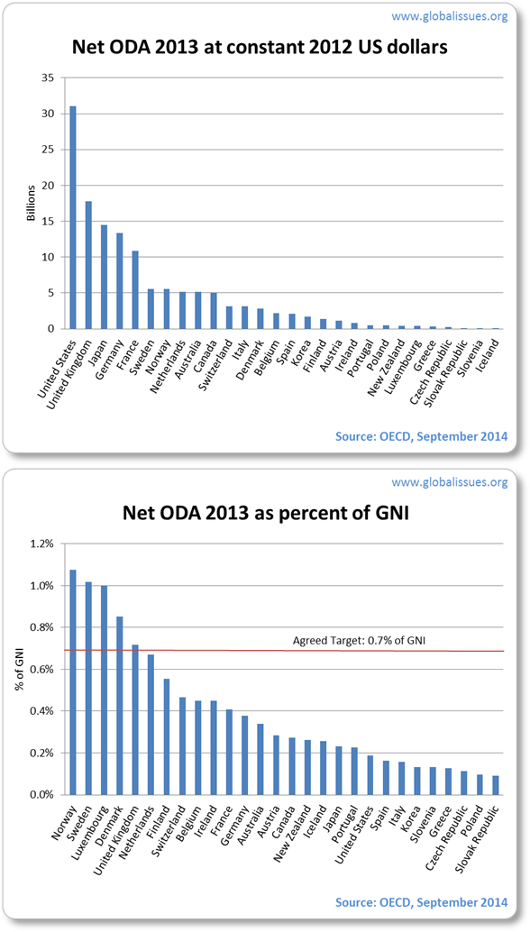
In 1970, the world’s rich countries agreed to give 0.7% of their gross national income as official international development aid, annually.
Since that time, billions have certainly been given each year, but rarely have the rich nations actually met their promised target.
For example, the US is often the largest donor in dollar terms, but ranks amongst the lowest in terms of meeting the stated 0.7% target.
Furthermore, aid has often come with a price of its own for the developing nations. Common criticisms, for many years, of foreign aid, have included the following:
- Aid is often wasted on conditions that the recipient must use overpriced goods and services from donor countries
- Most aid does not actually go to the poorest who would need it the most
- Aid amounts are dwarfed by rich country protectionism that denies market access for poor country products while rich nations use aid as a lever to open poor country markets to their products
- Large projects or massive grand strategies often fail to help the vulnerable; money can often be embezzled away.
This article explores who has benefited most from this aid, the recipients or the donors.
Read “Foreign Aid for Development Assistance” to learn more.
Nature and Animal Conservation
 Preserving species and their habitats is important for ecosystems to self-sustain themselves.
Yet, the pressures to destroy habitat for logging, illegal hunting, and other challenges are making conservation a struggle.
Read “Nature and Animal Conservation” to learn more.
Most Popular
Poverty Facts and Stats
Most of humanity lives on just a few dollars a day. Whether you live in the wealthiest nations in the world or the poorest, you will see high levels of inequality.
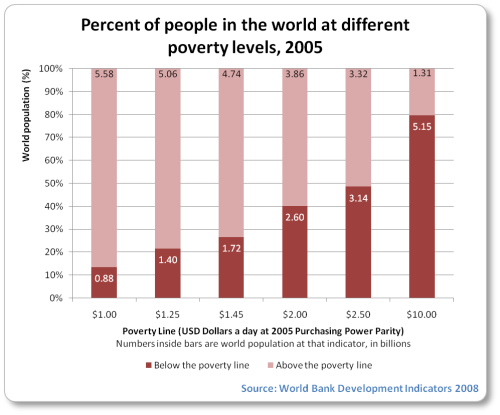
The poorest people will also have less access to health, education and other services. Problems of hunger, malnutrition and disease afflict the poorest in society. The poorest are also typically marginalized from society and have little representation or voice in public and political debates, making it even harder to escape poverty.
By contrast, the wealthier you are, the more likely you are to benefit from economic or political policies. The amount the world spends on military, financial bailouts and other areas that benefit the wealthy, compared to the amount spent to address the daily crisis of poverty and related problems are often staggering.
Some facts and figures on poverty presented in this page are eye-openers, to say the least.
Read “Poverty Facts and Stats” to learn more.
Global Financial Crisis
 Following a period of economic boom, a financial bubble — global in scope — burst, even causing some of the world’s largest financial institutions have collapsed. With the resulting recession, many governments of the wealthiest nations in the world have resorted to extensive bail-out and rescue packages for the remaining large banks and financial institutions while imposing harsh austerity measures on themselves.
Some of the bail-outs have also led to charges of hypocrisy due to the apparent socializing of the costs while privatizing the profits.
Furthermore, the institutions being rescued are typically the ones got the world into this trouble in the first place. For smaller businesses and poorer people, such options for bail out and rescue are rarely available when they find themselves in crisis.
Plummeting stock markets at one point wiped out 33% of the value of companies, $14.5 trillion. Taxpayers bailed out their banks and financial institutions with large amounts of money. US taxpayers alone have spent some $9.7 trillion in bailout packages and plans. The UK and other European countries have also spent some $2 trillion on rescues and bailout packages. More is expected. Much more.
Such numbers, made quickly available, are enough to wipe many individual’s mortgages, or clear out third world debt many times over. Even the high military spending figures are dwarfed by the bailout plans to date.
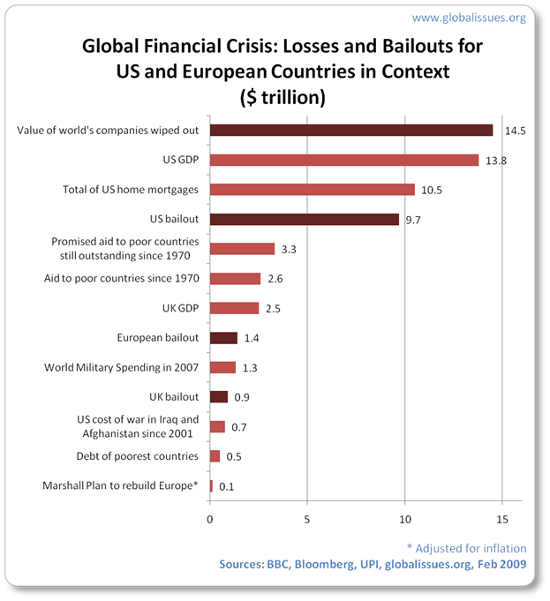
This problem could have been averted (in theory) as people had been pointing to these issues for decades. However, during boom, very few want to hear such pessimism. Does this crisis spell an end to the careless forms of banking and finance and will it herald a better economic age, or are we just doomed to keep forgetting history and repeat these mistakes in the future? Signs are not encouraging as rich nations are resisting meaningful reform…
Read “Global Financial Crisis” to learn more.
Causes of Poverty
Poverty is the state for the majority of the world’s people and nations. Why is this? Is it enough to blame poor people for their own predicament? Have they been lazy, made poor decisions, and been solely responsible for their plight? What about their governments? Have they pursued policies that actually harm successful development? Such causes of poverty and inequality are no doubt real. But deeper and more global causes of poverty are often less discussed.
Read “Causes of Poverty” to learn more.
Climate Change and Global Warming
The climate is changing. The earth is warming up, and there is now overwhelming scientific consensus that it is happening, and human-induced. With global warming on the increase and species and their habitats on the decrease, chances for ecosystems to adapt naturally are diminishing. Many are agreed that climate change may be one of the greatest threats facing the planet. Recent years show increasing temperatures in various regions, and/or increasing extremities in weather patterns.
This section explores some of the effects of climate change. It also attempts to provide insights into what governments, companies, international institutions, and other organizations are attempting to do about this issue, as well as the challenges they face. Some of the major conferences in recent years are also discussed.
Read “Climate Change and Global Warming” to learn more.
Environmental Issues
Environmental issues are also a major global issue. Humans depend on a sustainable and healthy environment, and yet we have damaged the environment in numerous ways. This section introduces other issues including biodiversity, climate change, animal and nature conservation, population, genetically modified food, sustainable development, and more.
Read “Environmental Issues” to learn more.
Racism
 Racism is the belief that characteristics and abilities can be attributed to people simply on the basis of their race and that some racial groups are superior to others. Racism and discrimination have been used as powerful weapons encouraging fear or hatred of others in times of conflict and war, and even during economic downturns. This article explores racism from around the world.
Read “Racism” to learn more.
Topical
Global Financial Crisis
Following a period of economic boom, a financial bubble — global in scope — burst, even causing some of the world’s largest financial institutions have collapsed. With the resulting recession, many governments of the wealthiest nations in the world have resorted to extensive bail-out and rescue packages for the remaining large banks and financial institutions while imposing harsh austerity measures on themselves.
Some of the bail-outs have also led to charges of hypocrisy due to the apparent socializing of the costs while privatizing the profits.
Furthermore, the institutions being rescued are typically the ones got the world into this trouble in the first place. For smaller businesses and poorer people, such options for bail out and rescue are rarely available when they find themselves in crisis.
Plummeting stock markets at one point wiped out 33% of the value of companies, $14.5 trillion. Taxpayers bailed out their banks and financial institutions with large amounts of money. US taxpayers alone have spent some $9.7 trillion in bailout packages and plans. The UK and other European countries have also spent some $2 trillion on rescues and bailout packages. More is expected. Much more.
Such numbers, made quickly available, are enough to wipe many individual’s mortgages, or clear out third world debt many times over. Even the high military spending figures are dwarfed by the bailout plans to date.
This problem could have been averted (in theory) as people had been pointing to these issues for decades. However, during boom, very few want to hear such pessimism. Does this crisis spell an end to the careless forms of banking and finance and will it herald a better economic age, or are we just doomed to keep forgetting history and repeat these mistakes in the future? Signs are not encouraging as rich nations are resisting meaningful reform…
Read “Global Financial Crisis” to learn more.
Climate Change and Global Warming
The climate is changing. The earth is warming up, and there is now overwhelming scientific consensus that it is happening, and human-induced. With global warming on the increase and species and their habitats on the decrease, chances for ecosystems to adapt naturally are diminishing. Many are agreed that climate change may be one of the greatest threats facing the planet. Recent years show increasing temperatures in various regions, and/or increasing extremities in weather patterns.
This section explores some of the effects of climate change. It also attempts to provide insights into what governments, companies, international institutions, and other organizations are attempting to do about this issue, as well as the challenges they face. Some of the major conferences in recent years are also discussed.
Read “Climate Change and Global Warming” to learn more.
Food and Agriculture Issues
 Food and agriculture goes to the heart of our civilizations. Religions, cultures and even modern civilization have food and agriculture at their core. For an issue that goes to the heart of humanity it also has its ugly side.
This issue explores topics ranging from the global food crisis of 2008, to issues of food aid, world hunger, food dumping and wasteful agriculture such as growing tobacco, sugar, beef, and more.
Read “Food and Agriculture Issues” to learn more.
Foreign Aid for Development Assistance
In 1970, the world’s rich countries agreed to give 0.7% of their gross national income as official international development aid, annually.
Since that time, billions have certainly been given each year, but rarely have the rich nations actually met their promised target.
For example, the US is often the largest donor in dollar terms, but ranks amongst the lowest in terms of meeting the stated 0.7% target.
Furthermore, aid has often come with a price of its own for the developing nations. Common criticisms, for many years, of foreign aid, have included the following:
- Aid is often wasted on conditions that the recipient must use overpriced goods and services from donor countries
- Most aid does not actually go to the poorest who would need it the most
- Aid amounts are dwarfed by rich country protectionism that denies market access for poor country products while rich nations use aid as a lever to open poor country markets to their products
- Large projects or massive grand strategies often fail to help the vulnerable; money can often be embezzled away.
This article explores who has benefited most from this aid, the recipients or the donors.
Read “Foreign Aid for Development Assistance” to learn more.
Tax Avoidance and Tax Havens; Undermining Democracy
 Through tax havens, transfer pricing and many other policies — both legal and illegal — billions of dollars of tax are avoided. The much-needed money would helped developing (and developed) countries provide important social services for their populations.
Some tax avoidance, regardless of how morally objectionable it may be to some people, is perfectly legal, and the global super elite are able to hide away trillions of dollars, resulting in massive losses of tax revenues for cash-strapped governments who then burden ordinary citizens further with austerity measures during economic crisis, for example. Yet these super elite are often very influential in politics and business. In effect, they are able to undermine democracy and capitalism at the same time.
As the global financial crisis has affected many countries, tackling tax avoidance would help target those more likely to have contributed to the problem while avoid many unnecessary austerity measures that hit the poorest so hard. But despite rhetoric stating otherwise, it does not seem to high on the agenda of many governments as you might think.
Read “Tax Avoidance and Tax Havens; Undermining Democracy” to learn more.
World Military Spending
World military spending had reduced since the Cold War ended, but a few nations such as the US retain high level spending.
In recent years, global military expenditure has increased again and is now comparable to Cold War levels. Recent data shows global spending at over $1.7 trillion. 2012 saw the first dip in spending — only slightly —since 1998, in an otherwise rising trend.

The highest military spender is the US accounting for almost two-fifths of the world’s spending, more than the rest of the G7 (most economically advanced countries) combined, and more than all its potential enemies, combined.
Read “World Military Spending” to learn more.
“If a man is offered a fact which goes against his instincts, he will scrutinize it closely, and unless the evidence is overwhelming, he will refuse to believe it. If, on the other hand, he is offered something which affords a reason for acting in accordance to his instincts, he will accept it even on the slightest evidence.” — Bertrand Russell, Roads to Freedom